Account-Based Marketing Examples Using Customer Stories
Deploy the right customer stories at each ABM touchpoint to move deals past skeptical buyers.

Most ABM campaigns fail at proof. Targeting, messaging frameworks, and tech stack are rarely the problem. They fail because the customer evidence they deploy is generic, mismatched, or buried in a PDF nobody opens. This article is about fixing that. Specifically, it walks through how B2B teams use customer stories at each ABM touchpoint to actually move the accounts they're pursuing.
Here's the context that makes this urgent. Per 6sense's 2025 data, buyers are already 61% through their decision process before they talk to sales. They've read competitor content, asked peers for recommendations, and built a shortlist. By the time your ABM sequence fires, you're making a case, not introducing yourself. And generic proof — "Trusted by 2,000+ companies" or a case study from a company in a completely different industry — doesn't make that case. What does? Evidence from companies that look exactly like them. According to 78% of buyers surveyed, the most important proof factor is evidence from similar customers.
Think of it this way: deploying the wrong customer story in an ABM play is like showing up to a costume party in a business suit — technically dressed, but completely missing the room.
So the goal is the right stories, deployed at the right touchpoints, for the right accounts — more case studies alone won't get you there.
What Makes a Customer Story Usable in an ABM Context (Versus One That Just Sits in a PDF)
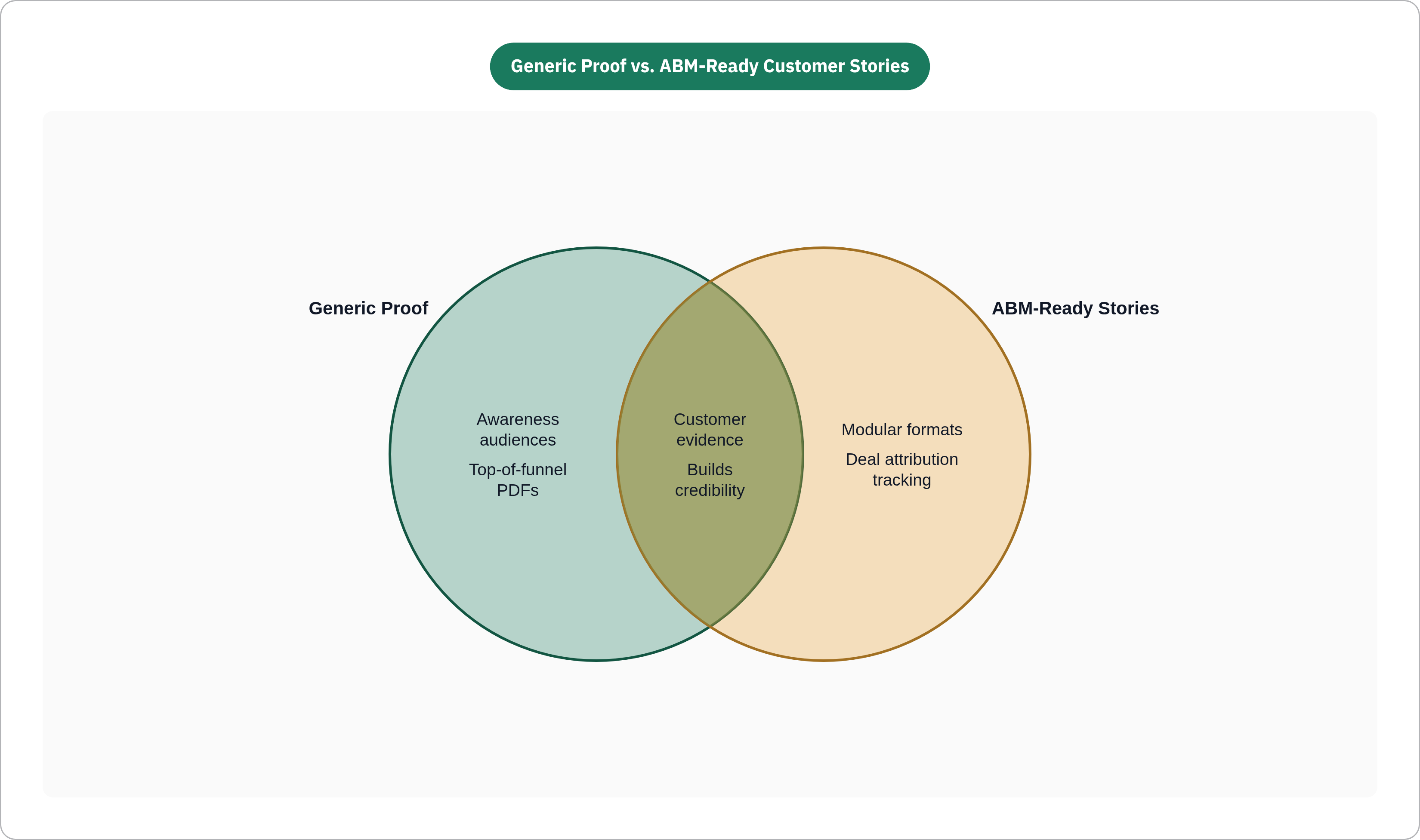
Most case studies are written for awareness audiences. People who are just learning about your product and need a general sense of what you do. That's fine for top-of-funnel. But it's the wrong tool for an account that's already evaluated three competitors and is looking for a reason to choose you.
An ABM-ready customer story is a different animal. Here's what it requires:
- A client snapshot precise enough for a target buyer to recognize their own situation. Industry, company stage, use case. If the story could describe a hundred different companies, it's not specific enough.
- A challenge framed as urgency, not background. The reader should feel "that's our problem," not "interesting, someone had that problem once."
- Outcome specificity. Named metrics, concrete timelines, a result the buyer can actually quote internally when they're making the case to their CFO.
- Modularity. The story needs to live as a one-pager, a web snippet, an email reference, and a sales deck slide. A long-form PDF that a rep has to summarize anyway won't serve the purpose.
The named-versus-anonymous proof question comes up constantly, especially in regulated industries like cybersecurity and financial services. The good news: blind-but-verified proof closes most of the trust gap. A third party confirms the customer's identity without publishing it. Per the 2025 Evidence Gap report, buyer trust in blind-but-verified testimonials sits at 60%, versus 64% for named ones. Close enough to work.
Format matters too. Video is high-trust and high-retention (viewers retain 95% of a message through video versus about 10% through text), but it's resource-intensive. Written proof is faster to produce and easier to slice by vertical. Modular proof snippets — quotes, stats, one-liners — are the actual unit of currency in live ABM plays.
The structural test is simple: if a rep can't find the right piece in under two minutes and drop it into an account-specific email, the story isn't ABM-ready. That's the bar.
Using Customer Stories to Personalize ABM Landing Pages and Microsites at the Account Level
The core tactic here is straightforward: build landing experiences that surface peer proof before a prospect ever talks to sales. The customer story isn't decoration on the page. It's the organizing logic of the page.
DocuSign identified six target industries and served industry-specific messaging, visuals, customer stories, and peer logos based on which segment a visitor self-reported. The result was a 22% increase in sales pipeline. The personalization worked because the proof matched the visitor's actual context.
The AVEVA and GSK example is even more instructive. AVEVA built a personalized microsite specifically for GSK. It generated 2,000 visits, opened 46 new relationships with GSK decision-makers, and produced £7m in active pipeline. GSK ended up expanding from one AVEVA platform to three. A microsite built around the right customer proof didn't just influence a deal. It expanded the account.
Robin, a workspace software company, ran paid social showing target decision-makers images of existing customers' actual office spaces. Visual, concrete peer proof. The result was a 50% increase in website traffic and 20% higher interest from key decision-makers. Nobody was looking at generic stock photos of open-plan offices. They were seeing real spaces from companies they recognized.
One more worth noting for smaller teams: Omnea booked 30+ meetings in a quarter with sales reps building 30+ personalized landing pages per week. Account-level personalization does not require enterprise headcount. It requires a proof library that makes it fast to build.
A few practical things to know here:
- Dynamic content tools can swap customer stories by segment without rebuilding pages from scratch.
- Personalization breaks down when the underlying story library is thin. The page is only as good as the proof you have to put on it.
Deploying Proof in Outbound Sequences and Sales-Led ABM Plays
Here's the gap most teams have: marketing produces case studies, sales improvises which one to use, and there's no system connecting the right story to the right account at the right stage. It's a structural problem, not a motivation problem.
Research analyzing over 6,500 sales rep proof requests found that case studies, customer stories, and similar-company lists represent 66.6% of all queries. Reps are already asking for this. The failure is in supply and findability. And 53% of sellers say their sales process is slowed by lack of relevant, specific customer evidence.
What effective sales-led ABM plays actually look like:
- Email sequences that open with a named customer story. "We helped [similar company] solve [specific problem] in [timeframe]" is a better first sentence than any product pitch.
- Call prep with matched proof. Before dialing, the rep reviews which customer stories fit the target account's industry, size, and stated pain.
- Late-stage proof drops. When a deal stalls, a precisely matched customer story sent to the economic buyer is a re-engagement tool — a reason to respond, not merely a follow-up.
Kyndryl's ABM program is the clearest example of what happens when you get this right at scale. They started with seven test accounts, scaled to 50, then 100. The discipline of matching account-level proof to each account produced a 32-percentage-point outperformance in won opportunities, a $3.2 billion pipeline expansion, and 573 new relationships with decision-makers and influencers. That's proof working as a sales motion.
There's also an internal champion play worth knowing. You work with an existing contact to document their success story. Then you use that story (as a presentation or a one-pager) to open doors in other departments within the same account. The existing customer's results become the business case for expansion. Multi-threaded ABM within a single enterprise, without cold-pitching strangers.
This is exactly the bottleneck Verbatim is built to solve. Turning customer conversations into structured, sales-ready proof assets so reps aren't waiting weeks for a case study that matches their deal.
Running Account-Specific Events and Content Experiences as Proof Delivery Vehicles
For strategic or enterprise accounts, a single piece of content rarely moves a buying group. The buying committee has multiple stakeholders, different priorities, and different objections. A content experience — delivered through an event — reaches all of them at once.
One tactic that works well: host a webinar exclusively for one client, and invite people from multiple divisions to hear how their own colleagues achieved specific results. The existing champion's story becomes the proof asset. Delivered live. To the people who need to hear it. The internal politics challenge is real here. You can't just cold-pitch other divisions. The solution is using the initial champion to make warm introductions. Proof travels better through trust than through outreach.
Storemaven and Signify used a different format with similar logic: podcast conversations with cold prospects. The podcast became a proof-gathering mechanism and a relationship engine simultaneously. They built relationships, gathered market intelligence, and converted those conversations into warm collaborative ones. The target account had a reason to engage that wasn't "book a demo." The value came first.
What all of these formats share: they give the account something worth their time before asking for anything in return.
The practical constraint is obvious. High-touch account events are resource-intensive. They belong at the top of your target account list. Highest-revenue potential, most stalled deals. Not spread across your full addressable market.
Building the Proof Library That Makes Account-Level Personalization Repeatable
The reactive proof problem is universal. Sales urgently needs a healthcare reference. Someone Slacks the advocacy manager. The advocacy manager searches a spreadsheet. The deal waits. This is expensive — in time and in deals. Per UserEvidence's 2025 Evidence Gap report, 67% of B2B buyers have ruled out a vendor due to untrustworthy or irrelevant evidence. A missing or mismatched story doesn't just slow a deal. It kills it.
A repeatable proof engine requires four things:
- Structured collection. Systematic outreach to customers post-implementation, not just when sales is on fire and needs a reference by Thursday.
- Tagging by segment. Industry, company size, use case, buyer role. Stories need to surface fast when a matching account enters the pipeline.
- Format variants per story. Full case study, one-pager, pull-quote set, slide-ready summary. The same underlying proof packaged for different touchpoints.
- Integration with sales workflows. Proof accessible inside Salesforce, Seismic, Highspot, or wherever reps actually work. A separate content portal they have to remember to visit won't get used.
Coverflex generated $1.3M in supported pipeline with a two-person marketing team. The constraint wasn't headcount. It was having systematic proof infrastructure. PitchBook saw a 79% increase in target account website visits. Onfido saw a 120% lift in enterprise demo bookings. Both outcomes point to the same thing: systematized proof deployment produces results that ad hoc proof deployment doesn't.
Verbatim is designed specifically to address the production bottleneck. It converts customer conversations into structured, tagged, sales-ready case studies. The part of the process that typically breaks at scale.
AI-assisted collection and deployment is also maturing quickly. Tools that pull quotes from call transcripts (Gong integrations, for instance), ingest review platforms like G2, and surface the right proof per deal in real time are reducing the manual work that makes reactive programs unsustainable. That infrastructure is becoming a baseline, not a differentiator.
Measuring Whether Customer Stories Are Actually Moving ABM Accounts
A case study with high download numbers that doesn't appear in won deals is brand awareness spending disguised as sales enablement. You could say it's all dressed up with nowhere to go.
Here's what to measure instead:
- Pipeline influence. Which deals had a customer story deployed? Did those accounts move faster or close at higher rates than accounts that didn't?
- Story-to-deal attribution. Track which proof assets were shared in which deals. This requires sales discipline and CRM tagging, but it produces the data you need to prioritize which stories to build next.
- Account engagement signals. Did target accounts return to the microsite after seeing the proof? Did new stakeholders from the same account show up? Engagement depth matters more than visit count.
- Deal velocity. Compare accounts that received matched customer proof versus those that didn't. Is the sales cycle shorter?
There's also an intelligence loop here that most teams miss. Sales reps hear buyer objections, hesitations, and exact language every day. Marketing rarely captures any of it. A regular cadence between sales and the team producing case studies turns deal feedback into the next story brief. You learn which proof gaps are costing you deals, and you fill them before the next deal hits the same wall.
The compounding effect is real. Consistent, targeted proof deployment builds on itself. One-off case study drops don't. And the durable competitive advantage at the end of all this is a library of specific, attributed, segment-matched customer stories that grows with every closed deal. Competitors can copy your messaging. They can't replicate your customers' words.