Demand Generation vs Lead Generation for B2B SaaS
Demand gen produces qualified leads at 4x the rate of lead gen, despite lower volume.
B2B SaaS teams love arguing about demand gen versus lead gen like it's a volume contest, a race to see which motion fills the funnel faster. But volume isn't the question that matters. The real question is what percentage of those leads turn into actual revenue, and the answer should change how you spend your budget.
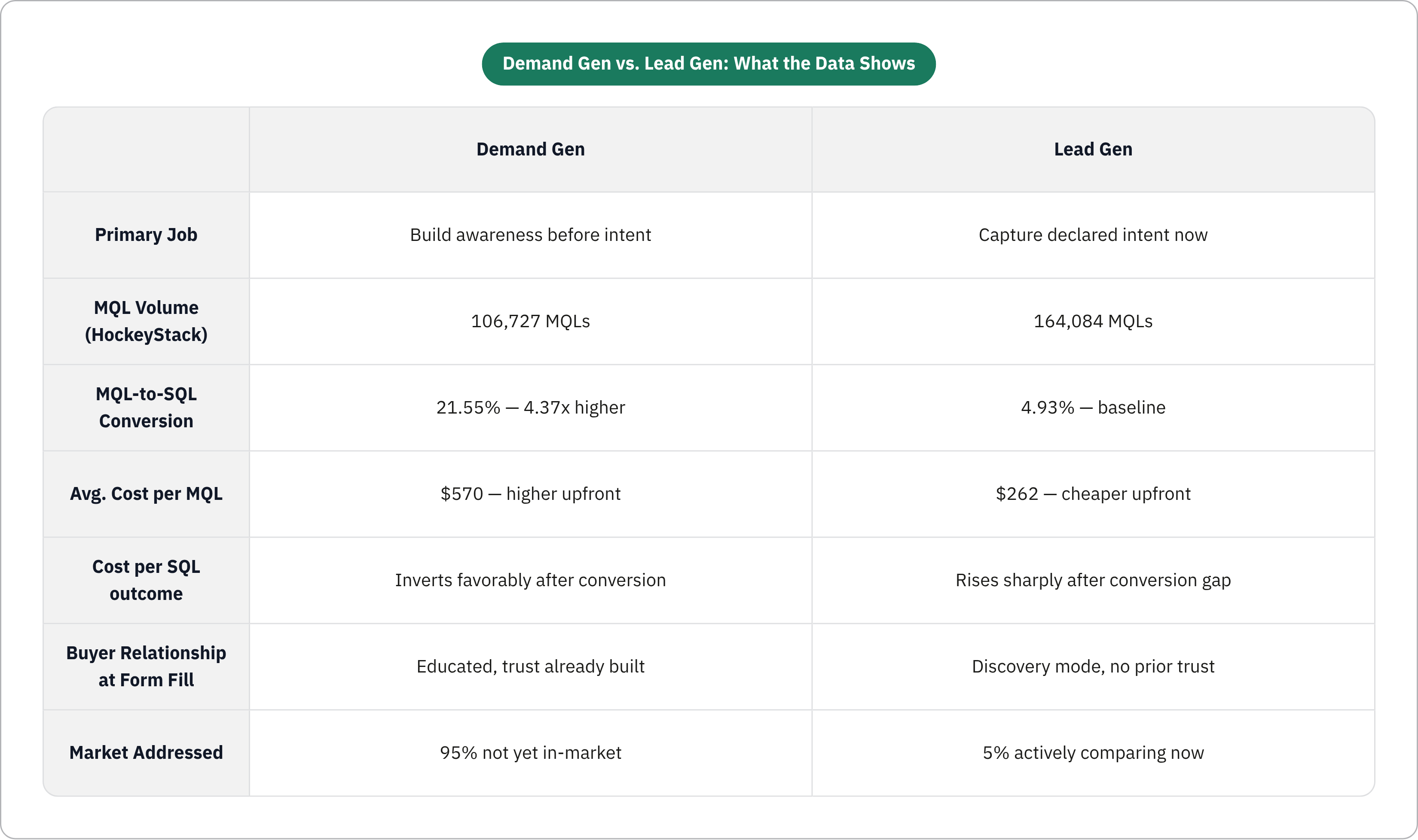
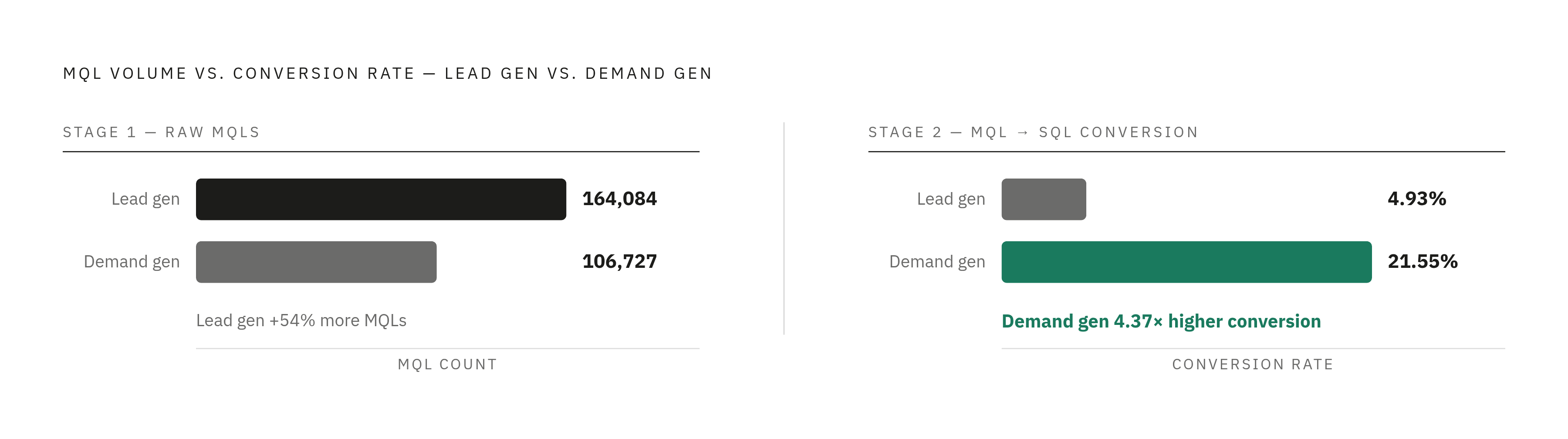
HockeyStack Labs pulled data from 87 B2B SaaS companies between October 2023 and March 2024, and it's the closest thing we have to ground truth on this argument. Lead gen generated 164,084 MQLs. Demand gen generated 106,727. Lead gen wins on raw volume, no contest. But flip to MQL-to-SQL conversion and demand gen hits 21.55% while lead gen limps in at 4.93%. That's a 4.37x gap. You can't settle this debate by counting leads, because the leads aren't the same species of animal. This piece is about what causes that gap, and what you're supposed to do once you know it exists.
What demand generation and lead generation each actually do — and where most teams conflate them
Demand generation builds awareness and preference in people who aren't shopping yet. It lives upstream of intent: content, education, brand-building, category thinking. Its whole job is to make sure you're the name that pops into someone's head the day they finally start looking. You measure it in brand recall, engagement, pipeline influence, and revenue contribution that shows up months later, not this week.
Lead generation captures people who've already raised their hand, right now, at the moment they've declared intent through a form, a demo request, a paid click. Its job is conversion efficiency among people already in market. You measure it in MQL volume, cost per lead, and SQL conversion rate.
Here's where teams get tangled up: both motions produce something called an MQL, so everybody treats MQLs as one uniform bucket. They're not. A demand gen MQL shows up already educated, already leaning your way, because they've spent weeks or months absorbing your content before they ever touched a form. A lead gen MQL clicked an ad twenty minutes ago and has no relationship with your brand beyond that click.
Look at cost. HockeyStack's 2024 numbers put average cost-per-MQL at $570 for demand gen and $262 for lead gen. On paper, lead gen looks like the bargain. But that number is stripped of what happens next, and what happens next is the whole point. Once you run the 4.37x conversion gap through the math, cost per SQL flips the story entirely. This is exactly why marketing teams celebrate record MQL counts while sales quietly loses faith in the pipeline. Sales complains about lead quality, marketing points at a dashboard full of green arrows, and nobody's wrong. They're just measuring different things and calling it the same thing.
Why most of your market isn't ready to fill out a form right now — and what that means for how you invest
Professor John Dawes at the Ehrenberg-Bass Institute put a number on something marketers have felt for years: at any given moment, roughly 5% of your target market is actually in-market to buy. LinkedIn's B2B Institute popularized this as the 95-5 rule, and it should reframe how you think about your entire funnel.
Lead gen only touches that 5%, the buyers already searching, comparing, filling out forms. That's valuable, but narrow. The other 95% aren't gone, they're just not ready yet. And here's the part that should worry you: when they finally do enter their buying window, if your brand means nothing to them, you're starting from zero against competitors they already recognize and trust. Demand gen exists precisely for that stretch. It's planting the flag for pipeline that shows up in two quarters, well before today's forms get filled.
SaaS Capital's 2025 Spending Benchmarks found the median SaaS company now spends $2.00 to acquire $1.00 of new ARR, up 14% since 2023. A big driver of that climb is everyone piling into the same 5% of the market with the same lead gen tactics, bidding each other up on the same keywords and the same buyer attention. It's musical chairs, except the chairs cost more every round.
LinkedIn's 2024 B2B Marketing Benchmark Report suggests a 60/40 split favoring demand gen as a starting point, not gospel, but a correction for teams that have drifted too far toward pure capture. The split isn't arbitrary. It roughly mirrors how your actual market is distributed between in-market buyers and everyone else who's still forming an opinion.
How buyers actually research before they ever talk to sales — and why your funnel doesn't see most of it
6sense's 2024 research puts the majority of the B2B buyer journey before the first conversation with a sales rep, and the average purchase cycle now runs past eleven months. That's a long time for a buyer to be forming opinions about you without you knowing it's happening.
Most of that research doesn't happen on your website. It happens in Slack communities, Reddit threads, DMs between peers who've bought the thing before, and review sites like G2 and Capterra. G2's CMO 2025 Buyer Behavior Report found a majority of enterprise buyers rank software review sites as their top research source, ahead of vendor websites and analyst reports. Ahead of your own homepage. Sit with that for a second.
This is what people call the dark funnel. It's a trust ecosystem running almost entirely on peer credibility and third-party proof, happening in rooms you don't have a key to, and no tracking pixel fixes that gap. A brand can have excellent demand gen content and still lose deals it never even knew were in play, because the deciding conversation happened in a private Slack channel between two VPs who worked together at a previous company.
The upshot for the demand gen versus lead gen fight: whichever motion earns trust before the buyer is ready to raise a hand ends up winning a disproportionate share of the eventual form fills. There's an emerging bridge tactic here too, sometimes called signal-based selling, where teams track intent signals like review platform activity, relevant job postings, or tech stack changes, and reach out before a competitor's form gets filled. It's a smart tactic, but it still needs the buyer to have some baseline familiarity with your name for the outreach to land, which means it depends on demand gen rather than replacing it.
What makes demand gen MQLs convert at 4x the rate — and what that implies about the content doing the work upstream
The 4.37x gap reflects where the buyer's head is at the moment they hit submit. Demand gen MQLs have usually consumed several pieces of your content, run into social proof somewhere along the way, and already formed a working opinion of your company before they filled anything out. They arrive understanding the category, believing the problem is real, and mentally sorting vendors into a shortlist.
Lead gen MQLs have declared intent, sure, they clicked, they searched, they filled a form, but they haven't necessarily built any trust yet. They're in discovery mode, not decision mode.
The content demand gen runs upstream, thought leadership, customer stories, community presence, reviews on third-party platforms, is doing qualification work that would otherwise land on an SDR's plate weeks later. That production work is something services like Verbatim, a managed case study and testimonial engine built specifically for B2B SaaS companies, exist to systematize so the proof compounds across the funnel rather than stalling in a spreadsheet. Uplift Content's 2024 research found 80% of B2B buyers use case studies during research, with 42% finding them valuable in both the middle and late stages of the buying process. That puts case studies squarely in the trust-building phase, not just the closing pitch. A buyer who read a specific, outcome-rich case study during their own dark-funnel digging is a fundamentally different MQL than someone who clicked a retargeting ad on their lunch break.
At its core, the conversion gap is a trust gap. Demand gen closes that gap before the lead ever shows up in your CRM; lead gen hands the job to sales after the fact, hoping they can close it in a 30-minute call. Forrester's 2025 research backs this up at the business level: companies running consistent demand gen programs see 24% faster revenue growth and 27% higher profitability than companies focused purely on lead capture.
How customer case studies function as demand gen infrastructure, not just sales collateral
Here's a habit worth breaking: most SaaS teams treat case studies as something you hand to sales for the final pitch, the last document before a signature. By the time a case study reaches that stage, it's done almost none of the work it could have done earlier, when the buyer was still forming an opinion in the dark funnel.
The fastest-growing SaaS companies use case studies as proof infrastructure that lives across the whole funnel. And these aren't rare artifacts, either; analysis of top-tier fast-growing SaaS companies shows the vast majority use case studies, often dozens per company, with more than half featuring them right on the homepage.
Customer logos and structured formats are table stakes now, not a competitive edge. Nearly every serious SaaS company shows logos and uses some version of a Challenge-Solution-Impact structure, and Uplift Content's 2024 research found the vast majority of SaaS companies use that Challenge/Solution/Results framework specifically. Adoption is high. Execution quality is all over the map.
What actually separates a good case study from a forgettable one is specificity. A defined result, a named challenge, a concrete timeframe carry weight that a logo wall or a vague testimonial can't match. The Challenge-Solution-Impact structure works because it mirrors exactly how a buyer sizes up fit: does this customer's situation look like mine, did the vendor actually solve it, and can I see proof of the result? Three questions, no wasted motion.
There's a framing principle worth internalizing here too. The customer should read as the hero of their own story, with your product serving as the tool that helped them win rather than the main character. That framing is what makes the story feel credible instead of like an ad wearing a customer's name as a costume.
Volume is climbing fast. Uplift Content's 2024 data shows SaaS companies now maintain an average of 64 case studies, up 73% since 2022, with plans for 19 new ones that year, a 38% year-over-year jump. That growth signals teams are finally treating case studies as a funnel-wide asset instead of a closing document. But more case studies at lower quality just dilutes the signal. Specificity and structure matter far more than raw count.
Distribution is where most programs quietly fail. Most SaaS marketers, per Uplift Content, lean on encouraging sales reps to drop case studies into calls and emails as the primary way these assets get used. If a case study only ever lives inside a sales deck, it never does any demand gen work at all; it's sitting in the wrong room. On the flip side, accessibility on the site itself has gotten better, with most companies featuring case studies within two clicks of the homepage. That's the floor, though, not something to be proud of.
Building social proof as a system, not a one-time project
There's a hard number behind why proof matters so much: UserEvidence's 2025 Evidence Gap Report found 67% of B2B buyers have ruled out a vendor because the evidence backing their claims felt untrustworthy or was simply missing. That's not a small leak in the funnel. That's buyers actively crossing you off the list.
Most teams don't undervalue social proof, not really. What they get wrong is treating proof collection like a project with a finish line rather than an engine that keeps running. A real system needs a trigger, something that prompts you to ask for proof, like after onboarding wraps or a customer hits a defined outcome milestone or comes up for renewal. It needs a format library covering case studies, video testimonials, reviews on G2 and Capterra, peer quotes, and reference calls ready to go. And it needs a distribution map so you know exactly which format goes where, in which part of the funnel, in which sales conversation.
Sales reps themselves are telling you the gap exists, loudly. Peerbound's 2025/2026 analysis of thousands of real questions reps asked through their Slack app found requests for case studies, customer stories, and lists of similar companies made up roughly two-thirds of all queries. Two-thirds of what reps are asking for, and they still can't find it fast enough.
Video testimonials remain underused given how well they perform. B2B companies using testimonial videos report a 2.6x increase in lead quality ratings, yet only about a third of top-tier fast-growing SaaS companies actually include video case studies. Most companies are leaving that lever untouched.
There's also a nuance worth knowing on anonymous proof. For regulated industries or customers who won't allow their name attached, blind-but-verified proof, where a third party confirms the customer's identity without publishing it, still carries real weight. The 2025 Evidence Gap Report found 60% of buyers trust anonymous verified proof compared to 64% for named testimonials. That's a much smaller gap than most marketers assume, and it means you don't need a name attached to every piece of proof to make it count.
AI is reshuffling where proof needs to live, too. In 2025, most B2B buyers used LLMs somewhere in their purchase journey, and those models surface consensus from across the web, not just your website. A case study that only exists on your domain has a smaller footprint than one distributed across third-party platforms an AI model is actually reading. That means structuring case studies with clear entity relationships, company, industry, problem, outcome, so they're parseable by AI systems isn't an SEO nice-to-have anymore. It's a distribution requirement.
One more thing worth knowing: the FTC's rule against fake and AI-generated reviews took effect in October 2024, with real financial penalties per violation. The only path forward that survives that rule is authentic, earned proof collected at scale, which is precisely what a proof system built on real triggers and real customers produces. Shortcuts aren't just weak, they're now legally expensive.
Where lead gen tactics still earn their place — and what they need from the demand gen layer to work
None of this makes lead gen a mistake. It's a timing mismatch when you point it at buyers who haven't been warmed up yet, not a broken tool.
Lead gen genuinely excels at a few things. It captures buyers already in-market and actively comparing vendors right now. It converts demand gen's upstream trust-building into declared, countable pipeline. And it owns the bottom-of-funnel moments: high-intent search terms, demo requests, pricing page visits, people cross-referencing you on review sites.
Sequence is everything here. Lead gen layered on top of demand gen converts well, because the buyer who fills out that form has already been educated by everything upstream. Lead gen running alone, with no trust-building underneath it, produces exactly the 4.93% MQL-to-SQL rate the HockeyStack data showed. Same tactic, wildly different outcome, depending entirely on what came before it.
Signal-based selling is really lead gen's most interesting evolution right now: tracking intent signals like G2 profile views, relevant job postings, or tech stack changes, then reaching out before a form ever gets filled anywhere. It works best for brands that already have some baseline awareness built up; without that, the outreach lands as a cold, slightly creepy surprise instead of a well-timed nudge.
And on cost: yes, $262 per MQL for lead gen looks a lot more efficient than $570 for demand gen, if cost per MQL is the number you're optimizing for. Cost per closed deal is the number that actually pays your bills, though, and once you run that math, the picture inverts completely. The practical move isn't picking a side. It's using demand gen to build trust across the 95% of the market that isn't ready yet, and using lead gen to convert the buyers demand gen already warmed up, right when they're finally ready to raise a hand.