Pipeline-Qualified Leads vs Marketing-Qualified Leads in Content Programs
Treating all leads the same wastes content where it matters most: winning deals.

MQLs and pipeline-qualified leads sit at different points on the buyer's path, yet most B2B content programs treat them like a single funnel with one long slide from "vaguely interested" to "signed contract." That's the mistake hiding in plain sight.
An MQL is someone who clicked, downloaded, or showed up to a webinar. They've signaled curiosity, not commitment. A pipeline-qualified lead has already run a trial, sat through a real sales conversation, or piloted the product; they're evaluating with intent. Confuse the two and you end up making content that's too specific to make sense to someone still defining their problem, and too generic to convince someone who's already three calls deep with your sales team.
Where most B2B buyers actually are before content ever touches them
Here's the uncomfortable truth: by the time most B2B buyers talk to a salesperson, they've already made up most of their mind. The research happens quietly, on their own time, across dozens of tabs a vendor never sees. Shortlists form, opinions solidify, and often a preferred vendor gets picked before anyone at that company fills out a "Contact Us" form.
And it's rarely one person doing this. B2B buying decisions run through committees now: a technical evaluator worried about integration, a finance person worried about the invoice, a legal reviewer worried about liability. Content that lands with one of them can bounce right off another. Write a piece that thrills your champion in engineering and it might read like Greek to the CFO who has veto power.
This changes what MQL-stage content is for. Since so much of this research happens outside your control, early content has a narrower job: to be present and credible while buyers form their shortlist without you in the room. Pipeline-stage content carries a heavier burden. The generic pitch for "why this category matters" is long done by the time someone's in a formal sales cycle, and what they need now is proof that your specific solution solves their specific headache, wrapped in a format they can forward to the skeptical VP who wasn't on the demo call.
Programs that pump out awareness content nonstop while starving decision-stage proof end up in a strange spot: everywhere during research, nowhere at the moment someone actually needs to commit.
What MQL-stage content is actually trying to do and where it typically falls short
The job of MQL content is modest, and that's fine. Build familiarity, establish that you know the problem cold, and earn enough trust that someone's willing to give you fifteen more minutes of their attention. That's the ceiling, and that's fine.
Long-form explainers, original research, problem-framing pieces: these are the formats that do this job well, because they meet buyers exactly where they're doing their homework.
But here's where programs trip over their own feet. Awareness content is cheap to produce and easy to count. Publish twelve blog posts a month and you've got a tidy chart for the leadership meeting. That comfort creates a gravitational pull: budgets and headcount drift toward the volume game, even though deals rarely stall because a prospect didn't read enough blog posts.
Worse, when a download gets treated as a qualification signal, "they grabbed the ebook, so they're ready to buy," sales teams end up fielding a parade of leads who aren't ready for anything except maybe a second cup of coffee. Sales calls it noise. Marketing calls it pipeline, and the relationship between the two teams corrodes fast when this keeps happening.
Good MQL content should hand off someone who gets the category, trusts the brand a little, and has shown enough real interest that a sales conversation is worth the rep's time. When educational content never escalates into proof, prospects quietly graduate themselves from "curious" to "convinced enough to look elsewhere," and marketing never even notices the exit.
What pipeline-qualified leads need that almost no content program is built to deliver
Once a buyer crosses into pipeline territory, their question changes entirely. They're no longer wondering if the category is worth their time. They're asking why your company, why right now, and how they convince three other people in a Slack channel that this is the right call.
That requires a different kind of proof:
- A story about a customer who looks like them, faced their exact headache, and got a measurable result, with specifics rather than a vague "we help businesses grow" anecdote.
- Evidence shaped for the reader holding it. A CFO wants numbers and payback periods, while a practitioner wants to know how the workflow actually changes on a Tuesday morning. Legal wants to know what happens if something goes wrong. Same case study, three different jobs.
- Something forwardable. Your champion is rarely fighting this battle alone in the room; they need ammunition that works in an inbox you'll never see.
Generic claims fall apart under real scrutiny at this stage. What holds up is specificity: named outcomes, before-and-after numbers, a customer quote that sounds like it could've come from the prospect's own mouth. Case studies function as sales tools at this stage, full stop; when you look at what sales reps actually ask for during live deals, requests for case studies and customer stories dominate the list.
So why do most programs fail at exactly this moment? Case study production tends to be slow, reactive, and treated like a side project instead of an ongoing system. The library goes stale, and it's mismatched to the segment sales is actually chasing. Deals stall, not because the product can't do the job, but because nobody can produce the right piece of proof at the right minute.
How case studies function differently depending on where in the funnel they appear
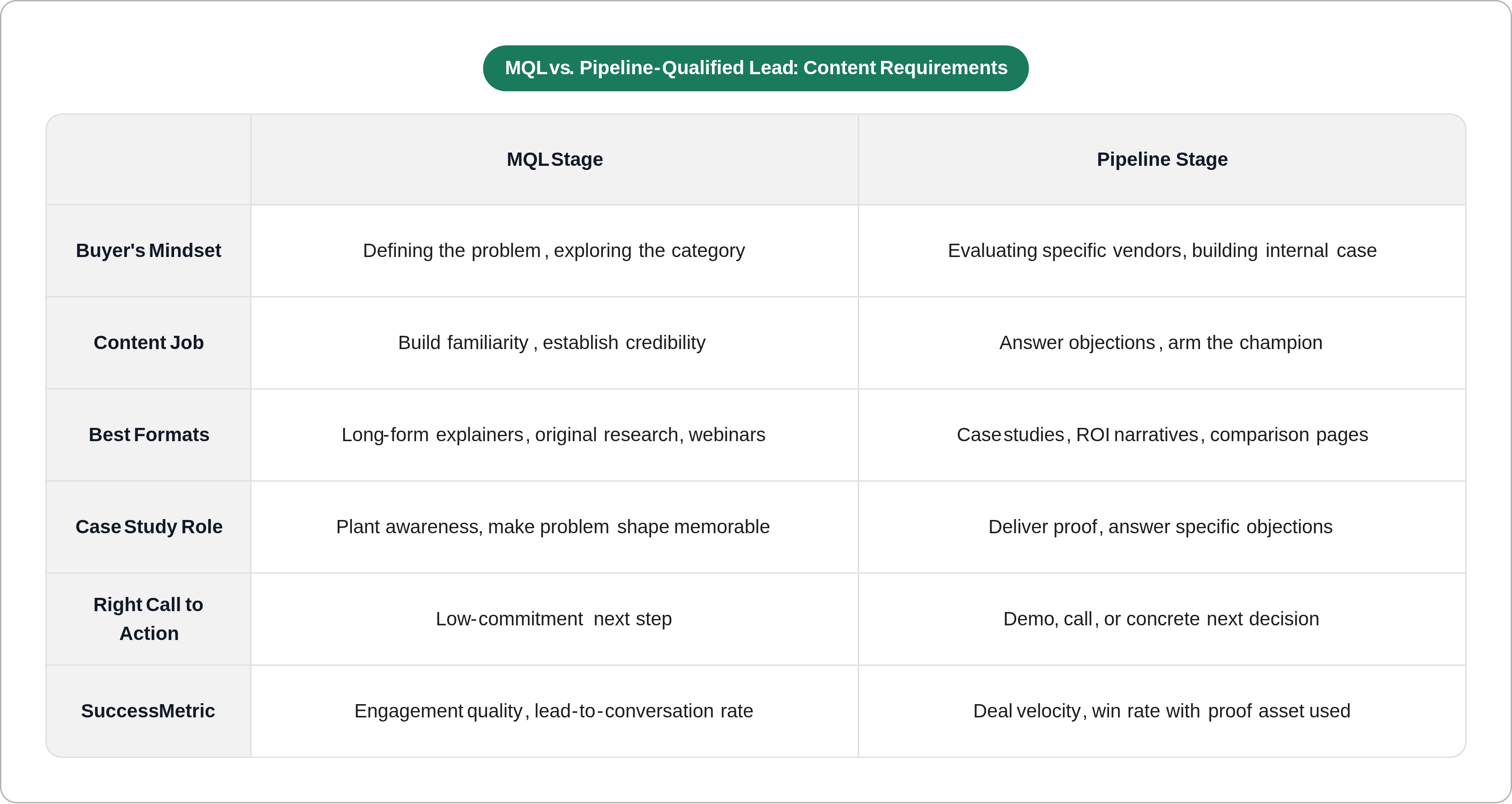
Same asset, wildly different job depending on where it shows up.
At the MQL stage, a case study is there to introduce the shape of the problem and plant the idea that you're the kind of company that solves it. The reader isn't evaluating anything yet, so the story just needs to be memorable and relevant, with no pressure to close.
At the pipeline stage, that same story has to do real work: answer the specific objection sitting on the table, whether that's switching costs, implementation risk, or "how fast do we actually see ROI," and arm the buyer with language they can use to defend the decision to their own boss.
A few structural choices decide which job a case study is capable of doing. Vague outcomes are fine for awareness content; precise, verified numbers are non-negotiable for late-stage conviction. Voice matters too, decision-makers respond more to stories told through the customer's own words than through the vendor's, according to Edelman's 2025 research on B2B trust. And structuring the story around a clear before-and-after contrast lands harder in the pipeline stage than it does earlier, when the reader isn't yet comparing their own "before" to anything.
Where the case study lives changes what it can accomplish, too. Sit it on a comparison page and it reinforces someone already actively weighing options. Drop it into a sales email sequence and it answers the objection the rep just heard on a call. Send it in a nurture email to an early-stage lead and its job is simpler: just plant the idea that someone like them already solved this.
And the call to action needs to match. A pipeline-stage case study should ask for the demo, the call, the next real step, because the qualifying work is already done. Ask an MQL for the same thing and you'll just come off pushy, like asking someone to move in after the first date.
Why the handoff between content and sales breaks down and what it costs
Most demand generation programs run on a simple assumption: marketing hands off leads, sales converts them. Simple in theory. In practice, it collapses the moment the content that got a lead qualified can't keep supporting the sale once it's in motion.
Here's what sales actually inherits at handoff: a prospect who's read the blog posts, downloaded the guide, maybe watched a webinar, but still doesn't have the specific proof that would put their remaining doubts to rest. Marketing considers the job finished. The buyer doesn't feel that way at all.
That mismatch is exactly why so many leads passed from marketing to sales get rejected as unready. When the definition of "qualified" is fuzzy, or when a click gets mistaken for intent, marketing hands over volume and sales receives static.
And even when a lead is genuinely ready, the proof gap shows up mid-deal. A rep needs a case study today, this afternoon, for a call in two hours, and what happens? They message the advocacy manager, dig through a shared drive that hasn't been cleaned up since last spring, and improvise. That's a scavenger hunt with a quota attached.
The cost is concrete: deals sit idle while someone hunts for the right story, the wrong case study gets sent because the right one was never written, and a competitor with a tidier proof library wins a deal your product should have won on merit alone. Fixing this doesn't happen in a quarterly alignment meeting. It requires shared criteria for what "qualified" actually means, a feedback loop where sales can flag when content misses the mark, and a proof library organized by deal context instead of by whenever it happened to get published.
Building a content program that serves both types without collapsing into one
MQL content and pipeline content need separate briefs, separate formats, separate ways of measuring success, and separate distribution plans. They can come from the same team. They should not come from the same playbook.
For MQL-stage work, invest in the long-form explainers, the original research, the pieces that earn organic discovery and build a reputation as the company that actually understands the problem. Measure it by engagement quality and by how many of those leads eventually become real sales conversations, not by how many names hit the spreadsheet. Newsletter signups and webinar registrations are fine signals here, as long as everyone agrees they mean "interested," not "ready to buy."
For pipeline-stage work, the investment looks different: structured case studies, ROI narratives built around real numbers, comparison pages, proof assets built for specific segments and specific objections. Organize all of it by use case, persona, and deal stage, so a rep can find the right piece in under a minute instead of texting three people. Measure success by deal velocity, by win rates on deals where a proof asset actually got used, by whether reference calls convert.
Most programs lean too hard on the MQL side, not because anyone decided to, but because it's the easier content to produce on a predictable schedule. Rebalancing means funding pipeline-stage production as its own real workstream instead of whatever's left over once the blog calendar is full.
And case studies can't run on a quarterly cadence if sales needs them weekly. The engine needs to run continuously, with clear triggers: capture the story right after onboarding, right after a big win, right before renewal, not "whenever someone on the team gets around to it." Turning raw customer conversations into structured, deal-ready case studies on a repeatable schedule, rather than treating each one like a special occasion, is what closes this gap.
What each lead type should signal to the content program going forward
MQL behavior is data, if you actually look at it. Which educational pieces attract people who go on to have real sales conversations, and which just rack up downloads that go nowhere? That answer should shape next quarter's content calendar, not just this quarter's lead count.
Pipeline behavior tells its own story. Which case studies do reps actually pull out and use, and which ones show up in deals that close? Which objections keep surfacing on calls with no content anywhere to answer them? That feedback should drive the case study production queue directly, no committee required.
Do this consistently and the payoff compounds. The gap between what marketing makes and what sales actually needs starts shrinking, quarter over quarter, and the proof library grows precisely in the places deals have historically gotten stuck.
Every piece of content should be able to answer one of two questions honestly: does this help someone understand the problem well enough to start evaluating solutions, or does this help someone already evaluating commit and defend that choice internally? A piece that can't answer either question isn't pulling its weight. Programs that treat everything as top-of-funnel leave their pipeline-stage buyers stranded without proof; programs obsessed only with case studies starve the funnel that's supposed to feed those late-stage conversations in the first place. Both mistakes cost real revenue, quietly, deal by deal.