Proof Asset Audits for B2B Sales Teams
Map your customer proof against deals to find what's actually costing you revenue.

Let's get something straight before we go any further. A proof asset audit is not a content audit. You are not counting assets, checking grammar, or making sure the logo is the right shade of blue. That is a different job. It belongs in a different meeting.
A proof asset audit maps three things simultaneously:
- What customer evidence exists and in what format
- Where in the sales cycle each asset is (or is not) actually being used
- Which gaps correspond to deals that are stalling or dying right now
The unit of analysis is the deal, not the document. A useful asset is one that moves a specific buyer past a specific objection at a specific stage. A beautiful case study that never surfaces in a real conversation is just content. It lives on a shared drive. It helps no one.
Proof assets cover a wide range: case studies, testimonials, ROI calculators, reference calls, third-party reviews, win/loss summaries, outcome data, anonymized stats. The audit maps all of them against the same framework.
The core diagnostic question is this: "If a rep is in a late-stage deal with a mid-market fintech buyer comparing us to a named competitor, what proof exists to support that conversation, and can the rep find it and use it in the next 24 hours?"
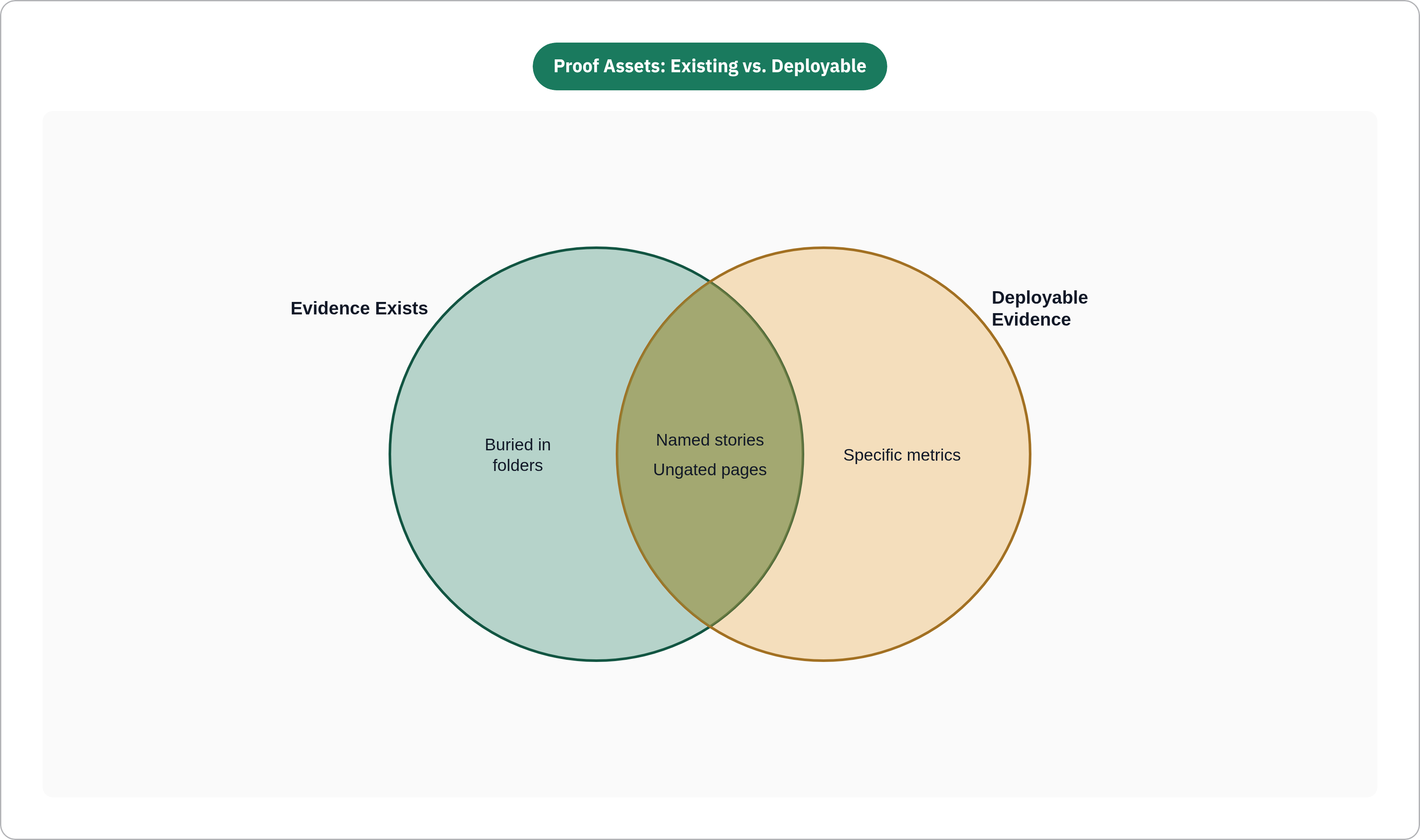
That last part is where most teams fall apart. There is a meaningful difference between evidence that exists somewhere and evidence that is actually deployable. A lot of what teams technically "have" is buried three folders deep, two years out of date, gated behind a form, or written for a campaign rather than a sales conversation. Existing and deployable are not the same thing. Confusing the two is how companies lose deals they had every right to win. Think of it this way: a locked treasure chest is not the same as gold in your hand.
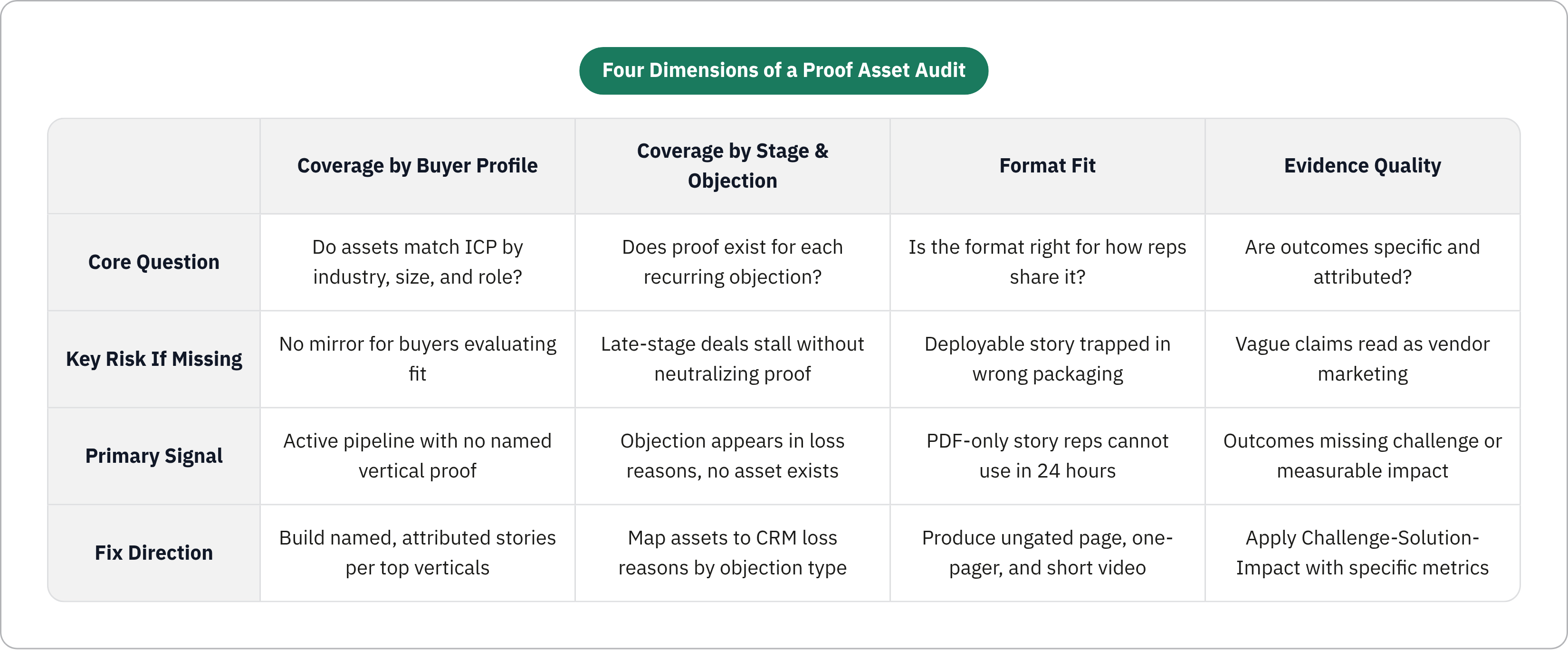
The four dimensions every proof asset audit must cover
Dimension one: coverage by buyer profile
Map your assets against your ICP matrix: industry vertical, company size, buyer role and title, geography. Research with over 800 B2B marketers, sellers, and buyers (via UserEvidence) found that 78% of buyers say the most important factor in evaluating proof is whether it comes from a similar customer. Same industry, same size, same role. Buyers are not looking for inspiration. They want a mirror.
The gap signal here is blunt. If a major vertical in your active pipeline has no named, attributed proof, that is a coverage gap with real revenue exposure. Not theoretical. Active.
Dimension two: coverage by sales stage and objection
Map assets to the moments where they need to show up: awareness, evaluation, late-stage validation, competitive displacement. Most teams build too much top-of-funnel awareness content and not nearly enough late-stage proof that neutralizes specific objections.
Pull your deal reviews. Pull your CRM loss reasons. Find out which objections are recurring. Then check whether any asset directly addresses each one. If there is no asset for "we are worried about implementation time" and that objection shows up in a significant share of your lost deals, you have found a gap that is costing you money right now. That is the whole point of the exercise.
Dimension three: format fit
A strong customer story locked in a lengthy gated PDF is not a deployable sales asset. It is a conversion obstacle wearing a friendly face.
CMI's 2025 benchmark found video is the most effective B2B content format, rated effective by 58% of respondents, with case studies close behind at 53%. The audit question is simple: does the format match how the asset is actually being requested and consumed at that deal stage?
Each proof asset should ideally exist in at least three forms. An ungated web page for buyers doing anonymous pre-sales research. A sales-ready one-pager for active deal conversations. A short video version where possible. Same story. Three different packages. Three completely different moments in the buying process.
Dimension four: evidence quality and specificity
An analysis of the top 58 fastest-growing SaaS companies in 2025 found that 93% use a Challenge-Solution-Impact framework in their case studies. The audit should flag any asset missing one of those three components. Assets that skip the challenge read as vendor marketing, not customer evidence. Buyers notice immediately, even if they cannot articulate exactly why they are skeptical.
TrustRadius found in 2025 that 87% of B2B decision-makers demand concrete evidence for solution effectiveness. Vague outcome language like "improved efficiency" or "saved time" does not clear that bar. The standard is specific, attributed metrics.
Think reMarkable working with Stripe and minimizing fraud to 0.10%. Toyota Connected working with Twilio Flex and cutting after-call work time by 13% and average handle time by 18%. Rituals working with Google Marketing Platform and achieving 85% increases in conversions and sales. That is what specific looks like. That is the kind of detail that earns a reply.
Where customers will not share exact numbers, use defensible proxies: relative deltas, time-to-value, error-rate changes, ranges with a brief methodology note. A verified story with ranges still beats a vague vendor claim by a wide margin. Worth noting, too: AI answer engines now reward content backed by attributed, checkable outcomes. An unnamed "Fortune 500 client" contributes nothing to search visibility or AI discoverability. Named and attributed proof is doing double duty.
How to read the audit results: scoring gaps by deal impact
Not all gaps are equal. The instinct is to prioritize whatever is easiest to fix. That instinct is wrong. Prioritize by revenue exposure.
High priority:
- Gaps in the segments that represent the largest share of active pipeline. A missing financial services case study matters more than a missing retail one if 60% of your open deals are in fintech. The math is not complicated.
- Late-stage gaps. Missing proof that surfaces after a prospect has already engaged is more immediately damaging than top-of-funnel gaps. The deal is live. The cost is now.
- Competitive gaps. If a competitor is consistently winning deals in a specific segment and you have no displacement proof, that is a structural problem. It compounds.
Medium priority:
- Format gaps. The story exists, but it is packaged wrong for how reps are actually sharing it.
Lower priority (for now):
- Coverage gaps in segments that are not yet in active pipeline. Build those eventually. Avoid building them at the expense of gaps that are costing you deals this quarter.
The primary scoring input is your CRM. Pull loss reasons. Pull late-stage stall patterns. Pull competitive displacement data. If reps are consistently losing deals because they could not find a relevant customer story, that pattern is the audit's primary signal.
UserEvidence found that 53% of sellers say their sales process is slowed or negatively impacted by a lack of relevant, specific customer evidence. The audit tells you exactly where that drag is concentrated. The output of this step is a ranked gap list with estimated pipeline at risk attached to each item. Not a wishlist.
Running the audit in practice: what to pull, who to ask, and where to look
The mechanics are not complicated. You are pulling from two buckets.
Primary inputs:
- CRM deal data. Stage-by-stage win/loss rates, loss reasons tagged by objection type, any deals where "no relevant proof" or "couldn't find a reference" shows up in the notes.
- Sales rep interviews. Ask every rep: "What proof do you wish you had in the last five deals you lost?" This surfaces gaps faster than any content inventory. Reps know exactly what is missing because they felt it in real time. They have just never been asked directly.
- Content library audit. Document every existing proof asset with format, last update date, whether it is gated, and which ICP segment it covers.
- Proof usage data. Email open and forward rates on case study sends, CRM attachment logs, engagement data from tools like Highspot or Seismic, UTM-tracked page visits from rep-shared links.
Secondary inputs:
- G2, TrustRadius, and Capterra reviews. Unstructured customer evidence that often contains specific outcomes reps can reference in conversations without having to produce a formal case study first.
- Call recording tools like Gong or Chorus. Surface recurring moments where prospects ask for proof and reps do not have it ready. Those moments are your gaps made audible.
- Analysis of over 6,500 real questions that sales reps asked a proof discovery tool found that requests for case studies, customer stories, and lists of similar companies made up 66.6% of all queries. Reps are asking for evidence they can use today. They are asking for substance, not thought leadership.
Who runs it: This works best as a joint exercise between sales leadership and whoever owns customer marketing or content. Neither can do it alone. Sales owns the deal data. Marketing owns the asset inventory. You need both in the room, and you need them to be honest with each other.
Time horizon: The full audit is completable in a focused week. The gap-scoring step is the only part that genuinely requires cross-functional alignment. Everything else can run in parallel.
What the evidence gap looks like in practice across common ICP segments
The anonymous research phase is where the most invisible damage happens. A large share of buyers do their pre-sales research with no rep involved. They self-qualify based entirely on what they can find. If your proof assets are gated or nonexistent for their segment, they never reach out. The deal dies before it starts, and nobody logs it in the CRM because nobody ever knew it existed. That is the uncomfortable part.
Then there is the "do you have customers like us?" moment, which typically lands early in discovery. A rep who can say "yes, here is a named story from a company your size in your industry with a comparable stack" compresses the cycle. A rep who says "I will check" loses momentum that is genuinely hard to recover. Buyers interpret that pause as uncertainty, even when the real problem is just a bad filing system and an overloaded Slack channel.
Late-stage competitive displacement is where segment-specific proof closes deals that generic content never could. A prospect comparing two vendors with similar feature sets will default to the one whose customers look more like them. That is a basic human response. Familiarity reads as trust, especially when buyers are making decisions that affect their own reputation internally.
The reference call bottleneck is something most teams recognize but rarely diagnose correctly. When you are cycling the same five reference customers through every late-stage deal, that is a proof system problem. You are burning customer goodwill because you have not built the infrastructure to scale their stories into something more durable than a 30-minute Zoom call that cannot be replicated.
For regulated and sensitive industries: proof is often available. It just needs anonymized formatting. UserEvidence's 2025 Evidence Gap report found that 60% of buyers trust blind-but-verified testimonials versus 64% for named ones. The gap between named and anonymous proof is far smaller than most teams assume. The audit should flag assets that can be produced in anonymized form rather than skipped entirely, because skipping them leaves a real gap where a workable alternative exists.
Building the fix: how to close the gaps the audit surfaces
Start with the customers already in your CRM who match the highest-priority gap segments. The proof often already exists inside those relationships. It just has not been extracted and structured.
Getting customers to participate is its own skill. Co-marketing value works well: a backlink, a speaking slot, a joint webinar. Early feature access, training credits, a charitable donation in their name. A clear value exchange increases participation rates in a real way. "It would really help us" is rarely enough on its own, and customers know when they are being asked to do someone a favor versus being offered something worth their time.
Structure every new case study against Challenge-Solution-Impact. Assets that skip the challenge section read as self-promotion. The customer's perspective has to anchor the narrative, with you as a supporting character rather than the hero. Edelman found in 2025 that 72% of B2B decision-makers identify more strongly with success stories focused on the customer's experience rather than the vendor's capabilities.
The format production sequence for each new asset:
- Ungated web page first. Serves the anonymous research phase and gets picked up by search and AI.
- Sales one-pager second. Formatted for how reps actually share proof in active deals.
- Short video third. Video testimonials outperform text-only versions on conversion. Prioritize this for your highest-priority gap segments.
For regulated industries or customers who will not share exact metrics, use defensible proxies with a brief methodology note. An anonymized, verified story with ranges still outperforms a vague vendor claim every time.
Format shifts matter as much as content. Mosaic Manufacturing moved from technical specifications to customer-focused proof and saw a 25% increase in inbound leads and a 15% increase in booked meetings within two months. The underlying content was not entirely new. The packaging was. That is worth sitting with for a moment, because it means the raw material for better assets already exists inside your organization. It is just formatted in a way that does not work for anyone trying to actually close a deal.
Most teams can produce first usable evidence within four to six weeks of structured outreach, assuming customer contacts are already in the CRM and the interview design is finalized quickly. Six weeks is not a long runway. You have deals in the pipeline right now that will close before then, without the proof they need.
Turning the audit into a repeatable system rather than a one-time fix
A one-time audit has a shelf life. Your pipeline changes. Your ICP evolves. New competitors show up in segments you were not expecting. The gaps you closed in Q1 are not the gaps you will have in Q3. Run the audit once and treat it as finished, and you will be back in the same position two or three quarters later — slightly different gaps, same underlying problem, same uncomfortable conversation about why deals are stalling. It is like patching a single hole in a leaking boat and calling it seaworthy.
Systematize collection. Surveys delivered in-app, via email, or through lifecycle touchpoints can automatically feed into a searchable library tagged by industry, company size, use case, and competitor. That converts one-off testimonials into an indexed proof library instead of a folder someone has to dig through and hope is still current.
Tag proof assets to deals in the CRM. Track which assets were used in won and lost deals. Compare win rates on deals where relevant evidence was shared against deals where it was absent. This closes the attribution loop the audit opened, and it stops the conversation from being theoretical. You will have actual numbers to show, which changes the conversation with leadership significantly.
Run the audit on a cadence. A quarterly review against the ICP matrix is sufficient for most teams. The trigger for an off-cycle audit is a meaningful shift in pipeline composition or a new competitive entrant showing up consistently in your loss data.
Gong's State of Revenue Growth 2025 found that 48% of revenue teams are already using AI tools, with another 24% planning to adopt them. AI-powered proof discovery tools that automatically surface and recommend the right asset for each deal are a logical next layer. But the library has to exist and be structured before AI can do anything useful with it. The audit builds the foundation. Skip it, and you are asking technology to organize chaos. No tool handles that gracefully, regardless of how many features it ships with.
The companies with the strongest proof libraries right now started building before they felt ready. They did not wait for perfect coverage or a complete content strategy. They ran the diagnostic, identified the most expensive gaps, and built into those first. Everything else followed from that.