Battle Cards Built from Customer Win Stories
Extracting battle card content directly from the deals your reps already won.

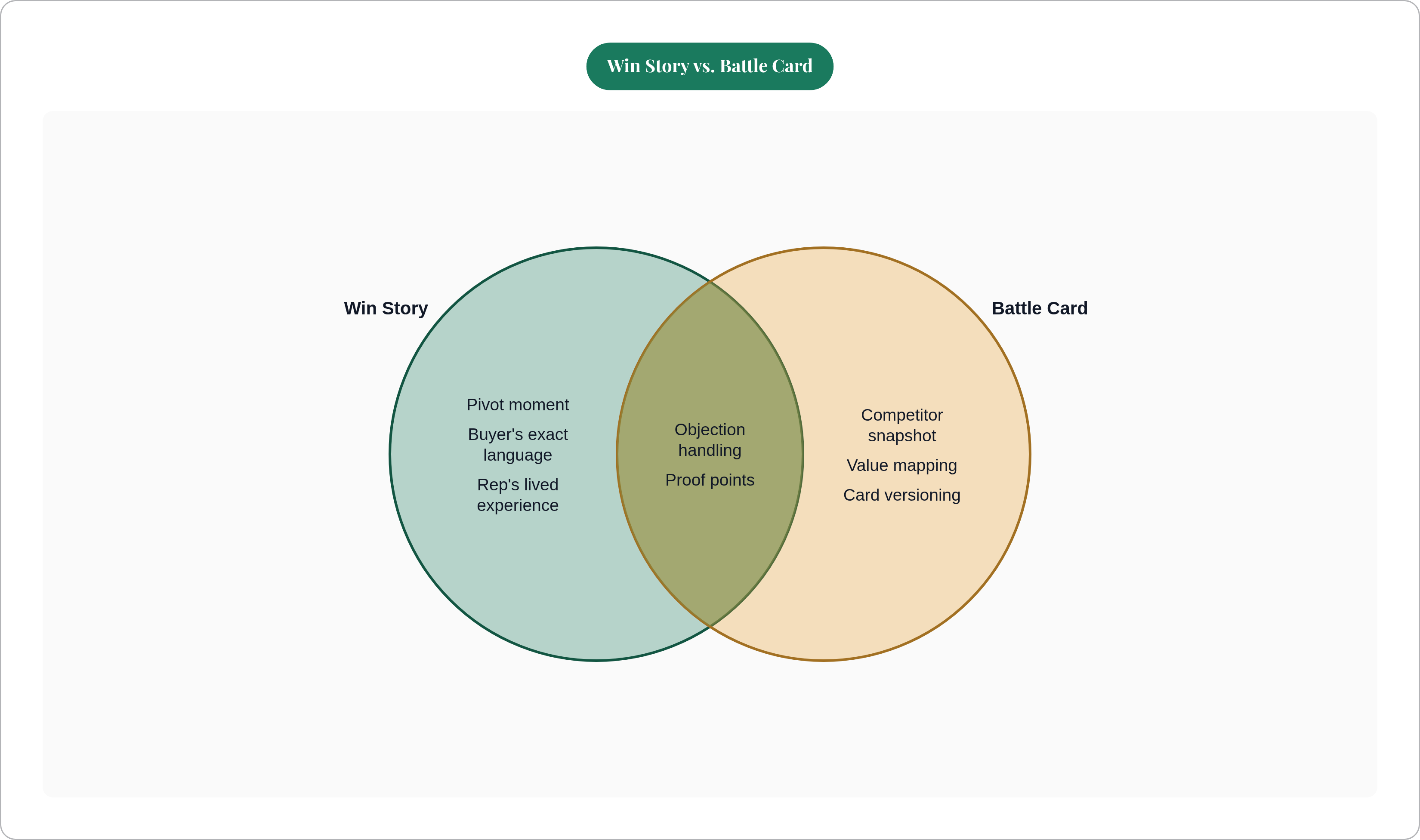
A win story and a battle card are the same information wearing different clothes. The win story has the competitive context, the objections that came up, the moment something shifted, and the outcome that made the whole thing worth it. A battle card has competitor comparisons, objection handling, differentiators, and proof points. These aren't parallel categories that happen to rhyme. They're the same categories.
Map it directly:
- Competitor comparison → which vendor was displaced, and why the buyer walked away from them
- Objection handling → the specific doubts the prospect raised during the actual deal
- Differentiators → what the rep said that changed the conversation, in the moment it changed
- Proof points → the measurable result the customer experienced after buying
The difference between a card built from research and one built from a win story isn't cosmetic. A research card describes what someone thinks buyers care about. A win story card records what a buyer actually cared about, with real money on the table. One is a map drawn by someone who's never been to the territory. The other is directions from someone who just made the trip last Tuesday.
There's also a memory argument that's worth sitting with. Reps don't recall a document they skimmed before a call. They recall a story that stuck. Story-formatted information has been shown to be retained dramatically better than isolated facts. And yet most battle cards are still lists of bullet points pulled from a competitor's website. That's a sourcing problem, not a tool problem.
The Structured Information Already Living Inside a Win Story
A win story isn't one thing. It's layered, and each layer has a different destination in a battle card.
Here's what's actually inside a well-captured win story:
- Competitive context: who else was evaluated, what those alternatives offered, why the prospect was even looking at them
- Objections raised: the specific hesitations that came up. Price. Risk. Switching cost. A feature gap they heard about from a competitor's sales rep.
- The pivot moment: what the rep said, showed, or proved that changed the prospect's position. This is the most underrecorded layer, and it's the most valuable.
- Decision criteria: what the buyer said they were optimizing for, which is often different from what they said at the start of discovery
- Outcome data: the measurable result. The "after" that validates the "before."
If you've ever built a case study using a Before-After-Bridge or Challenge-Action-Result framework, you already know this structure. The skeleton that produces a good case study is the same skeleton that produces extractable battle card content. This isn't a new methodology. It's just applying an existing one to a different output.
One useful real-world example: Netskope's battle card, documented by dock.us in 2025, includes micro case studies against specific competitors, with company size, use case, and the explicit reason for the win all named. That level of specificity isn't possible from desk research. It comes from the deal record. Someone had to ask.
This is also what win stories contain that competitor research almost never does: the buyer's actual language for their pain, the objection that nearly killed the deal, the third-party comparison that came up organically on a late-stage call. Nobody puts that in a product marketing brief. It only surfaces if someone asks for it, which is what the debrief is for.
How to Run a Win Story Debrief That Captures Battle Card Material
The default debrief question is "Why did we win?" The default answer is "Great product, strong relationship." That answer is useless for a battle card.
The debrief needs to be structured around battle card destinations, not general reflection. That means asking different questions.
To extract competitive intelligence:
- Who else were they evaluating, and what did those vendors offer?
- At what point in the process did we become the frontrunner?
- What did they say was the deciding factor, in their exact words?
To extract objection-handling material:
- What concern almost killed this deal?
- What did you say or show that resolved it?
- Did they raise a specific claim a competitor made that you had to counter?
To extract proof points:
- What outcome did you promise them in the pitch?
- Have they seen any early results you could name?
- What would they tell a peer who asked why they chose us?
Two sources are worth pursuing: the rep and the customer. Both matter, but for different reasons. The rep knows what happened internally. The customer knows what they actually felt. And customer language is more persuasive than anything your rep would say unprompted. When a customer says "we chose them because we'd been burned by that competitor on implementation and this team actually showed us the migration plan upfront," that's a sentence that belongs verbatim in an objection-handling cell.
For situations where customers won't go on record, regulated industries, sensitive deals, anonymized but verified evidence still carries most of the weight. UserEvidence's 2025 Evidence Gap report found that named evidence lands at 64% trust and anonymized but verified lands at 60%. That gap is small enough that you shouldn't leave those captures on the table just because someone won't sign a release.
Timing matters more than people expect. Customers are most forthcoming right after a successful outcome or smooth onboarding. That window closes fast. The debrief process has to be systematic, not something you remember to do when you have a free afternoon and feel like being thorough.
Extracting and Tagging the Material for Battle Card Use
Raw win story material isn't ready for a battle card. It needs to be parsed into typed fields that map to specific card sections. Less exciting than the debrief, but this is where the library actually gets built.
A simple extraction taxonomy looks like this:
- Competitor name: who was displaced
- Objection raised: the prospect's exact language, if you captured it
- Counter used: what the rep said or showed that resolved it
- Differentiator claimed: what specifically was positioned as better
- Proof point attached: the outcome that backed the claim
- Context tags: industry vertical, company size, buyer persona, deal stage where the issue surfaced
The context tags are what make the material retrievable when it matters. UserEvidence's 2025 Evidence Gap report found that 78% of buyers say proof from a similar company is the most important factor in trusting evidence. A proof point without context is nearly useless in a live deal. A proof point tagged to "Series B SaaS, security use case, displaced Zscaler" is immediately deployable. Those two things are not the same thing, even if the underlying evidence is identical.
The Before-After-Bridge and Challenge-Action-Result frameworks make extraction easier because they're already segmented. The "before" is the objection or pain. The "bridge" or "action" is the counter and differentiator. The "after" or "result" is the proof point. Structured input produces structured output, which sounds obvious until you realize most teams are dumping unstructured notes into a folder and calling it a library.
At scale, AI-assisted categorization can surface and recommend proof by deal context in real time. But even a manual tagging system in a spreadsheet produces a usable indexed library. The tool matters less than the discipline of actually doing it.
Building the Battle Card from Extracted Win Story Material
A win-story-sourced battle card has a different internal logic than a research-sourced one. Every cell is backed by a real deal. Not a product marketing hypothesis. An actual decision made by an actual buyer.
Here's how the win story material flows into each section:
- Competitor snapshot: what you learned about how that competitor was positioned in real deals. Not from their website. From buyers who evaluated them and picked you instead.
- Common objections and responses: the exact objections raised in debriefs, paired with the counter that actually closed the deal. No hypothetical answer someone workshopped in a conference room.
- Differentiator claims: only the differentiators that showed up as real decision factors. Not the full product marketing list.
- Micro case study: a two-to-four line proof block. Industry, use case, what switched, measurable outcome. The Netskope model from dock.us is the template: company size, competitive context, reason for the win, all named.
- Value mapping: differentiators mapped to buyer outcomes, in customer language, not internal positioning language.
The micro case study cell is the most underbuilt section in most battle cards, and also the most persuasive one for reps who need credibility fast. Especially in compliance-heavy deals where a buyer's default position is skepticism and "just trust us" doesn't do anything useful.
Keep the card short enough to consult mid-call. The extraction and tagging work happens upstream. The card itself is a distillation. If the rep has to scroll past eight sections before finding the objection that's live on the call right now, the card already lost.
Cards should be versioned by competitor and, optionally, by vertical. The same win story material, indexed differently, produces distinct cards without redundant work. That's not a small thing when you're trying to scale this without adding headcount.
Getting Reps to Use the Card in Live Deals
Here's how most battle card programs actually end: someone builds the cards, posts them in a shared drive, announces them in Slack, and then watches the win rate stay flat. The card was fine. The distribution was the problem.
The card needs to live where the rep already is. In the CRM. In the sales enablement platform. In a pinned Slack channel organized by competitor. Not in a wiki they have to remember to visit before a call they didn't expect to go sideways.
Customer proof platforms that ingest evidence and surface it inside Salesforce, Seismic, Highspot, and Slack are the mature version of this setup. But even a basic system works. A Slack channel organized by competitor name, updated after each win debrief, is a functional starting point. It's searchable. It's where reps already are. It doesn't require a platform budget to get started, which matters when you're trying to prove the concept before anyone cuts a check.
The micro case study cell is specifically designed for verbal use. Short enough to cite from memory or read in a call. Specific enough to be credible. Structured enough that the rep doesn't have to editorialize. "We worked with a Series B security company that was also looking at that competitor. Their main concern was implementation risk. We walked them through the migration plan in the second call, and they cited that as the deciding factor." That's citable. That's what the cell should produce.
Card maintenance has to be a system, not a project. Each new win debrief feeds new material into existing cards. Objections get updated as competitors adjust their pitch. Proof points get added as customers report results. A card built from three win stories is useful. A card updated after twenty is something reps actually fight over. That shift, from "tool someone made" to "resource people trust," doesn't happen from the initial build. It happens from the tenth update.
The constraint was never a lack of competitive intelligence. It wasn't a shortage of case study content. It was the absence of a process that connected the two, and that process was already happening every time a rep closed a deal. It just wasn't being written down.