Turning a Customer Case Study Into a LinkedIn Post Series
Unlock five LinkedIn posts from every case study you already have.

Most content teams treat a case study as one artifact: a PDF, a webpage, a beginning, middle, and end. That is the mistake. Structurally, a case study is already a bundle of separate stories pretending to be one document, like a novel that has been quietly hiding five different books inside its spine.
Pull it apart and you get five distinct layers:
- The before state. The customer's specific pain. The cost of doing nothing. What they'd already tried that hadn't worked.
- The decision moment. What finally made them move. Why now instead of six months ago. What the evaluation actually looked like.
- The implementation process. What happened after they signed. Who was involved. Where things got messy and how it got cleaned up.
- The measurable result. The hard numbers. How long it took to see them. What metric moved and by how much.
- The human perspective. What the customer felt. What they'd say to a peer who asked. The quote that captures the whole thing in one sentence.
Each layer answers a completely different buyer question. The before state catches someone still diagnosing their problem. The decision moment speaks to someone already comparing vendors. The result post is what an internal champion needs to justify the purchase upstairs. These are not interchangeable. Swapping them in for each other is how you end up sending the CFO a feelings post and the frontline practitioner a spreadsheet.
One thing that surprised me when I started breaking case studies apart this way: the human layer, the quote, the emotion, the peer voice, often gets treated as decoration. A nice-to-have. Something the designer wraps in a pull-quote box. It isn't. It's a standalone proof asset that some buyers will engage with before they read a single number. It deserves its own post.
Before you plan anything, do a quick audit. Map which of these five layers is well-documented in the case study and which is thin. A thin result section means you need to go back to the customer. A thin human layer means the interview probably stayed too surface-level. Thin layers do not become strong posts, so find out what you're working with before you start writing.
Matching Each Extracted Layer to a LinkedIn Post Format
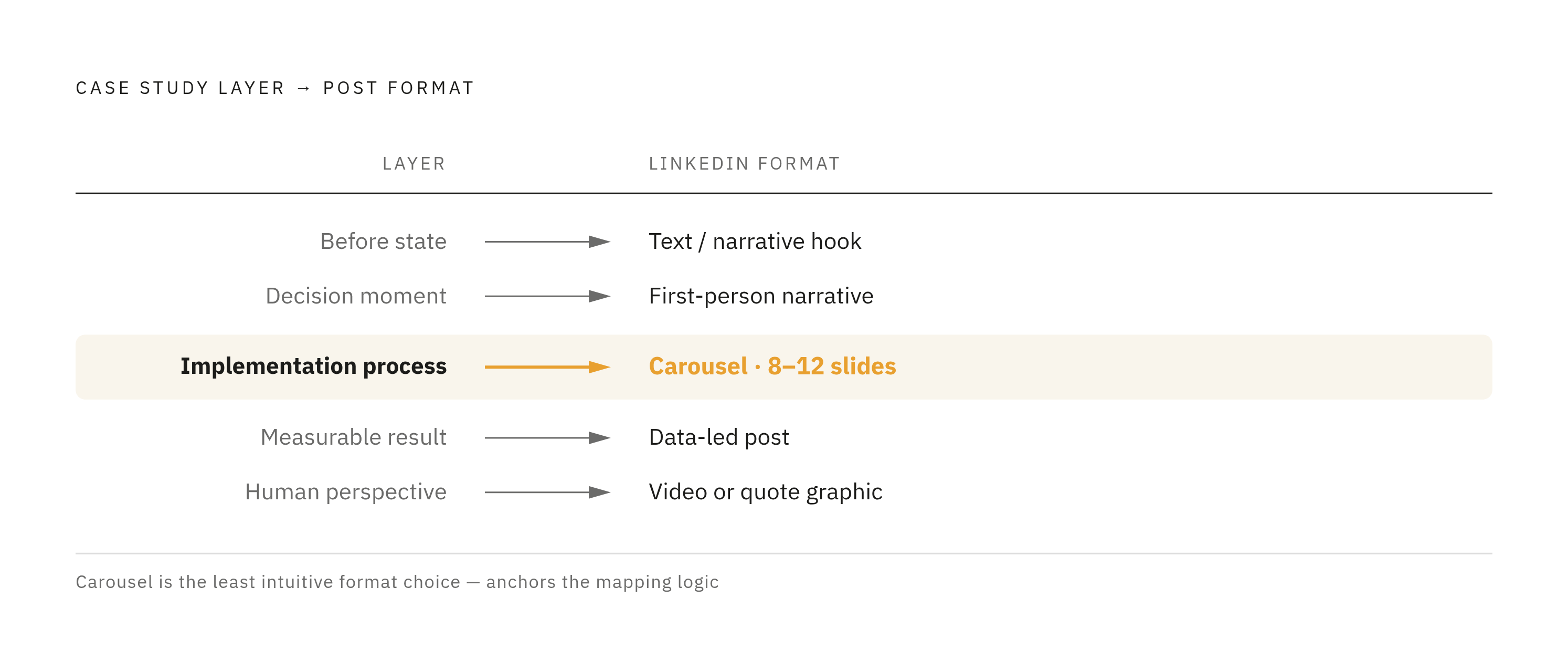
Format is not about aesthetics. It's about what each layer needs to do, and how buyers actually move through a feed.
The before state becomes a text post or a short narrative hook.
The job here is pattern interruption. You want a buyer living the same problem to stop mid-scroll and think, "That's me." You don't need numbers for this one. Recognition is the conversion event. Write the pain in the customer's words. Be specific enough that the right person feels seen. Withhold the outcome so there's a reason to keep reading.
The decision moment becomes a first-person narrative post.
Write it in the customer's voice, or as reported dialogue. Something like: "We'd looked at three other vendors. We'd run a pilot with one of them. But the thing that changed our minds was...." This post speaks directly to buyers in active evaluation. "Why now" and "why this vendor" are exactly the questions they're turning over in their heads. That's where emotional proof lives. B2B buyers are more likely to choose a provider they feel a real connection with, and this format is how you build it.
The implementation process becomes a carousel (uploaded as a PDF).
The process post is about risk reduction. Show the work. Show who was involved, what onboarding actually looked like, where friction came up and how it got resolved. Carousels consistently earn strong engagement on LinkedIn, and story-driven carousels tend to outperform purely educational slide decks. The key distinction: structure the implementation as a journey, not a feature list. Eight to twelve slides. No more than forty words per slide. First slide is the hook, last slide is the CTA, everything in between is the proof.
The measurable result becomes a data-led post.
Lead with the number, then give it context. What did it take to get there? How long? What changed operationally? This post arms the economic buyer and gives the internal champion something they can screenshot and forward. Before-and-after comparisons do more persuasive work than summary statements. A number without context is just trivia.
The human perspective becomes a short-form video or a quote graphic.
This is the peer voice. It's the last objection cleared. Most buyers say proof from a similar customer is one of the most important factors in their decision, and video is where that lands hardest on LinkedIn right now. Record vertically, keep it under ninety seconds, and open with the customer's most specific claim in the first three seconds. Drop-off is steepest right at the start. Don't spend those three seconds on your company name.
Sequencing the Posts So They Build Toward a Decision
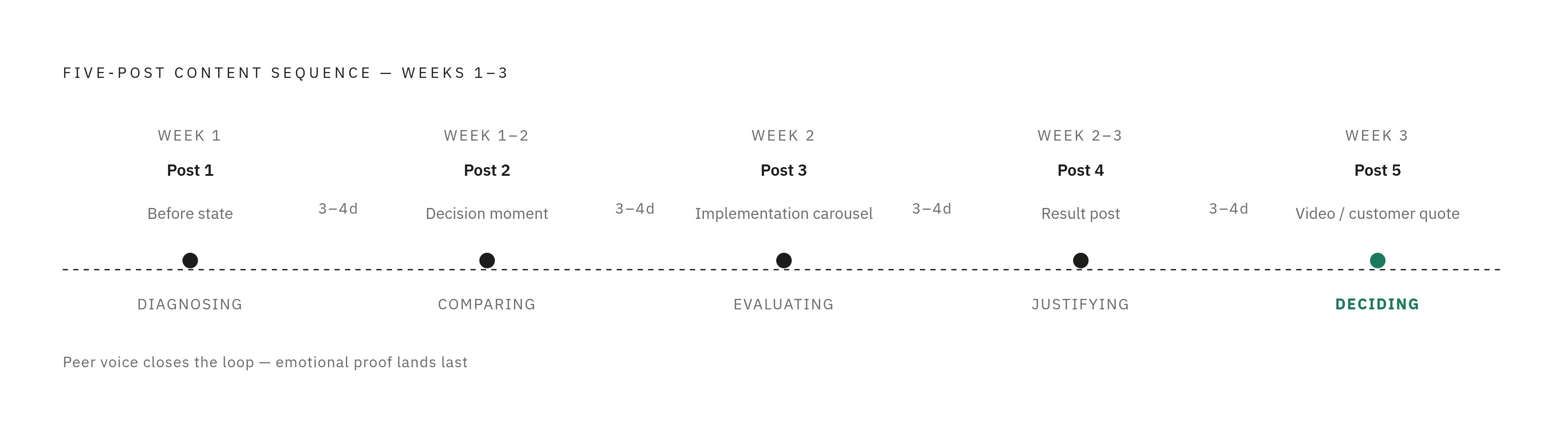
Order matters. The sequence mirrors the buyer's internal journey, from "I think I have a problem" all the way to "I need to justify this purchase to my boss."
Here's a working arc for a two-to-three week series:
- Week 1, Post 1: The before state. Catch buyers who are still in problem recognition mode.
- Week 1, Post 2 or early Week 2: The decision moment. For buyers who've recognized the problem and are now comparing options.
- Week 2: The implementation carousel. For buyers who've self-selected and want to know what working with you actually looks like.
- Week 2 or 3: The result post. Economic proof for whoever has to build the internal business case.
- Week 3: The video or customer quote. The peer voice that closes the loop and prompts direct outreach.
A few things to keep in mind as you sequence.
Every post should stand alone. A buyer entering the series mid-sequence should not be confused. They don't need to have seen post one to get value from post three. If a post only makes sense in order, it's not fully baked.
Vary the posting voice. Not every post needs to come from the company page. Individual reps should post some of them. Ideally the customer amplifies at least one. Content shared by employees consistently earns more engagement than the same content through a branded channel. LinkedIn's own data puts it around eight times more. That's not a rounding error.
Space posts three to four days apart. Organic reach has tightened over the past couple of years, but engagement per post is actually up. Volume is less important than rhythm. Give each post room to breathe before the next one lands.
Writing Each Post So It Triggers the Right Conversation, Not Just Impressions
Reach is not the goal. A specific buyer stopping, reading, and typing a response is the goal. Those are different targets and they require different writing.
The hook. The first line must be specific enough that the right buyer recognizes themselves in it. Not "a SaaS company." "A 40-person B2B sales team that was losing deals they should have won." Specificity is what earns the scroll-stop. Vagueness is bait nobody bites.
The tension structure. Every post needs a gap — think of it as the distance between two cliffs that the reader has to leap across to reach the other side. Between where the customer started and where they ended up. Between what buyers assume is true and what actually happened. That gap is what makes someone read to the end. No gap, no reason to keep going.
The close. End with a question or an invitation, not a link. LinkedIn's algorithm rewards comment depth, and posts that generate real back-and-forth exchanges get meaningfully more amplification than posts that don't. A link in the closing line kills that dynamic. A question opens it.
Format specifics worth knowing:
- Text posts: the nine-hundred to twelve-hundred character range works well for narrative hooks. The "see more" break should land at a moment of tension, not a logical pause.
- Carousels: eight to twelve slides, forty words max per slide, hook on slide one, CTA on the last slide.
- Video: open with the customer's most specific claim in the first three seconds. Skip the company name. Skip the thank you. Lead with the claim.
What to leave out matters as much as what to put in. Resist the urge to summarize the whole case study in every post. Each post's job is to be complete for one audience, not comprehensive for all of them. Specificity is what earns credibility. Not polish. Not length.
How to Use the Series in Active Sales Cycles, Not Just as Organic Content
This is where the series stops being content marketing and starts being a sales tool.
Reps can share individual posts rather than the full case study PDF. A prospect still diagnosing their problem gets the before-state post. A champion trying to justify budget gets the result post. The implementation carousel goes to someone asking "what does working with you actually look like?" You are matching the proof to the moment in the deal, not handing someone a fifty-page document and hoping they find the part that matters to them. It is, to put it plainly, the difference between handing someone a map and walking them to the door.
Research from Peerbound analyzing more than six thousand sales rep queries found that requests for case studies, similar company examples, and customer stories represent the largest category of proof-related asks reps make to marketing. The problem is they usually get one document back. The modular series gives them five assets with clear labels. That's findable. That's deployable. A single PDF sitting in a Google Drive folder is neither.
The tagging practice is worth building early. When a rep shares a post in a deal, log it in the CRM. Track which assets show up in won deals versus lost ones. That feedback loop tells you which layer of the case study is actually doing the deal-closing work, and that tells you what to prioritize when you're interviewing the next customer.
There's also an inbound signal the series generates on its own. A buyer who engages with multiple posts in the sequence is self-identifying as in-market. A rep monitoring company post engagement has a warm outreach trigger that didn't require a form fill. That's a real lead, surfaced without a single gate.
Forrester has noted that most marketing-created sales content goes unused because reps cannot find it. Five posts with clear labels (problem post, decision post, process post, results post, voice-of-customer post) solve that problem in a way a single PDF never will.
Building the System So Every New Case Study Becomes a Series Automatically
One case study series is an experiment. A repeatable system is what makes it compound.
The intake template is where it starts. When a new case study is produced, the writer fills out a five-layer extraction worksheet at the same time. Before state, decision moment, process, result, human quote. The series brief exists the moment the case study is approved. You are not going back three weeks later trying to figure out what posts to write. You already know.
The production rhythm follows from there. Each case study generates five post briefs, assigned at approval, drafted in batch, scheduled across two to three weeks. Two to three case studies per quarter produces a compounding library of proof across industries, roles, and use cases. The editorial calendar fills itself if the case study pipeline is consistent.
The customer involvement question is worth solving at the interview stage. The strongest series include a post written from or with the customer. Getting one good quote on record and asking for a sixty-second vertical video at the case study interview costs nothing extra. Ask for it while you have them on the call. That unlocks the highest-trust post format before the case study is even written. Most people don't ask. Most customers would say yes.
Employee amplification needs to be coordinated before the series goes live. Share the post schedule and a few suggested opening comments with the sales team ahead of time. The first sixty to ninety minutes of engagement determine algorithmic distribution. A coordinated internal response is the difference between two hundred views and two thousand. That's just how the algorithm works.
The measure that actually matters is not impressions. It's direct message replies, profile visits from target accounts, and which posts were shared by reps in deals that closed. Those signals tell you which layer of the case study is doing real work. And that tells you exactly what to ask the next customer when you sit down with them for the interview, trying to build the next one.