Referral Program Examples From B2B SaaS Companies
Each referral model serves a different growth stage and customer motion.
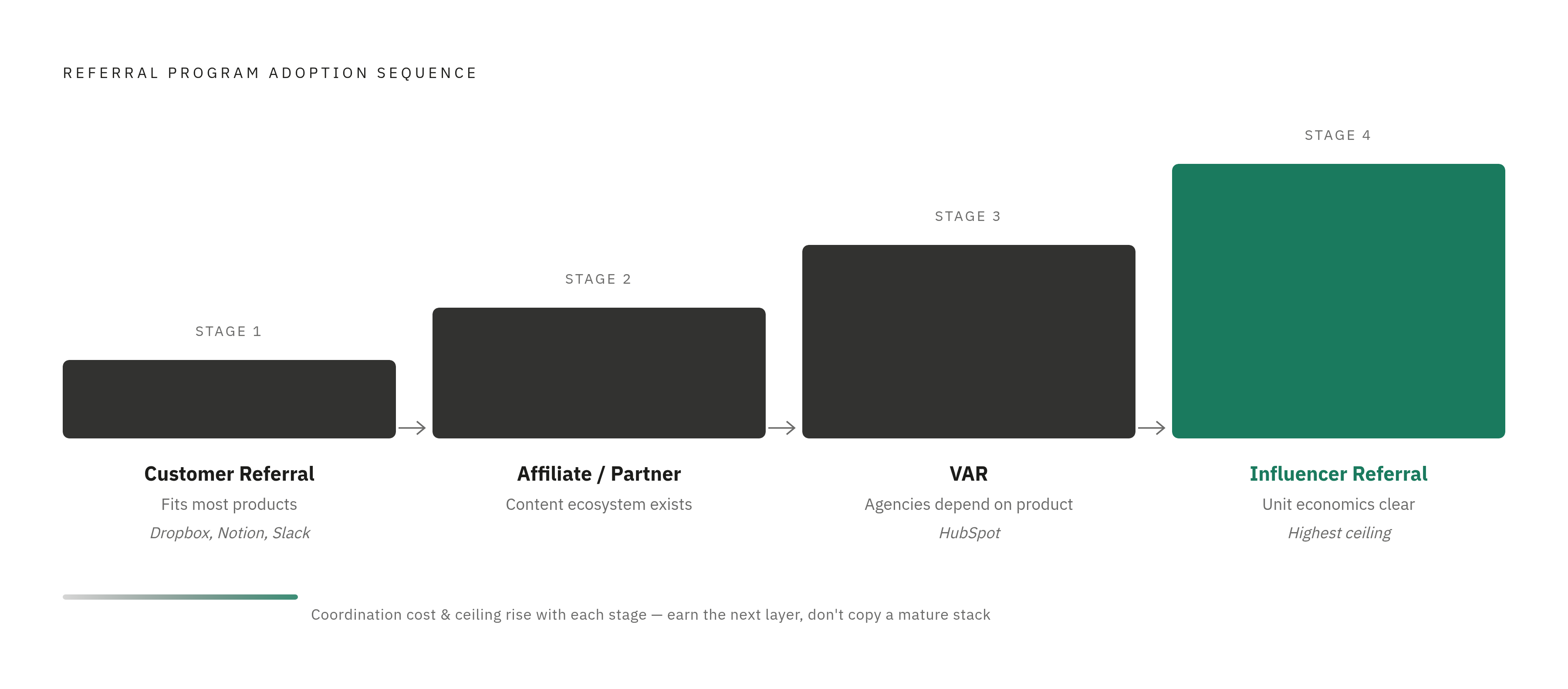
Before you copy anyone's mechanics, figure out which type of program you're actually building. There are four distinct models, and they serve very different motions.
Customer referral. Existing users refer peers. Usually one-to-one. This is the most common starting point and fits most stages and product types. Dropbox, Notion, and Slack all built early growth here.
Affiliate or partner referral. External creators, reviewers, or integrators promote your product on a performance basis. This works when a content ecosystem already exists around your category. If people are writing newsletters, recording podcasts, or publishing comparisons about the problem your product solves, this layer is worth exploring.
Value-added reseller (VAR). Agencies and consultants who use your product with their own clients. HubSpot is the canonical example. The referrer's livelihood depends on the product working well.
Influencer referral. High-reach niche creators. Highest ceiling, highest coordination cost. Fits when a recognizable voice already exists in your ICP's professional world.
The staging logic: early-stage companies start with customer referral programs. Partner and influencer layers come later, once unit economics are clear and you know exactly who you're trying to reach. The real decision is which type matches where your customers already live professionally.
What a Structurally Sound Referral Program Looks Like Before Any Example
Three levers determine whether a program compounds or stalls.
Incentive design. What you offer, to whom, and whether the reward actually aligns with how your product is sold. Credits for product-led growth products. Cash or revenue-aligned payouts for higher-ACV deals. The denomination matters as much as the dollar amount.
Trigger timing. When you make the ask. Programs that ask after a genuine customer win see meaningfully higher participation than programs that ask at signup. Asking too early is one of the most common mistakes. It's also one of the most fixable.
Reward mechanics. One-time versus recurring. Flat versus tiered. Single-sided versus dual-sided. Each choice shapes how the referrer behaves over the long run, not just the moment they first share.
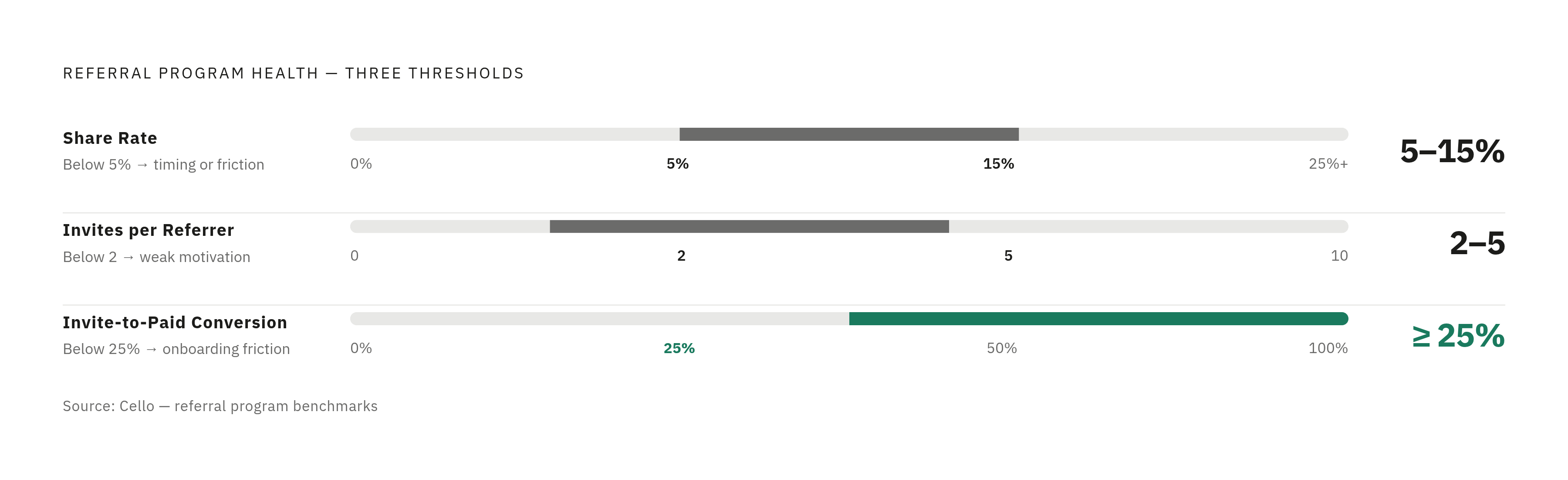
A few benchmarks worth knowing, per Cello: a healthy program sees 5 to 15% of active users sharing, each referrer sending 2 to 5 invites, and 25% or more of invites converting to paid. Useful targets before you start tuning for your own product's motion.
Dual-sided rewards are close to a universal signal of a mature program. They reframe the ask from "go sell your colleagues on us" to "here is something valuable to pass along." Most programs fail because the ask comes too early, lives in the wrong channel, or requires too many steps to act on. The incentive size is usually secondary to all of those problems.
Dropbox: How Dual-Sided Storage Credits Made Every User a Distribution Channel
Dropbox's referral program is the one everyone references, and it earned that status. The core mechanic: both the referrer and the new user received free storage. The reward was denominated in the product's own currency, not cash. Think of it as paying someone in the thing they already love — like tipping a chef with a better knife.
The behavioral design went a level deeper than that. A visual progress bar on the referral dashboard made partial progress visible, which leaned on the psychology of near-completion to drive repeat sharing. You could see exactly how close you were to the next storage tier. That detail was deliberate.
Dropbox grew from roughly a hundred thousand to millions of registered users within fifteen months. Referrals eventually accounted for a substantial share of daily sign-ups.
What actually travels to B2B here: when you denominate the reward in the product's own value (storage, seats, features), the referrer is sharing something they already believe in. The incentive and the product become the same thing. There's no awkward "here's fifty dollars" moment that makes the whole thing feel transactional.
That said, Dropbox's mechanics relied on a consumer-adjacent motion with fast activation. Pure B2B products with longer sales cycles need to modify the trigger and the reward structure. The logic is worth borrowing. The exact template is not.
Gusto: Tiered Cash Rewards That Escalate with Referrer Commitment
Gusto's referral program gets a few things right that most programs get wrong.
First, the definition of a successful referral is precise. The referee must run at least one paid payroll, not just sign up. That activation gate ties the reward to genuine use. If you pay out before someone actually activates, your economics will eventually break. It's just math.
Second, the reward is tiered. Visa gift card amounts escalate with each successful referral, meaning the most active referrers are rewarded disproportionately. Referrers with three or four successful referrals have a financial reason to stay engaged. It turns your best customers into recurring contributors to your pipeline, which is a different relationship than a one-time thank-you.
Third, the program surfaces in two places in the product: the customer dashboard and the Personal details section. High visibility, not interruptive.
Gusto also runs a separate accountant partner channel, paying per qualified partner client added. That's a VAR layer sitting on top of the customer program, and the two coexist without stepping on each other.
What the Gusto design reveals: when the referrer has real professional credibility at stake (an accountant recommending payroll software to their own clients), cash rewards are appropriate. The referrer's reputation is the actual currency in that transaction. The incentive needs to match the stakes of the relationship.
Notion: Small Credits, Asymmetric Split, and Why the Referral Gets More Than the Referrer
Notion's program looks simple on the surface. The referrer earns a smaller credit. The referred user earns a larger credit toward any paid plan. The split is intentional.
The logic is clean: the referred user has the higher activation barrier. They haven't committed to paying yet. So the larger incentive goes to the point where conversion friction is greatest. That's not generosity. It's targeting.
Credit denomination in the product's own plan currency keeps the reward tied to paid conversion rather than something unrelated to actual use. That alignment matters more than the dollar amounts.
This fits Notion's motion well. Wide free tier. Community-driven adoption. Users who share tools as part of how they already work. The referral ask is low-friction because passing along a useful tool is already a natural behavior in the communities Notion serves.
Compare that to Gusto. Same dual-sided structure, completely different denomination and split. That contrast is the point. The mechanic should follow the product's motion, not a template you found somewhere else.
Slack: When the Product Invite and the Referral Are the Same Action
Slack's approach breaks the normal frame entirely, which is why it's worth understanding on its own terms.
There's no separate referral dashboard. No reward to claim. No ask that feels like marketing. Inviting a teammate to Slack is both a product activation event (the tool becomes more useful with more people in it) and a referral. From the user's perspective, those two things are indistinguishable. You're not doing a favor for Slack. You're doing a favor for your teammate.
The referral prompt is embedded in the core workflow. It feels like using the product.
Slack grew to millions of daily active users and a multibillion-dollar valuation with lean marketing spend. The referral loop did a lot of the work.
The design principle: for collaboration, communication, or any tool where value scales with the number of users, the product architecture itself can be the referral program. Adding a cash incentive on top of that can actually feel incongruous. It introduces a transactional frame where the product's social proof was already doing the job. Slack's growth loop was like a snowball rolling downhill — the more people joined, the more the momentum built on its own.
The limitation: this only works when the product has a genuine network effect. Trying to replicate it for a solo-use tool is a category error, and it shows.
Expensify: What a Structurally Weak Program Looks Like and Why It Matters
Expensify's program has a referral link with the referrer's name embedded (a real trust signal) and a detailed FAQ. The surface-level execution is competent. The structure underneath has problems worth naming.
Single-sided reward. Only the referrer benefits, not the referee. That removes a key conversion lever for the new user. There's no incentive pulling the referred person toward activation.
Channel restriction. The program is accessible only through email and the mobile app, not the browser platform where most expense reporting work actually happens. That's friction at exactly the wrong moment.
One-time payout without an activation gate. A reward paid before the referee converts to paid distorts your LTV-to-CAC ratio. If the referred user churns, the economics don't hold. You've paid for a customer who didn't stay.
The Expensify case is useful not because the program is a disaster. It's useful because it shows that referral program design is primarily about aligning the reward structure with the moments that actually predict long-term customer value. Generosity alone is secondary to that. Any program that can't answer "what behavior are we actually rewarding?" will eventually produce referrals that don't convert or don't retain. Sometimes both.
Folk CRM and the Uncapped Recurring Model for High-Churn Risk Categories
Folk CRM's referral program runs on a different model. Referrers earn ongoing payouts tied to referred customers remaining active, with a minimum commitment period of twelve months. The reward is tied to retention over time, not a one-time handoff.
The alignment this creates is worth paying attention to. The referrer has a financial reason to make sure the person they referred actually succeeds with the product. Referral quality self-selects upward. You're not just getting introductions. You're getting introductions from people who are motivated to make those introductions work out.
The uncapped structure means the program's best performers are never disincentivized to keep referring. There's no ceiling that signals "okay, you've done enough."
Compare that to a one-time model. A referrer who receives a single payment has no skin in the game after the check clears. A referrer on a recurring model is effectively a long-term partner in the outcome.
The trade-off is real, though. Recurring models are more complex to administer. The referrer needs to trust that payouts will continue month after month. Program credibility and clear terms matter more here than in any other structure. If you go this route, your documentation and payout reliability become part of the product experience. Mess that up and you lose both the referrer and the referred customer.
HubSpot and the VAR Layer: When the Referrer's Business Depends on the Product
HubSpot's Solutions Partner Program is a different animal. Agencies receive training, co-marketing resources, and dedicated support. The program is an ecosystem, not just a commission structure.
The referrer profile is different here. Agencies recommending HubSpot to clients aren't doing it primarily for the cash. They're doing it because the product is central to the service they sell. HubSpot's success is their success. Those two things are genuinely linked.
This changes the incentive design logic entirely. Money matters less than enablement, co-selling support, and the credibility that comes with official partner status. If you're a marketing agency and you can say you're a certified HubSpot partner, that credential has value to your own clients. The program pays in reputation as much as it pays in dollars.
This model applies to any B2B SaaS where agencies, consultants, or integrators routinely implement or extend the product for their own clients. Those practitioners are already a sales channel. The VAR program just formalizes what's already happening.
What separates VAR programs that scale from ones that stall: whether the company treats partners as distribution or as genuine co-creators of customer value. The ones that treat partners as a cheap sales force get treated accordingly.
The Structural Patterns Across All Working Programs
Across these examples, five patterns repeat consistently.
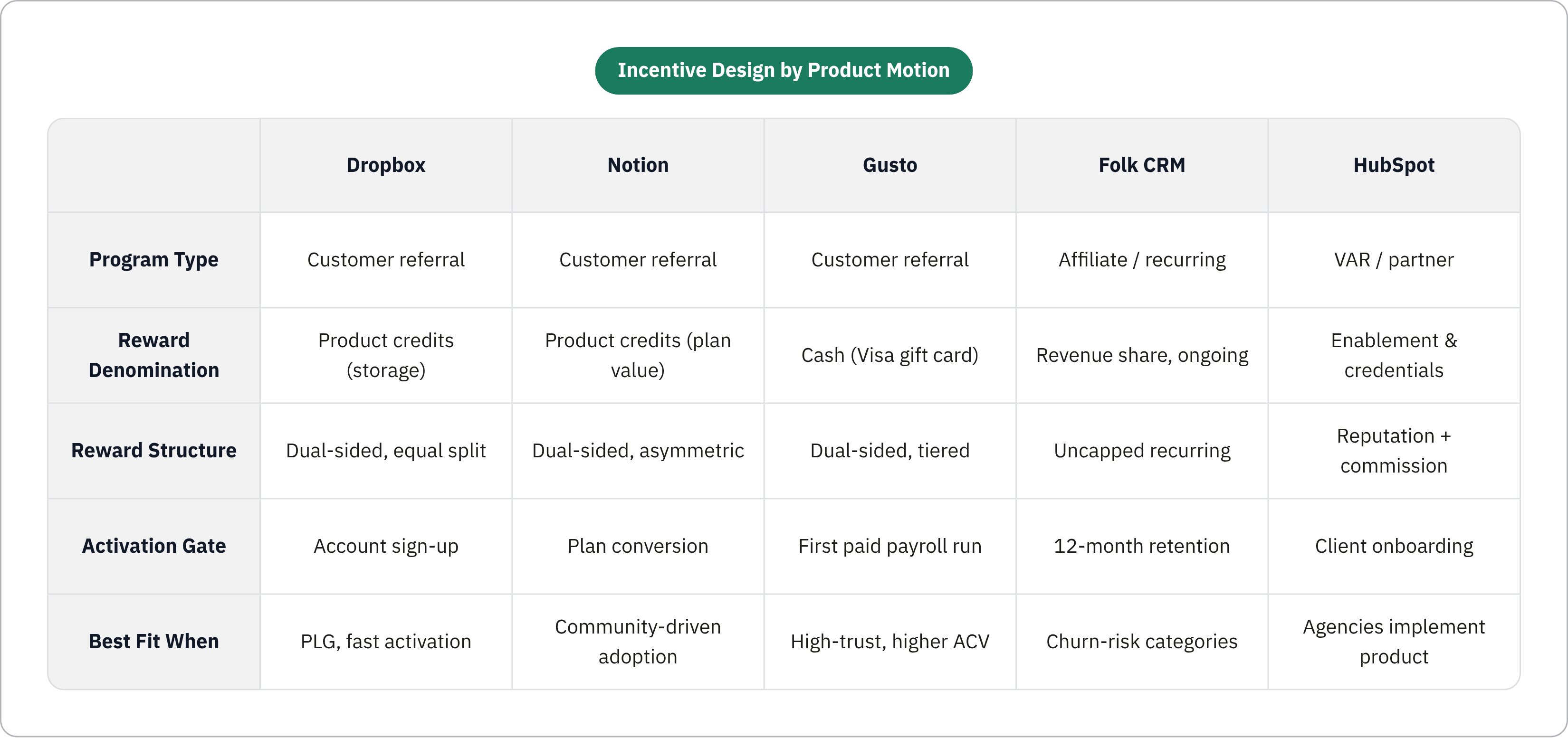
Incentive denomination follows product motion. Credits for product-led growth products (Dropbox, Notion). Cash for high-trust or high-ACV products (Gusto). Revenue share for ongoing relationships (Folk CRM). Enablement and credentialing for VAR partners (HubSpot). What you offer signals what you think the relationship is worth.
The best trigger is a customer win, not a calendar. Programs that ask after activation, a milestone, or a positive NPS moment outperform programs that ask at signup or on a fixed schedule. You're asking someone to stake their reputation on your product. Wait until they've actually won something with it.
Dual-sided rewards are close to table stakes. The programs with structural weaknesses share single-sided design as a common flaw. The ones that compound almost universally reward both parties. Consistent enough that a single-sided program should be the exception, not the default.
Reward the behavior that predicts retention, not just acquisition. Gusto's activation gate (one paid payroll run). Folk CRM's twelve-month minimum. The reward structure should encode what a good customer actually looks like. If you pay out on signup, you're optimizing for signups. You'll get exactly that, and probably not much else.
The referral ask should feel native to the product experience. Slack's teammate invite. Notion's tool-sharing culture. Friction in the referral flow is a direct tax on participation. Every extra step loses a percentage of the people who were ready to share.
One sizing anchor worth keeping: per Impact.com, an average SaaS referral incentive represents 15 to 25% of the first month or first year subscription value. Reasonable starting range before you adjust for your product motion and referrer type.
What to Build Before Launching a Program and What to Measure After
Most companies want to skip straight to the launch. Don't skip to the launch.
Four things you need before the program goes live:
- A clear ICP. Referral programs amplify whatever customer profile you already have. If that profile is fuzzy, the program generates noise, not pipeline.
- An activation moment you can actually instrument. You need to know when a customer has genuinely succeeded with your product before you can trigger the ask at the right time.
- A defined reward that fits your product motion. Use the incentive-denomination pattern above, not whatever your favorite competitor is doing.
- A mechanism for tracking attribution. Manual tracking caps scale. The automation gap in B2B referral programs is real and shows up directly in outcomes.
Metrics that tell you whether the program is working:
- Share rate among active users. Healthy range is 5 to 15% per Cello. Below that points to a timing or friction problem. Above it means you have an engaged base worth accelerating.
- Invites per referrer. Two to five is normal. Below two suggests the incentive or ask isn't compelling enough. Consistently above five from a subset of referrers suggests those people belong in a partner-tier structure, not a standard customer referral flow.
- Invite-to-paid conversion rate. Aim for 25% or better. Below that, look at the friction in the onboarding experience the referred user encounters, not just the referral mechanics themselves.
- Referral CAC versus paid CAC. This is the number that justifies the program to leadership. If your referral CAC isn't meaningfully lower, the activation gate is probably wrong.
- Churn rate by acquisition source. Referred customers should churn less. If they're not, the program is attracting the wrong referrers or the wrong referrals. Usually both.
The program isn't the end state. It's the structure you build so the right customers can pull others in. Once that structure is solid, you stop chasing referrals and start receiving them.