Employee Advocacy Platforms vs Customer Advocacy Programs
Employee advocacy builds awareness early; customer advocacy closes deals with peer trust.

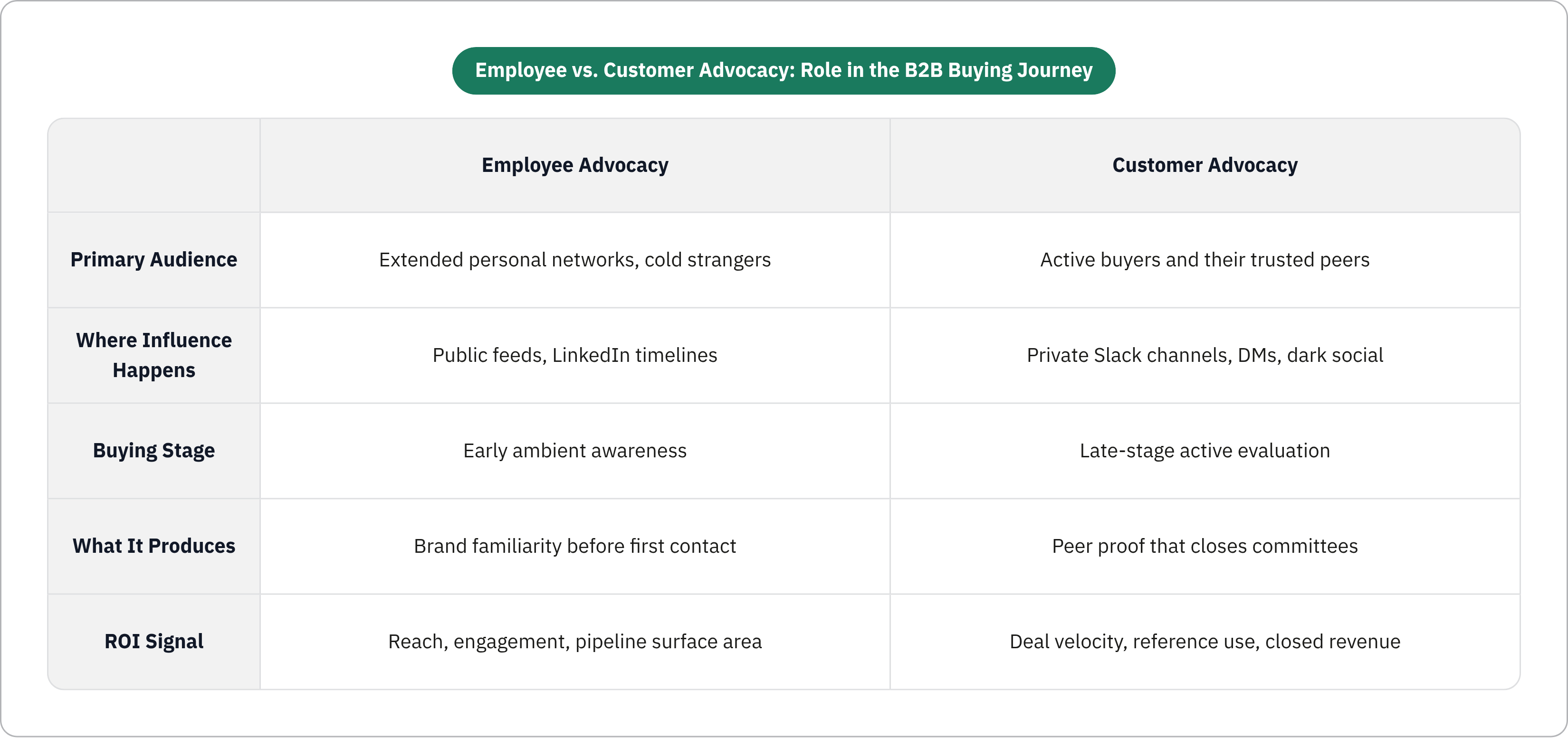
Employee advocacy reaches strangers. Specifically, the extended personal networks of your workforce. LinkedIn connections, niche community followers, people who have never heard of your company but follow someone who works there. This is top-of-funnel territory. The value is visibility at first encounter, and the credibility bump that comes from a real person sharing something instead of a brand account.
Think of it like a warm introduction at a party versus a cold call. Same message. Completely different reception.
Research from the DSMN8 Benchmark Study 2025 (n=252) backs this up. Nearly three-quarters of program managers named increasing leadership involvement as a top priority, because executive voices on LinkedIn carry outsized reach. That tracks with what you'd observe just by watching your own feed. A post from a VP of Engineering reads differently than the same post from a company page. Same words, different signal.
Customer advocacy reaches a completely different group. It reaches the people your buyers already trust. Peers in the same industry. People in the same role who have already solved the same problem your buyer is wrestling with. This influence doesn't happen in public feeds. It happens in private Slack channels, LinkedIn DMs, WhatsApp groups, closed communities. The industry shorthand for this is "dark social," and it's where a lot of actual B2B buying decisions get made, often before a vendor even knows the evaluation is happening.
Here's the distinction that most teams underestimate. Employee advocacy can get your name into someone's feed. Customer advocacy gets your name into the conversation a buyer is having with their trusted peers before they ever fill out a form or talk to a rep. In B2B, where purchases are committee-driven, high-stakes, and slow-moving, peer-to-peer trust carries more late-stage weight than anything a brand-amplified employee can post. These are just different animals serving different purposes, and treating them as interchangeable is where the money quietly disappears.
Where Each Lever Fits Across the B2B Buying Journey
There's good data on this now. Per 6sense's 2025 B2B Buyer Experience Report, the first direct contact between a vendor and a buyer happens roughly 61% of the way through the buying journey. Most of the evaluation is already done before a rep enters the picture. Both levers compete for influence during that pre-contact window. They just show up at different points within it.
Employee advocacy belongs in the early, ambient awareness phase. A potential buyer scrolls LinkedIn. They see a thoughtful post from someone at your company. They mentally file your brand as relevant to a problem they're vaguely thinking about. Sustained over time, this builds a "familiar before first contact" effect. It makes outbound work better. It makes inbound stickier. What it doesn't do well is influence an active evaluation. A buyer who's comparing three vendors on a shortlist isn't swayed by employee LinkedIn posts. They're asking for proof.
Customer advocacy is the proof. Reference calls, case studies, peer reviews, verified testimonials. These are what a skeptical buying committee asks for when they're close to a decision. When you look at what sales reps actually request from advocacy managers, customer stories, case studies, and similar-company lists dominate the list. Every time, without fail.
The combination isn't complicated. Employee advocacy builds your pipeline surface area. Customer advocacy closes what enters it. Using one as a substitute for the other is leaving money on the table in the most literal sense.
What the Employee Advocacy Platform Market Looks Like in Practice
The market is real and growing. It's projected to cross a billion-dollar threshold in 2025 (Archive Market Research), largely because organizations are formalizing what used to be completely ad hoc. Someone on the marketing team would occasionally ask their CEO to share a post. That's not a program. That's a favor with variable results.
Some numbers from the DSMN8 Benchmark Study 2025 that actually changed how I think about this category:
- 61% of program leaders rated employee advocacy "extremely important" or "very important" to their organization.
- 26% of organizations are still managing programs manually, meaning a meaningful chunk of the market hasn't gotten to software yet.
- 74% of programs provide text posts and articles; 68% use video; images and graphics are the most popular format overall.
- 43% of employee advocates reported significant career impact from posting on social media. Another 38% reported moderate impact.
- 34% of respondents said the biggest program impact was increased employee engagement, not marketing reach or leads.
That last one catches people off guard. If you're trying to get budget for an employee advocacy platform and you're only making the marketing case, you're leaving half the argument on the table. Internal employee engagement is a real ROI story, especially in organizations where HR and people teams have actual budget and real influence over technology decisions.
On the platform side, a few names that come up consistently:
- DSMN8 is built for large organizations and leans heavily on automation.
- Sociabble combines advocacy with internal comms and social intranet features, which is useful if you want one tool for both functions.
- EveryoneSocial focuses on social selling and employee activation.
- BeAmbassador leans into AI-driven content generation and advanced analytics.
AI is becoming table stakes at the leading edge. Intelligent content recommendations, automated impact analytics, CRM connectivity. If a platform doesn't have a credible AI story right now, that's a signal worth paying attention to.
One thing that doesn't get talked about enough: employee advocacy platforms are purpose-built for adoption across a non-marketing workforce. That's a meaningfully different design problem than a social media management tool with advocacy features bolted on. The gamification, mobile apps, content segmentation by role, internal comms integration. Those exist specifically because getting a distributed, non-marketing team to actually share content consistently is genuinely hard. Most bolt-ons make the problem look solved while the adoption numbers quietly stay flat.
What a Mature Customer Advocacy Program Actually Produces for Sales
The outputs that move deals are specific. Case studies. Verified testimonials. Reference calls. Peer reviews. Co-created content. Each serves a different deal stage and a different member of the buying committee, and that granularity matters more than most programs acknowledge.
A CFO wants ROI data. A practitioner wants to know the thing actually works in their environment. A security or compliance stakeholder wants to know it won't blow up their stack. One case study format doesn't serve all three. Assuming otherwise is how you end up with a library full of content that technically exists and practically never gets used by anyone.
The format landscape is also shifting. Customer advocacy is moving beyond static PDFs toward video customer stories, co-created webinars, product co-innovation, and interactive proof experiences where prospects can filter customer results by their own criteria. Industry, company size, use case, competitor they're replacing. That filtering capability is the difference between proof that feels relevant and proof that feels like it was written for someone else's problem.
Trust calibration is something that comes up in practice more than most articles cover. Named case studies carry the highest credibility. But in industries like cybersecurity or financial services, where customers genuinely don't want to be publicly associated with a vendor relationship, "blind-but-verified" testimonials are a legitimate alternative. The customer identity is protected, the claim is independently verified. Not as powerful as a named reference. Much better than nothing.
The sales rep behavior problem is real and mostly ignored. When proof isn't easy to find inside the tools reps already use, they do one of two things. They grab the one case study they remember seeing. Or they Slack the advocacy manager and wait. Both are symptoms of a systems problem, not a content problem. There are probably thirty great case studies sitting in a folder somewhere that reps never find because the folder isn't connected to Salesforce or Seismic or wherever reps actually live during a deal.
The platforms addressing this share a common architectural logic: ingest evidence, verify it, and surface it inside Salesforce, Highspot, Seismic, and Slack with filters for industry, role, use case, and competitor. UserEvidence, Influitive, ReferenceEdge (by Point of Reference), and Peerbound all converge on this model. Verbatim fits this category too, purpose-built for B2B sales teams who need customer conversations turned into structured, deployable proof assets quickly. The emphasis there is on the production side. Capturing the conversation, structuring it into something a rep can actually use in a deal, and getting it into the right hands fast enough to matter.
ROI measurement is the current pressure point across all of these. "We ran a lot of case studies" isn't a number. "This content appeared in a significant share of closed-won deals last quarter" is. Programs that can't make that second kind of argument are facing scrutiny right now, and probably should be.
Why Most Customer Advocacy Programs Stay Reactive and What Systematic Looks Like Instead
Here's the default state most teams are in. A buyer asks for a reference. The rep Slacks the advocacy manager. The advocacy manager searches a spreadsheet. The deal waits. This is reactive advocacy. It is the norm in most organizations, and it is not a platform problem. It is a process problem.
The underlying cause is that proof collection gets treated as a one-time project tied to a campaign or a product launch, not an ongoing operational function with ownership, triggers, and infrastructure. You do a batch of case studies before a big conference. The conference happens. Then nothing gets added for six months, at which point you start over, and you're back where you started.
A systematic approach has four components. None of them are complicated, but all four need to be running at the same time or the whole thing doesn't hold:
Collection triggers. Structured outreach to customers at defined milestones. Onboarding completion. First renewal. Expansion. The goal is to capture evidence when positive outcomes are freshest, not six months later when the customer has moved on and the win has faded into the background noise of their job.
Verification and rights management. Tracking who approved what, usage rights by channel, and renewal dates. Unglamorous work. Also what prevents a legal situation when someone uses a customer quote in an ad without realizing the approval only covered written materials. Case studies older than two to three years start feeling stale, especially as AI is reshaping workflows across every industry. Keeping the library current is an active job, not a one-time cleanup.
Structured production. A repeatable format that extracts the elements sales actually deploys. The specific pain. The measurable outcome. The comparable customer context. The customer as the hero of the story, the product as the tool they used. This sounds obvious. Most case studies don't do it. They read like a company congratulating itself, which is not a formula for winning over a skeptical buying committee.
Activated distribution. Evidence surfaced inside sales workflows, not in a separate portal that reps have to remember to log into. With filters that match the right proof to the right deal context in real time.
Vertical specificity compounds this system's value over time. An industry-specific case study collection outperforms a generic one because it removes the "but are you actually relevant to my situation" objection that stalls late-stage deals. Every new story added to the library makes it more comprehensive, more current, and more likely to match the exact context a rep needs in the next deal. That compounding is real. It's why systematic beats reactive every time, given enough runway to let it work.
How the Two Models Are Converging and Where the Boundaries Are Blurring
Some platforms are beginning to support both employee and customer engagement within a single system. The logic makes sense. Employees sharing customer stories creates a feedback loop between internal culture and external proof that generic brand content never produces. When an employee shares a customer case study or co-created webinar on LinkedIn, that's meaningfully different from sharing a standard brand post. The specificity of customer evidence makes it more credible and more relevant to a peer who is actively evaluating a purchase.
Community is emerging as a middle ground. Exclusive customer events, peer networking programs, digital community hubs, co-innovation programs. These sit somewhere between employee advocacy and customer advocacy in character. Neither purely internal nor purely external, but drawing on the mechanics of both.
AI is accelerating integration across both models. The most advanced platforms are connecting advocacy data to CRM and sales tools in ways that create real-time demand signals flowing between employee amplification and customer proof. That's genuinely new, and it's moving faster than most advocacy program owners are ready for.
But the distinction holds regardless of how the platforms converge. Employee advocacy is primarily an awareness and culture play. Its ROI shows in reach, engagement, and pipeline surface area. Customer advocacy is primarily a conversion and trust play. Its ROI shows in deal velocity, reference utilization, and closed revenue. No amount of platform convergence changes the fact that a buying committee asking for references needs customer proof. Employee LinkedIn posts don't answer that question. You can't close a deal on vibes, and a LinkedIn post, however genuine, is not a reference call.
How to Decide Which Lever to Invest in First Given Your Current Stage and Pipeline Reality
The diagnostic question isn't "which is better." The question is: where is the friction in your current pipeline?
If deals are stalling at the evaluation stage despite qualified pipeline coming in, the constraint is customer proof. More employee LinkedIn posts won't fix that. They'll just add more people to the top of a funnel that leaks at the bottom.
If top-of-funnel awareness is thin and outbound is essentially the only engine, employee advocacy addresses a real gap. But it won't fix a proof problem. It just changes where the problem surfaces.
A rough starting point based on stage:
- Early-stage. Customer advocacy infrastructure first. The first ten to twenty customer stories are the highest-leverage content investment available. A systematic case study program at this stage compounds directly into pipeline. You need proof before you need reach.
- Growth stage with qualified pipeline. Optimize customer proof deployment. Shift from reactive reference management to activated evidence inside sales workflows. The library probably exists in some form already. The problem is accessibility and structure, not volume.
- Scaling stage with established pipeline. Layer employee advocacy on top. The workforce is now large enough to generate meaningful reach. The brand has enough substance worth amplifying.
Resource constraints are real. Both programs require operational ownership. Customer advocacy needs someone who can source stories, manage approvals, and keep the library current. Employee advocacy needs someone who can curate content, drive adoption, and report on impact. Spreading thin across both without dedicated ownership produces two underperforming programs instead of one strong one. That's a budget argument worth making internally before you commit to either path.
The measurement asymmetry matters too. Customer advocacy ROI is closer to the revenue line. Case studies used in closed-won deals. Reference calls that preceded signature. Testimonials cited in proposals. Employee advocacy ROI is real but more diffuse. Reach, engagement, pipeline influence over time. For teams accountable to near-term pipeline numbers, that asymmetry should influence where you start.
For B2B sales teams that have happy customers but no system to turn those conversations into deployable proof, the gap between "our customers would say great things about us" and "we have structured case studies in the hands of every rep" is exactly the problem worth solving first. It's more expensive than it looks, and it's almost always the one that moves the needle fastest.