platforms that extract verbatim quotes from customer interviews and call recordings for case study production
AI platforms can extract clean, attributed quotes from customer conversations at scale.
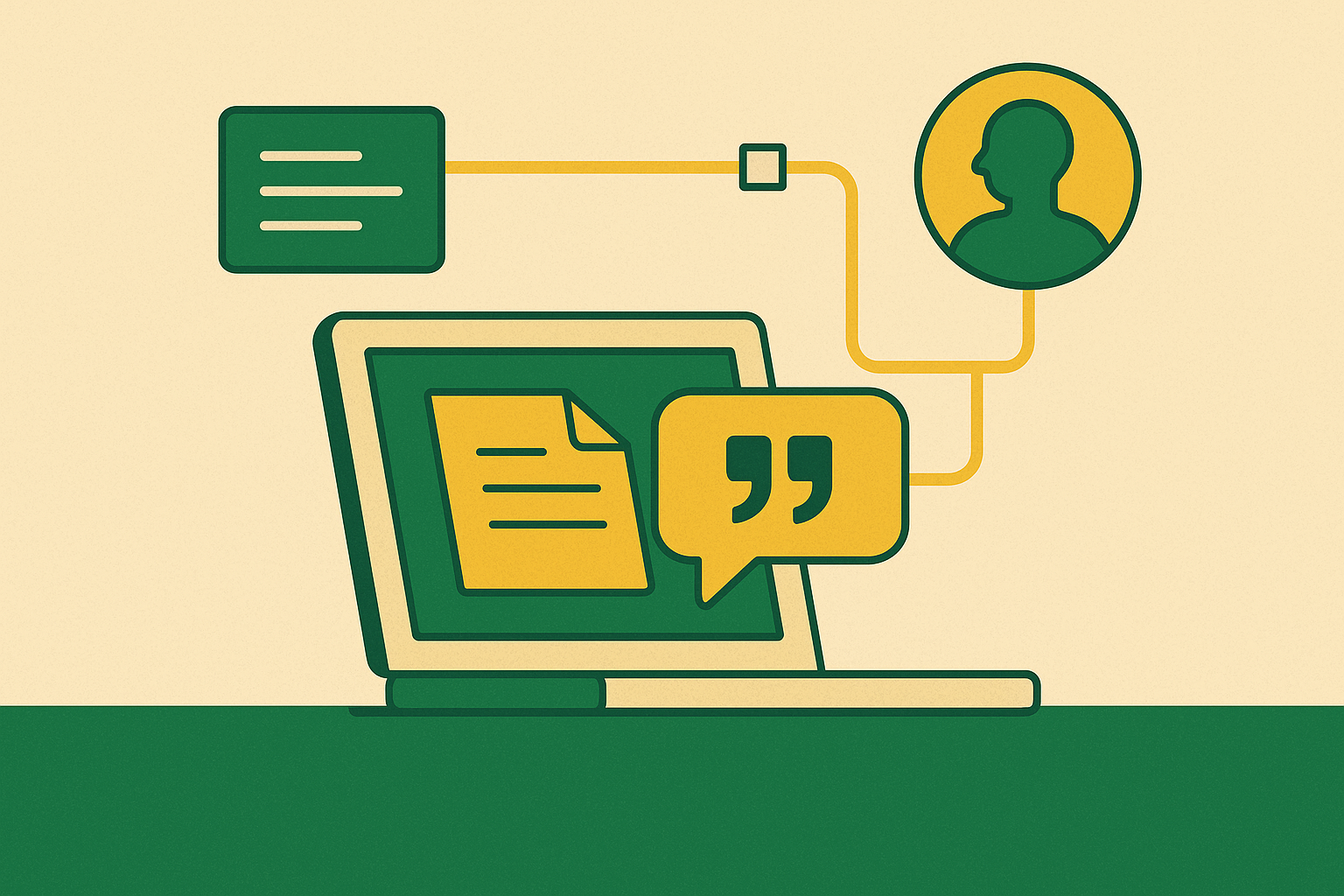
A great customer call dies a slow death between the recording and the final case study draft. The quotes fade, the metrics get fuzzy, and by the time someone sits down to write, all that's left is a vague memory of a customer who seemed happy back in May. That's a capture problem, not a writing problem, and fixing it means picking the right tool for where your evidence already lives, not the tool with the flashiest demo.
Conversation intelligence platforms: Gong, Chorus, and Claap for sales call evidence
Sales teams sit on a pile of usable evidence already. It's in every discovery call, every renewal conversation, every check-in that got recorded and transcribed without anyone asking for it. Whether that evidence exists was never the question. Whether anyone besides a sales coach can find it again later is another matter entirely, and most teams can't.
Gong is the heavyweight here, and the numbers back that up. It was named a Leader in the first-ever Gartner Magic Quadrant for Revenue Action Orchestration in 2025, runs on more than three billion customer interactions, and holds a 4.7 out of 5 across 5,821 G2 reviews. That kind of consistency at that sample size doesn't happen by accident. Gong now bundles in 15-plus AI agents at no extra cost, covering call reviews, account briefings, deal reviews, data extraction, and rep training. Pricing for 2025 runs about $250 per user per month for the Core, Engage, and Forecast bundle, plus a platform fee of $5,000 to $50,000 a year depending on company size. A 50-person team should budget somewhere around $150,000 to $180,000 a year, all in.
Here's the catch nobody puts in the sales deck: Gong is built and priced as a revenue platform, not a case study tool, and treating it like one is a mistake. Its data extraction agents can point at a defined call library, which matters once volume outgrows what a human can skim. But pulling a clean, attributed quote out of that library still takes a workflow somebody has to build by hand. UserEvidence integrates directly with Gong call recordings, which gives teams already paying for Gong a way to route that evidence into an actual proof library instead of letting it rot in the CRM.
Chorus by ZoomInfo takes a different angle. It records and transcribes across phone, video, and email, and plugs into the ZoomInfo data platform and CRM so call evidence stays attached to deal and account context. There's a mobile app for reps who'd rather listen on a commute, and it surfaces recurring voice-of-customer patterns across conversations. For case study producers, the advantage is knowing exactly which calls belong to which named customer without digging through a CRM first.
Claap runs leaner. It records, transcribes, and summarizes meetings on its own, flagging action items, objections, deal risks, and competitive mentions as they happen. Its Smart Tables feature analyzes a batch of calls at once, so a team can see how reps across 50 discovery calls handled a pricing objection in about two clicks. Claap markets itself as the "Gong-like" option without the three-month rollout or the platform fees, and that cross-call view is what separates a quote that's actually representative from one that's just memorable.
None of these three were built to produce a case study. They're revenue tools first, and good ones at that. Turning what they capture into something a writer can use still takes a deliberate extraction step on top, and services like Verbatim, a managed case study and testimonial service for B2B SaaS companies, are built around doing that step rather than leaving it to the sales team. Skipping it is exactly how good quotes end up buried for good.
AI-moderated interview platforms: Perspective AI, Conveo, Outset, Listen Labs, and Koji for purpose-built customer conversations
Human interviews get specific, quotable answers. They also don't scale past a handful of calls a week. Surveys scale fine, but nobody's ever quoted a numeric rating scale in a case study, and nobody ever will. AI-moderated interview platforms exist to break that tradeoff: adaptive follow-up questions asked at a volume no single researcher could match on their own.
Perspective AI runs interviewer agents that hold open-ended conversations with large numbers of customers at once, and the agents push back when an answer comes back vague, the same instinct a good human interviewer relies on. Its automated summary and quote extraction features turn raw transcripts into shareable material without anyone doing a manual coding pass. It's built for people without a research background, so a customer success manager or a founder can launch a study without a research ops team behind them. That pushing is what actually matters for case studies: a customer who says "it saved us time" gets asked how much time, in what process, compared to what baseline, until the answer turns into something a writer can cite instead of a nice sentiment nobody can verify. Perspective AI recently raised funding to expand its platform capabilities.
Every quote produced this way ties back to a verbatim transcript. It's a checkable moment in a real conversation, not text someone typed into a doc from memory weeks later. AI-assisted analysis then surfaces the most representative or distinctive quotes across hundreds of transcripts without anyone reading every line start to finish. Automatic transcription and cross-transcript surfacing clear the attribution and traceability bar any serious case study process needs.
Outset and Listen Labs both run live conversations, voice or text, at scale, following up in real time and flagging low-quality or fake responses on their own. These fit best where the case study pipeline needs ongoing, repeatable customer conversations, not a one-off interview whenever someone remembers to schedule one.
Koji sends an AI-moderated voice or text interview to a customer, who completes it whenever works for them. The AI probes for the specific, quotable detail that actually makes a proof point land. Voice mode gives customers a natural way to share specifics that might not come through in a typed response. Every interview gets transcribed, analyzed, and stored in one searchable place, so a year of reference conversations turns into an actual library instead of a graveyard of forgotten recordings. One conversation can feed a testimonial, a case study, a sales deck slide, and a social proof snippet, all from the same source material. What sets this whole category apart from conversation intelligence tools is simple: the interview is designed from the start to produce a usable quote. Extraction isn't bolted on after the fact here, it's the entire point of the call.
Transcription and analysis tools: Otter.ai, Sonix, BuildBetter, and Aha! Discovery for teams working from existing recordings
Some teams aren't running purpose-built interviews. They're sitting on a backlog of recordings and need to make sense of what's already there, fast.
Otter.ai turns speech into searchable text in real time, tags speakers automatically, and timestamps every line so clicking it jumps straight to that moment in the recording. It claims transcription accuracy up to 95%, catches action items on its own, and its "Otter AI Chat" feature lets someone ask questions about a past conversation instead of rereading the whole thing. For case study work, the speaker tagging matters most: the quote arrives already labeled with who said it, not just when they said it.
Sonix is the pick when raw transcript accuracy is the primary concern, and it supports a range of languages that can matter for teams working across different markets.
BuildBetter's bot recorder joins Zoom, Meet, Teams, or Webex on its own, then surfaces themes, jobs-to-be-done, and sentiment across every conversation it's touched, not just one transcript in isolation. The manual version of this work, a product manager re-listening to calls and hand-tagging quotes, can eat 4 to 8 hours for a single batch. That pattern-surfacing across a call library is exactly what tells a team which quotes represent the customer base and which ones are just outliers that happened to sound quotable.
Aha! Discovery is built for teams that want to keep interview recordings and transcripts organized in one place. It integrates with Gong too, which helps teams bridge sales call evidence with a more deliberate research process instead of treating the two as separate universes that never talk to each other.
NVivo Transcription suits researchers running formal, structured coding projects inside qualitative data analysis software. Marvin fits research repository and UX team workflows. Both are more specialist than most case study teams need, built for people with a dedicated research function rather than a sales-enablement motion.
Skip the AI transcription entirely when accuracy on rough audio is non-negotiable. Modern AI transcription lands around 95-98% word accuracy on clear English audio, but heavily accented or noisy recordings still favor a human ear. Human transcription services exist for exactly that gap, and paying a human to get it right beats publishing a misquote that damages a customer relationship that took years to build.
Social proof and customer evidence platforms: UserEvidence and Koji as the library layer
Extraction alone doesn't solve the problem. It just moves the problem somewhere else. A team can have hundreds of great quotes sitting in a folder and still have no way to find the right one when a rep needs CFO-level proof from a company with 1,000-plus employees, right now, for a call in ten minutes.
UserEvidence exists to close that specific gap, and it does it by treating the library itself as the product, not the quotes inside it. It automates social proof for go-to-market teams, generating verified case studies, testimonials, and stats, and pulls evidence in through surveys, G2 and TrustRadius imports, and Gong call recording ingestion. Everything lands in a searchable library indexed by industry, company size, role, use case, and competitor, so filtering for that CFO quote takes seconds instead of a Slack message to marketing and a two-day wait for a reply. Customers include Pendo, Workato, Gong, Jasper.ai, and Ramp. In August 2025, UserEvidence acquired Zealot, its first known acquisition, expanding into reference management and advocacy, and raised $7 million on top of that, bringing total funding to $21 million. It launched a G2 integration in June 2025 to auto-ingest reviews as marketing assets, and by early 2026 had shipped AI features including an MCP Server for Claude and a Proof Recommender that scans deal context and pushes relevant proof to reps on its own, part of 18 platform updates in March 2026 alone. That Proof Recommender is the piece that actually closes the loop: proof finds the deal, instead of a rep burning fifteen minutes hunting for proof that already exists somewhere.
Koji plays a similar role from the interview side, storing every reference conversation and surfacing the strongest quotes and recurring themes on its own, so a year of customer interviews turns into a searchable asset instead of a folder nobody opens again.
Here's what actually separates this category from everything above it: the output arrives as a finished piece, not a transcript and a draft somebody still has to shape by hand. It's a structured, filterable library a rep can search under deadline pressure. Traceability, making sure every quote in a case study leads back to a specific call, a specific speaker, a specific date, is what turns that library into something a prospect trusts instead of something they'd fact-check and quietly toss. Services that handle case study production end to end build that traceability in from the first recording through the final draft. That's how the anti-hallucination standard actually gets enforced: not as a policy on a slide, but as a rule baked into every quote before it ships.