approaches to turning kickoff call recordings into case study source material
Capture raw customer truth from kickoff calls before it vanishes into generic case study language.
Kickoff calls are the one moment in the customer relationship where someone describes their problem before anyone's had a chance to spin it. That raw audio is the best case study material a company owns, and almost nobody treats it that way. This piece breaks down how to actually pull it apart and use it, and where most teams get the extraction backwards.
What the right kickoff questions actually produce for a case study writer
A case study needs six things only the customer can hand over: the problem as it existed before the vendor showed up, what they tried before that didn't work, the actual pain (money, time, reputation, pick your poison), how they personally defined a win, who inside the company owned the mess, and the words they used to describe all of it, in their own language rather than the vendor's.
Standard kickoff questions rarely get at this, and here's why: most kickoff questions are logistics questions. "What's your timeline?" "Who's on point?" Fine, necessary, boring. The questions that actually open the vault sound more like "walk me through what was breaking before you made this decision," or "what does success look like in 90 days?" That second one matters because it captures the customer's own definition of success, before onboarding quietly redefines it for them.
Ask "who else in your organization is going to feel the impact of this?" and stakeholder texture comes back, the kind you can later slice into persona-specific versions of the same story. Then ask "what were you most worried about before you signed?" and objection language comes back verbatim, the exact material that becomes testimonial proof for the next prospect sitting on the same fence. Per revnew.com's analysis, the testimonials that convert are the ones that hit the exact worry a prospect has at their exact stage. Manufacturing that language later isn't possible; catching it while it's still fresh enough to be honest is the only way it exists at all.
Here's the coordination gap nobody fixes: CS teams run the kickoff, content teams want the story, and the two rarely compare notes on what questions to ask. A shared question bank, five or six lines, gives CS something to pull from without turning the kickoff into an interrogation. Three well-answered minutes inside an hour-long call can anchor an entire case study's opening. The rest of the hour can stay exactly as boring as it needs to be.
How transcription and tagging tools turn raw recordings into searchable source material
Most kickoff recordings just sit there. Filed, forgotten, never opened again. A call gets recorded, dropped in a folder named something like "Q3 Kickoffs," and then it dies there, unseen, like a gym membership nobody cancels.
Conversation intelligence tools exist specifically to stop that. Some teams hand the whole extraction-to-case-study pipeline to a managed service like Verbatim, which runs customer proof engines for B2B SaaS companies end to end. Gong catches and organizes customer interactions and makes them searchable by rep, account, deal stage, or keyword, with AI flagging key moments and talk tracks automatically. Chorus, now folded into ZoomInfo, runs a similar model, with transformer-based transcription that turns an hour of audio into text in the time it takes to refill a coffee. UserEvidence already pulls highlights straight out of Gong recordings to stock customer evidence libraries, which tells you the integration path between "call got recorded" and "usable proof" already exists. Nobody needs to build that pipe from scratch.
The catch: these tools tag for the wrong job. Action items, risks, next steps, that's CS-flavored tagging, built for account management. Case study extraction needs its own tag set: problem statement, before state, success metric, customer quote, objection voiced. Building that taxonomy inside a tool already being paid for is a one-time job that keeps paying rent on every call afterward.
The bigger unlock is pattern-spotting across calls, not just within one. AI assistants can scan a library of transcripts and surface what keeps coming up, where customers keep stumbling, which objection shows up call after call. That's the difference between mining one recording and mining a whole vein of them. End state: a searchable, tagged library of actual moments, not a graveyard of hour-long MP4s nobody will ever open again.
The extraction pass: moving from tagged transcript to structured case study blocks
Listening to a call for CS purposes and mining it for case study material are two different jobs, done at two different times, by two different parts of a brain. Combine them and both get done badly. This is the part most teams skip, and it's the actual bottleneck.
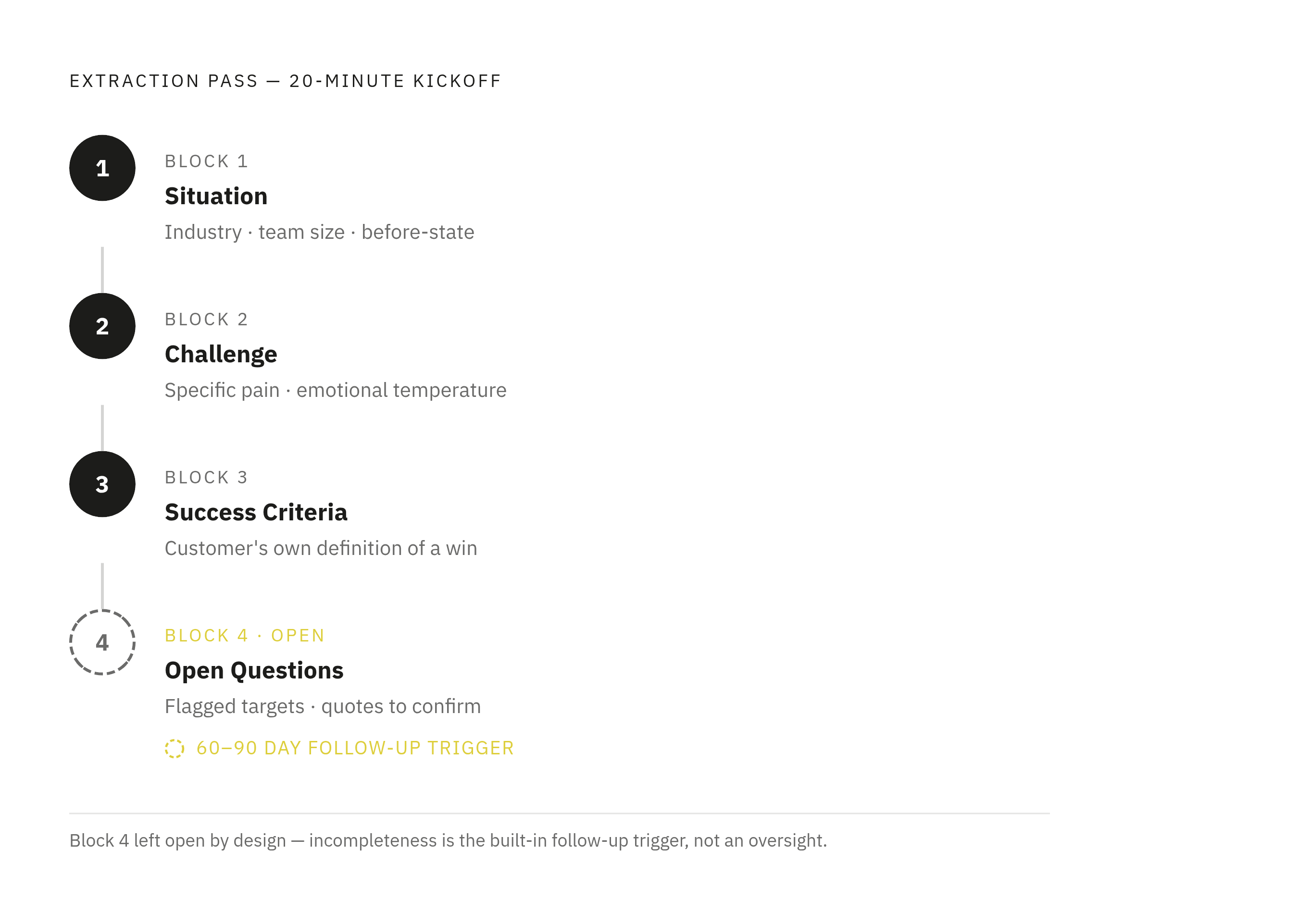
The extraction pass is a dedicated review, and it produces three blocks in order of priority. The situation block covers the customer's context: industry, team size, what things looked like before anyone got involved. The challenge block captures the specific pain, ideally with the emotional temperature still attached, frustration, urgency, cost, whatever it was. The success criteria block records what the customer said would count as a win, in their own words, before anyone coached that definition into something more marketing-friendly.
What the kickoff can't give: the ending. There's no "after" on a kickoff call, because nothing's happened yet. Flag the success criteria as open questions for a follow-up interview 60 to 90 days out. Customers almost never volunteer hard numbers on a kickoff call either, so note what targets they named and treat those as the things a follow-up needs to confirm.
This is the moment where specificity either gets captured or vanishes for good. Most case studies that read as generic didn't fail in the writing. They failed here, upstream, when nobody pinned down the actual number, the actual timeline, the actual quote, before it slipped out of memory.
In practice, a simple four-block template, filled out during a 20-minute review of a tagged transcript, produces a brief a writer can start structuring the same day. Per peerbound.com's guide to customer proof, AI can automate the scraping and indexing of quotes from calls, but deciding which quote earns a place in the final piece still takes a person. The tools find candidates; a human picks the ones with a pulse.
Combining kickoff material with a follow-up interview to complete the story arc
Before-and-after is the format that works, full stop, with few real competitors. The kickoff recording is the earliest, least-rehearsed version of "before" a company will ever get. The follow-up interview supplies "after," and skipping straight to a case study without both halves is why so many read like brochures instead of stories.
Timing matters more than people assume. Wait 60 to 90 days: early enough that the initial results are still fresh, late enough that something real has actually happened. Build the follow-up trigger directly into the kickoff extraction brief, a calendar reminder baked into the workflow, not a hope that someone remembers three months from now.
The follow-up itself stays short, 20 to 30 minutes, because the kickoff extraction already wrote the questions. It only needs to confirm actual outcomes against the success criteria named months earlier, surface anything that surprised the customer during implementation, and lock down the quote candidates flagged in the extraction pass.
There's a timeline bonus buried in here too. A deal closes, a kickoff gets recorded, and 60 to 90 days later a case study is ready to publish, which lines up almost perfectly with when an organic content program starts earning its keep. And per a 2025 Edelman study, 72% of B2B decision-makers identify more strongly with success stories told from the customer's perspective than from the vendor's. The unpolished, unscripted voice from a kickoff recording carries a genuine edge that professional case study writing alone can't fake.
Turning one recording into multiple formats for different sales situations
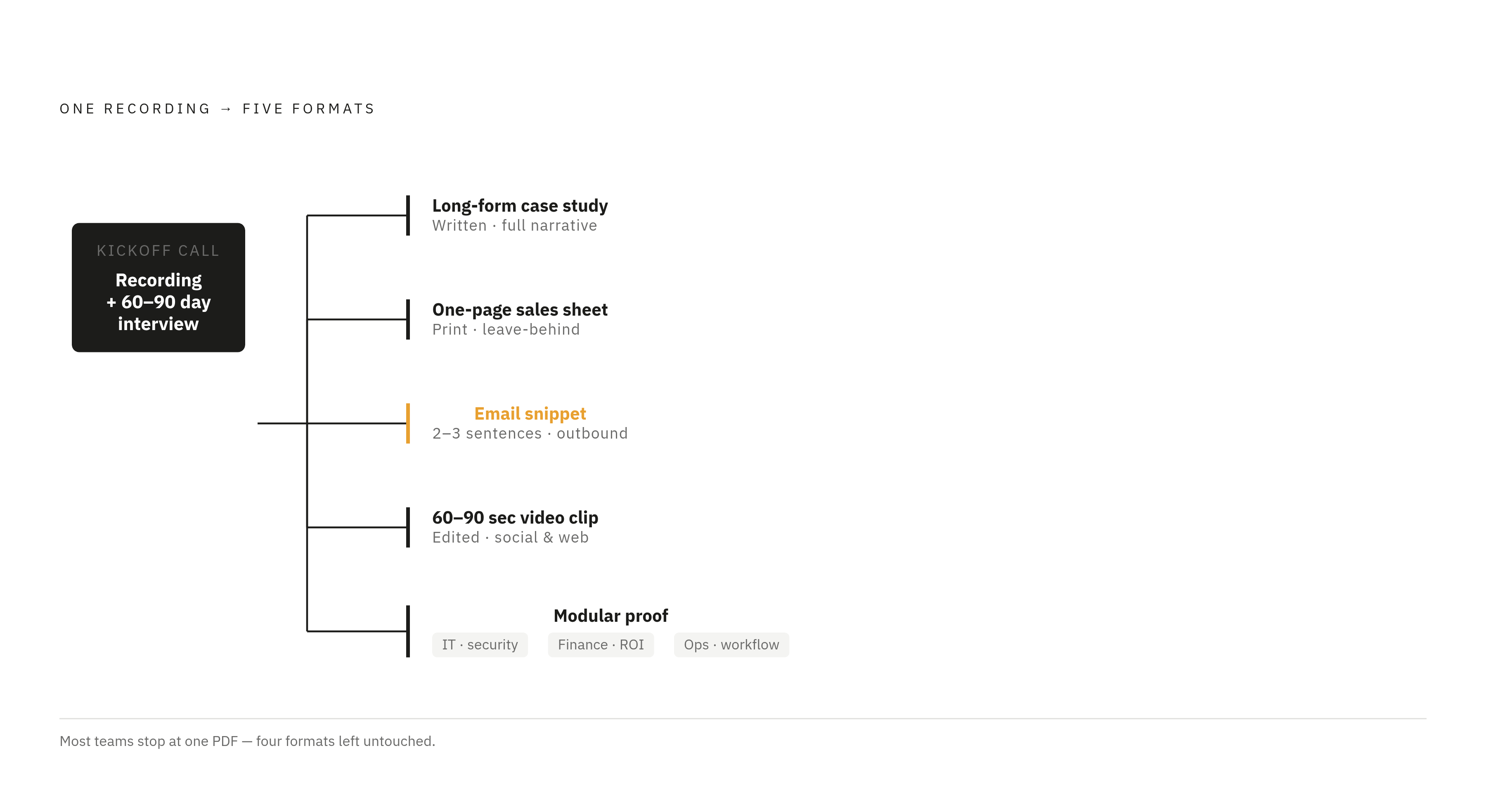
One kickoff recording, paired with a follow-up interview, should never produce just one PDF sitting in a shared drive. Treating it that way leaves most of the value on the table, and it's the single most common waste in this whole process.
The same material can become a long-form written case study for organic search and decision-stage buyers, a one-page sales sheet condensing situation, challenge, solution, and result for reps to attach to a follow-up email, a two-to-three sentence email snippet for outbound sequences, and, if the kickoff was recorded on video, a 60 to 90 second clip of the customer describing their problem in their own words. That clip works precisely because nobody scripted it. The absence of a marketing veneer is exactly why it reads as credible once it becomes marketing, which sounds backwards until you sit with it for a second.
Video also just performs better as a format. Viewers retain something like 95% of a message delivered on video versus roughly 10% through text alone. A kickoff clip, used with permission, often lands harder than a polished testimonial, because the missing production gloss signals authenticity instead of undermining it.
None of this is optional busywork. The typical B2B buying decision runs through stakeholders across different functions, and a single case study document can't speak to all of them at once. The modular pieces pulled from one recording get routed by role instead: the security clip to IT, the ROI paragraph to finance, the workflow quote to ops.
Consent, meanwhile, is less of a barrier than most teams assume. Per the 2025 Evidence Gap report, the trust gap between blind-but-verified testimonials and fully named ones is a lot smaller than people expect, which gives early-stage companies more room to use anonymized or lightly attributed kickoff material without waiting on a legal sign-off marathon.
Building the extraction workflow as a repeatable system, not a one-off project
Most teams run this reactively. Sales needs a reference, someone digs through a spreadsheet that hasn't been updated since March, and the deal sits there waiting. That's a scavenger hunt with a deal size attached.
A working system flips the order. Every kickoff gets recorded as a matter of process, not a favor granted when content asks nicely. Every recording goes through an extraction pass inside a defined window, with clear ownership, CS or content, doesn't matter which, as long as somebody's name is on it. Extracted blocks and quote candidates land in a shared library, tagged by industry, use case, role, and objection addressed. That library then feeds case study production, sales sequences, and persona-specific proof, rather than sitting there as a digital filing cabinet nobody opens.
Conversation intelligence platforms like Gong solve the retrieval problem, but retrieval isn't extraction, and confusing the two is where most of these systems quietly fall apart. Case study work needs a tagging layer built for narrative, tags like "problem statement," "before state," and "customer quote," that turn a searchable transcript into structured blocks a writer can use immediately. Building that tagging taxonomy as part of the extraction workflow itself is what lets teams move from an hour of audio to usable source material without someone re-listening to the whole thing from scratch.
The system needs a few unglamorous pieces to hold together. A recording policy with real consent language baked into scheduling. A shared four-block extraction template, a tagging taxonomy built for case studies rather than borrowed from CS, a 60-to-90-day follow-up trigger attached to every kickoff, and a clear answer to who owns extraction, who owns production, and who owns getting the finished asset into a sales sequence.
Per HubSpot's 2025 State of Marketing Report, companies that publish case studies regularly generate 45% more qualified leads. Regularly is the word doing the work there, and it comes from intake design, not from effort or good intentions. The teams pulling ahead here often lack the sharpest writers on staff. Solving the boring problem first is what set them apart, because good source material, not writing talent, was always the actual bottleneck.