Sales Battle Cards vs Case Studies as Sales Assets
Battle cards handle objections mid-call, while case studies build credibility earlier in the deal.

Sales teams love to dump everything into one folder and call it "content." Decks, one-pagers, battle cards, case studies, all sitting in the same shared drive, waiting for a rep to sort it out mid-call. That's the whole problem in one sentence.
Battle cards and case studies aren't rivals fighting for the same slot in a pitch. They do different jobs, at different moments, for different reasons, and treating them as interchangeable is why so many deals stall out on objections that a better-timed asset would've handled weeks earlier.
Here's why the mix-up happens in the first place: both assets are short. Both get pulled out mid-conversation with a prospect. Both usually come out of the same marketing or enablement team, sometimes even the same Google Doc template. Surface-level, they look like cousins. But the job each one is hired to do couldn't be more different, and that distinction, not the format, is what actually matters. This piece maps out where each asset earns its keep, so your team can build coverage across the whole deal cycle instead of guessing.
What battle cards are actually built to do
A battle card is a cheat sheet for a fight that hasn't started yet. It's built so a rep, mid-call, with a prospect who just said a competitor's name out loud, doesn't freeze or freelance.
Good ones include a few things:
- Talk tracks for positioning against a specific, named competitor
- Objection responses that are scripted enough to be reliable, loose enough to sound human
- Honest competitive framing (where you win, where the other guy wins, how to handle the trade-off question without flinching)
- Language tuned to the buyer in the room, since a technical evaluator and an economic buyer need different words for the same win
The real job here is consistency. A battle card takes what your best, most tenured rep knows in their bones and hands it to the rep who started six weeks ago. It's institutional memory, laminated.
There are two flavors worth knowing apart. The standard battle card is you-versus-one-named-rival, built for the deal where everyone already knows the enemy. The research or comparison format is more neutral, side by side, built for technical buyers who don't want a sales pitch, they want a spec sheet with opinions removed.
And competitors show up more than teams like to admit. Crayon's 2025 State of Competitive Intelligence report found sellers run into a named rival in roughly two out of every three deals. That means a rep without a battle card isn't occasionally caught flat-footed. They're improvising in the majority of their conversations. That's not a rounding error, that's the job.
What case studies are actually built to do
A case study has one function: turn a marketing claim into a verified result. "Our product saves time" is an assertion. "This customer cut onboarding from six weeks to nine days" is a fact with a name attached to it.
The structure is almost always the same shape: what the customer's problem was, what they tried before that didn't work, how the product fixed it, and what happened next in numbers. Cost saved, hours recovered, conversion lift, whatever the metric is that made someone in finance stop squinting. A case study without a number is still just a claim, it's just wearing a customer's name as a disguise.
One interview, done well, can become five different things:
- A long-form written piece for the website and sales decks
- A two- or three-minute video, shot in the customer's own words
- Short snippets for email, social, and slide decks
- A competitive switching story that later feeds a battle card
Video deserves its own mention here because it carries weight the written version can't fake. A written case study is a structured account a buyer reads on their lunch break. A video is a peer talking, with the pauses, the half-laugh, the "honestly, we were skeptical at first" left in. That's not the same trust signal, and everyone in sales knows it, even if they can't explain why.
None of it works, though, if the prospect doesn't see themselves in the story. Industry, company size, use case, role, all of it needs to line up close enough that the reader thinks "wait, that's basically us." Miss that alignment and the best case study in the library just becomes a nice story about someone else.
Where each asset belongs in the deal cycle
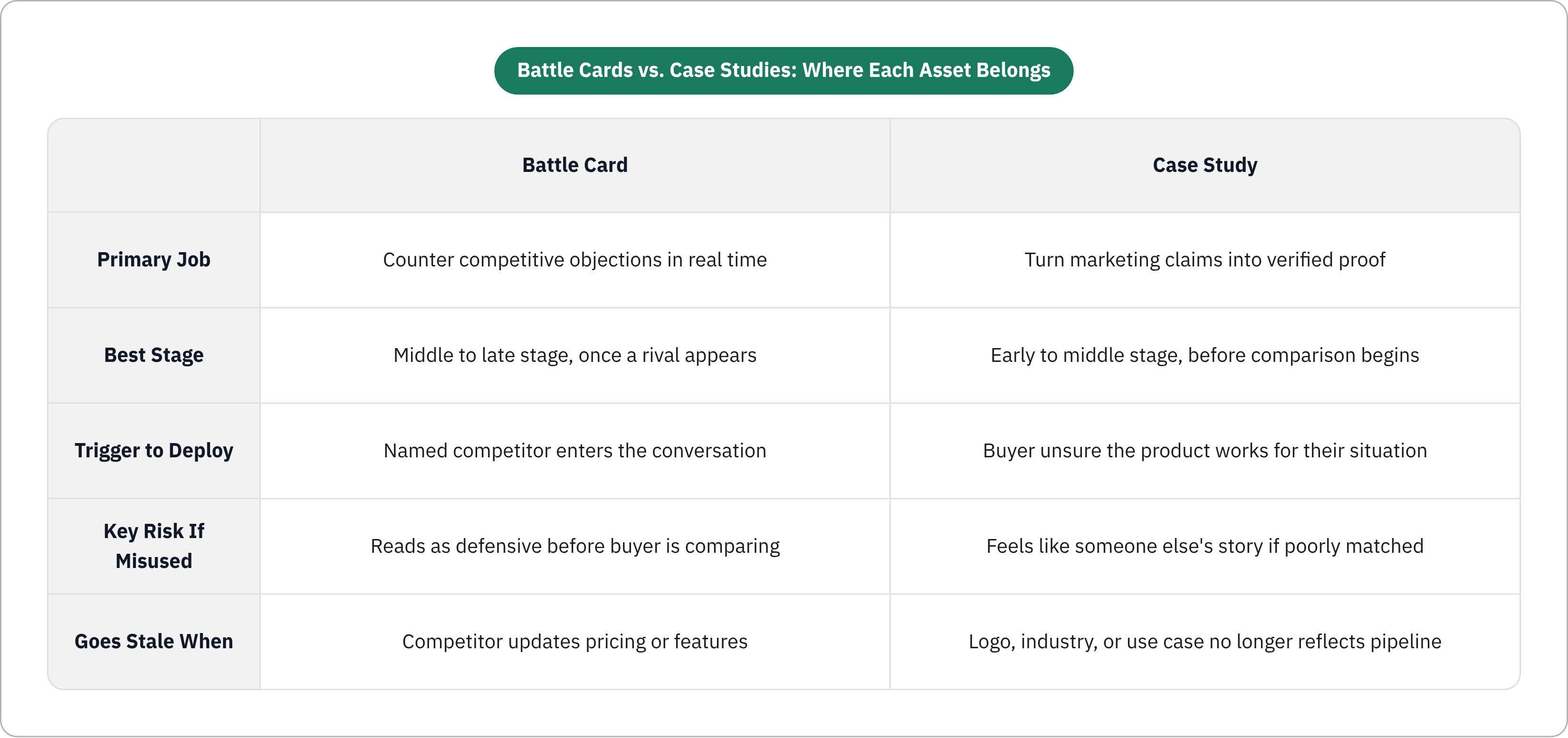
Buyers have a different job to do at each stage of the cycle, and the right asset is whichever one serves that job, not whichever one the rep happens to have open in a browser tab.
Early stage. The buyer's job is figuring out if the problem is even real, and if it's solvable. This is where a short case study clip, matched to their industry, does the heavy lifting. It builds credibility before the rep has earned any. Battle cards, on the other hand, have almost no business showing up here. Nobody's comparing vendors yet, so pulling out competitive positioning this early just reads as defensive, like answering a question nobody asked.
Middle stage. Now the buyer is actively comparing, building consensus internally, trying to lower their own risk of looking foolish six months from now. A full written case study, matched tightly to their use case and persona, becomes something the internal champion can forward to their boss without editing it first. Battle cards start to matter here, but only once a specific competitor enters the room. The trigger should be the competitor showing up, not the rep feeling like it's time to use the card sitting in their pocket.
Late stage. Finalist evaluation, procurement, legal review, the home stretch. This is peak battle card territory: objections get sharper, and the buyer is often fielding pressure from a rival's rep at the same time. Pair it with a short outcome video, aimed at the decision-makers who weren't in the early calls and need something faster than a 20-minute case study to get up to speed. One handles the rational case, the other handles the social risk of being the person who championed the wrong vendor internally.
The most common mistake reps make is pulling the battle card the second a competitor's name gets mentioned, at any stage, without asking whether the prospect is genuinely evaluating that rival or just dropping a name they read in a G2 review. Not every mention is a threat. Some are just noise.
The shelfware problem — why most battle cards go unused
Here's the paradox. Battle cards are one of the most commonly produced assets in the entire competitive intelligence toolkit, according to Crayon's research, produced by the vast majority of CI teams. And yet only a fraction of reps actually use them with any consistency.
The asset isn't the problem. The plumbing is.
If a battle card lives buried three folders deep in a shared drive, a rep has to stop a live call, go digging, and hope they remember the file name. That basically never happens, and honestly, who could blame them. Worse than a missing battle card is a stale one: outdated pricing, features the competitor deprecated last quarter, positioning that hasn't been true since before the last product release. A stale card doesn't just fail to help, it actively hands the rep false confidence walking into a fight.
The fix is distribution, not more content. Pin it in Slack under the competitor's name. Surface it inside the CRM at the opportunity level. Make it searchable by the rival's name, not some internal doc title nobody remembers. Pair that with an owner and a refresh schedule, quarterly at minimum, monthly if the market moves fast, and treat an out-of-date card the same way you'd treat a broken link: something to fix immediately, not a maintained asset just because it exists.
Case studies rot the same way, just with a different smell. The story's fine, but it's three years old, the logo's from an industry you don't sell into anymore, or it's sitting in a marketing folder that sales has never once opened. Building the content was step one. Building the system that gets it in front of a rep at the right second is the actual job.
How battle cards get stronger when they borrow from case studies
The best battle cards aren't pure positioning. They've got proof baked in.
A micro case study, dropped right into a battle card, usually includes:
- Company size and industry, specific enough to feel real, vague enough to respect an NDA
- The exact competitor the customer was evaluating or switching away from
- The one factor that actually tipped the decision, in the customer's own words
- A single number, if there's one available
Here's the difference it makes. "We're better than Competitor X at onboarding" is a claim any vendor could make about any competitor, and buyers have heard it a thousand times. "A 200-person fintech company switched from Competitor X because onboarding took nine days instead of six weeks, and cut support tickets by a third" is evidence. Same point, completely different weight.
Getting these stories requires an actual pipeline, not a folder you remember to check once a quarter. That's the argument for treating case study collection as a system rather than a project: the payoff shows up in more places than just the case study library.
Persona-specific proof slots in the same way. A CFO objection deserves a CFO testimonial. A security objection deserves a story about a security team that got convinced. Match the voice in the card to the voice raising the concern.
Why the evidence gap costs deals — and what reps actually ask for
Start with the buyer's side, because it's blunt. Research into buyer behavior has found a substantial share of B2B buyers have ruled out a vendor specifically because the proof they were shown felt vague, generic, or just not trustworthy. Not because the product was wrong for them. Because the evidence didn't hold up.
Reps feel the other end of that same rope. More than half say their sales process gets slowed down or actively hurt by a lack of relevant, specific customer evidence. That's not a motivation problem. Nobody's being lazy. It's an infrastructure gap, the right story exists somewhere, it's just not reachable when the rep needs it.
What do reps actually ask for when they go looking for proof? Analyses of real questions reps ask about customer evidence consistently show that requests for case studies, customer stories, and similar-company lists make up roughly two-thirds of everything asked. That's not a subtle signal. Reps know exactly what they need, they're asking for it constantly, and the system to hand it to them, filtered by industry or persona or use case, usually doesn't exist.
Battle cards work on a different clock entirely. Reps rarely ask for one mid-conversation, because by the time a competitor's name comes up, it's too late to go searching. A battle card has to be pre-loaded before the call starts, not retrieved during it. Which means case study access needs to be on-demand and filterable, while battle card access needs to be ambient, always current, and honestly kind of boring in how reliably it's just there.
Building a proof system that serves both assets
Stop treating case studies and battle cards like projects with a finish line. They're not. They're operational functions, and they need an owner, a schedule, and a way to actually reach the rep's hands.
Think about a single customer interview, recorded shortly after implementation while the details are still fresh. From that one conversation, a team can pull:
- The long-form written case study for the website
- A short video for late-stage deal pushes
- Social snippets for LinkedIn and email
- A micro case study to drop into the right battle card
- A competitive switching story, if the customer came over from a named rival
That's five assets from one session, not five separate projects.
The bottleneck is usually speed. Traditional case study production, from interview to published asset, can take weeks once customer review, legal sign-off, and quote approval all get in line. Shooting on camera early and pulling every format from that one session is what actually collapses the timeline, instead of running five separate approval chains for five separate pieces.
Consent needs to be nailed down at the moment of collection, not after. Usage rights for the website, for sales decks, for third-party placement, these often differ, and a great story you can't legally use anywhere useful is a wasted interview. Purpose-built case study production tools exist specifically to close this gap, moving proof out of marketing's queue and into a rep's hands while the deal is still open, not three months later.
Sourcing should start with a clear picture of the ideal case study subject: industry, size, use case, role. Every new story should fill a real hole in the library, not duplicate the fifth fintech customer story you've already got sitting there. And competitive switching stories collected during these interviews should feed straight into the battle card refresh cycle. The customer who actually left Competitor X is the single most credible source for what belongs in that card.
How to decide which asset to build first when resources are limited
Every early-stage team wants to build the battle card first. It feels tactical, it feels fast, reps can use it tomorrow. Understandable instinct. Often the wrong one.
If your pipeline is thin, the problem usually isn't competitive positioning. It's that nobody's convinced yet the product works for a company like theirs. That's a proof problem, and it's earlier and bigger than any competitive fight. Case studies solve that one first.
A simple way to sort it out:
- Losing deals at evaluation because buyers aren't sure it'll work for a company like theirs? Case studies are the gap.
- Losing deals at the finalist stage to one specific named competitor? Battle cards are the gap.
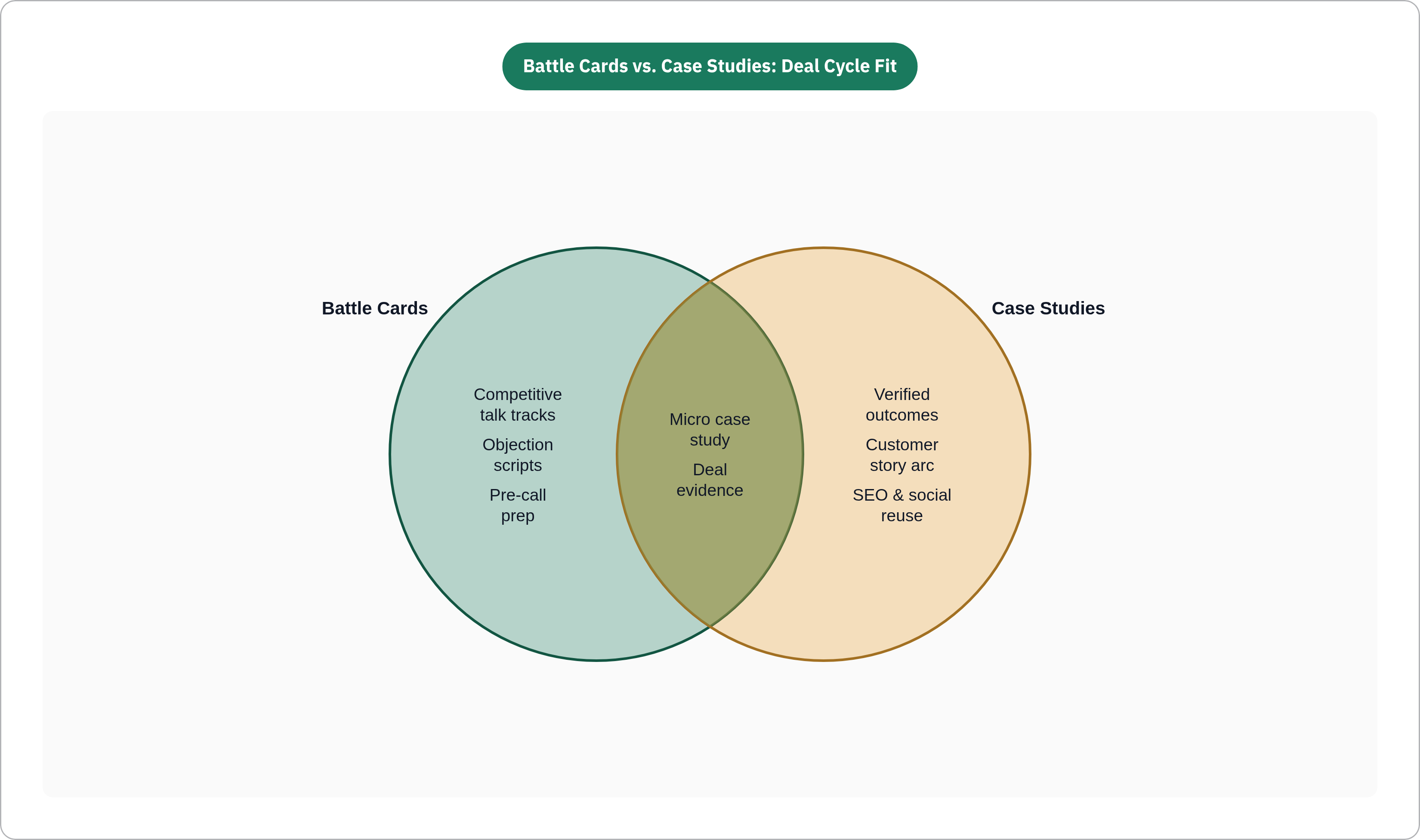
- Losing both, at the same time? Build the micro case study embedded in a battle card. It's the one asset that does both jobs at once.
Go look at your last ten closed-lost deals and figure out where in the cycle they actually died. The pattern tells you which gap is bleeding the most money, and it usually settles the argument faster than any planning meeting would.
There's a compounding argument for case studies worth sitting with, too. A battle card gets used once per competitive conversation, then it sits there waiting for the next one. A case study keeps working long after it's published: it's a sales asset, an SEO page, a LinkedIn post, an email, and eventually the raw material for a micro case study inside next year's battle card. Social proof isn't a one-and-done deliverable. Teams that treat it as an ongoing engine, producing new stories on a steady cadence, end up with a library that stretches across more industries, personas, and use cases over time. And that means more moments where a rep can lean across the table and say, with a straight face, "we've got a customer just like you."