Structuring a B2B Case Study for Sales Rather Than Marketing
Solve the four questions your buyer silently asks before they commit.

Most B2B case studies get written for the wrong reader. They're built to make marketing happy, but they rarely survive contact with a skeptical buyer reading alone at 11pm before a committee meeting. This piece covers the whole subject: how to structure a case study so it does a rep's job when no rep is in the room.
Here's the stat that should keep marketing teams up at night: 6sense's 2024 B2B Buyer Experience Report found 81% of B2B buyers have already formed a vendor preference before they ever talk to sales. That means the case study isn't a supporting document handed over during a pitch. It's often the pitch, with no one there to explain the nuance, soften an objection, or clarify that "your industry" roughly means "your industry." The words on the page have to do all of it.
So when a case study leads with what the vendor did, that's the tell. It's optimized for a narrative marketing wants to tell, not the questions a buyer is actually holding. A sales-built case study leads with what the buyer was afraid of, and design, length, and fonts matter far less than that fear.
What buyers are actually asking when they read a case study mid-deal
Nobody reads a case study mid-deal for inspiration. They're reading to defend a decision they haven't made yet, to a committee that hasn't met yet, about money that isn't spent yet. That's a nervous read, not a leisurely one.
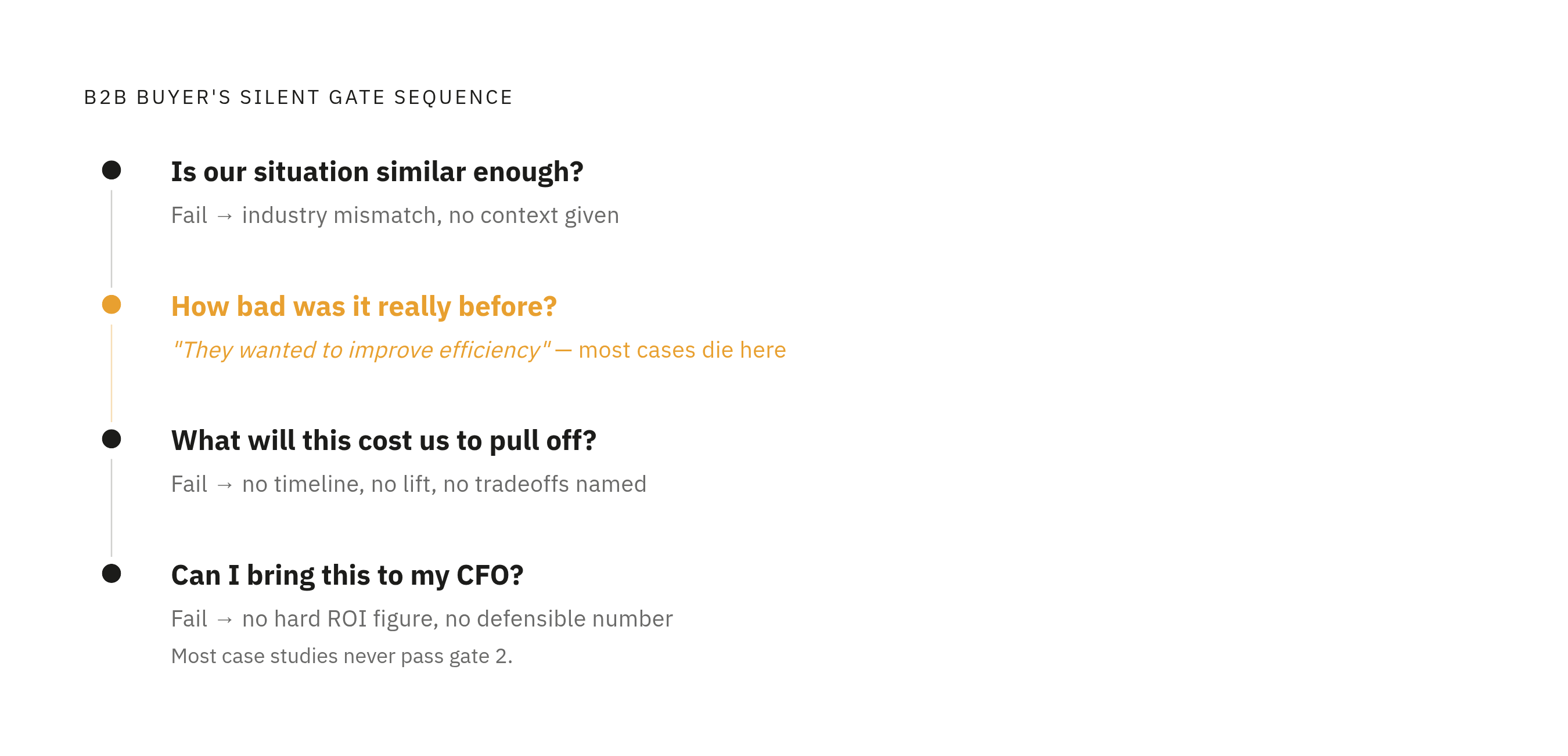
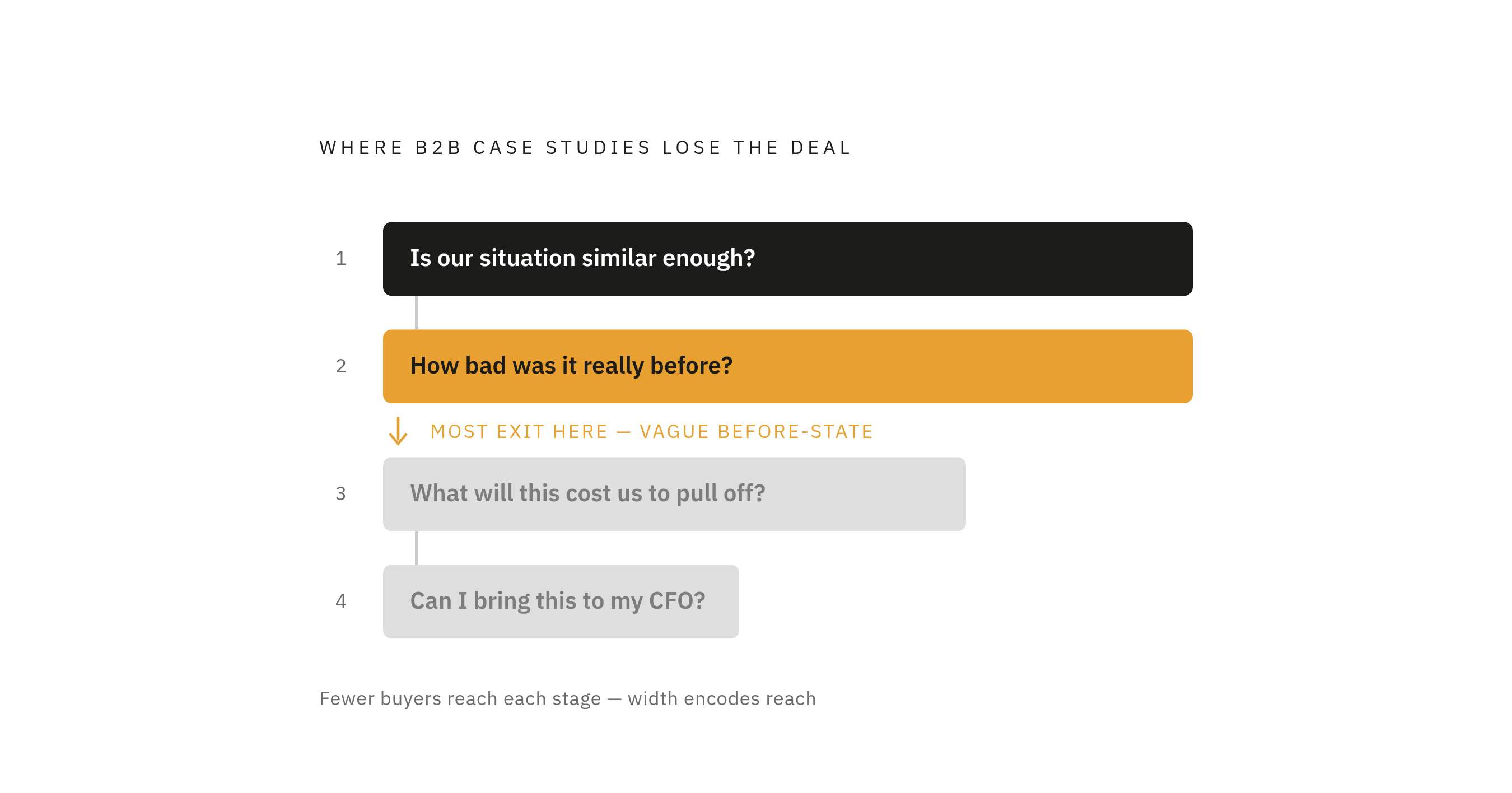
Underneath that nervousness are four questions, and if your case study doesn't answer them, it's decoration:
Is our situation similar enough for this to apply to us? They're checking industry, size, team structure, the shape of the problem.
How bad was it really before? Buyers need to see their own mess reflected back, not a tidied-up version of it.
What will this actually cost us to pull off? Time, disruption, the number of Tuesdays someone's team loses to implementation.
Can I bring this to my CFO? They need something they can quote, forward, or paste into a slide without editing it first.
Most case studies fail on question two before they even get to the others. They'll say the client wanted to "improve efficiency," a phrase that has never once made anyone buy anything. Nobody wakes up wanting efficiency; they wake up because something's broken, expensive, or humiliating in front of their boss. Say the specific thing, because that's what makes a reader go "oh, that's us" instead of skimming to the logo wall.
The stakes on the ROI question are rising, not flattening out. Demand Gen's 2024 survey found 41% of buyers were doing more detailed ROI analysis than the year before. Your case study is competing for attention, and increasingly it's showing up inside somebody's spreadsheet.
Every section that follows should trace back to one of those four questions. If a section doesn't answer something the buyer is actually asking, it's there for the vendor's ego, and egos don't close deals.
The sections a sales-oriented case study needs and what each one must accomplish
Start with the headline, and lead with the number, not the client's logo or a pun somebody in marketing was proud of. "How a 40-person logistics SaaS cut sales cycle length by a third" tells a scanning buyer everything in three seconds. "Customer Success Story: Acme Corp" tells them nothing except that Acme exists.
Right below that, the snapshot box: industry, company size, region, team type, products used, key KPI. This is the part doing triage before a single sentence of prose gets read.
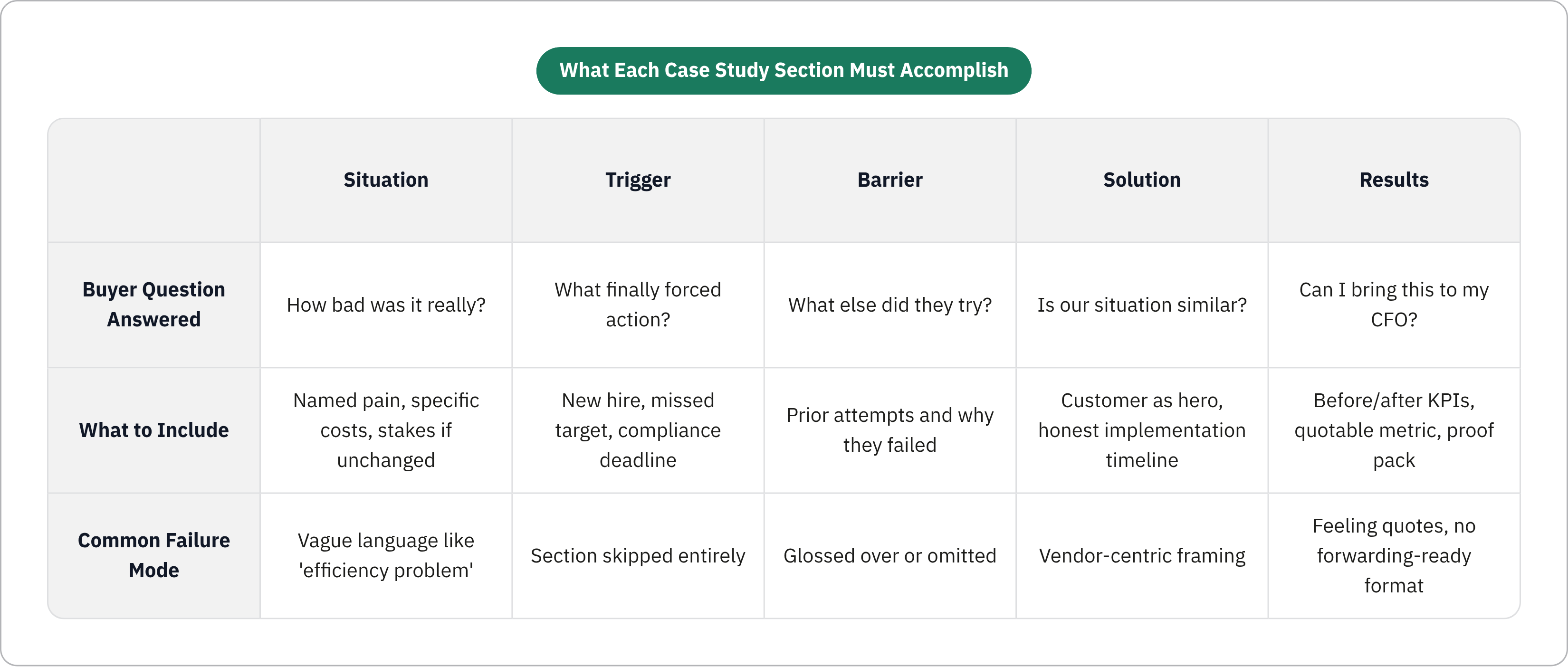
The situation section comes next, and it's the most important part, and, ironically, the one most teams phone in. Name the actual pain. "The team spent 14 hours a week manually pulling data out of three disconnected systems" does more work than "they had an efficiency problem," because one of those sentences is a fact and the other is a euphemism. Include what was at stake if nothing changed: cost, risk, competitive exposure, the internal embarrassment of missing a number in front of the board.
A trigger section belongs here too, and most case studies skip it entirely. What changed that finally forced action? A new hire, a missed target, a compliance deadline breathing down someone's neck? This is the part that makes a prospect currently living through their own trigger moment sit up.
The barrier section follows: what did they try before this, and why didn't it work? This section quietly gives your prospect permission to abandon whatever duct-taped solution they're currently defending internally, which, in a complex sale, is half the battle.
The solution section should stay modest about the vendor's role. The customer is the hero, the product is the tool they picked up. Cover implementation honestly, including what took longer than expected, because buyers doing real diligence will smell it if everything sounds frictionless.
Results come last, structured so the section can be lifted and forwarded, not just read. Lead with the sharpest available number. Use a before/after comparison wherever you can; a clear before/after structure gives buyers something concrete to anchor to rather than a claim they have to take on faith. Include a quote that names an outcome, not a feeling: "We loved working with them" is filler, while "We cut onboarding time significantly" is ammunition.
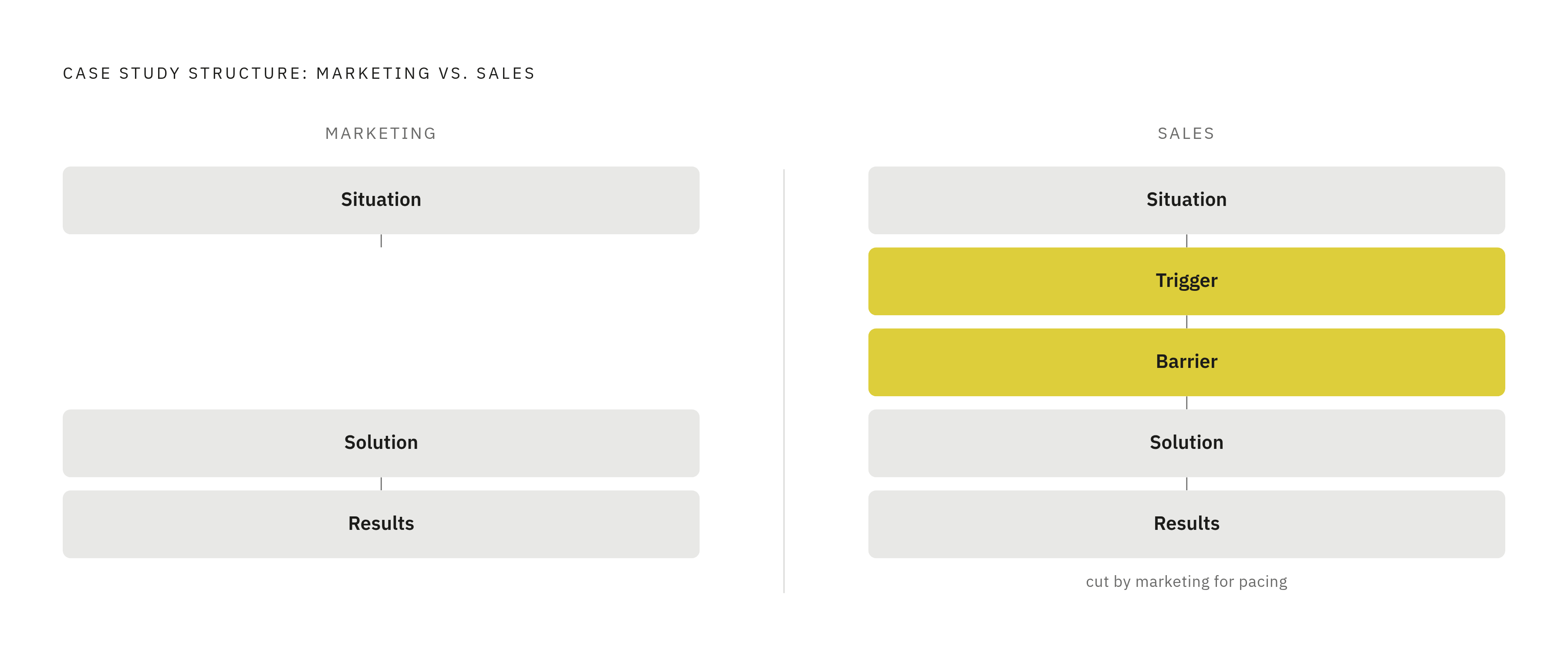
Package all of it into a proof pack: quote, metric snapshot, maybe a diagram, built so someone can drop it straight into a deck without touching it. Among the top 58 fastest-growing SaaS companies in 2025, the vast majority use some version of a Challenge-Solution-Impact framework. The sales version just adds the trigger and the barrier, the two sections a pure marketing narrative tends to cut for pacing.
How the snapshot box and headline do the filtering work a rep would otherwise do
A rep would normally say "this one's about a company just like yours" before handing over a case study. Without that rep in the room, the headline and the snapshot box have to say it instead, in about five seconds flat.
The headline formula is simple: specific outcome plus customer type. It should read like a fact, not a tagline.
The snapshot box is a match test. If a buyer sees their industry, their size, and a KPI they actually track, they keep reading; if they don't, they're gone, and no amount of good writing further down the page will bring them back. Always include industry, company size (revenue or headcount), geography where it matters, use case or department, and the headline metric.
Two optional fields punch above their weight in sales contexts. Tech stack or integration environment kills the "will this even work with what we already have" objection before it's spoken. The buying role of the protagonist matters more than people assume, too: a CFO reading about another CFO's decision believes it faster than a CFO reading about a marketing manager's.
There's also a distribution argument buried in here. Buyers overwhelmingly prefer content they don't have to trade an email address for, 86% by one measure. A gated case study is invisible to the 81% doing quiet, anonymous research before they ever contact sales. Gating adds friction exactly where deals are most fragile.
Making the results section something a buyer can forward to their committee
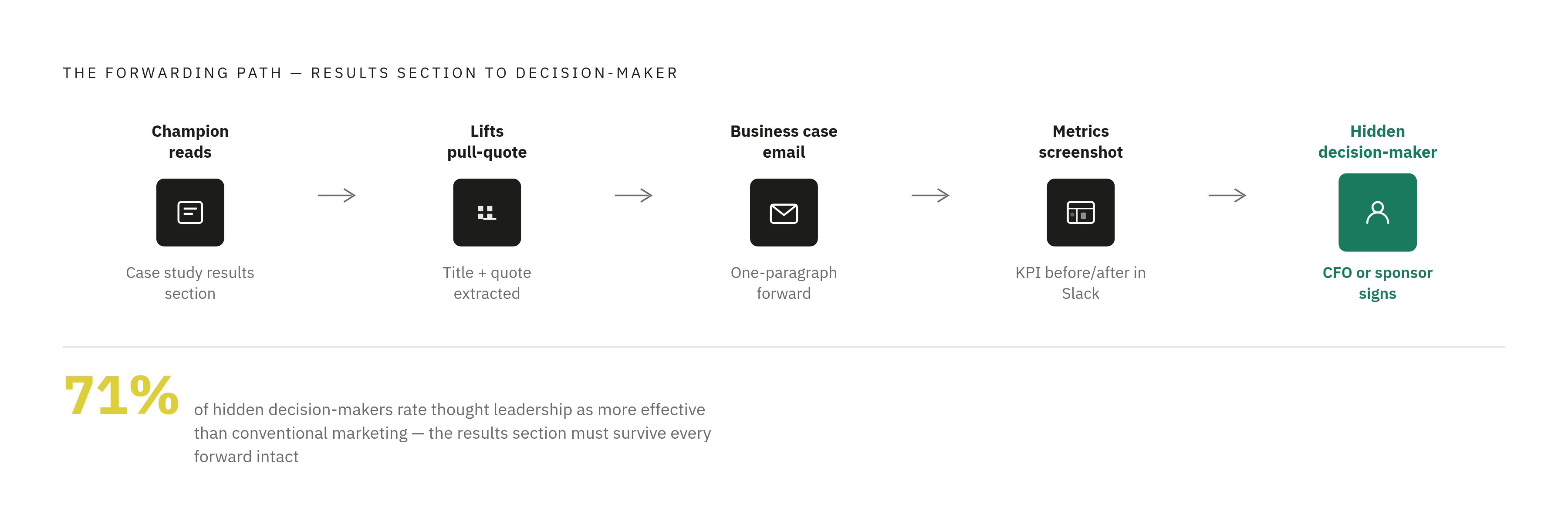
The person reading your case study is often not the person signing the check. They're a champion who has to go sell it internally, using your material as their raw ammunition. Build the results section like it's going to be forwarded, because it is.
A pull-quote needs a title attached, not just a name. "Our cost per acquisition dropped sharply in the first quarter," attributed to Head of Demand Generation at a Series B SaaS company, survives being copy-pasted into a Slack thread. "I'd recommend this to anyone" does not survive contact with a skeptical VP.
Add a metrics table, three to five KPIs, before and after, something screenshot-able, something that fits on a slide without reformatting.
Write a one-paragraph business case summary, too, one your champion can paste directly into an email. Specificity is the mechanism that makes all of this work: "improved team productivity" is soft and forgettable, while "reduced weekly reporting time from 6 hours to 45 minutes" is a number someone can stand behind in a meeting and defend if challenged.
The 2025 Edelman–LinkedIn B2B Thought Leadership Impact Report found 71% of hidden decision-makers rate thought leadership as more effective than conventional marketing materials at showing what a vendor can actually do. The lesson translates directly: frame everything around what the customer achieved, not what the product features are. If hard numbers genuinely aren't available, a tightly specific quote, naming the problem, the change, and the outcome, can do almost the same job. Concrete language substitutes for metrics when the story itself is concrete enough.
Selecting which customer stories to build into case studies based on where they'll close deals
Most teams pick case study subjects based on who's easiest to schedule a call with. That approach overlooks the better filter: which deals are currently dying, and why.
Look at your open pipeline and find the recurring objection. If "we're not sure this works for our industry" keeps showing up, that's your next case study. The happiest customer or the biggest logo matters less than the gap that's actively costing you deals.
Audit the coverage gaps directly. Industry segments where you win but have zero proof on paper. Company size tiers, since a case study about a 500-person company won't land with a 15-person buyer no matter how good the writing is. Use case or department, because a story that speaks to a sales team leader won't move the IT person holding veto power. And deal stage: do you have proof built for the evaluation stage, with real ROI evidence, or only feel-good stories suited for early awareness?
Volume matters here too. Among the top 58 fastest-growing SaaS companies in 2025, the overwhelming majority use case studies, averaging dozens apiece. A diverse pipeline throws off a diverse set of objections, and one case study can't cover them all.
Plot your ICP segments against what you already have published. Every blank cell in that grid is a deal you're quietly losing, right now, because the proof that would've closed it doesn't exist yet.
For regulated industries where a customer legally can't go on record with their name, blind-but-verified testimonials, named role, unnamed company, verified outcome, fill the gap. When the underlying evidence is specific and verifiable, this format can still earn meaningful buyer trust.
Deploying case studies at the right moment in the deal, not just the right page on the website
A case study sitting on a resources page, occasionally tossed into a follow-up email as an afterthought, functions more like a museum exhibit than a sales tool.
Match the case study to the objection in front of you, not to a generic funnel stage. Before the first call, send the snapshot-box version as a primer: here's a company like yours, here's their problem, here's what they got. After discovery, once you know the buyer's specific pain, send the case study whose situation section mirrors it most closely, and say so directly in the email: "You mentioned X, this customer had the exact same issue." During multi-stakeholder evaluation, hand over the results section as a standalone one-pager built for forwarding. At the close, drop the proof pack, quote plus metrics table, straight into the proposal.
Give reps a three-line blurb per case study that spells out the match ("50-person B2B SaaS, same problem you described on our call"). That removes the guesswork reps otherwise do on the fly, badly, under time pressure.
CMI's 2025 benchmark ranked case studies among the most effective B2B content types, full stop, but that effectiveness depends entirely on when the case study lands in someone's inbox, not on the fact that it exists somewhere on the internet.
One customer story should get turned into a web page, a PDF, a quote card for email and LinkedIn, and a slide or two for the deck. The structural work happens once, while the deployment surface multiplies. Track what reps actually send and forward, too, because usage numbers tell you whether a case study is working long before pipeline reports catch up.
Building a system that produces case studies fast enough to keep up with sales needs
Traditional case study production takes weeks: customer approval cycles, a writer's queue, a design backlog. Deals don't wait weeks, and that mismatch is the whole problem.
The bottleneck usually sits at the interview stage. A loose, freeform customer conversation produces a sprawling transcript that somebody then has to comb through, interpret, and force into shape after the fact. That's where programs stall out.
Fix it at the source: treat the interview like a data collection exercise, not a storytelling session. Use a question set mapped directly to the sections you need, problem, trigger, barrier, solution, results, so the transcript arrives already structured instead of needing to be excavated.
Tighten the approval step too. One shared document, one clear deadline, a narrow ask ("just confirm these three things are accurate"), beats sending an open draft that invites a customer to start rewriting your prose.
A minimal system for a small team needs four things: a repeatable interview guide built around the objection-based structure, a template that turns interview answers into sections without a blank-page start every time, a coverage map that shows exactly which deals are exposed, and a deployment kit, email blurb, PDF, quote card, produced automatically alongside every case study rather than as a bolt-on project later.
Speed alone isn't really the point. UserEvidence's 2025 Evidence Gap research found 67% of buyers have ruled out a vendor over evidence they didn't trust. The system's real job is producing proof that's specific, verified, and named fast enough to be there when the deal needs it, not two weeks after the buyer already moved on.