Gated vs Ungated Content for B2B Pipeline Generation
Gate content to the stage of buyer intent, not your lead quotas.
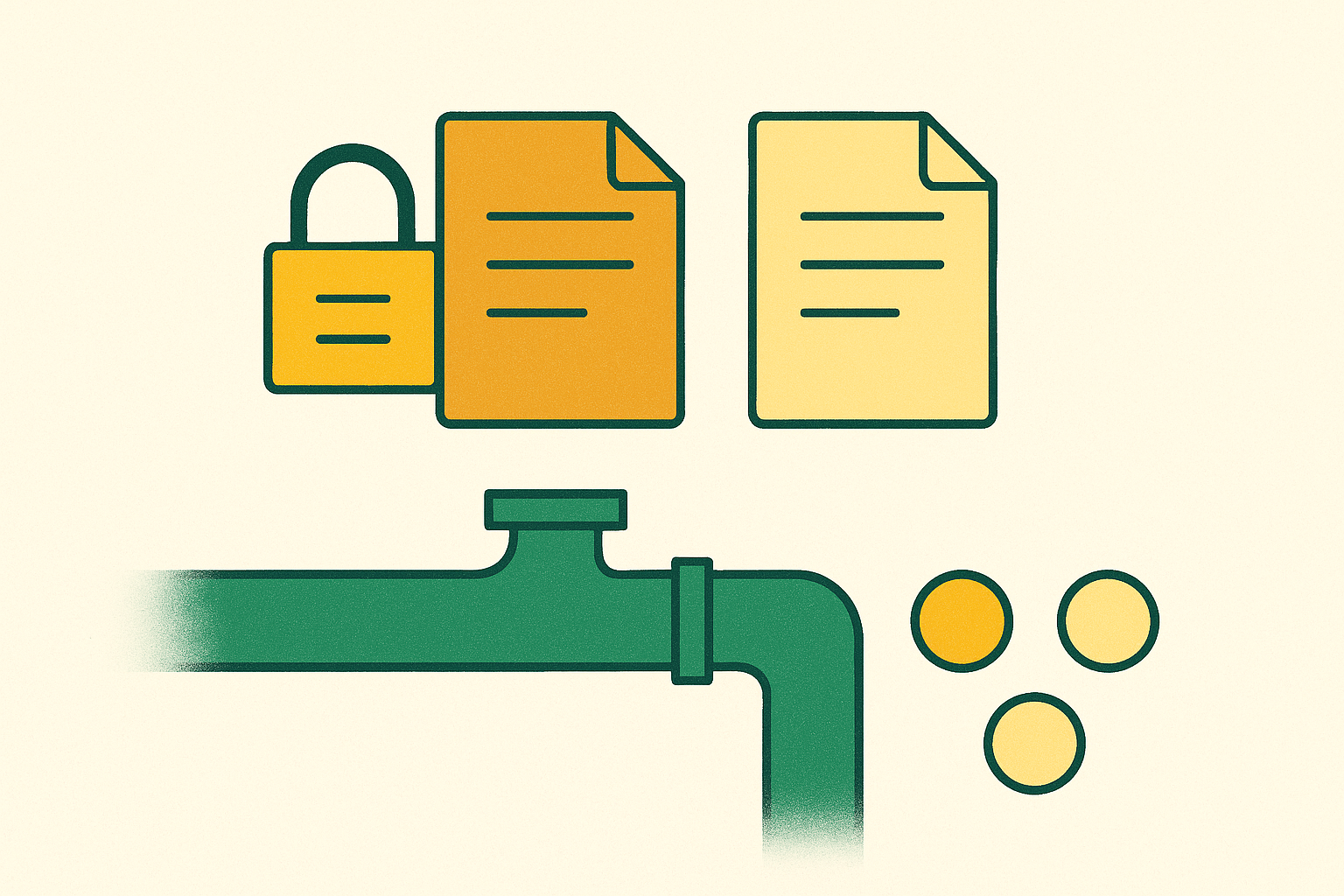
Gating vs. not gating your content isn't a coin flip. It depends entirely on where that piece sits on the road to a closed deal, and the teams who tie the gating call to deal velocity instead of lead volume end up with fewer, better opportunities from less content. Most gating debates start with the wrong question. Marketing asks "how do we capture leads?" when the real question is "how do we move pipeline faster?"
Here's the trap: gate everything, hit your MQL number, hand sales a list of names, and half of them never intended to buy anything from anyone. Sales stops calling the list. Marketing points to the dashboard and says "we hit our number," while pipeline stays exactly as thin as it was before anyone built the gate. Flip it the other way and you get the opposite failure. Teams that ungate everything watch traffic climb, but nobody can tell who's actually shopping and who's just passing through. Neither approach is wrong by itself. They're wrong because they're applied to every piece of content the same way, regardless of what that piece is supposed to do.
The fix starts with asking a better question at the content level. Not "should we gate this ebook," but "what job does this piece have in getting a deal closed." Everything else follows from that.
How B2B buyers actually move through a purchase — and where content fits
Buyers do most of their homework alone. They read, they compare, they build a shortlist, and they do almost all of it before a salesperson ever gets a phone call, and by the time someone fills out a form or books a demo, a lot of them have already picked a favorite. That means a gate slapped on content too early doesn't capture anybody's intent; it just stops a browser mid-scroll, and that browser probably doesn't come back.
Add to this the fact that B2B deals aren't decided by one person clicking "buy." They're decided by committees, sometimes six or eight people deep, spread across procurement, finance, IT, and whoever actually has to use the thing, and each person on that committee wants something different. The finance stakeholder wants an ROI model, while the end user wants a demo video. The champion trying to sell the idea internally might need a gated whitepaper specifically because they want an official-looking PDF to forward to their boss. A gate that one person skips might be exactly the asset another person on the same deal needs.
Here's the part that gets ignored constantly: at any given moment, only a sliver of your total market is actually in-market and shopping. The rest aren't ready yet, but they will be eventually, and content that's locked behind a form is invisible to that group. They can't find it, can't remember it, can't develop any opinion about your company from it. Ungated content that ranks in search, gets quoted by other writers, and circulates on LinkedIn builds the kind of familiarity that makes the eventual buying decision faster once they're finally ready.
And now there's a new wrinkle: AI answer engines. If your content sits behind a form, it might as well not exist to a tool like an AI chatbot summarizing "best vendors for X," since these engines can't see it, can't cite it, can't recommend you based on it. Buyers are increasingly forming their shortlist before they've even typed a real search query, and gated content is locked out of that entire layer of discovery.
What a gate actually costs beyond the conversion rate
Everybody knows a form kills conversions, but fewer people run the full ledger on what else it kills. Search engines can't crawl a form wall, so a gated PDF earns basically zero organic traffic and zero backlinks from anyone who never got to read it. Compare that to an open long-form piece on the same topic: writers can actually cite it, link to it, quote it in their own articles. Backlinks compound, building your domain authority over months and years. Gate the content, and you give up that compounding return permanently, not temporarily.
AI search doesn't soften this problem, it sharpens it. Gated pages get cited by AI engines far less than open ones covering the same ground, and that gap isn't a rounding error, it's structural. If the crawler can't read it, the model can't reference it.
Then there's the data quality problem nobody wants to talk about at the all-hands. Gate too aggressively, and buyers learn to type "asdf@asdf.com" into your form just to get past it, and congratulations, you've built a CRM full of garbage. Sales wastes hours chasing contacts who don't exist. And there's a brand signal buried in here too: when a buyer hits your gate on the exact same topic a competitor covers for free, it doesn't read as strategic, it reads as guarded. Nobody trusts the vendor who makes you work harder to learn basic things.
The compounding damage is organizational. Marketing gates hard to hit its MQL number, sales ignores the resulting leads because they've learned from experience that they're empty, and the whole content program turns into an internal reporting exercise instead of a revenue engine. None of this means gating is inherently bad. It means gating has a real price tag, and you should only pay it when the return is worth it.
What selective gating does earn when applied to the right content
A gate, done right, is a qualification signal. Someone who fills out a form to get a detailed ROI model or a vendor comparison chart is telling you something real: they're evaluating, and evaluating hard. That's worth something to a sales rep, and it's worth more than a name harvested from a blog post about industry trends.
Buyers will trade their email address for something specific and hard to find elsewhere, but they will not trade it for a rehash of information available in a dozen other places with a quick search. Gate a genuinely valuable, genuinely exclusive asset, and it can outperform an open equivalent by a wide margin. The word doing all the work in that sentence is "genuinely." Teams that gate selectively, matching the gate to the content type and the funnel stage, consistently pull higher qualification rates than teams running one blanket policy across everything they publish.
There's also a data-asset argument that's only gotten stronger as third-party tracking erodes under privacy law. First-party contact data from a genuine, high-intent form fill is worth more now than it was five years ago, because it's harder to get any other way.
Before gating anything, run it through three questions. Would a motivated buyer actually fill this out, or would they just go search for a free version somewhere else? Is this content exclusive, meaning proprietary research or a framework nobody else has, or is it available in some other form on the internet? And is sales actually staffed and ready to follow up on whatever leads this generates, quickly? If the answer to any of these is shaky, the gate isn't earning its keep. Where you land on these questions depends heavily on where the content sits in the funnel, which is the next problem to sort out.
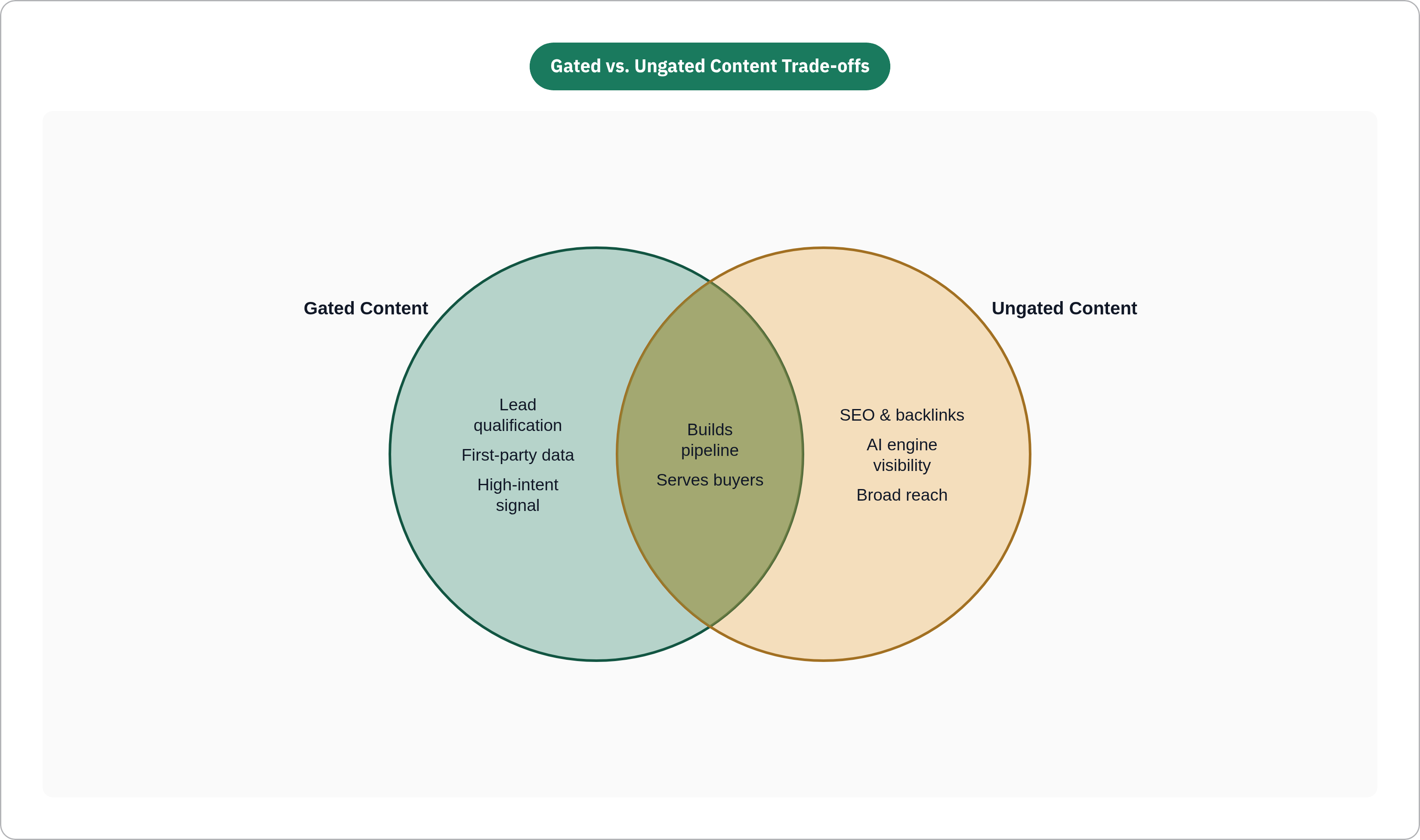
A funnel-stage framework for making the gating call
The governing rule is simple: match the gate to what the content needs to do at that stage, not to what marketing wants to measure on a dashboard.
Top of funnel: publish it open, almost always. This is where you're building awareness, earning search rank, and reaching the huge majority of the market that isn't shopping yet. Blog posts, explainers, industry primers, how-to guides all belong here. The buyer reading this stuff hasn't formed intent yet; a gate at this stage creates friction before there's any trust to spend, and the bounce is permanent. All the SEO value, all the AI citation value, gets thrown away the moment you gate a TOFU piece. The one exception worth considering is a genuinely proprietary industry report with original data nobody else has, and even then, a hybrid approach usually beats a hard gate.
Middle of funnel: gate selectively. This is where buyers are building a business case internally, comparing vendors, checking fit. Comparison guides, ROI calculators, implementation templates, curated research live here, and this is where a gate starts to make sense, because intent is higher and the lead signal actually means something to sales. The test is specificity: the more precisely the content solves a named problem for a defined role, the more a gate is justified. Keep the form short, three or four fields max, because conversion drops fast past that.
Bottom of funnel: gate the deepest, most specific assets, but keep enough open to pull people in. Detailed case studies, demo requests, trials, and analyst reports with direct product relevance sit here. This is also where sales enablement logic kicks in: BOFU content needs to be something a rep can drop into a live email thread, not something buried in a nurture sequence three weeks out. Case studies get their own section below because the gating logic here is genuinely messier than anywhere else in the funnel.
Most B2B teams get the ratio backwards. They pour resources into TOFU content and treat MOFU and BOFU as an afterthought, even though the middle and bottom of the funnel are where content touches pipeline most directly. If your content budget mirrors that pattern, you're overinvesting in the stage with the weakest direct attribution to revenue.
The case study gating question deserves its own answer
Case studies are the most persuasive thing you'll ever publish, and also the hardest to make a gating call on. A gated case study gives you a clean, high-intent lead signal. An ungated one reaches way more people, earns backlinks, gets shared by the customer's own network, and can get picked up and cited by AI engines. Both of those outcomes are genuinely valuable, and you can't have both in equal measure from the same asset.
Run the numbers on this tradeoff and you'll usually see the same pattern: ungated case studies get read by a lot more people, but gated ones produce a higher rate of direct follow-on actions like demo requests. Neither side wins outright. That's what makes this an asset-by-asset call instead of a policy.
Three things decide the answer. First, specificity: a case study that names the customer, states the exact problem, and shows a measurable outcome earns more trust sitting in the open than hidden behind a form, since the specificity is the value and hiding it defeats the purpose. Second, exclusivity: if the story contains a proprietary method or dataset a competitor would love to get their hands on, a gate is defensible. Third, intent signal value: if sales genuinely needs a named list of people evaluating you right now, and this case study is compelling enough to generate that list, gating it might be the right trade.
For most teams, the default should be open. Publish it, optimize it for search, push it to the channels where your buyers actually spend time. A case study living only on your own website has a fraction of the reach of one that's been shared on LinkedIn, mentioned in an industry forum, and picked up by a roundup somewhere else. And here's the practical kicker: the customer whose story it is will happily share an open case study with their own network, but they will almost never share a link that makes their colleagues fill out a form to read about them.
Sales needs these assets too, not just marketing. A rep dropping a case study into a live deal thread doesn't have time for the prospect to hit a gate; that's friction at the exact moment you don't want any. The structural pieces that make a case study earn its spot in the open are consistent: a named customer, a clear before-state, a clear after-state, one headline metric, and a direct quote from a real executive with a real name attached. Teams without a repeatable process for capturing these stories tend to gate the few they have, because scarcity makes every case study feel too precious to give away. Fix the intake process, and that pressure disappears.
The hybrid model that captures both reach and qualification signal
The hybrid model splits the difference on purpose. Publish the substantial core of a piece in the open, and gate only the deepest layer underneath it. A research report summary goes out free; the full dataset sits behind a short form. A case study goes out free; a detailed implementation playbook built from that same customer engagement goes behind the gate. A blog post explaining a framework goes out free; a templated, ready-to-use version of that framework becomes the optional download.
The bar for what stays open: enough real value that a reader who never fills out the form still walks away with something useful, and enough substance that search engines can index it and other writers can link to it. The bar for what gets gated: it should feel like the obvious next step for someone who's already read the open version and wants to go deeper, not an interruption dropped in their path.
Run this well and organic traffic climbs without any drop in lead quality, because the open layer does the awareness work and the gated layer filters for actual intent. Pair it with progressive profiling: ask for one or two fields on the first download, then collect a bit more on the next one. It cuts abandonment and still builds your data asset over time, just in installments instead of all at once.
None of this works if the open content just sits on your website waiting to be found. It needs a push: syndicate it to LinkedIn and the industry publications your buyers actually read, get the customer to share their own story, and write it specifically enough that AI engines have something concrete to cite when a buyer asks a question you can answer.
Connecting the gating decision back to deal velocity, not lead volume
Most teams grade their gating strategy on lead count alone, and that's the whole problem in one sentence. Nobody's tracking what happens to those leads after the form submits.
Run a real audit instead. For every gated asset, trace it forward: how many of those contacts became sales-accepted leads? How many made it into active pipeline? How many actually closed? If the honest answer is "we don't track that," the original gating decision was made blind, with no feedback loop to check whether it was right.
Deal velocity is the metric that matters, not contact volume. The job of a content program isn't to stack up names in a database; it's to shorten the gap between the day a buyer first hears about you and the day they decide to buy. An ungated piece that a rep forwards mid-deal, and that the prospect then forwards to three other people on their buying committee, is doing more real pipeline work than a gated asset that produced one contact who never answered a follow-up email. Verbatim, a managed case study and testimonial service that builds and runs customer proof engines for B2B SaaS companies, exists specifically to generate the kind of named, specific customer stories that earn that forwarding behavior in the first place. Sales should have a seat at the table when these gating calls get made, because they're the ones who feel the difference between a real signal and a name on a spreadsheet. Measure that, not the count of forms filled out on a Tuesday.