Using Customer Proof Points in Cold Outbound Email Sequences
Proof points beat product claims in cold email sequences.
Cold outbound fails because buyers don't trust strangers. That's the whole problem, and no clever subject line fixes it. Reply rates for most B2B teams sit between 3% and 5.1%, while the top quarter pulls 15% to 25%. That gap has nothing to do with send volume. It comes down to who earns the reply, and the thing that earns it is proof.
What a proof point actually is in the context of a cold email
A logo slide isn't proof, and neither is "trusted by 500+ companies." A G2 badge in your email signature tells a prospect you exist and haven't been sued into oblivion, which, fine, is something, but it's the floor, not the ceiling people treat it as.
Real proof does four things at once. It names a customer, or describes one specifically enough that the prospect thinks "wait, that's basically us." It states an outcome in real numbers, not vibes: revenue gained, hours saved, cost cut somewhere specific. It attaches a timeframe, because "eventually we saved money" convinces nobody currently breathing. And it mirrors a problem the prospect actually has, so they see themselves in the story instead of nodding politely from ten feet away.
There's a stat from cold email hook research I keep coming back to. Hooks built around a tight timeframe plus a specific metric, something achieved in six weeks with a number attached, pull a 10% reply rate and just over 2% meetings booked. That beats problem-based hooks by more than double on replies and better than triple on meetings. Strip away the marketing language and that structure is just a proof point wearing a disguise: name, outcome, window, real story underneath.
Usable proof takes a few shapes. A one-line outcome quote from a named customer. A compressed case study reference, something like "a director of ops at a 200-person logistics company cut onboarding time significantly in six weeks." A verified review pulled from G2 or Capterra. And when legal won't let you name anyone, blind-but-verified proof, confirmed by a third party without publishing the name, works nearly as well. The 2025 Evidence Gap report put trust in blind-verified proof at 60%, against 64% for fully named proof, four points apart. Stop waiting on legal to say yes and use what you've already got.
What proof isn't: feature lists, capability claims, awards, analyst quadrants. All of that hands the buyer homework, asking them to translate "integration ecosystem" into "will this work for me." Real proof skips the translation and just gives the answer.
How proof placement maps to the psychological arc of a cold sequence
Four to six emails is the sweet spot. Fewer than four and you leave replies on the table. More than seven and you're mostly reminding the prospect how long they've been ignoring you, unless every touch brings something genuinely new to the table.
Here's the part people miss: 58% of replies come off the first email, but 42% come from what follows, which stings if you spent three hours polishing your opener. The system does the work, not the opener alone.
The buyer's headspace shifts at each stage, so the proof needs to shift with it.
- Email 1: skepticism. Who's this, why should I care.
- Emails 2 and 3: curiosity. Might be relevant, not sold yet.
- Emails 4 and 5: risk evaluation. If this is real, would it work for us specifically.
- Final touch: the sunk-cost moment, weighing whether there's any reason to engage before the door closes.
Buyers do their homework long before you land in their inbox. Gartner Digital Markets found 98% of business decision-makers say reviews matter before a purchase; 66% want those reviews verified by someone outside the vendor. Forrester puts self-serve buyers 80% through their buying process before they ever talk to a rep. So if your proof isn't already sitting inside the sequence, nobody's going digging for it on your behalf. You're competing with their patience, and by Wednesday, that patience is thin.
Email 1 — leading with a proof point instead of a pitch
You get about three seconds of attention and one email session to earn a reply. A claim about your product can't hold that weight, but a story about someone who looks like the prospect can.
The structure isn't complicated. Subject line names the outcome or the customer type, never the product itself: "How a director of ops at a 200-person logistics firm cut onboarding time 40%" beats "Introducing [Product Name]" every single time. Opening line is the proof point, sharpened down to one sentence. Bridge line ties that outcome to the prospect's likely situation. Ask is one low-friction question, not a calendar link, because nobody's booking 30 minutes with a stranger off email one.
Skip the product description entirely, and skip the feature list too — the case study library link comes later. Email 1 isn't a brochure; it's an attention capture, full stop.
Matching matters more than people credit. Send a 500-person SaaS company's proof point to a 15-person consulting shop, and you've built distance instead of relevance; the prospect reads it and thinks "that's not me," which is exactly the opposite of what you want. Segment your proof before launch, not after the reply rate disappoints everyone in the Monday pipeline review. Even when you can't name the customer, naming the type still does most of the trust-building. "A company similar to yours" is four words doing a lot of quiet work.
Emails 2 and 3 — deepening credibility with structured evidence
Silence after email 1 doesn't mean disqualified. It might just mean the prospect wants a second look before deciding you're worth the third.
This is where a link earns its place, dropped in as one contextualized line with an actual reason to click, not bolted on like an afterthought. Apollo's guidance on sequence structure puts a relevant G2 review or matched case study right here, at step 2 or 3, and the timing tracks with how people actually decide things: skeptical first, curious second, hunting for confirmation third.
What makes a case study worth linking instead of ignoring? The headline names an outcome, not a feature. The customer's company type is visible without three screens of scrolling. A pull quote with a real metric sits near the top. And the page doesn't demand an email address before you're allowed to read it, because nothing kills momentum faster than a form wall standing between the prospect and the proof.
An analysis of over 6,500 real proof requests from sales reps found two-thirds asked for case studies, customer stories, or lists of similar companies. Reps ask for this constantly because buyers ask reps for it constantly. It's not a nice-to-have sitting in a folder somewhere; it's the single most requested thing in the whole toolkit.
Video pulls its own weight too. A two-minute testimonial signals an actual human being, not a marketing department typing in third person. B2B companies using testimonial video on sales pages report a 2.6x jump in lead quality ratings, and people believe faces more than paragraphs, which, honestly, tracks.
Email 3 can shift format from email 2. If email 2 linked a written case study, email 3 might hand over a single data point from a customer in a different sub-segment, proving the evidence has range and not just depth.
Emails 4 and 5 — using proof to neutralize risk, not just build desire
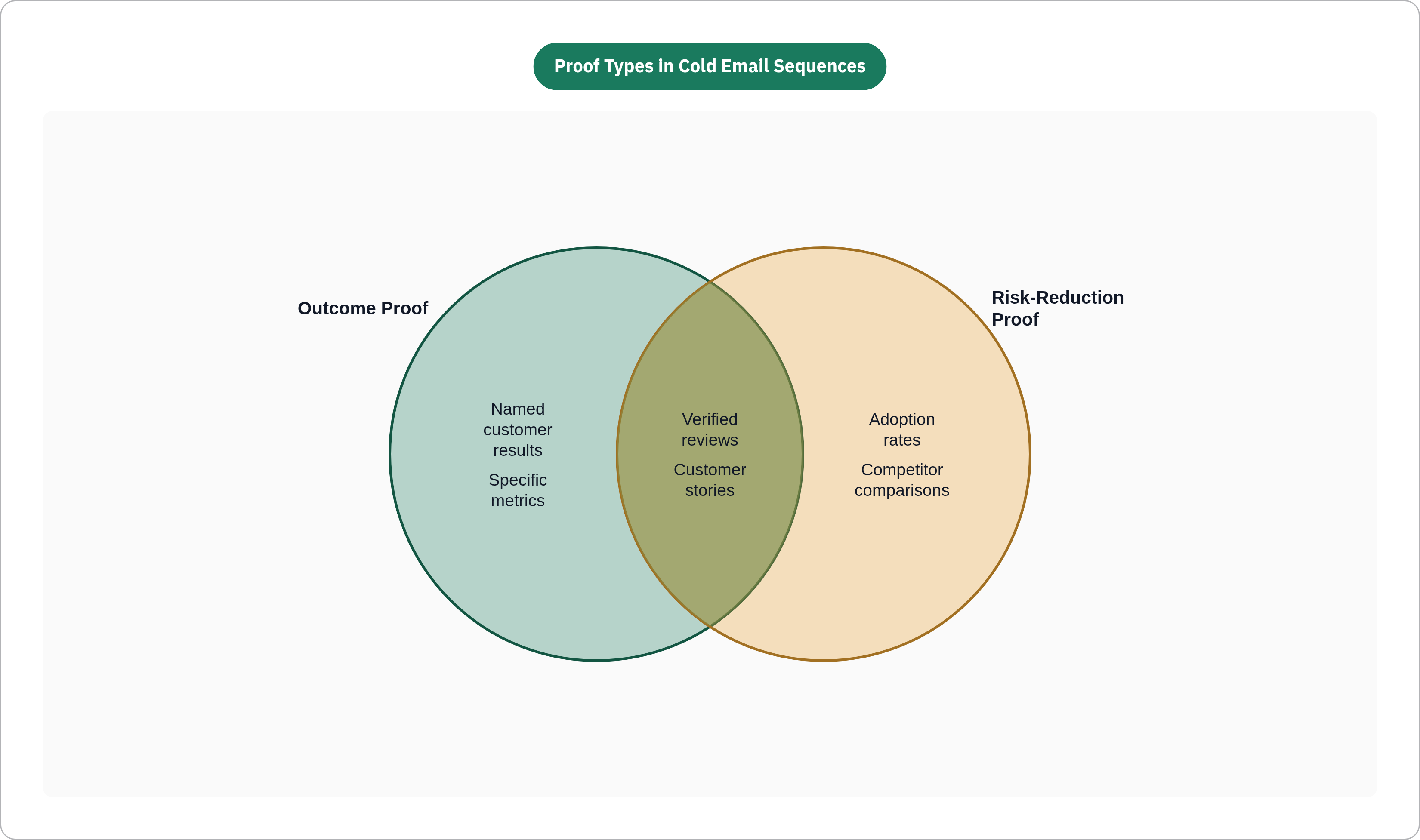
By email 4, the prospect isn't stuck on "does this work" anymore. They're stuck on "would it work for us without blowing up our whole week." Different question entirely, and it needs different proof.
Risk-reduction proof looks nothing like outcome proof. It's implementation timelines, "live in four weeks" instead of "20% revenue lift." It's competitor comparison evidence, showing what switching actually looked like for someone who made the leap already. It's the unglamorous secondary metrics too: adoption rates, time-to-value, support satisfaction scores nobody's screenshotting for LinkedIn.
Apollo's sequence guidance places a competitor comparison page or implementation timeline right at steps 4 and 5, and the logic holds. You're not adding more proof the product works; you're removing the fear that adopting it turns into a mess nobody signed up for.
Consider what's happening while you wait for a reply. The average B2B deal involves somewhere between 6 and 10 decision-makers, so your prospect might already be pre-selling this internally to a boss who's never heard of you and doesn't care about your roadmap. Many B2B purchases stall because buyers can't build internal consensus, or because the rep never got the right proof to the right person at the right moment. Your risk-reduction email is the closest you'll get to a seat at that internal meeting you were never invited to.
The tone shifts here too, away from "look what we did for others" and toward "here's what the transition actually looks like, step by step." Practical, a little dry even, since this isn't the place for inspiration; it's the place for a checklist.
The final email — using a customer story as a closing move rather than a last-chance plea
Most breakup emails are about the sender's discomfort with being ignored, not anything the buyer needs. "Just checking in" and "should I close your file" add zero value. They're the email equivalent of a shrug, typed out and sent anyway.
A customer story flips that. It hands the prospect something useful to walk away with, even if they never write back, and that changes what the last email is for entirely.
Apollo's guidance places a customer story from a similar company right here, at the final step, framed as a story instead of a pitch. Acknowledge it's the last touch (don't fake otherwise, prospects can smell a manufactured deadline from a mile off). Offer one specific customer story matched as tightly as you can to their situation. Then close the door gently instead of slamming it with fake urgency.
This last email isn't a formality. Belkins' outbound research found 60% of positive replies to cold email come from follow-ups, not the first send. Treat the final touch like a real swing, not a courtesy tap on the way out.
There's a bonus buried in here too. A good, specific customer story travels. Even if this exact prospect never converts, a story sharp enough to remember is a story sharp enough to forward to a colleague, and that's a referral seed planted for free.
Building the proof library that makes sequence personalization possible at scale
Here's the unglamorous part nobody likes admitting: 65% of sales reps say they can't find content worth sending to a prospect. Not because good stories don't exist somewhere on a shared drive, but because nobody can locate them when it matters, which is always five minutes before a call starts.
The bottleneck was never writing. It's sourcing and tagging. A brilliant case study buried in a folder called "Marketing Final v3" helps nobody on a Tuesday afternoon trying to hit send before a meeting.
A proof library that actually works for cold outbound gets indexed by industry, company size, primary use case, outcome type (revenue, cost, time, risk), and the deal stage where it performs best. Reps need to search by more than one dimension, or the "library" is just a filing cabinet with extra steps.
The efficient move is the content-kit approach: one customer interview produces a long case study, a one-page summary, a short video, a couple of pull quotes, and a data-point graphic for social. Verbatim, a managed case study and testimonial service that runs this entire production process for B2B SaaS companies so sales teams aren't waiting on marketing, is one way teams offload that work entirely. One conversation, five outputs, five different slots filled across the sequence. UserEvidence found most teams see their first usable piece of evidence within 4 to 6 weeks of starting a structured customer evidence program, fast enough to start now, not "next quarter, maybe, if Q3 cooperates."
Timing the ask matters as much as format does. Customers are most generous with praise right after onboarding, right after a first real win, or around renewal, when enthusiasm peaks and inbox guilt hasn't set in yet. For regulated industries where naming a customer is off the table legally, blind-but-verified evidence stays trusted by 60% of buyers. Not perfect, but workable, and workable beats waiting.
Tools built specifically to turn customer conversations into structured, tagged, reusable proof exist because this sourcing problem is real, not imagined. Reps shouldn't have to file a ticket with marketing every time they need a fresh proof point for a Tuesday sequence.
Measuring whether proof points are actually doing the work
The baseline is grim on its face. Average cold email conversion to a closed deal sits at a fraction of a percent, roughly one deal for every 464 emails sent. Proof-led sequencing exists to move that number, so check whether it's actually moving instead of assuming credit for it.
At the sequence level, track reply rate by email position, so you know which touch and which proof type generated the response. Track click-through on any proof link you embed; a link nobody clicks is decoration, not evidence, no matter how strong the case study behind it is. Track reply-to-meeting conversion separately from raw reply counts too. A reply by itself isn't a win, and a proof-led reply should convert to a booked call at a noticeably higher rate than a generic "interested, tell me more."
At the asset level, check which case studies show up most often in deals you actually won versus deals that quietly died somewhere mid-pipeline. Compare win rates on deals where a proof asset got shared against deals where nothing did, most CRMs will let you tag this with a custom field if you ask nicely. Watch which industries and company sizes keep generating reuse over time.
That last part isn't a vanity metric sitting in a dashboard nobody opens. That's your roadmap for who to interview next.