Content Pillars for Early-Stage B2B Startups
Focus your content on the sales-cycle objections that actually kill deals.
Early-stage B2B startups don't have a content problem. They have a math problem: too many topics, too few of them tied to an actual deal. The fix is something other than more output. It's picking a small number of themes and going deep enough on each one that buyers actually change their behavior because of it.
What a content pillar actually is in a B2B sales context
A pillar is more than a subject area. It's a question that keeps showing up in the sales cycle, one that deserves a real, sustained answer instead of a blog post that gets published and forgotten.
Three things get lumped together that shouldn't be:
A topic, like "supply chain automation," is too broad to make any decision from. A content cluster, the SEO kind built around a head term, is fine for traffic but doesn't do anything for a rep trying to close a deal. A sales-aligned pillar is different. It exists because it resolves a specific objection, teaches a specific stakeholder something they need to know, or speeds up a specific stage of the buying process.
Here's the test. Can the theme be traced to a deal outcome? A shortened cycle, a new stakeholder who's suddenly on board, an objection that stops coming up on calls. If not, it's not a pillar. It's just a topic wearing a pillar's clothes.
Fewer pillars, done well, beat more pillars done halfway. Three or four fully built out will outperform eight that are thin, because buyers need to see depth before they trust a vendor enough to pick up the phone. Depth reads as expertise. Breadth, ironically, reads as a company still figuring out what it actually does.
And pillars need to come from the go-to-market strategy, not from whatever the founder feels like writing about that week. Per Kalungi's 2025 guide, content has to align with how the business actually wins in the market. Editorial instinct is not a substitute for that.
How to identify which pillars your buyers actually need
Start with the sales cycle. Not the content calendar, not a keyword tool, the actual sales cycle.
Pull the objections that keep showing up on calls, the ones that stall deals or kill them outright. Map each one to a stage: awareness, consideration, decision. The pillar that covers the most mid-to-late-stage objections is usually the one worth building first, because that's where deals actually die.
Buyers don't talk like industry blogs. Survey the customer base, or better, go back and listen to sales call recordings. The vocabulary that surfaces there rarely matches the jargon marketing teams default to. A pillar built in the buyer's own words beats one built in the vendor's preferred framing, every time.
B2B deals also involve more than one decision-maker, and each one is asking a different question. The economic buyer wants ROI. The technical evaluator wants to know it won't break anything. The end user wants to know it won't make their day harder. Legal wants to know it won't get anyone sued. A pillar worth building should be addressable at more than one of those levels, even if the format changes for each.
Before committing budget, check search intent. Commercial-intent keywords convert at something like 10 times the rate of purely informational ones, so a pillar candidate needs to be screened for whether buyers are searching to act, not just searching to learn. Long-tail phrases tied to specific buyer scenarios often beat high-volume head terms on actual pipeline contribution, even when the traffic numbers look less impressive on a dashboard.
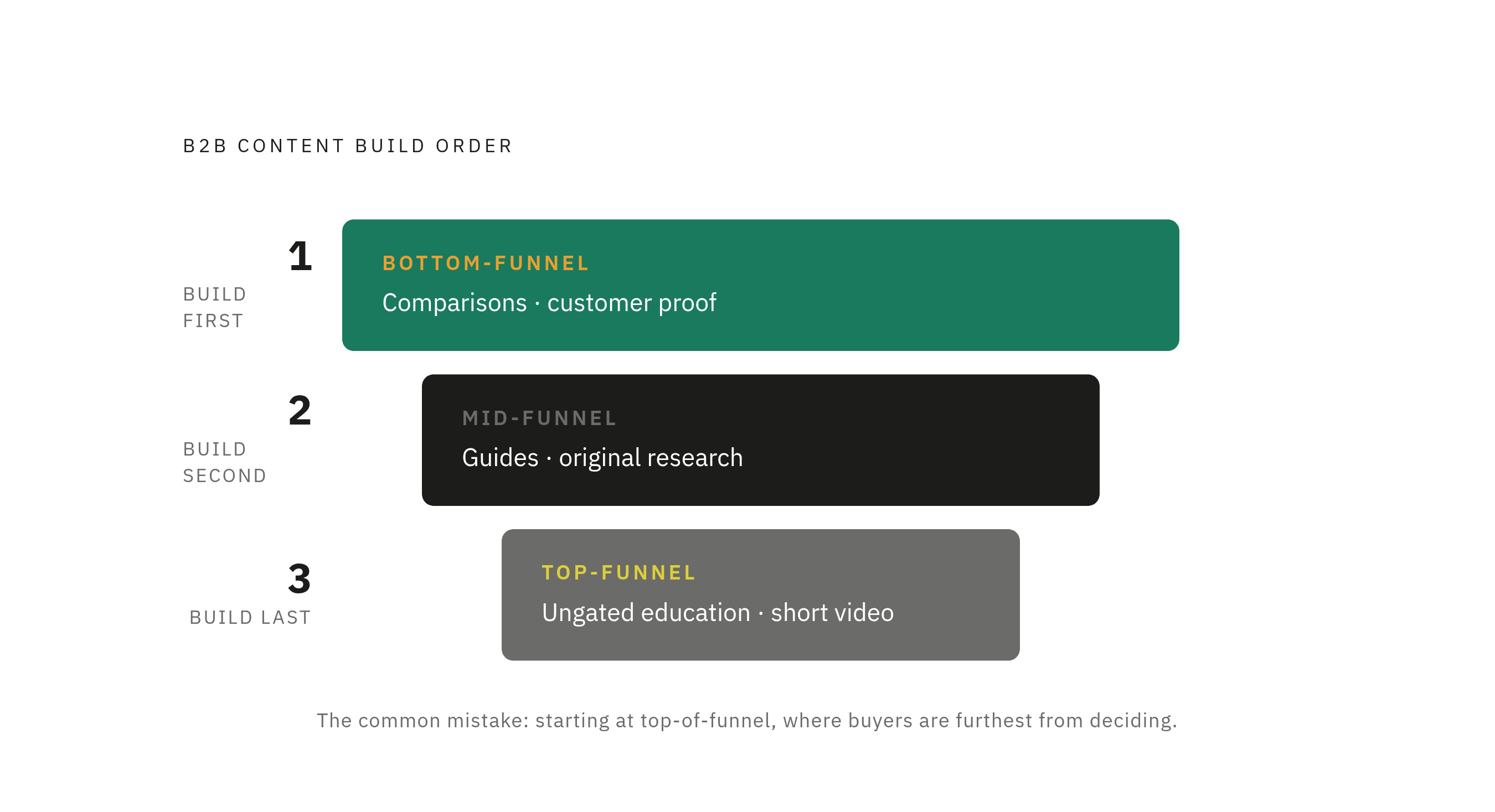
Then prioritize bottom-funnel first. Comparison content and customer proof reach buyers who are closest to deciding, and even at lower search volume, those pieces generate leads who are ready to move. Middle-funnel authority content comes second. Top-of-funnel scale comes third. Building it backward is the single most common early-stage mistake, and it's an easy one to make because top-of-funnel content is the easiest to produce in volume.
The four pillar types that consistently move B2B buyers through long sales cycles
Four pillars keep showing up across B2B companies that get this right. Not because it's a magic number, but because each one covers a distinct job a buyer needs done before they'll sign.
Pillar 1: Customer proof and case studies.
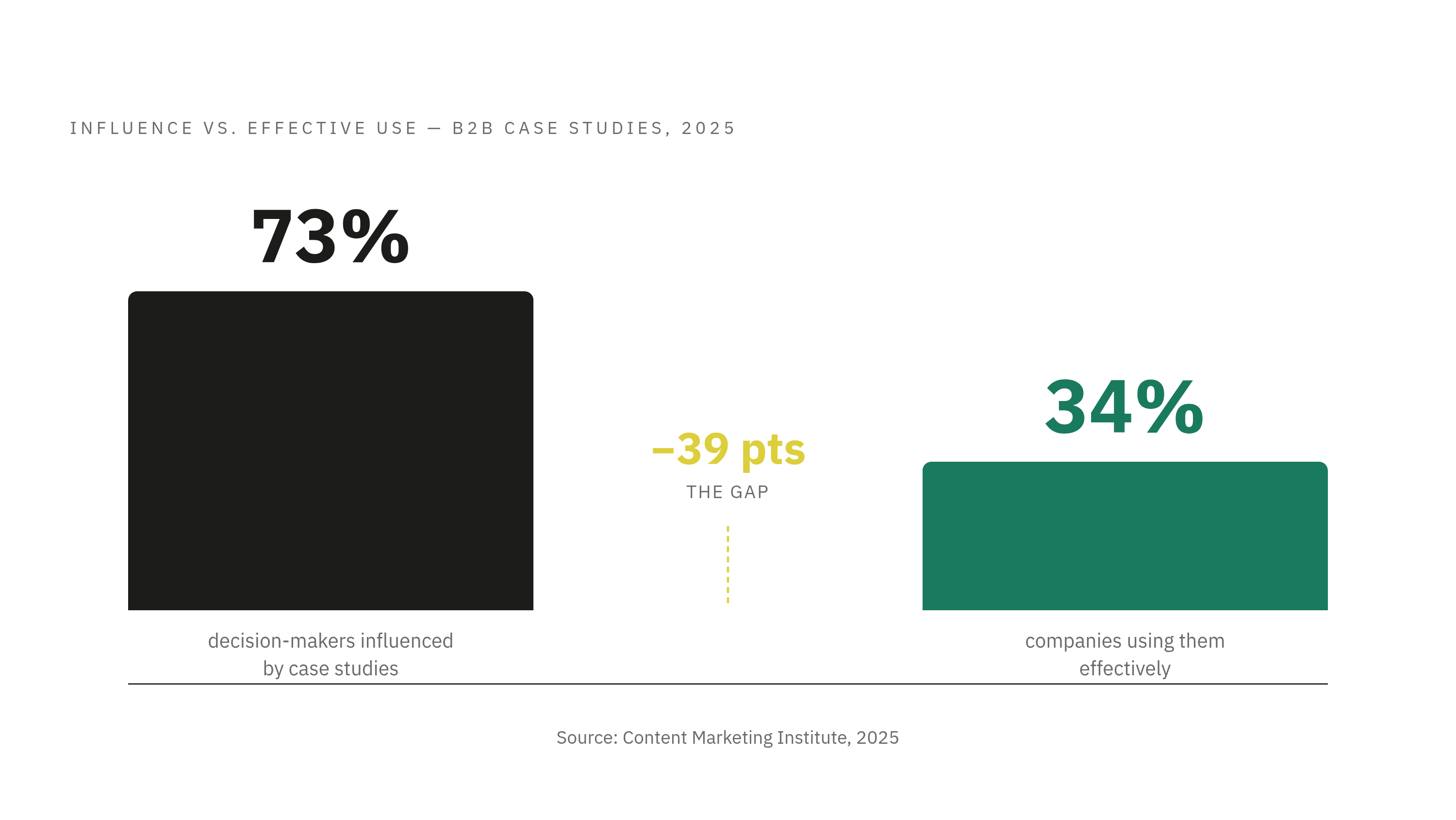
Case studies do more work at the decision stage than almost anything else in the arsenal. Per the Content Marketing Institute's 2025 report, 73% of B2B decision-makers say case studies significantly influence the purchase decision. Yet only 34% of companies use them effectively. That gap between how much they matter and how well they're executed is, frankly, the whole opportunity sitting right there.
Stanford University neuroscientific research found that information delivered in story form gets remembered up to 22 times better than the same information delivered as isolated facts. That's not a stylistic nicety. Narrative structure is a memory mechanism, and skipping it means the case study gets read once and forgotten by the time the buyer's internal committee meets.
A case study that actually functions as a sales asset makes the customer the hero, not the vendor. It should follow a structure that pre-answers the questions a buyer has to answer for their own team: who the client was, what they were dealing with, what was at stake if it didn't get fixed, how they solved it, and what changed afterward in numbers someone can repeat in a budget meeting.
Companies that consistently publish strong case studies generate 45% more qualified leads, according to research cited by HubSpot.
Pillar 2: Comparison and competitive clarity.
"Alternatives to X" and "X vs. Y" content captures a very specific kind of reader: someone actively evaluating, credit card practically in hand. Commercial-intent keywords convert at roughly 10 times the rate of informational ones, so this pillar earns its keep even on modest traffic.
The content itself needs to be honest and specific, comparing actual approaches rather than a feature checklist that reads like it was written by legal. It should say plainly where the product fits and where it doesn't. Specificity, oddly enough, is what builds trust with a skeptical buyer who's read six vendor sites already and is tired of everyone claiming to be the best fit for everyone.
Keep this content ungated. Gating a comparison post trades a small amount of lead data for a much larger amount of organic reach and trust, and buyers tend to come back to ungated comparison content right before they're ready to decide.
Pillar 3: Problem-depth education.
This pillar exists because different stakeholders need to understand the problem differently before any of them will champion a solution internally. Generic thought leadership fails here. It has to be scoped tightly enough to the buyer's actual problem that a reader sees their own situation on the page, not a watered-down version built to appeal to everyone at once.
Per Kalungi's 2025 guide, content that speaks directly to a persona's pain points moves buyers through the journey; content built to please everyone moves nobody. The formats that hold up: long-form guides that show real depth, original research when there's proprietary data behind it, and frameworks written in a practitioner's voice rather than a marketer's.
Research shows that nearly half of B2B buyers read three to five pieces of content before ever talking to a salesperson. This pillar is what fills that gap, quietly doing the selling before a rep is even looped in.
Pillar 4: Verified social proof beyond the case study.
Peer opinion now reaches buyers before a company's own content does. Per the research cited in this space, 72% of marketing leaders say the buying journey now starts with buyers asking peers in private groups, overtaking Google as the very first stop. And 94% of B2B buyers used tools like ChatGPT during their purchase research in 2025, which matters because proof indexed in public content gets picked up by those systems. Proof that lives only in a sales deck or a Slack thread doesn't.
This pillar covers review-site presence (badges, verified excerpts), practitioner testimonials, third-party validation, and for regulated industries, blind-but-verified proof. The 2025 Evidence Gap report found that 60% of buyers trust blind-but-verified testimonials versus 64% for named ones, a smaller gap than most teams assume when they default to only using named logos.
The flip side is sharper than most teams want to admit. Per that same report, 67% of B2B buyers have ruled out a vendor because the evidence offered wasn't trustworthy. Missing proof carries weight. It's a risk factor buyers actively hold against a company.
How to build content within each pillar so it compounds across the sales cycle
One dense asset can carry a whole pillar, if it gets atomized properly. Start with the richest piece, usually a full case study or an original research report, and pull multiple formats out of it rather than starting from scratch every time.
A single case study can chain out like this: full narrative case study for the decision stage, an executive summary one-pager for the economic buyer who doesn't have time to read six pages, a short video clip for LinkedIn at the top of the funnel, an email excerpt for mid-funnel nurture, and a proof point that gets dropped into a comparison post at the bottom of the funnel. One research effort, five assets, five different jobs.
Within a pillar, link the pieces to each other. Case studies connect to problem-education posts. Comparison content links to customer proof. That internal wiring is what actually separates a pillar from a pile of loosely related blog posts sitting on the same subdomain.
Format should follow funnel stage. Bottom-funnel wants case studies, comparisons, and ROI calculators, the stuff that answers "why you, why now." Mid-funnel wants webinars, in-depth guides, and original research; original research tends to attract buyers actively educating themselves, and webinars give sales teams both registrant data and reusable clips after the live event ends. Top-funnel wants ungated education and short video; CMI found that 21% of B2B marketers named short-form video their highest-ROI format in 2024, usually beating out the polished brand video that cost ten times as much to produce.
Video deserves a mention on its own, not as a fifth pillar but as an amplifier across all four. Video testimonials lift conversion rates by roughly 80%, and viewers retain something like 95% of a message delivered on video versus around 10% through plain text. None of this requires a production budget. A screen recording of a customer walking through their dashboard usually outperforms a slick agency-produced brand film, if the story underneath it is real.
What makes any of this compound instead of just piling up is that every new asset adds a link, a new way for someone to find the site through search, and one more proof point for a buyer who's already three pieces into their research. That compounding is structural. It's built into how the pieces connect, not something that happens by accident because a blog got popular.
Connecting pillar output to pipeline metrics rather than traffic metrics
Traffic and impressions look good in a monthly report. They also get content budgets cut, because none of them prove a deal happened.
Run the test plainly: a post with 500 visits that produces 15 marketing-qualified leads is worth more than a post with 5,000 visits and zero conversions. Cost per MQL and pipeline influence are the numbers that matter. Pageviews are the numbers that get a program defunded when a CFO asks what marketing actually did last quarter.
If marketing sources less than 30% of total pipeline, that signals a structural problem, not a volume problem. The fix is something other than publishing more. It's publishing content actually aligned to where buyers are in the cycle. Per the Ebsta x Pavilion 2025 GTM Benchmarks (built on more than 655,000 opportunities and roughly $48 billion in tracked pipeline), average B2B win rates fell to 19%. At that rate, a team needs more than 5x pipeline coverage just to hit quota, which makes content-sourced pipeline load-bearing in a way it wasn't a few years ago.
Attribution has to be built in from the start, not bolted on after the fact when someone in finance starts asking questions. Assign each content cluster a sourced-pipeline target before the editorial calendar gets approved, and connect CRM data to content touchpoints so influence is actually traceable back to specific assets. Progressive profiling and behavioral scoring help route and qualify the leads those assets bring in, rather than dumping everyone into the same generic nurture sequence.
Gating decisions double as a pipeline lever here. Gate mid- and bottom-funnel assets, the ones a buyer engages with at peak intent, to capture lead data when it's worth the most. Leave top-of-funnel content open. Gating everything chokes off the organic reach and trust-building that has to happen before a buyer is ready to hand over their email.
Timelines matter too, and pretending otherwise sets a program up to get killed before it works. SEO-driven content usually takes several months to rank and produce steady organic traffic. Content distributed through owned channels like email can generate leads more quickly than organic search. Most programs need sustained runway before meaningful pipeline impact shows up, since organic and paid distribution both require time to compound into consistent output. Set that expectation before launch. Programs that don't get that runway rarely get the chance to prove they'd have worked.
Building a systematic proof engine so the customer proof pillar never runs dry
Most customer evidence programs run on panic, not process. Sales needs a reference for a call in an hour, so someone starts digging through Slack hoping a happy customer mentioned something usable three months ago. That's not a proof pillar. That's a scavenger hunt with a deal on the line.
The advocacy is usually already there, just scattered. A customer raves about the product in a Slack community. Another agrees to hop on a reference call when asked nicely. None of it is indexed, none of it is tied to a deal stage, and none of it is reusable without someone remembering it exists in the first place.
A systematic version treats proof like inventory, not like a favor. That means tracking which customers have given usable quotes, which ones are willing to go on camera, which ones fit which vertical or use case, and which deal stage each piece of proof is built for. When sales needs a fintech reference for a mid-market deal stuck on security objections, the answer shouldn't require a Slack search. It should already be sitting in a library, tagged, ready, and one link away from the rep who needs it.