Organic Content Strategy for B2B Startups Before Series A
Build bottom-of-funnel content first to close deals before chasing top-of-funnel awareness.

Here's the number nobody wants to say out loud: at $200K ARR, a typical marketing budget (7 to 9% of revenue) works out to roughly $1,300 a month. At $500K ARR, that climbs to around $3,300 a month. Even the aggressive venture-backed range, 20 to 40% of revenue, only gets a $200K ARR company to about $5,000 a month. That's a plan without a budget. That's a rounding error with a messaging channel.
None of that covers a real team, either. Per the 2026 B2B SaaS Marketing Playbook, hiring dedicated staff to cover SEO, content, and demand gen runs north of $370K a year in salary alone, before benefits, before recruiting fees, before the 3 to 6 months it takes any of those hires to actually produce something usable. A content agency runs around $4,000 a month. A full-time content hire runs around $80K a year. Both assume a budget most seed-stage founders don't have sitting in the bank.
So skip the hire. Don't build a department at $500K ARR, full stop. The ramp time alone eats half the runway to Series A, and that's before the new hire has shipped a single piece anyone reads.
Here's the part that makes the constraint less scary: content marketing generates roughly three times the leads of advertising at about 62% less cost (2026 B2B SaaS Marketing Playbook, Averi's budget guide), and organic search drives 44.6% of all B2B revenue, which is closer to half the pie than a rounding error. Genesys Growth data (cited in Sproutworth) puts the average 24-month ROI of long-form SEO content at 748%. No typo there. That's the payoff for doing the unglamorous thing, consistently, for two years straight.
The model that actually fits a seed-stage budget looks less like a department and more like a stack, combining AI-powered content workflows in the $99-a-month range, a fractional strategist for direction, and founder time for voice and customer insight. That combination buys real output without the $370K payroll attached to it. The constraint is real, but the economics still favor content over paid this early, when there's a long runway left for compounding to actually compound.
The two inputs that give a pre-Series A content system its edge
Two things make a lean content system punch above its budget: the founder's voice, and the customer's proof. Everything else is execution, and execution is the easy part to outsource.
Founder authority is the one asset a well-funded competitor can't just buy. Buyers aren't only evaluating the software, they're evaluating the person who built it. Per the Edelman-LinkedIn B2B Thought Leadership Impact Report, 95% of hidden buyers said strong thought leadership makes them more open to hearing from sales anyway. One Series A fintech founder, cited in Sproutworth, picked up six inbound enterprise conversations in 90 days from a single weekly LinkedIn post grounded in real customer data. No ad spend. No cold outreach. Just a founder saying something specific, in public, on a schedule, week after week.
Specificity beats polish. A brand voice can't fake conviction, but a founder can say something true and let the truth do the work.
Customer proof is the second input, and it's usually just sitting there, untouched, rotting in a video call recording nobody will ever rewatch. Sales calls, QBRs, CS check-ins, product demos, they're full of the exact language a skeptical buyer needs to hear. A shortage of proof was the problem. The absence of any system to catch it before it evaporates is. And the buyer-side numbers make the stakes plain: 62% of B2B decision-makers lean more heavily on case studies than other content types, 80% actively hunt for them during evaluation, and 84% say real customer voices make a brand more credible. On the flip side, per UserEvidence's Evidence Gap report, 67% of B2B buyers have ruled out a vendor because the evidence on offer felt untrustworthy. That's a missed opportunity. That's a deal that closed itself, for the competitor.
Put the two together and the funnel gets covered end to end: founder content earns the attention, customer proof closes the distance to a decision. One without the other is half a system, and half a system converts like it.
None of it works, though, if the ICP is still fuzzy. A pattern shows up constantly: a pre-seed team spends months building content before nailing down who they're actually building it for, pivots, and watches most of that content go irrelevant before it even ranks. Lock the ICP first. Everything downstream depends on that one decision, so get it right before writing a single word.
How to structure the content system across the funnel before you scale it
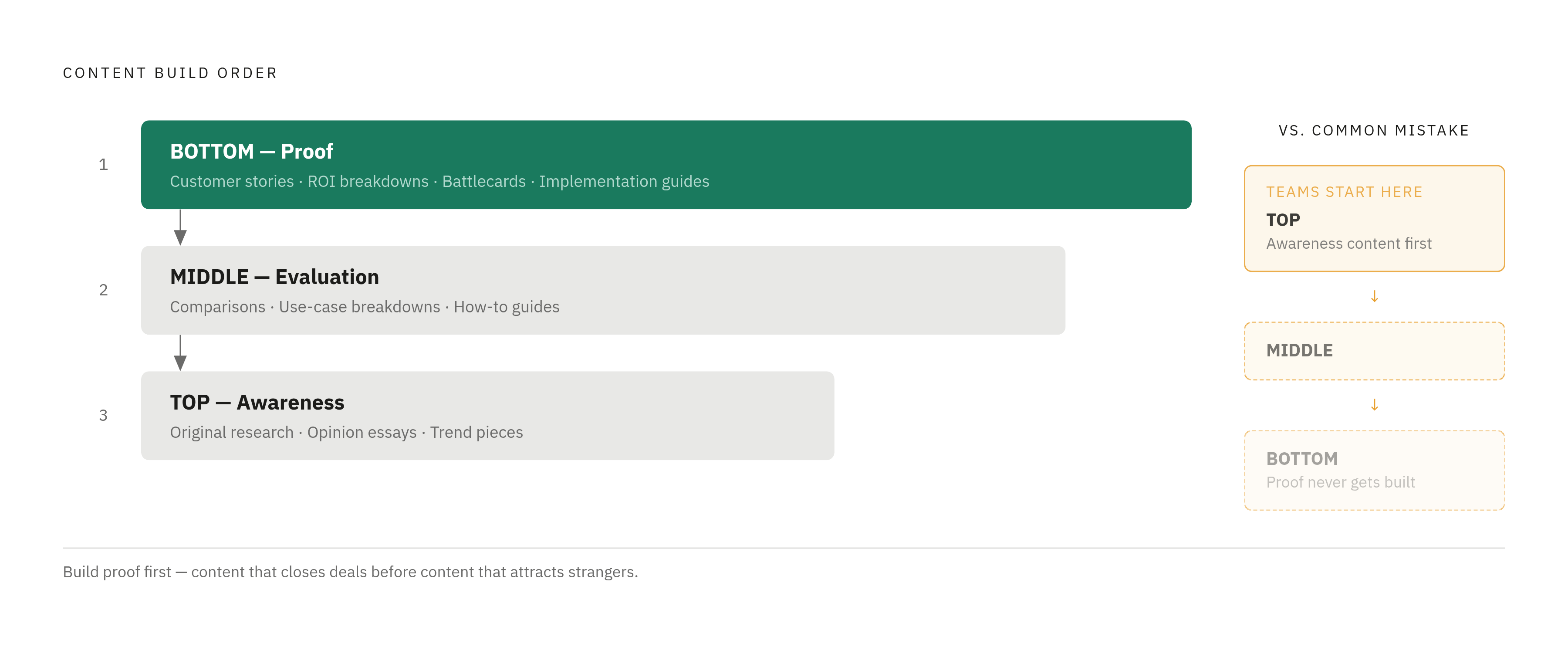
Build the content that closes deals before building the content that attracts strangers. Most teams do the opposite, the single most expensive sequencing mistake at this stage.
The instinct at seed stage is to chase awareness: big broad blog posts, trending keywords, top-of-funnel everything. Resist that instinct completely. That content takes the longest to rank and closes the fewest deals of anything on the list. Start at the bottom instead: customer stories with hard numbers, ROI breakdowns, competitive battlecards for the sales team, implementation guides for people already leaning toward yes. Then build the middle: comparison pages, use-case breakdowns, how-to content that answers the questions evaluators actually ask out loud on calls. Only after that's in place does the top-of-funnel stuff (original research, opinion essays, trend pieces) start paying off, because now there's somewhere for that traffic to land instead of bouncing.
The stage-matching logic holds regardless: bottom-of-funnel proof drives decisions, mid-funnel research content serves evaluation, and long-form posts anchor organic awareness. Traffic by itself proves nothing, though. It's just visitors passing through.
Buyer behavior explains why this architecture isn't optional. INFUSE's Voice of the Buyer research found B2B buyers touch an average of 7 to 9 content formats and channels before deciding anything, and research consistently finds that 94% of B2B buyers do online research before ever talking to a salesperson. Whether it was designed to or not, the content is already doing the job of a sales rep at 2 a.m. on a Saturday, minus the coffee breaks.
Channel priority shifts with deal size, per the 2026 B2B SaaS Marketing Playbook. Deals in the $5K to $30K range, the typical seed-to-Series-A zone, call for a blended motion: SEO, content, email, LinkedIn, light outbound, with content-driven inbound feeding sales assist. Below $5K, the product needs to sell itself through self-serve flows and content-driven virality. Above $30K into the $100K range, content still anchors evaluation, but ABM and events start earning their spend.
Gate the long guides and original research behind a form, but leave the customer quotes and stories wide open. Proof only works if people can actually see it. Gating it kills the exact distribution that makes it worth anything.
Building a case study engine that produces deal-closing proof, not marketing trophies
Pick customers who look like the buyer still on the fence, not just the biggest logo sitting in the CRM. A story about a massive enterprise account impresses nobody if the actual prospect runs a 40-person team with a completely different budget and a completely different headache keeping them up at night.
The failure mode here is depressingly common: case studies written like project reports. Here's what got delivered, here's the timeline, here's the tech stack. A case study stuffed with vague adjectives and zero real numbers convinces nobody who's already skeptical walking in. Buyers don't read case studies to admire the process. They read them to check if someone, anyone, understands their exact problem.
The fix is a structure, not a rewrite. Challenge, solution, result. Open with the customer's pain in their own words. Show the product as the thing that unlocked the change, not the hero of the story, the customer is the hero. Name a real customer who resembles the target buyer, state the problem the way that customer stated it, show what changed with a real number and a real timeframe, and include a quote so specific a competitor couldn't paste it onto their own site and have it make any sense.
Airtable's customer story about Taylor Guitars is a good template for what this looks like done right. Named people, a marketing project manager named Nicole and a social media manager named Matt Steele, walk through exactly how the tool replaced scattered spreadsheets and saved hours of admin work every week. It runs long for a case study, but it holds attention because it explains how the team actually uses the thing, not just that they use it. Media-rich, quotes that sound like actual humans said them, no corporate mush anywhere in it.
Format matters too. A Demand Gen Report study found interactive case studies pull 31% higher engagement than static ones, worth testing on high-value accounts or a deal that's stuck in late-stage limbo and needs a nudge.
One customer interview, handled well, doesn't just produce one case study. It produces a case study, three standalone quotes, a stat for an ad, a nurture email, a one-pager for sales, and a guest slot on a webinar. The packaging discipline matters as much as the interview itself, sometimes more. There's evidence that restructuring case studies around a clear before-and-after, instead of a features list, can push demo requests from those pages up substantially in a single quarter. Same customers, same stories, different structure, wildly different result.
Deploying proof where deal hesitation actually happens
Most teams build one customers page, drop every logo and quote on it, and call the job finished. That's a strategy without distribution. That's a filing cabinet with a URL. Proof only earns its keep where a buyer is actually hesitating, and that's rarely the homepage. It's mid-evaluation. It's the week before the contract's supposed to get signed and someone on the buying committee gets cold feet.
Match the proof to the moment. Early in a deal, when a rep is just trying to establish credibility, a short clip or quote from someone in the same industry does the job: it says solved this before, for someone just like you. Mid-evaluation calls for the full written case study, challenge, solution, numbers, the whole narrative laid out. Late-stage, when a buyer is nervous and hunting for a reason to say yes, a short video (something like 90 seconds) of a real customer describing the outcome in their own words closes a gap a written page never quite manages.
Three things make this proof land psychologically. Authority gives a buyer's procurement team something solid to point to internally, an endorsement from a respected company carries weight nobody has to explain twice. Similarity does the rest: a story from someone in the same industry or role resonates in a way generic praise never does, and segment-matched proof consistently outperforms the one-size-fits-all version. Volume seals it, since a steady, growing pile of consistent evidence makes adoption feel safe instead of risky.
Getting proof out of sales calls and QBRs before it disappears takes a system, not good intentions. Platforms in this space (Peerbound is one example) can flag a line like "this saved us 20 hours a week" straight out of a QBR recording, tag it by the outcome it represents, and surface it for a rep working a similar deal down the line. A workable production pipeline looks something like this: record the interview, transcribe it, draft the story, run it through human review, get customer sign-off, then push it out in sales-ready form across LinkedIn, email sequences, and whatever toolkit reps actually use day to day.
Attribution here is messy, and pretending otherwise would be dishonest. Proof rarely shows up as the last click before a deal closes. What can actually get measured: whether pages with segment-matched proof convert better than pages without it, whether deals that touched case study content close at a higher rate, and how often reps or buyers mention a customer story unprompted when asked what tipped the decision.
Measuring content by pipeline influence, not pageviews
Pageviews measure attention. They say nothing about revenue, and treating them like a proxy for revenue is how marketing budgets get cut at the next board meeting. A pre-Series A content system should get judged on whether it moves a deal forward, not whether a blog post trended for a week and then vanished.
That means tracking which content touches a closed-won deal somewhere along the way, not just which content got clicked the most. It means asking sales which case study got shared, which founder post triggered an inbound reply, which comparison page came up on a call last Tuesday. Per Content Marketing Institute's B2B benchmarks report, only 29% of B2B marketers rate their content strategy as highly effective, and the ones falling short are rarely short on output. They're short on a system that ties each piece back to a stage in the funnel and a deal in the pipeline.
The uncomfortable truth for a founder staring at a dashboard full of traffic charts: none of that traffic pays payroll. Pipeline does. Build the system so every asset answers one question, does this get a deal closer to signed, and the vanity metrics stop mattering almost overnight.