Organic vs Paid Pipeline for B2B SaaS at Seed Stage
Organic content compounds over 12 months while paid stops working the moment you stop paying for it.
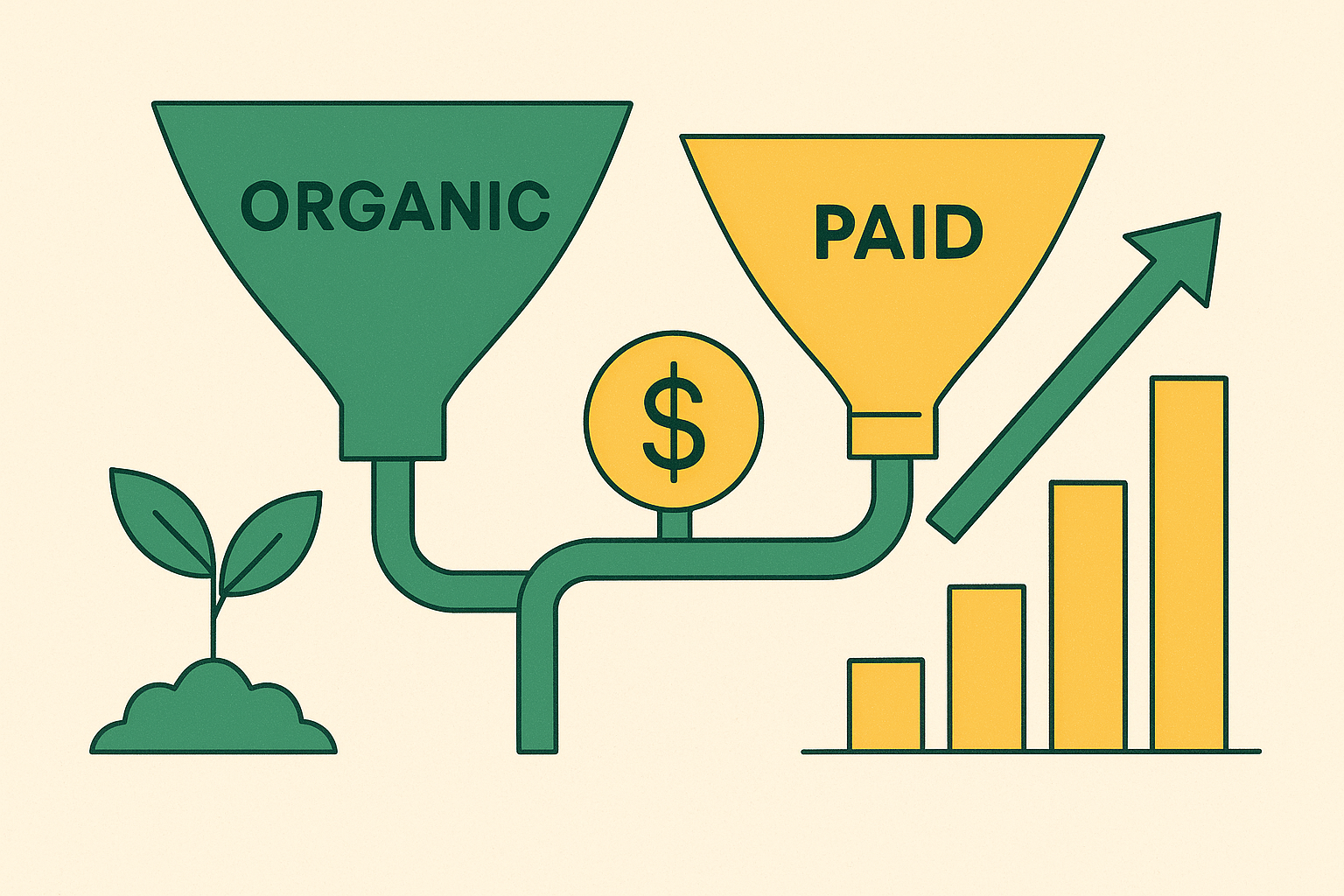
Most founders don't actually run the numbers. So let's do it together.
LinkedIn CPMs in B2B tech are pushing past $70. Google paid clicks on SaaS-buying keywords sit above $35. Seed-stage marketing budgets typically run $5,000 to $15,000 a month. Do the math on that and you're not running a campaign. You're buying a narrow slice of attention from a narrow audience and hoping something converts before the runway math catches up.
The cost per click isn't even the real problem. The deeper issue is what's underneath it.
Paid acquisition only makes sense when you have a proven CAC-to-LTV ratio. At seed stage, that ratio is usually unknown. So you're not spending to grow. You're spending to learn. That's fine. But call it what it is: a research budget. Not a pipeline engine.
What actually gets founders in trouble is the dependency trap. If paid is your only source of pipeline for 18 months, the whole thing stops the moment cash gets uncomfortable. I've watched Series B companies cut paid budgets by 30 to 50 percent and spend the next two quarters scrambling to backfill with content and SEO. Doing at Series B what they should have figured out at seed. You can learn from that or repeat it.
Here's where paid genuinely earns its keep early on: rapid message validation. Test ten keyword themes in a week. Find the three that convert. Build organic content around the winners. That's a high-value use of an early budget. But it is a tactical role. Not a foundation.
How Organic Pipeline Compounds While Paid Pipeline Resets to Zero
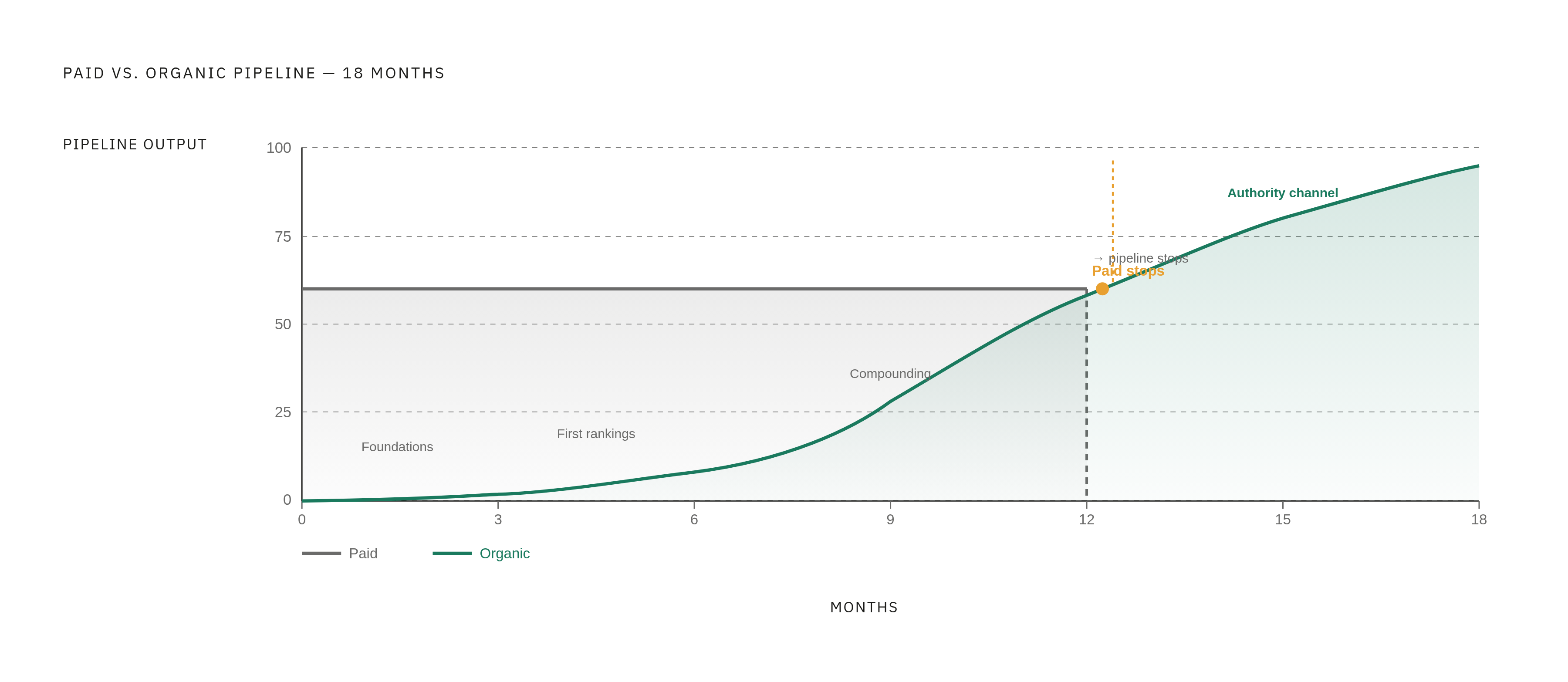
The structural difference between paid and organic isn't complicated. It just takes some patience to appreciate.
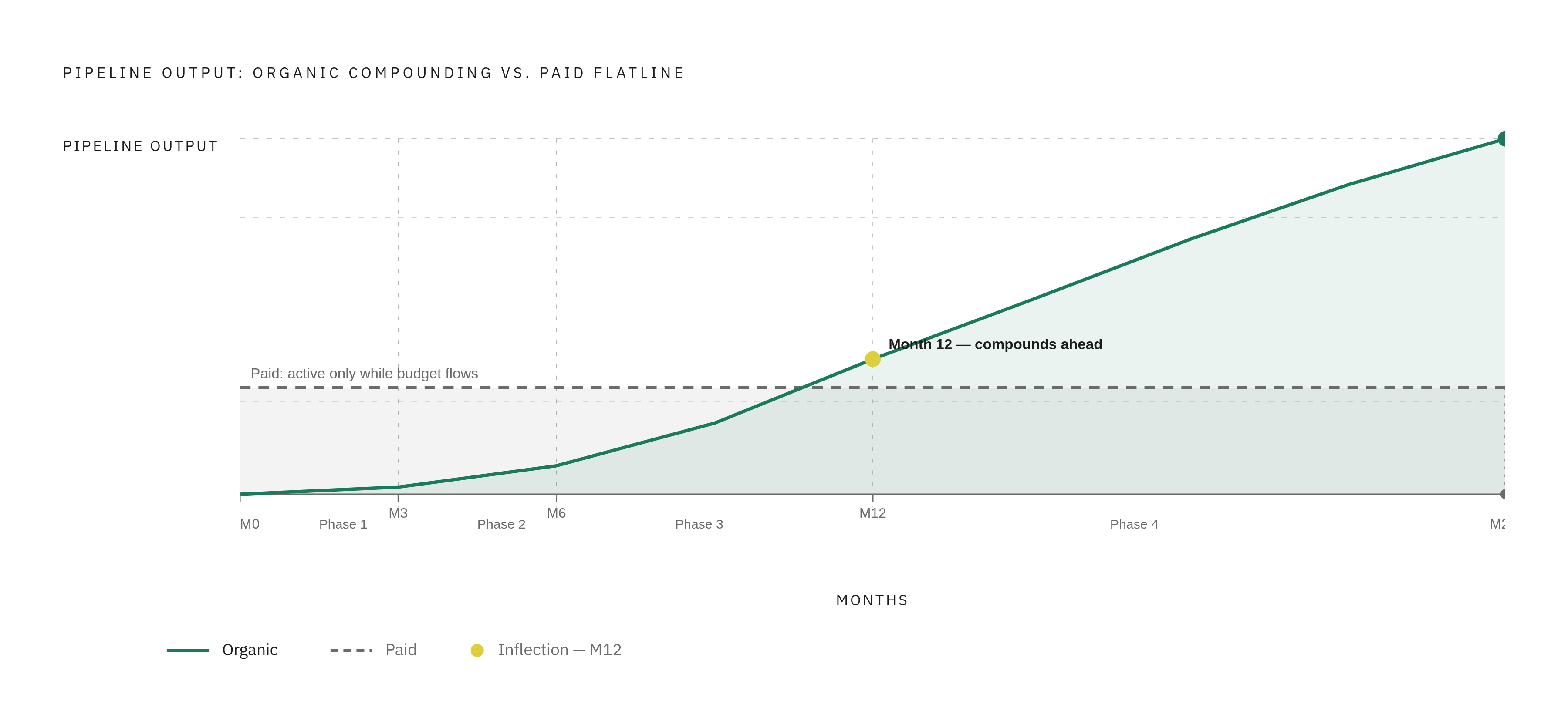
Paid produces pipeline while the meter is running. Stop paying, it stops working. Organic assets, things like content, search visibility, community presence, word of mouth, keep working after the initial effort is done. Each piece stacks on the last. The compounding is real, and it follows a pretty consistent timeline:
- Months 1 to 3: Research and foundational content. No results yet. You're planting seeds in what feels like concrete.
- Months 4 to 6: Initial rankings appear. Traffic starts to trickle.
- Months 7 to 12: Traffic compounds. Conversion rates stabilize.
- Months 12 to 24: Domain authority matures into a reliable acquisition channel.
SEO typically takes 6 to 12 months to become a top-three lead source for B2B SaaS. That delay isn't a flaw. It's the point. Everyone who quits at month four misses the compounding phase entirely. You either budget for the full year or you don't bother starting, because partial commitment produces no return and leaves you with the invoice.
Content marketing generates three times more leads at 62 percent less cost than paid. At nearly any seed-stage spend level, the economics favor organic. This is not a close call.
The timing implication is worth saying plainly. Because the ramp takes 6 to 12 months, the right moment to start is before you actually need it. Starting after paid has already let you down means you've lost months you can't recover.
Why B2B Buyers in 2025 Reward the Founders Who Started Early
This is the part most founders are underestimating, and it's gotten more urgent fast.
Gartner research shows 67 percent of surveyed B2B buyers preferred a buying experience without a sales representative involved. Forrester found in 2024 that 89 percent of B2B buyers used generative AI tools during their last purchase cycle. They're asking ChatGPT the same vendor-selection questions they used to type into Google. If your content isn't indexed and cited, you're invisible to a growing share of the pipeline, and you'll never see the missed impression in any analytics dashboard. There's no "lost to AI research" column in HubSpot.
What this means practically: the first sales conversation is happening later than it used to. Buyers arrive having already done their research, already formed a shortlist. Organic content, specifically case studies, indexed proof pages, articles that answer real evaluation questions, is what earns a spot on that shortlist before a human ever gets involved. Paid ads rarely appear in AI-generated research summaries. Crawlable HTML content does.
The mechanics aren't complicated. Publish proof as crawlable HTML, not PDFs or JavaScript carousels. Add schema markup. Describe your product consistently across your website, G2, press coverage, and LinkedIn. That's how you show up when buyers are doing pre-conversation research without you in the room.
Organic content in 2025 is no longer just an SEO play. It's the primary way a seed-stage company earns buyer trust before any human gets involved.
What an 18-Month Organic Foundation Actually Looks Like in Practice
Most seed-stage teams should focus on two or three channels maximum until one hits consistent ROI. Spreading across five before proving one is one of the most common and most expensive mistakes at this stage. It just dilutes the execution everywhere.
The starting point is usually either founder-led content or targeted SEO. Not both at once.
Founder-led content moves fastest because it doesn't need domain authority. It travels on the founder's existing network and credibility. SEO compounds longer but requires consistent production and a full year's patience. Choose based on where you actually are, not where you'd like to be.
A rough channel mix by stage:
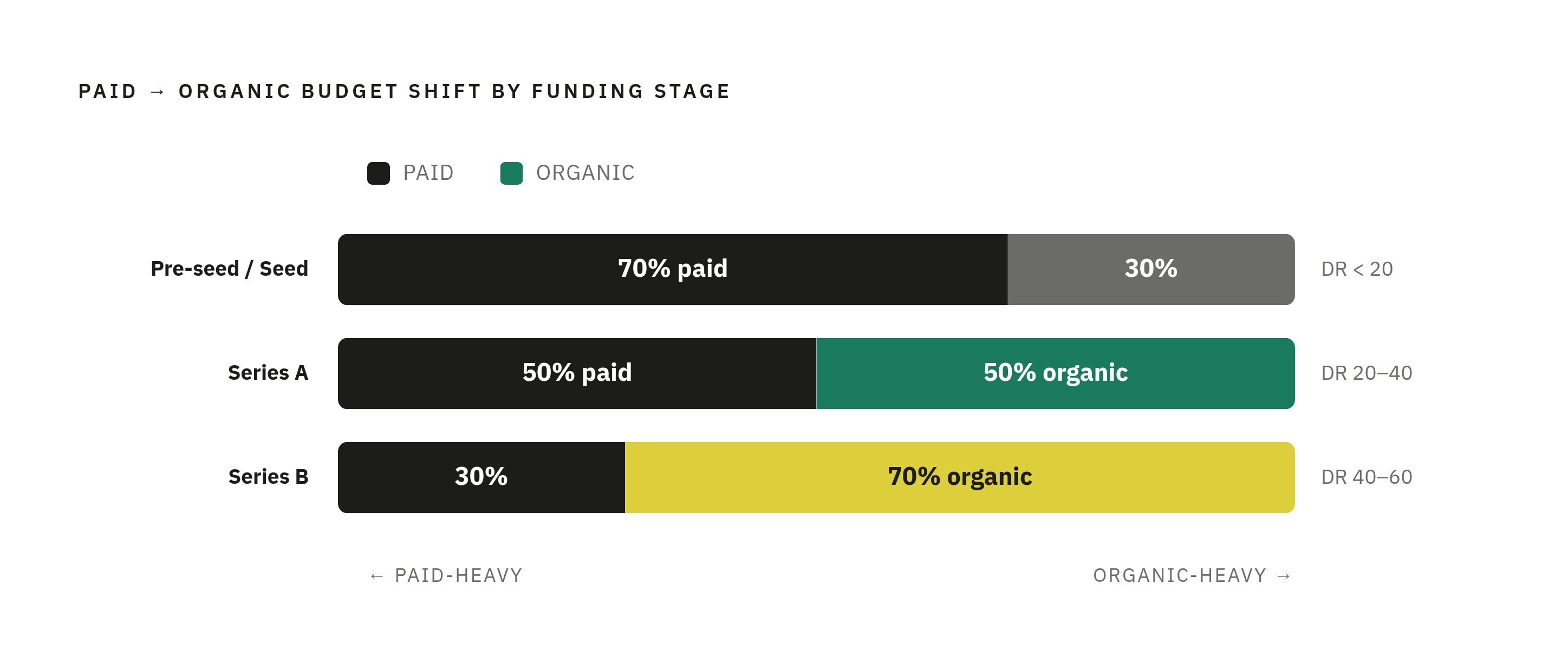
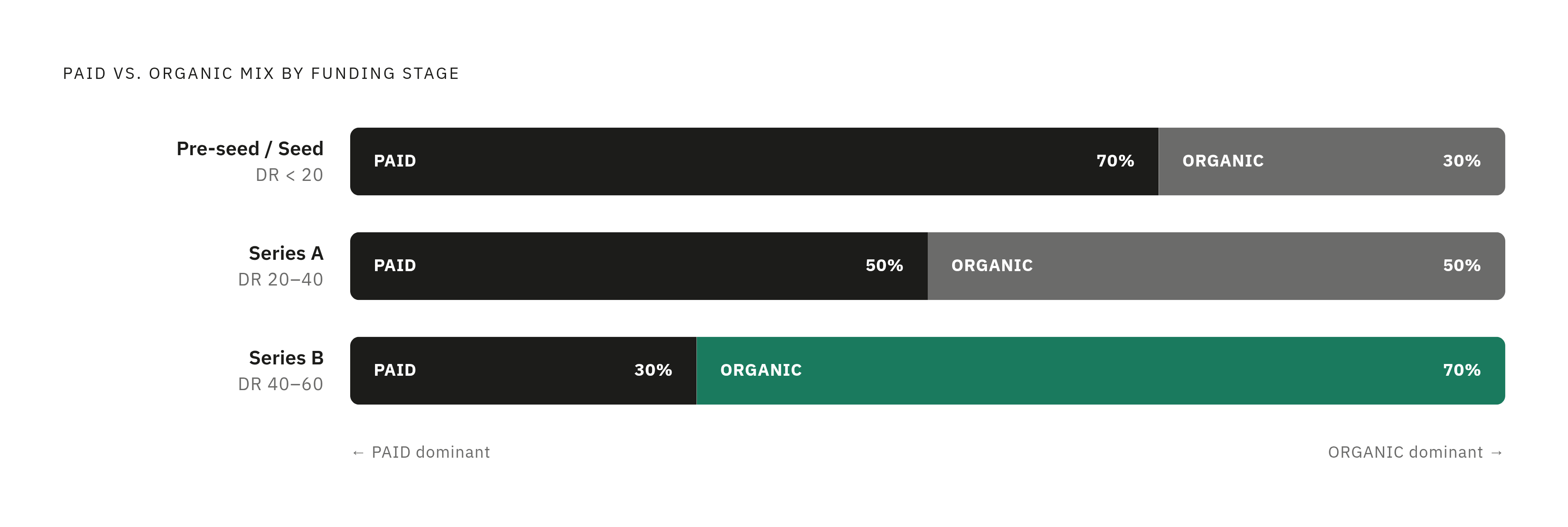
- Pre-seed and seed (Domain Rating under 20): Roughly 70 percent paid, 30 percent organic. Validate messaging with ads while building SEO foundations with core product pages and a handful of keyword-targeted articles.
- Series A (DR 20 to 40): Shift toward 50/50. Use paid conversion data to prioritize which organic topics to build next.
- Series B (DR 40 to 60): Around 30 percent paid, 70 percent organic, as the content asset base matures.
The paid-to-organic feedback loop is what makes this work. Paid ads surface which keyword themes actually convert. Those winners become the organic content roadmap. That's faster and more reliable than guessing from a keyword tool alone.
The most important thing about organic strategy at this stage, though, is that it starts with the buyer's actual problem. Not a keyword list. What is the specific situation they're in before they find you? What metric will they use to decide your product worked? What constraint does your solution uniquely relieve? The keyword universe follows from those answers. Not the other way around.
Why Customer Case Studies Are the Highest-Leverage Organic Asset at Seed Stage
Among 56 top-growing B2B SaaS companies, 88 percent use case studies, averaging 45 per company. For companies under 30,000 monthly visitors, case study volume correlates strongly with web traffic. That's not a coincidence.
Insight Collective's 2025 research found that case studies make it easier to evaluate shortlisted solutions for more than half of B2B tech buyers. A 2024 Uplift Content study found 76 percent of SaaS sales teams request written case studies when selling to prospects. Gartner found that when buyers saw supplier content as genuinely helpful, they were 2.8 times more likely to experience high purchase ease and three times more likely to buy a bigger deal with less regret. UserEvidence's 2025 Evidence Gap report found 67 percent of B2B buyers have ruled out a vendor due to untrustworthy evidence.
Those numbers come from different studies, different years, different methodologies. But they all point in the same direction.
Case studies do three jobs simultaneously that most content can't:
- SEO: Indexed HTML case study pages attract long-tail search traffic from buyers researching specific outcomes.
- Sales enablement: Reps use them as proof assets in live deals, pulling quotes for decks and PDFs for email follow-ups.
- AI citation: Structured, specific, crawlable proof pages are the format AI assistants are most likely to surface when buyers are researching vendors on their own.
At seed stage, a handful of well-structured case studies outperforms months of generic thought leadership. Specificity and similarity to the buyer's situation are what actually move deals. "We helped a company like you" will always beat "we help companies generally."
How to Produce Case Studies That Actually Close Deals, Not Just Fill a Resources Page
The biggest bottleneck in case study production isn't writing. It's customer participation and approval. Plan for that friction from day one, because it will bite you if you ignore it.
The framework most top-growing companies use is Challenge-Solution-Impact. Define the customer's pain point. Explain how the product addressed it. Show quantifiable results. Average word count is around 965 words. It's not a novel, and it shouldn't read like one.
Every case study should have one target reader in mind. A CFO comparing cost savings. A CTO assessing technical fit. An end user trying to make their daily work less painful. The language, the metrics, and the customer chosen should all match that reader. If your product serves multiple buyer types, write multiple case studies. One per persona.
What makes a case study convincing enough to actually work:
- Real quotes. Not a paraphrased summary of what the customer "basically said."
- Specific numbers. Even modest ones. A 23 percent reduction in support tickets is more convincing than "significantly fewer tickets."
- Honesty about context and limitations. Buyers distrust overly polished stories. Production value does not substitute for specificity.
Distribution format matters more than most people realize. The same story should be packaged for every stage of the deal: full written version for the website, pull quotes for sales decks, short anonymized snapshots for early conversations, PDF for email follow-ups.
Video is underused and high-signal. Only 36 percent of companies include video in case studies, but when companies designate featured case studies, video appears in over 90 percent of them. A 60-second customer clip adds human trust that text simply cannot replicate.
One more thing on page design. Late-stage buyers don't scroll to the bottom to convert. Put your primary CTA above the fold. Add a secondary CTA tied to the results section. Make the next step obvious after you've just convinced them.
Building the Evidence Engine So It Doesn't Depend on a Heroic Individual Effort
Most customer evidence programs are reactive. Sales asks for a reference. Someone Slacks the advocacy manager. The deal waits. This workflow breaks under any volume, and it always breaks at the worst possible time, like when you're trying to close your biggest deal of the quarter.
A functional always-on system needs four things:
- Feedback collection through in-app surveys, email, or direct links
- Review aggregation from G2 and TrustRadius
- Call highlights pulled from recorded sales and customer success conversations
- A searchable library indexed by industry, company size, use case, and competitor
Apply a simple rule: if reps cannot find the right proof in under two minutes, it effectively does not exist. Invest in tagging and organization so the right asset is instantly findable. This sounds boring. It is boring. It also makes the difference between a system that gets used and one that collects dust.
Proof also has a shelf life. Anything more than two years old can actively hurt credibility. Refresh at least annually. Archive proof from churned customers immediately.
Six proof formats mapped to the buyer's journey:
- Text testimonials with specific metrics (early awareness)
- Video testimonials from peer-level executives (consideration)
- Structured case studies (evaluation)
- Aggregate star ratings from G2 or Capterra (shortlisting)
- Certifications and industry awards (validation)
- Press and media mentions (credibility check)
Each format serves a different moment. The companies averaging 45-plus case studies didn't get there through one big sprint. They built a system and kept it running, even when it felt like nobody was reading any of it.
Where Paid Fits Into the First 18 Months Without Becoming a Crutch
Paid is not the enemy. Dependency on paid, before organic is proven, is the problem. There's a meaningful difference there.
The legitimate uses of paid at seed stage are three:
- Message validation. Test which pain points, audiences, and offers convert before committing to organic content around the wrong themes.
- Short-term demand capture. Paid fills the pipeline gap during the 6 to 12 month SEO ramp. Bridge, not destination.
- Amplifying what already works. Paid distribution of a high-performing case study or article accelerates what organic has already proven.
The feedback loop is what keeps everything connected. Paid tests identify top-converting themes. Those become the organic content roadmap. That roadmap builds authority. Authority lowers paid CAC over time, because buyers who already recognize you convert at higher rates. Each phase feeds the next, but only if you're actually paying attention to what the data is telling you.
The constraint that keeps paid in its lane: only scale it after organic signals validate which messages and channels convert. Let paid run ahead of proven unit economics and the math turns against you fast.
By month 18, a founder who started organic early has a compounding content asset base, a proof library with real case studies, and a paid channel informed by 18 months of actual conversion data. A founder who spent 18 months on paid alone has pipeline that evaporates the moment the budget gets cut, and nothing that survives the Series A gap.
The organic work doesn't feel urgent until it's too late to start it. That's the trap. Start it anyway.