Sales Enablement Strategy for Founder-Led Sales Teams
Founders' sales knowledge lives in their heads—here's how to extract it.

Founders close deals the way a great chef cooks without a recipe. They know what to add, when to add it, and why it works. But if you ask them to write it down, they stare at you like you've lost your mind. The problem isn't that the knowledge isn't there. It lives entirely in one person's head, and the moment a second rep joins the team, that person is flying without instruments.
This piece is about fixing that. Not with a new CRM. Not with a sales methodology framework. With a simple, structured system that pulls what the founder already knows out of their head and puts it somewhere the whole team can use it.
What Founders Already Know That Their Teams Don't
There are three categories of founder knowledge that close deals. Most founders have all three. Almost none of them have documented any of it.
Proof points. Not "customers have seen great ROI." Specific outcomes with real numbers and real context. The kind of thing you say in a late-stage call and watch the prospect's posture change. "Our customer cut their reporting cycle from three weeks to four days after switching" is a proof point. "Customers love us" is not.
Objection responses. The founder has heard every objection. They know which frame resolves the pricing concern, which analogy dissolves the integration fear, and which customer story to drop when a prospect says "we tried something like this before." They don't know they know this. They've never had to think about it. They just respond. That's exactly what makes it hard to transfer.
Buying triggers. The founder can tell in the first ten minutes of a discovery call whether a deal is real. They've pattern-matched across enough conversations to know which signals mean genuine pain and which ones mean the prospect is window shopping. This is the hardest category to transfer, and the last one to worry about. Focus on proof points and objections first.
Here's the thing about why this is hard to extract: you cannot ask a founder to "write down what you know." They'll either produce something too high-level to be useful, or they'll stare at the blank page long enough to abandon the whole project. The only way to get this knowledge out is through structured interviews or recorded call review. The nuance, the specific customer language, the sequencing of when to deploy which story. That's what gets lost when a founder tries to brief a new rep informally over coffee.
The upside is that this knowledge already exists and has been market-validated. It just needs to be surfaced.
Customer Stories Are the Most Transferable Piece of Founder Knowledge
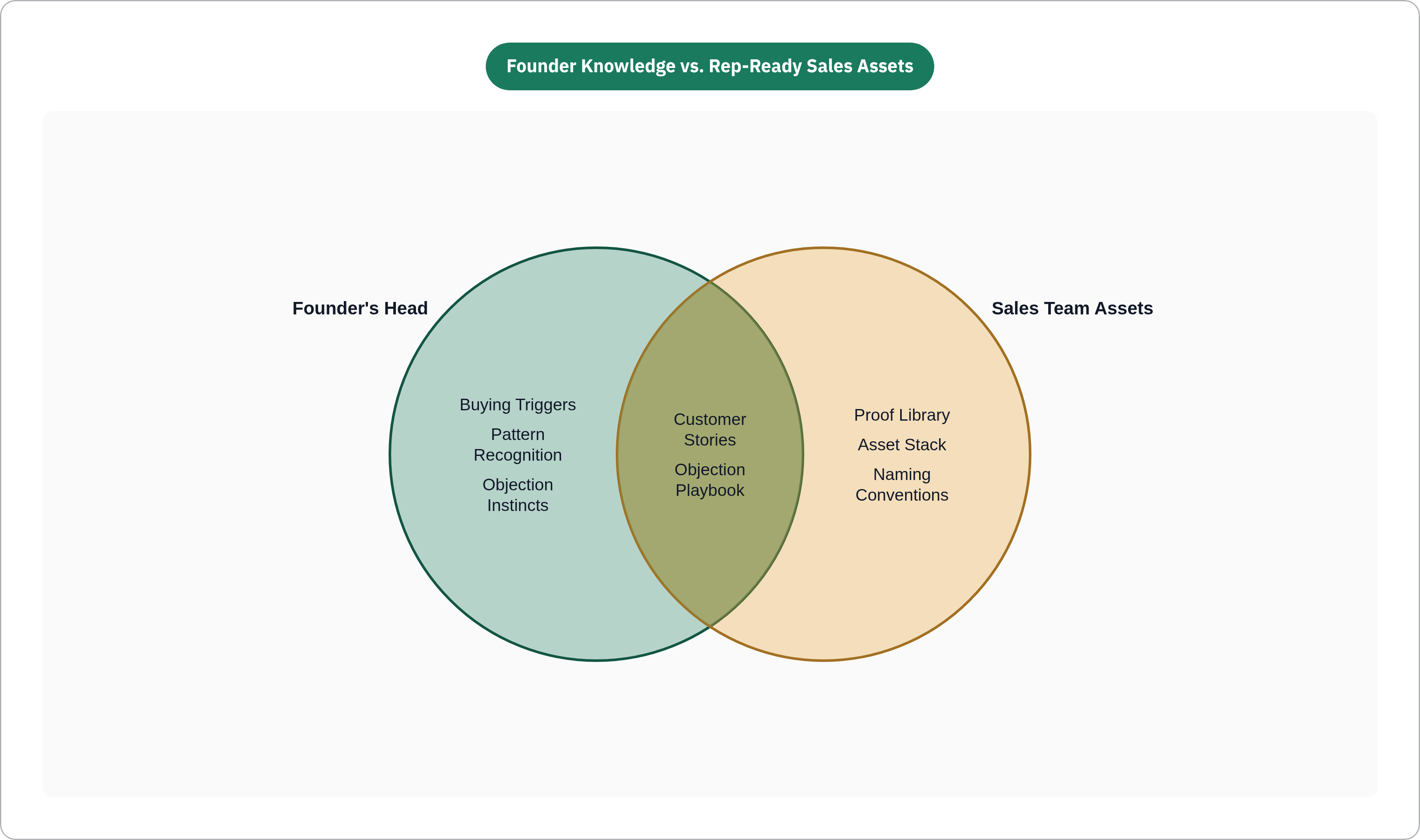
Of the three categories, customer stories are the only one a rep can deploy without improvising. A well-structured story can be memorized and delivered by anyone. It doesn't require the pattern-matched instincts the founder has built over years. It just requires knowing the story and knowing when to use it.
Objection responses require judgment. Buying triggers require experience. But a specific, structured customer story is a repeatable asset from day one.
Specificity is what determines whether a story actually works. "We helped a company like yours" fails. It's too vague to stick and too generic to build trust. "A 40-person SaaS team in your space cut their sales cycle by 30% in one quarter" lands. The prospect can place themselves in that story. They can feel the before and the after.
The research behind why this matters is worth understanding. Information delivered in story form is retained far more effectively than isolated facts. A stat the founder mentions in passing on a call doesn't stick. A story built around that stat does. This isn't a content marketing theory. It's how human memory works.
There's also a trust dimension. Research from Forrester has found that the overwhelming majority of B2B buyers trust peers in their industry, while a much smaller share trust vendor salespeople. A customer story told in the customer's own voice is the closest a rep can get to a peer referral at scale. That's not a small advantage.
The practical takeaway is this: before you build a full sales playbook, before you buy a new tool, before you hire another rep, the first thing worth producing is a small set of high-quality, specific customer stories that cover your two or three core use cases.
How to Structure a Customer Interview That Produces Deal-Closing Evidence
Most case study interviews fail immediately because of the first question. "What did you like about working with us?" produces a testimonial. The customer talks about the relationship, about how responsive your team was, about how much they enjoy the quarterly check-ins. None of that closes a deal.
A customer interview that produces actual sales evidence follows seven beats. In order.
- What they were dealing with before. The specific operational or business pain. Not a category label like "inefficiency" or "lack of visibility." The actual situation. What was breaking, how often, and who was feeling it.
- The moment that triggered the search. What changed that made the status quo unacceptable. Something usually kicks off a buying process. Find it. That trigger is often the same trigger your next prospect is feeling right now.
- What mattered in the evaluation. How they compared options. What almost sent them to a competitor. The criteria that actually drove the decision, not the ones that sound good in a press release.
- What almost blocked the deal. This is the one most interviewers skip. The objection the customer had going in, and what resolved it. This is gold. It's the founder's objection playbook, told in the customer's own words, with more credibility than anything a rep could say themselves.
- What changed operationally once they started. The first 30 days. The friction, the adoption curve, what surprised them. This is the part that makes the story feel real instead of polished.
- The measurable result. With real numbers wherever the customer approves sharing them. Specific is persuasive. Vague is not.
- What they would tell a peer in the same situation. Ask them to speak directly to someone like them who is considering making the same decision. This is peer-referral language in the customer's own words, and it's the most usable quote in the whole interview.
A few operational notes. The best time to request the interview is immediately after a major milestone or result. The customer is genuinely excited. The details are fresh. Six months later, enthusiasm fades and numbers blur.
Reduce friction for the customer. Tell them you'll handle the entire production process and send a draft for their review. The less work required of them, the higher the yes rate. And frame the value for them personally. A published case study positions their team as smart, strategic decision-makers who solved a hard problem. It's a career asset for the person who championed your product internally. Make sure they know that.
Turning One Interview Into the Assets a Sales Team Actually Uses
One well-structured customer interview does not produce one case study. It produces the raw material for an entire asset stack, without requiring any additional time from the customer.
Here's what one interview can yield:
- A long-form case study (roughly 1,200 to 1,500 words) on the website. The canonical version. Ungated. Written for SEO and for the buyers who are researching anonymously and will never fill out a lead form.
- Three to five pull quotes, tagged by objection type or buyer persona, ready to drop into outbound emails or sales decks.
- A single-metric proof point formatted for ads or cold outreach. Short. Specific. Built around one number.
- A one-pager for live sales conversations and follow-up emails. Scannable. Outcome-focused. No prose.
- Two or three LinkedIn post formats: the customer's "before" story, the result, and the lesson it holds for someone in the same industry.
- A deck slide: one result, one quote, matched to the deal stage where that use case is most relevant.
On gating: publish the long-form case study as an ungated web page. Per 6sense's 2024 B2B buyer research, 81% of buyers have already chosen a preferred vendor before speaking to a rep. Those buyers are doing anonymous research. They will not fill out a form to see proof. Gating the evidence they need to make a decision actively works against the sale.
The production principle is simple. Build the asset stack once and don't rebuild it. A rep who needs proof for a mid-cycle email should be pulling a pre-built quote, rather than writing their own summary of a case study they half-read at 9pm the night before the call.
How to Organize Proof So Reps Can Find and Deploy It in Under Two Minutes
Most B2B teams have more proof than they think. It's sitting in scattered decks, old email threads, Slack messages from happy customers, and call recordings that no one has reviewed. The evidence exists. It just isn't organized in a way that's usable under deal pressure.
The persona-match principle is the most commonly violated rule in proof deployment. A testimonial from a 10-person startup will not persuade an enterprise procurement team. A mismatched proof point doesn't just fail to help. It can actively damage credibility. Buyers notice when the evidence you're showing them doesn't reflect someone like them.
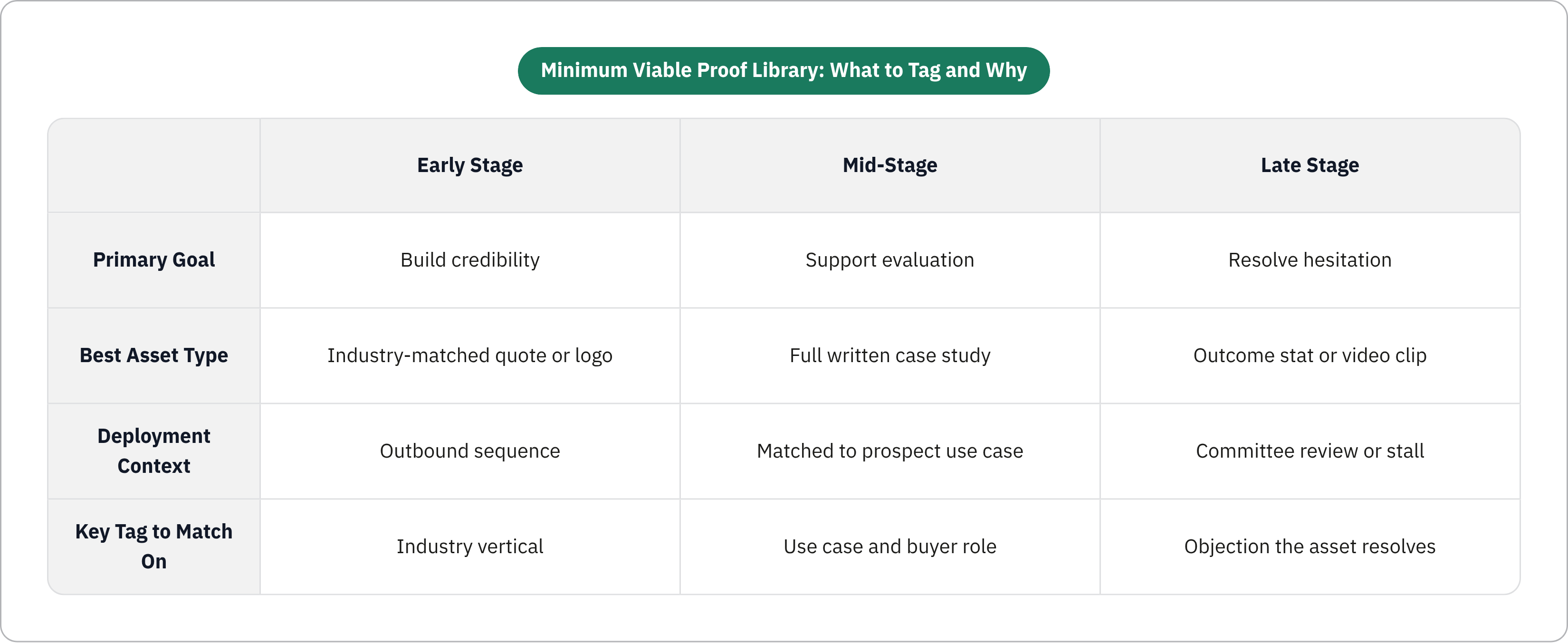
Here's the minimum viable proof library for a founder-led team. Tag every asset by:
- Industry vertical
- Company size
- Buyer role
- Use case
- The primary objection the asset resolves
A rep should be able to search "mid-market fintech, champion is VP of Ops, objection is integration complexity" and retrieve one or two assets in under two minutes. Start with a shared folder and a consistent naming convention before you invest in a platform. The discipline matters more than the tooling at this stage.
There's also hidden evidence worth surfacing. Customer language from sales calls. Specific phrases from renewal conversations. Results mentioned in QBRs. These often contain the most credible proof points available, and they cost nothing to collect.
Audit the library quarterly. Retire assets where the customer relationship has meaningfully changed. A featured customer who churned is a credibility liability if their name comes up in a reference conversation.
Match assets to deal stage:
- Early stage (credibility building): an industry-matched quote or logo in the outbound sequence.
- Mid-stage (evaluation): the full written case study, matched to the prospect's use case.
- Late stage (hesitation or committee review): a specific outcome stat, or a short video clip in the customer's own words.
Packaging the Founder's Objection Responses Into a Repeatable Playbook
Case studies handle objections implicitly, through the customer's story. An objection playbook handles them explicitly. Both are needed, and they work together.
The extraction method is straightforward. Record and review the founder's last 10 to 15 sales calls. Listen specifically for the moment an objection is raised and what the founder says in the next 90 seconds. That window is where the knowledge lives.
For each objection, capture four things:
- The exact language the prospect uses. Not a paraphrase. The words themselves. "We've tried tools like this before and they never stick" is different from "we're concerned about adoption." They require different responses.
- The founder's reframe or response. The logic, not just the conclusion. Why does this response work? What's the underlying argument?
- The customer story or proof point the founder reaches for. And why that one specifically.
- What a "resolved" signal looks like. How does the founder know the objection is behind them? A tone shift? A specific question the prospect asks next? Document that too.
The five to seven objections that account for most late-stage friction are usually consistent across deals. Identifying them is a pattern recognition exercise, rather than a creative one. Listen to enough calls and they will repeat themselves.
Format matters more than most people expect. A long document gets skimmed or abandoned entirely under deal pressure. The playbook should be scannable, indexed by objection type, and short enough that a rep can review it in the 15 minutes before a call.
Link the playbook directly to the proof library. For each objection, point to the one or two assets that resolve it. Not "see case studies." A specific link to the right story for that specific friction point.
And treat it as a living document. As competitive entrants emerge, pricing changes, or market conditions shift, the founder reviews and updates the responses. The discipline of maintaining it is what keeps the whole team calibrated over time.
Using Founder-Led Content to Make Proof Work Before a Rep Enters the Picture
Per 6sense's 2024 research, 81% of B2B buyers have chosen a preferred vendor before ever speaking to sales. Read that again. By the time a rep gets on a call, most buyers have already made up their mind. That means the founder's proof needs to be working when no one from the team is in the room.
Founder-led content is how that happens. Posting customer outcomes on LinkedIn, sharing the "before and after" of a specific use case, discussing objections publicly. These things put the right evidence in front of buyers who are researching but not yet ready to raise their hand.
The conversion math here is not subtle. Inbound outreach, where a prospect contacts the founder after consuming their content, converts at a dramatically higher rate than cold outbound prospecting. The difference is roughly an order of magnitude. Content that brings buyers to you is doing real commercial work.
What this means practically: the case study stack is not just a sales tool. It's the raw material for the founder's LinkedIn presence. Every post that shares a specific customer result is the proof library doing distribution work.
Platform priority for B2B is LinkedIn first. The audience density, the dwell time, and the algorithm's reward for substantive content make it the compounding channel. Per research from Richard van der Blom in 2025, engagement per post is up year-over-year even as organic reach has declined for many accounts. Substantive content is being rewarded.
What founder content does that a company page cannot: the founder's voice carries the credibility of the person who built the product. The same post published from a company account gets a fraction of the reach and converts at lower rates. The company page has a role. It is not this role.
Here's the reinforcing loop that makes this worth building. A rep sends a case study to a prospect. The prospect looks up the founder on LinkedIn. They see posts validating the same outcomes, told with specificity, in the founder's own voice. The content and the sales motion are now working together instead of running in parallel, each independently trying to make the case.
The Minimal System a Founder-Led Team Needs Before Hiring Their Second Rep
Founders often want to solve the tooling problem before the content problem. A new CRM, a better sequencing tool, a smarter dialer. The right order is the reverse. The tools only amplify what's already there. If what's there is an undocumented mess of founder instincts and scattered proof points, the tools just help you do that faster.
Here's what needs to exist before the second rep's first deal:
The core content assets:
- Three to five structured case studies covering the team's core use cases, ungated, with real numbers
- An asset stack cut from each case study: a quote set, a one-pager, LinkedIn post formats, and a deck slide
The organizational layer:
- A proof library organized by the tags that matter for deal-stage deployment (industry, company size, buyer role, use case, and objection)
- A shared folder with a consistent naming convention. A platform comes later.
The playbook:
- An objection document covering the five to seven objections that account for the bulk of late-stage friction, each linked directly to the relevant proof asset
That's it. That's the system. It's not glamorous. It won't make for an impressive demo. But it means the second rep walks into their first deal with the same evidence the founder has been closing on for two years. They won't have the founder's instincts. They won't have the pattern-matching from hundreds of calls. But they'll have the proof, organized and accessible, matched to the moment they need it.
That's the difference between a rep who is flying blind and a rep who is equipped. And at this stage of a company's growth, that difference is everything.