Sales Productivity Tools That Reduce Pre-Call Prep Time
AI-powered prep tools cut the chaotic research ritual into a single, structured brief.
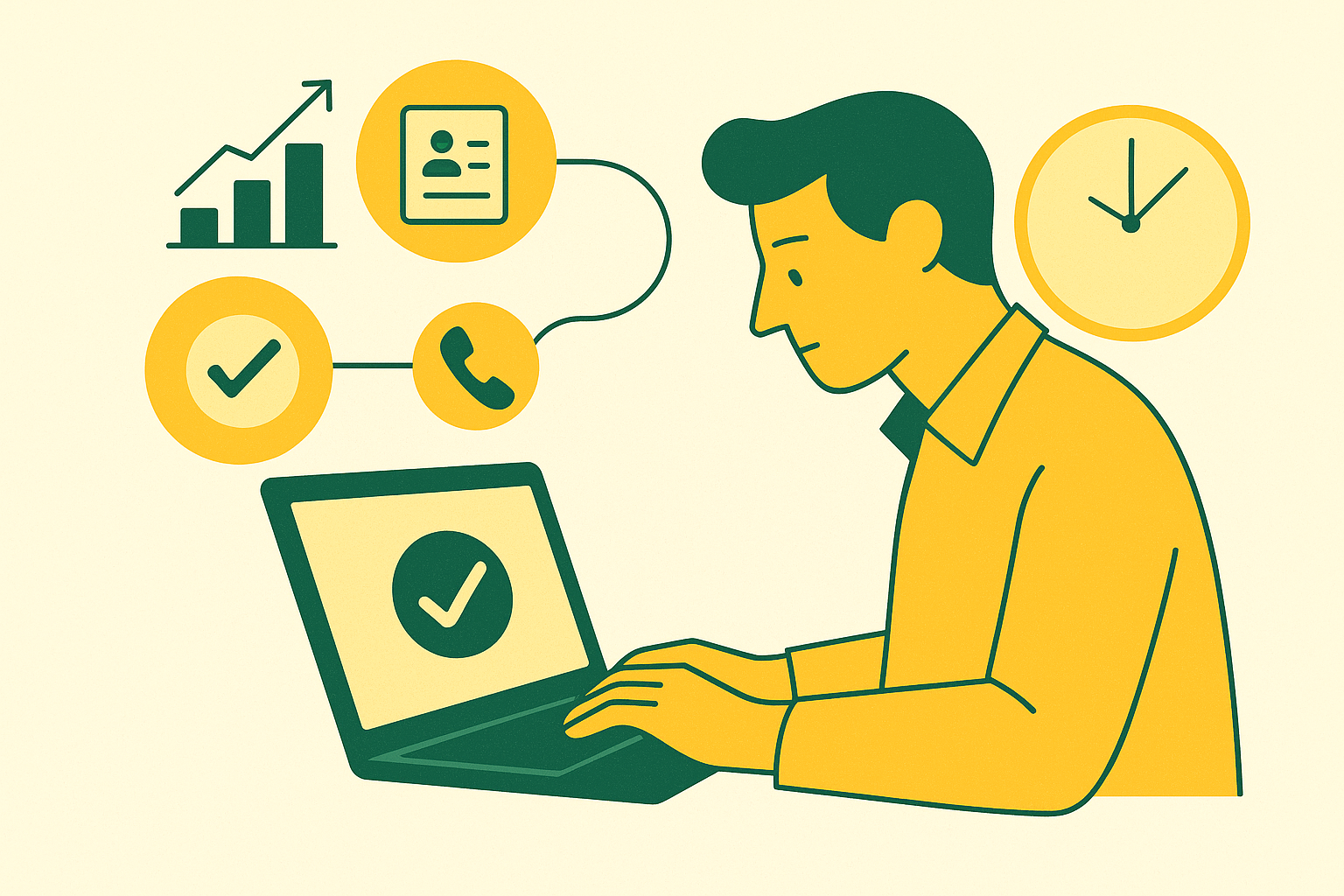
Pre-call prep wastes more rep time than most sales teams want to admit. The hour before a call typically breaks down like this:
- Open the CRM and skim deal history
- Pull up LinkedIn and scan whoever's attending
- Dig through old email threads trying to remember what was promised last time
- Hunt through a shared drive for a case study that might be relevant
- Build a one-off summary doc that will never be opened again
None of these steps are unreasonable on their own. The problem is running all five back-to-back, with nothing connecting them, before every single call.
Every tool switch carries a cognitive reload cost. You're not just changing tabs. You're rebuilding context from scratch each time you move. By the fourth app, you're already a little fried. And that summary doc you just spent twenty minutes on? Gone the second the call ends. It was built for this rep, this moment, this meeting. It doesn't build into anything. It just disappears.
What reps actually need before a call isn't complicated:
- Attendee backgrounds
- Deal history
- A customer story that matches the prospect's situation
- A suggested agenda
All of that is knowable. The inputs exist somewhere already. The frustrating part is that pulling it together is still, in 2025, a manual job.
Pavilion's 2024 Sales Tech report found that the tools reps found most useful were the ones that reduced steps and saved time. Not the most sophisticated analytics. Not the shiniest dashboards. The ones that made the pre-call ritual less painful. That's the bar. Friction removal. Full stop.
AI-powered pre-meeting briefs and what they actually automate
The pitch for AI-powered pre-meeting brief tools is simple enough. Connect your calendar, your CRM, your call recordings, and your email. Get a structured brief before the meeting starts. No hunting. No assembly. Just context, ready when you need it.
Sybill's Pre-Meeting Briefs work this way. The tool pulls from connected data sources and surfaces attendee backgrounds, company context, deal milestones, past conversation recaps, and a suggested agenda. The brief also adjusts by meeting stage. A discovery call gets different prep than a proposal review. That's the right instinct, because the questions worth asking at discovery are genuinely different from the ones worth asking when you're trying to close.
What this eliminates is the manual assembly ritual. Reps receive context instead of hunting for it. And because the output pulls from shared data sources, everyone on the team has access to it. Not just the rep who would have cobbled something together the night before.
Gartner projects that by 2027, 95% of seller research tasks will be initiated by AI. In 2024, that number was below 20%. Manual prep is becoming an edge case, at least for teams paying attention.
One design principle worth holding onto, from Pavilion's research: the best AI in sales works behind the scenes. It doesn't ask reps to learn a new system or change their behavior. It shows up inside the workflow they already have. That's the real test. If a rep has to remember to use the tool, the tool will lose.
Sales intelligence platforms that compress account research into the prospecting workflow
The research burden doesn't actually start at meeting prep. It starts earlier. At prospecting. Reps are manually identifying and qualifying accounts before a single conversation has happened, and that's where a lot of invisible time goes.
Two platform categories are doing the heaviest lifting here.
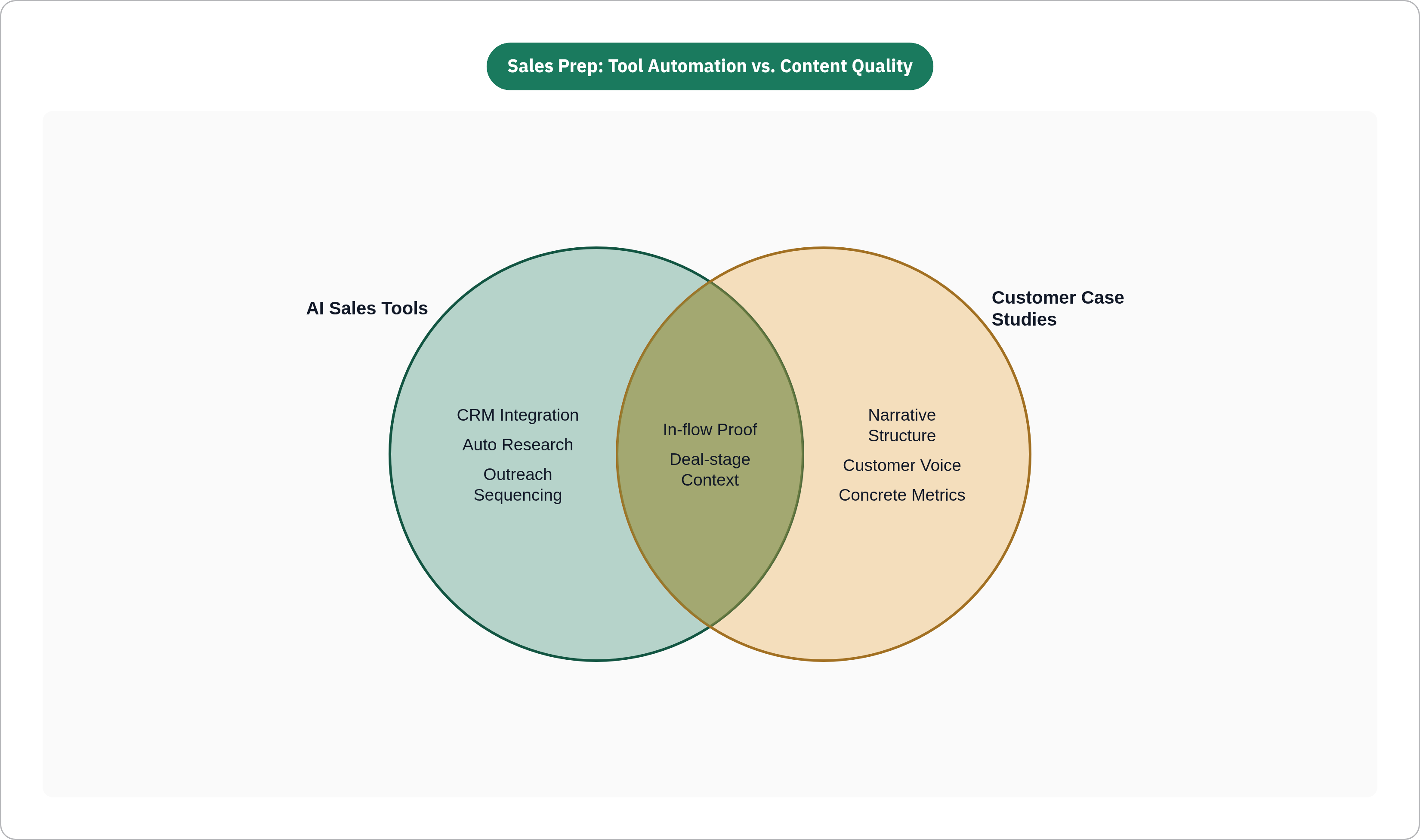
Sales intelligence platforms aggregate company and contact data so reps aren't building prospect profiles from scratch. Apollo is a clear example. With a database of over 200 million verified contacts and 60 million companies, the time a rep would spend manually tracking down the right person at the right company collapses fast. Advanced filters handle qualification. Automated outreach and AI-driven follow-ups take care of the top-of-funnel sequence. The whole process compresses.
Sales engagement platforms coordinate and log multi-channel outreach so reps aren't manually tracking what they sent, when, and to whom. Salesloft handles outreach sequencing, deal scoring, meeting prep, and conversation summaries. The administrative overhead that stacks up between calls gets absorbed by the platform instead of by the rep.
The compound benefit is real. When research and engagement both live inside the same platform, the pre-call brief has richer, more current data to pull from. Better upstream data means better downstream context. These tools reinforce each other in ways that aren't obvious until you're actually using both.
Gong's 2024 State of Sales Productivity report found that 85% of reps used AI in the past six months, and those reps spent 44% of their time on customer-facing work. That's not a marginal shift. That's a meaningful reallocation of where the day actually goes.
In-flow enablement tools that surface content without breaking a rep's focus
Here's a prep failure that happens constantly and nobody talks about enough. The rep knows a relevant case study exists somewhere. They just can't find it before the call. So they go in without it. Or they spend ten minutes frustrated, tab-switching, coming up empty, and then feeling slightly off-balance once the call starts.
In-flow enablement tools solve a different layer of this problem. Not research generation. Content surfacing. Getting the right asset in front of the rep at the moment it's actually relevant.
Spekit is a useful example. It delivers resources, coaching, and context inside the tools reps already use. Salesforce. Email. Slack. The rep doesn't navigate to a separate content portal. The content comes to them. AI recommendation engines take this further by suggesting the most relevant playbooks, case studies, or one-pagers based on specific deal context. Industry, stage, persona, competitor. The system reads the situation and surfaces the proof that fits.
An analysis of real questions sales reps asked about customer proof found that requests for case studies, customer stories, and similar-company reference lists made up over 66% of all queries. Not thought leadership. Not general product information. Structured, shareable proof matched to the prospect's situation. That's the dominant ask. Tools that surface this proof in-flow address the highest-volume need reps have, and they do it without requiring anyone to break focus and go hunting.
The design logic is straightforward once you see it. Content appears in the context where the rep is already working. Not in a separate system they have to remember to visit.
Why the proof reps need most (customer case studies) is often the hardest to produce
Most companies are sitting on a case study gap they don't fully want to admit. A platform that surfaces case studies instantly is only as valuable as the case studies actually living in the system. And most companies don't have enough good ones.
Content Marketing Institute's 2025 data found that case studies significantly influence the purchasing process for nearly three-quarters of B2B decision-makers. But only about a third of companies use them effectively. That's a wide gap between how much this stuff matters and how often companies actually pull it off.
Why is production so slow? Extracting proof from customers is genuinely coordination-heavy work. You have to schedule the interview. Conduct it. Turn a raw conversation into a structured narrative. Get legal involved. Get the customer to approve it. Sales feels the pain of missing proof in real time, deal by deal. Marketing feels the production burden without the same deal-level urgency. The result is a backlog that never really clears.
And when case studies do get made, they often fail anyway. Not because nobody tried. Because they fall into predictable traps:
- Missing hero. The story never properly introduces the customer or their specific pain. Buyers can't project themselves into it.
- All features, no problem. Lists product capabilities without connecting them to a real situation.
- No hard numbers. Lacks the concrete metrics that make a result believable and quotable.
- Stripped voice. Written in corporate language that removes the one thing buyers are actually looking for: authenticity.
That last one matters more than people realize. Buyers don't read case studies as pure information. They're asking: does this look like my situation? Does this look like my problem? When the match fails, the proof fails. A vague story about a generic enterprise company solving a fuzzy challenge doesn't give a buyer anything to grab onto. It creates recognition of nothing. Which means it does nothing.
How to source customer stories that have both the results and the narrative to persuade
Not every happy customer makes a good case study subject. The selection decision matters just as much as the production process, maybe more.
The best candidates combine two things: quantifiable results and a narrative that resonates with the prospect types most active in your current pipeline. The real question isn't "who had a good experience?" It's "does this story address the objections and questions reps are actually hearing right now, in the segment the team most needs to win?"
Where do you find candidates? Customer success teams have the clearest view of who's genuinely succeeding. Sales teams know which objections keep surfacing. Cross-reference those two inputs and the highest-value candidates get obvious pretty quickly. Let the deal pipeline drive selection criteria. Not the best relationship with marketing. Not whoever's easiest to schedule.
Forrester's 2025 research found that a significant majority of B2B purchasing decisions are made before the first sales contact. Buyers are doing self-directed research before a rep ever enters the picture. That means the stories already in market need to match the questions prospects are asking on their own, not just the ones that come up in late-stage calls.
One generic case study can't serve both ends of that journey. An awareness-stage researcher needs to know the problem is solvable at all. A late-stage buyer needs to validate a specific vendor choice. These are genuinely different psychological moments. They require different proof, and you won't accidentally produce one story that handles both.
The usage data makes the stakes clear: a substantial portion of B2B buyers name case studies as their most important research resource when making purchases. These aren't passive marketing assets sitting on a website. They're active decision inputs. Treat them accordingly.
Structuring customer interviews and stories so they convert rather than inform
Most case studies fail at the interview stage, not the writing stage. If the conversation doesn't surface the right material, no amount of good writing fixes it afterward.
The interview structure that actually works moves through three moments:
- Before. The specific challenges. The frustrations that had been building. The breaking point that made change feel necessary.
- During. The decision journey. What alternatives were on the table. Why this vendor was chosen over the others.
- After. Concrete results with real metrics. Unexpected benefits. What the new normal looks like day to day.
Each moment serves a different buyer need. Before creates recognition. During handles competitive anxiety. After provides the result they're actually buying toward.
The narrative arc that converts goes: challenge introduction, decision point, implementation including the struggles, transformation, ongoing reality. That middle piece (the struggles) is the one that gets cut most often. It shouldn't be. Struggles make the result credible. Without friction in the story, the transformation looks miraculous and unearned. Buyers have seen too many polished PDFs to fall for miraculous.
The B2B Marketing Institute's analysis of successful B2B case studies found that stories containing five key elements achieve meaningfully higher conversion rates than those missing any of them: a results-driven title, customer context, a clear solution path, concrete measurable results, and authentic customer voice. That last one isn't a nicety. It's a conversion variable. Editing the customer's actual language out of the story in favor of polished corporate copy kills the proof's persuasive force. Every time.
Stanford neuroscience research backs up why structure matters at a more fundamental level. Information in story form is retained significantly better than isolated facts. Structure isn't just aesthetically preferable. It determines whether the proof sticks after the call ends, when the buyer is back at their desk making a decision.
Turning one customer story into proof assets that work across the sales cycle
The production cost of a single good case study is high. The distribution strategy should squeeze every bit of value out of it.
One story can become:
- A full written case study
- Social posts highlighting key results
- An email campaign segment
- A video testimonial
- A sales presentation slide
- A LinkedIn article
- A homepage snippet
Each format serves a different channel and a different moment in the buyer's journey. The same proof, packaged differently, reaches buyers at awareness, at consideration, and at decision. You're not creating seven different stories. You're telling the same story seven different ways to seven different versions of the same buyer.
Uplift Content's research found that the most common way case studies actually reach buyers is through sales reps using them directly in calls, emails, and pitches. Not the website. Not social media. The rep. Social sharing was second. Website placement was third.
Arm reps first. Then amplify through owned channels. If your case study launches on the website before it's in the hands of your sales team, the priority order is backwards.
Video deserves a mention here because it's genuinely the highest-leverage format for proof when you can get it. A customer talking on camera, in their own words, about a specific result does more persuasive work than any polished PDF. It solves the authentic voice problem in format form. You don't have to wonder whether an editor scrubbed the personality out. It's right there on screen, in the customer's face and tone of voice.
Pre-call prep is a solvable problem. The tools exist to automate research, surface proof at the right moment, and reduce the friction that quietly drains rep time every day. But the tools are only as good as the proof inside them. Build the case studies. Structure them to convert. Get them into reps' hands first. Then let the platforms do the rest.