Competitive Battle Cards vs One-Pagers for Late-Stage Deals
Battle cards prep reps; one-pagers convince skeptics you never meet.
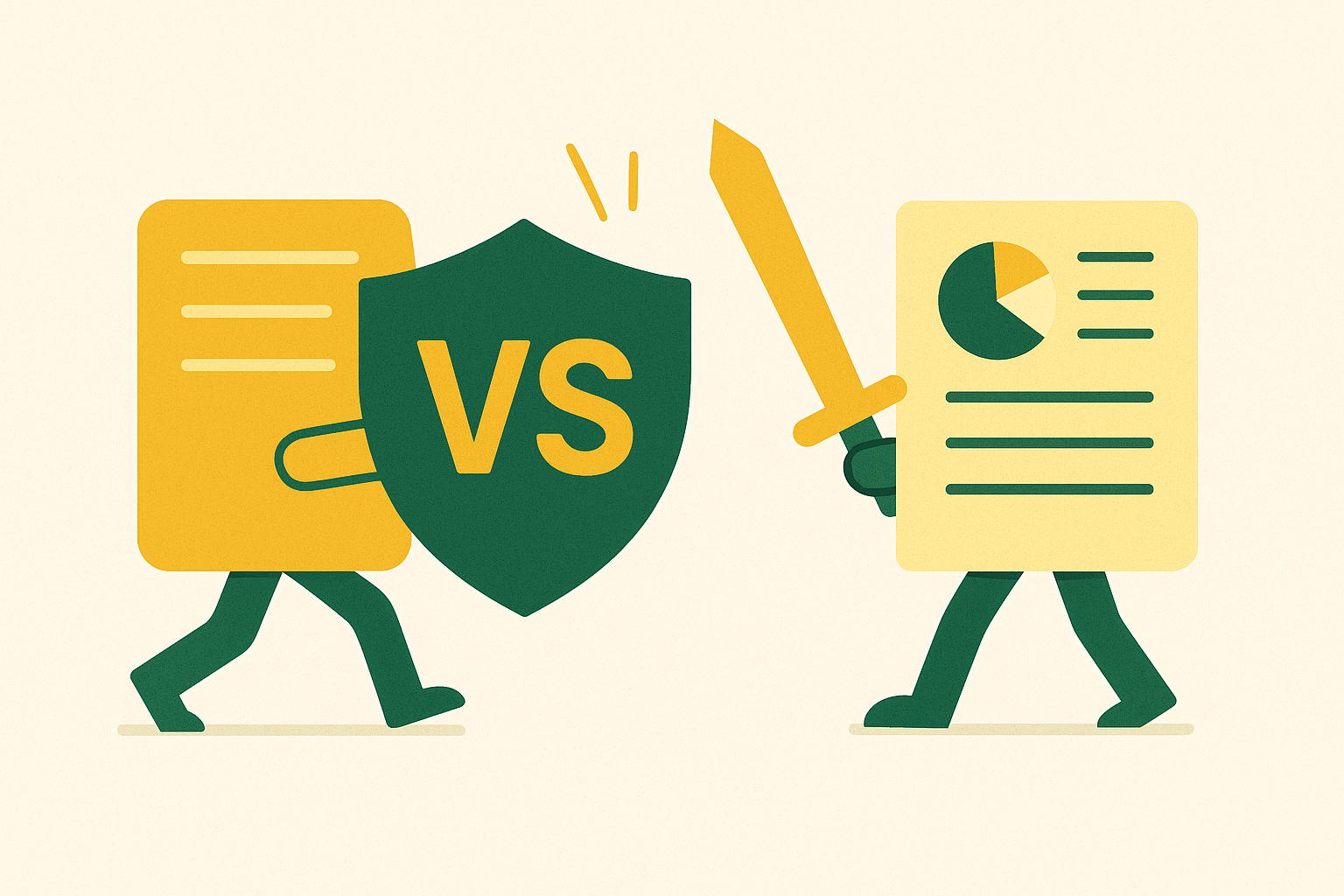
Late-stage deals have a way of exposing every gap in your sales process. The messy competitive objections, the invisible stakeholders, the champion who suddenly needs to justify the decision to someone you've never met. Most teams try to solve all of it with whatever content they can find fastest. That's usually where things go sideways. Battle cards and one-pagers both feel like "sales content," both come from marketing, and both are short enough to skim. But they are built for completely different jobs. Using one when you need the other doesn't just fail to help. It can actively cost you the deal.
Why late-stage deals specifically stress-test this distinction
Early-stage deals forgive a lot. The buyer is still exploring. The rep can recover from a bad call, reframe a message, or just try again next week. Late-stage is a different environment entirely.
By the time a deal hits late stage:
- A shortlist exists. Competitors aren't hypothetical anymore. They're named.
- More stakeholders are in the room, most of whom the rep has never met.
- The buyer is managing two separate problems at once: beating out the competition externally, and building alignment internally.
- Every misstep has more weight, because the deal can die in two distinct ways. It can get lost to a competitor. Or it can stall because the champion couldn't get internal buy-in.
Those two failure modes require different tools.
When competitive pressure is the threat, the rep needs intel. Talk tracks. Specific counters to specific rivals. That's a battle card problem. When internal friction is the threat, the champion needs something they can hand to a skeptic. Something self-explanatory and credible without the rep in the room. That's a one-pager problem.
Sellers encounter competitors in 68% of deals, per Crayon's 2025 State of Competitive Intelligence report. In those deals, the rep is managing both problems at the same time. Which is precisely when it's easiest to reach for the wrong tool.
What a late-stage battle card actually contains and how reps use it
Let's clear up what a modern battle card actually is, because the old version doesn't really work anymore.
The old version was a printed feature comparison. Side-by-side columns, basic pros and cons, maybe a few talking points. Useful in theory, clunky in practice, stale within months.
The current version is a live competitive intelligence tool. Structured for real conversations, not for reading aloud. Built around how competitors actually sell, not just what their product does.
A strong late-stage battle card covers:
- Company and product profile of the specific competitor
- Three to five outcome-driven differentiators (not feature lists)
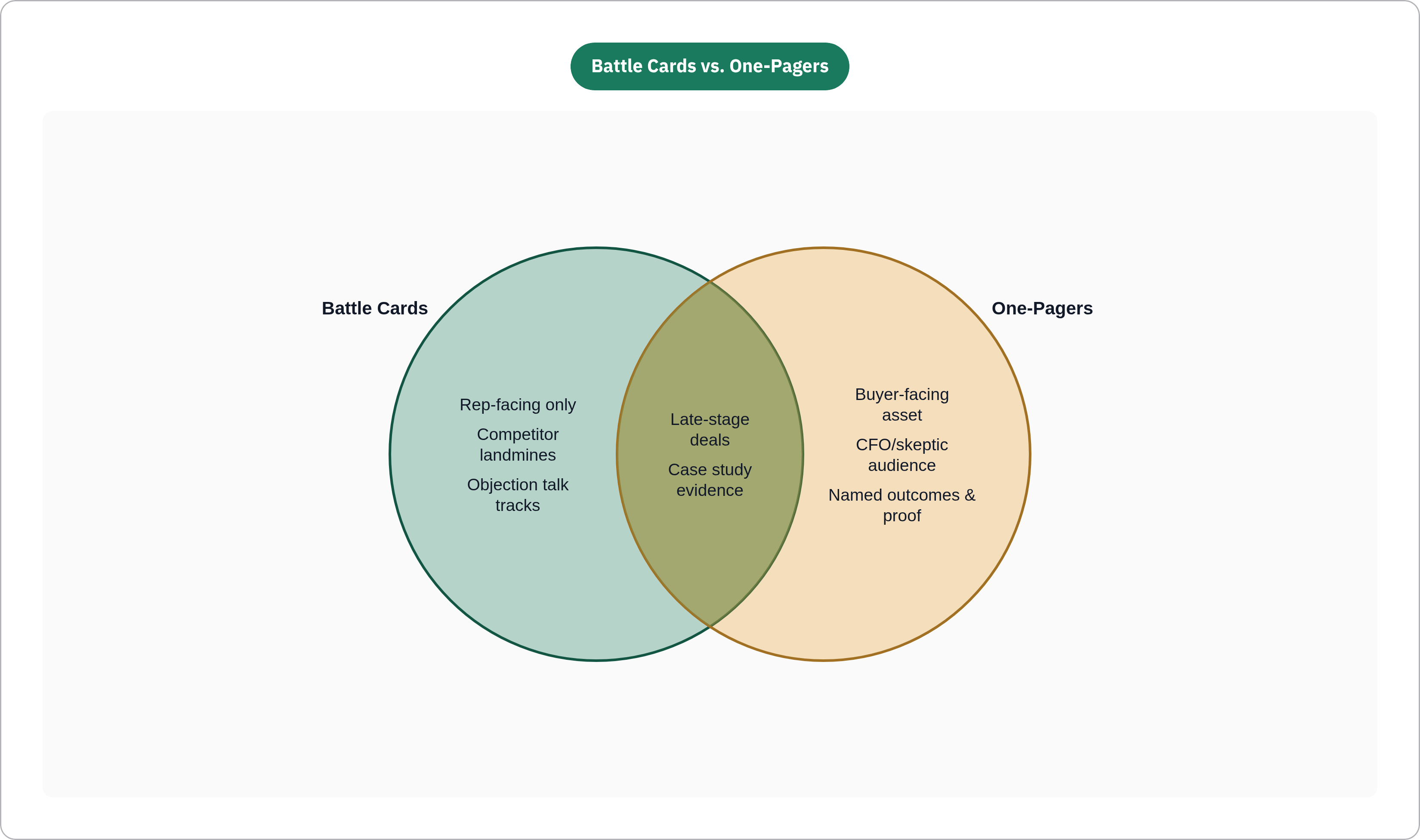
- Approved objection-handling talk tracks the rep can internalize and adapt
- Landmine questions that surface a competitor's weaknesses without the rep having to make the accusation directly
- Proof points tied to that rival specifically. Win stories from buyers who switched. These are the most credible thing on the card.
- Links to deeper resources for when the deal escalates beyond the standard objections
HubSpot's "One-to-One Competitive Card" format, which focuses on a single competitor rather than a crowded matrix, is described as "invaluable in closing sales" and explicitly includes case studies from customers who switched from that specific rival. The depth is the point. Generic doesn't survive late-stage scrutiny.
How reps actually use this: before the call to prepare, during a break to check a specific objection, after a tough question lands to think through the right response. Not read aloud at the table. Not forwarded to the prospect. Not dropped into the shared deck.
That last part matters. The moment a battle card leaves the rep's hands and lands in the buyer's inbox, it stops being a battle card. It becomes a comparison sheet. And a comparison sheet written for a rep's eyes, full of competitor landmines and internal talk tracks, is not something you want a buyer analyzing.
What a late-stage one-pager actually contains and who it's really for
Here's the thing people get wrong about one-pagers: the champion is not the real audience. The real audience is whoever the champion has to convince next.
That's the CFO who skipped every demo. The IT or security lead who has concerns about risk. Procurement running a vendor comparison. The executive sponsor who has two minutes and zero context.
These are not people who know your product. They're not familiar with your category. They have no reason to trust you yet. The one-pager has to do the whole job without the rep there to fill in the gaps.
That means it has to answer three questions clearly:
- What does this do?
- Why does it matter?
- Why should we trust it?
The first two are table stakes. The third one is where most one-pagers fall apart.
What actually earns trust at this stage is specific customer evidence. Not a testimonial blurb. Not a logo wall. Named outcomes. Real numbers. Before-and-after framing that a skeptic can evaluate.
And relevance matters more than quantity here. Research from UserEvidence found that similar industry matters to 70% of buyers when evaluating proof, similar use case to 54%, and similar company size to 49%. One case study from the same industry and same scale as the buyer outperforms five polished but generic ones. Every time.
The case study embedded in or attached to the one-pager is doing the heaviest lift. It's not decoration. It's the proof the internal skeptic needs to say yes.
The deployment decision: which asset to reach for and when
The trigger question isn't "what stage is the deal?" The trigger question is: "who has the problem right now?"
If the rep has the problem, it's a battle card moment. If the buyer has the problem, it's a one-pager moment.
Here's how that maps to common late-stage scenarios:
- "We're also evaluating Competitor X." The rep uses the battle card to prepare the counter. If the buyer is running a formal vendor review, a clean comparison one-pager is appropriate too. But the battle card itself doesn't travel.
- "I need to bring this to my CFO." One-pager. Match the customer evidence to the CFO's industry and company size. Make it something they can read in four minutes and feel confident about.
- "Competitor told us they do the same thing." Battle card talk track. The rep uses it to expose the gap in conversation. The card doesn't get handed over.
- "Can you send something I can share with my team?" One-pager. Not the battle card. Never the battle card.
The important nuance here is that these are often parallel activities, not a fork in the road. The rep prepares with the battle card before the call. They send the one-pager after it. Both things happen. They just happen in different directions.
Teams using structured battle cards win 23% more competitive deals, per sifthub.io's 2026 data. The takeaway isn't that battle cards alone close deals. It's that internal preparation and buyer-facing proof work together. One doesn't replace the other.
Why battle cards fail even when the content is good
Here's a number that should bother every team producing battle cards: 79% of competitive intelligence professionals say they produce battle cards for their sales teams. Only 26% say reps actually use them enough, per Crayon research.
That gap between production and use is the real problem. And content quality is rarely the root cause.
There are two actual failure modes:
Discovery failure. The rep can't find the card when they need it. It's buried in a shared drive. It's not in the CRM. It's not surfaced anywhere near where the rep already works. When you need competitive intel in the middle of a live deal cycle, "I'll go search for it later" doesn't cut it.
Staleness failure. The card was accurate when it was built, which was 18 months ago. The competitor has updated their product since then. The rep uses the old intel, and the prospect corrects them. That moment is worse than having no card at all. It signals to the buyer that your team isn't paying attention.
The fixes aren't complicated, but they require actual infrastructure.
For discovery: pin it in Slack, embed it in the CRM by competitor name, surface it where reps already live. The card has to find the rep. The rep shouldn't have to hunt.
For staleness: build in a refresh cadence. Monthly at minimum for the competitors that come up most. And here's something important from syncgtm.com's 2026 data. Content that reps co-create with marketing gets used three times more than content marketing builds alone. Battle cards need rep input to stay credible and to stay used.
The manual build cost doesn't help. Conventional methods take five to ten hours per competitor, per oneshot.ai's benchmarks. That kind of overhead is exactly why most teams fall behind on maintenance. You build it once and hope it holds.
Why one-pagers fail even when the design is clean
The design is almost never the issue. The evidence is.
A beautifully formatted one-pager full of generic claims gives a skeptical CFO nothing to work with. "Customers love us." "Industry-leading solution." "Trusted by thousands." These phrases look like confidence. They read like noise.
The sourcing problem is specific and common: teams grab the most polished case study they have, not the most relevant one. A gorgeous case study from a Fortune 500 tech company means very little to a mid-market manufacturing buyer evaluating the same product. Polish doesn't substitute for match.
67% of B2B buyers have ruled out a vendor due to untrustworthy evidence, per UserEvidence's 2025 Evidence Gap report. Not "evidence they didn't find compelling." Evidence that actively damaged credibility. Vague or unverifiable proof at late stage doesn't just fail to help. It moves the deal backward.
The fix is a library problem, not a design problem. Build customer evidence organized by industry, company size, use case, and competitor. So when a rep is heading into a CFO conversation with a healthcare company, they're not pulling the best-looking case study they can find. They're pulling the one that says "we did this for a healthcare company your size and here's what happened."
That specificity is what earns the "that's us" reaction from a committee. Nothing else really does.
Building a system so reps always have both assets ready when the deal demands them
The underlying problem both assets share is that teams treat them as projects instead of systems.
Battle cards get produced for a product launch, celebrated once in a team meeting, and then quietly ignored until a rep emails asking for help with a competitor. One-pagers get designed for a campaign, published to a folder, and left there while the deals they were meant to support keep moving without them. Neither gets refreshed. Both get abandoned.
A functioning system looks like this:
For battle cards:
- Joint ownership between Product Marketing (positioning, differentiation) and Sales Enablement (real-world usability)
- A defined refresh cadence, not "we'll update it when something changes"
- Embedded in CRM by competitor name so the card surfaces in the deal, not in a separate search
For one-pagers and customer evidence:
- A repeatable interview process. Capture the customer story once, then produce every format the sales motion needs from that single source.
- An evidence library tagged by industry, company size, use case, and competitor. Reps query for relevance, not just for availability.
The flywheel that makes this self-sustaining:
Win stories from competitive deals feed the next round of battle cards as proof points tied to specific rivals. Those battle cards generate more wins. Those wins generate more stories. The system compounds.
Reps already spend only 30% of their time actually selling, with 440 hours per year lost to searching for content, per sifthub.io's 2026 data. A system that surfaces the right asset at the right moment doesn't just save time. It returns that time to selling. For the customer evidence side of that system, some B2B SaaS teams outsource the production entirely to managed services like Verbatim, a done-for-you service that builds and runs ongoing case study and testimonial engines so sales always has fresh, structured proof to draw from. That's the actual return on the infrastructure investment.
If your team has neither asset working well right now, start here: identify the competitor you lose to most. Build one deep battle card on that competitor. Build one matched customer one-pager using evidence from a buyer in the same industry and size band as your most common prospect profile. Test both in real deals. See what breaks. Then fix it before you scale.
That's it. One competitor, one card, one one-pager. The rest is iteration.