Customer Evidence Programs at Series A Startups
Most B2B deals are decided before sales calls even happen.

By the time a buyer gets on a call with your rep, they've already decided who they like.
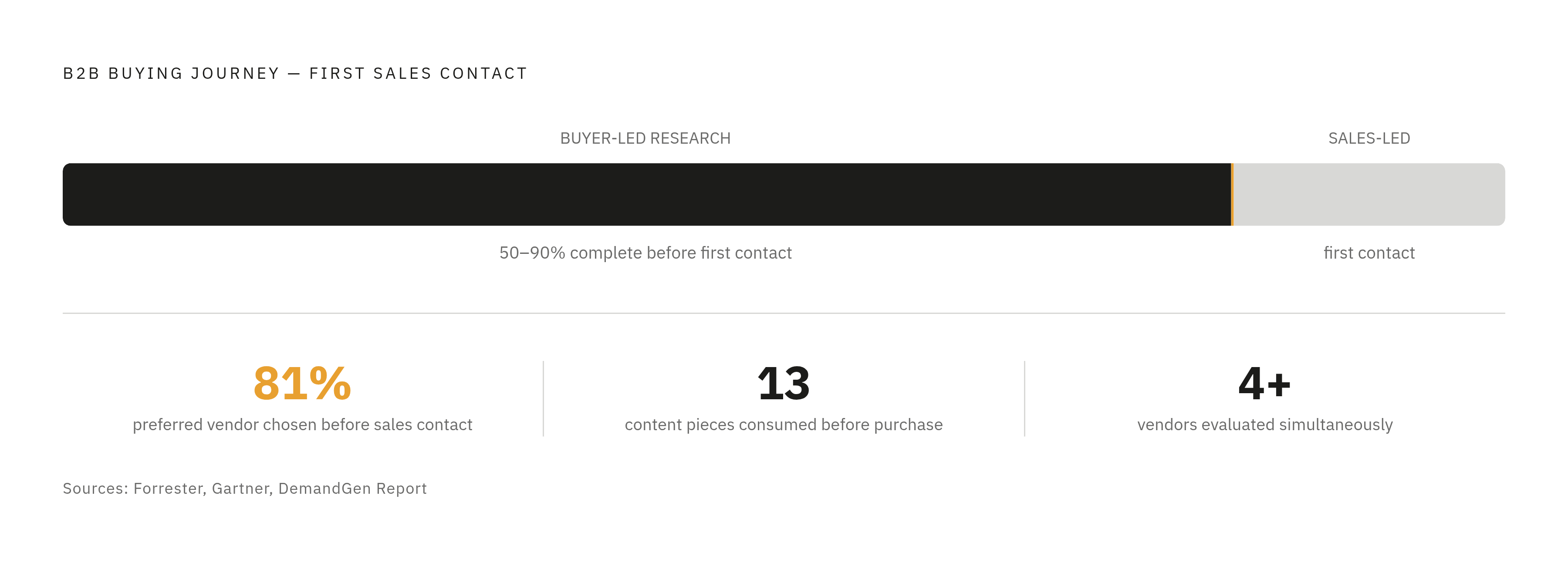
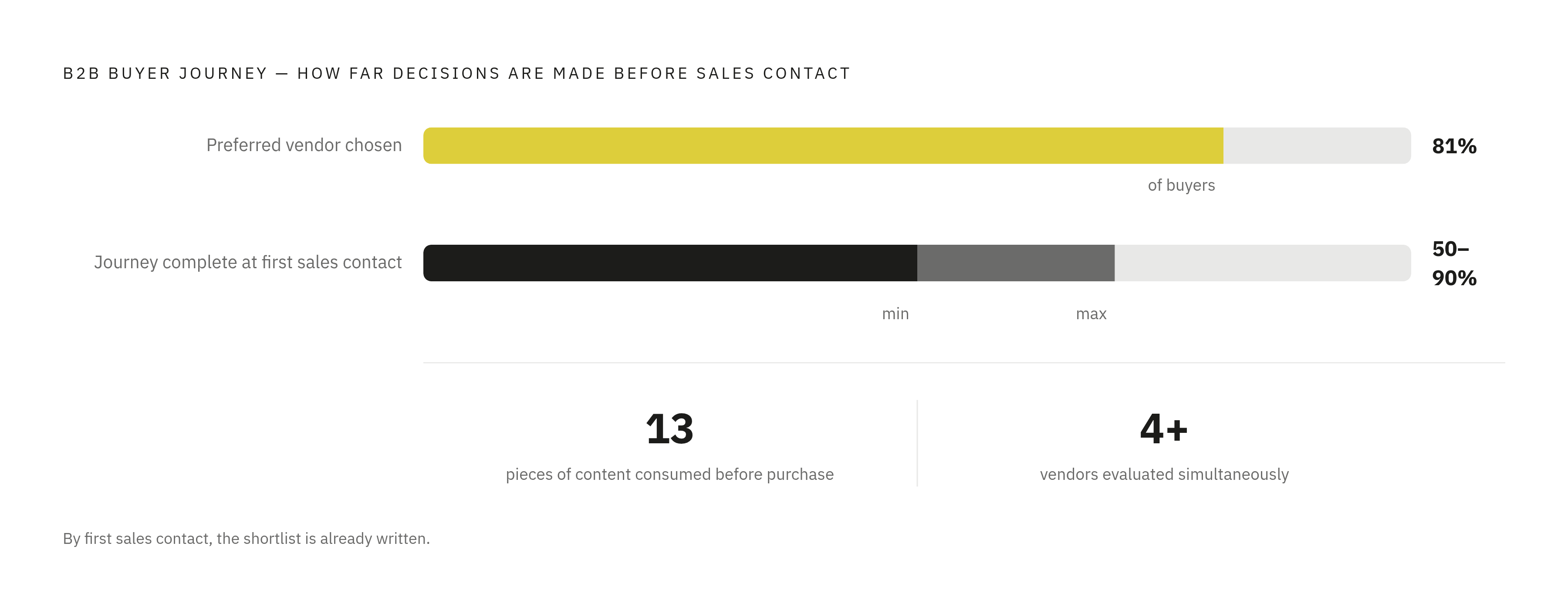
The number is 81%. That's the share of B2B buyers who have already picked a preferred vendor before they ever engage with sales, according to UserEvidence's 2025 Evidence Gap report. The buying journey is between 50% and 90% complete before first contact. Buyers consume an average of 13 pieces of content before finalizing a purchase. Nearly half are evaluating four or more vendors simultaneously.
Your reps aren't the first impression. Your evidence is.
And buyers are not patient about weak evidence. 67% of B2B buyers, per the same report, have ruled out a vendor because the proof felt untrustworthy. Not the product. The proof. The thing you probably haven't spent nearly enough time on.
B2B proof is also different in kind from what works in consumer contexts. Star ratings don't move enterprise deals. What actually moves them:
- Verified ROI data tied to outcomes a buyer actually cares about
- Stories of switching from a competitor they're currently using
- Cases from their own industry or role, not some vague generic use case
Three psychological levers drive evidence in B2B contexts. Authority (a recognizable logo signals legitimacy). Similarity (a buyer in financial services wants to see a financial services customer). And volume (the sense that a lot of smart people have made this bet and come out fine).
If your evidence isn't findable, specific, and credible during the self-directed research phase, you're losing deals you never even knew were in play. By the time your rep gets on a call, the shortlist is already written — you're either on it or you're not. Think of it like a restaurant reservation list: if your name isn't on it before you show up, no amount of charm at the door gets you a table.
Why the Classic Case Study Format Isn't Built for How Reps Actually Sell
The two-page PDF case study is not evil. It's just built for the wrong job, and handed to people at the wrong moment.
It was designed for awareness. It tells a complete, polished story with a beginning, middle, and tidy resolution. Great for a conference booth. Almost useless when a rep needs a single credible stat for a follow-up email they're writing at 4pm on a Thursday before a call at 4:30.
The production problem makes everything worse. Customers are protective of their playbooks. Champions leave mid-cycle. Legal approval can sit in a queue for months. Coordinating a real case study is a genuine project management burden, and most early-stage teams don't have the slack to absorb it. So you end up with a company that has hundreds of customers and case studies from maybe a dozen of them, if you're lucky.
Then there's how reps actually behave in the real world, which is not how anyone designs content for. They're not browsing the asset library between calls, and they're not submitting requests three days before they need something. If the right piece isn't in front of them at the right moment, they do one of two things: they send nothing, or they write something from scratch. Sales reps waste an estimated 440 hours per year searching for content, and 40% of content gets recreated because teams can't find what already exists.
The format mismatch is the root of it. A polished narrative PDF doesn't help when what's actually needed is:
- A one-line stat for a follow-up email
- A competitive displacement story for a slide
- A reference customer in a specific vertical, fast
The classic case study answers a question no one was asking at the moment it mattered. It's a Swiss Army knife handed to someone who needed a scalpel.
The Structural Shift: From Case Study Production to a Customer Evidence Program
A customer evidence program is not a content calendar. It's not a case study backlog with a fancier name. It's a system, and the difference between having one and not having one shows up directly in pipeline.
Three things it has to do well:
- Collection. Capturing proof where it already lives. In calls, QBRs, check-ins, review sites. Not waiting around for customers to volunteer it at a convenient time.
- Packaging. Structuring that proof into formats that match how it will actually be used. Long-form for some contexts, one-liners for others, data for late-stage economic buyers.
- Deployment. Getting the right evidence to the right rep at the right deal stage without requiring a manual Slack message every single time.
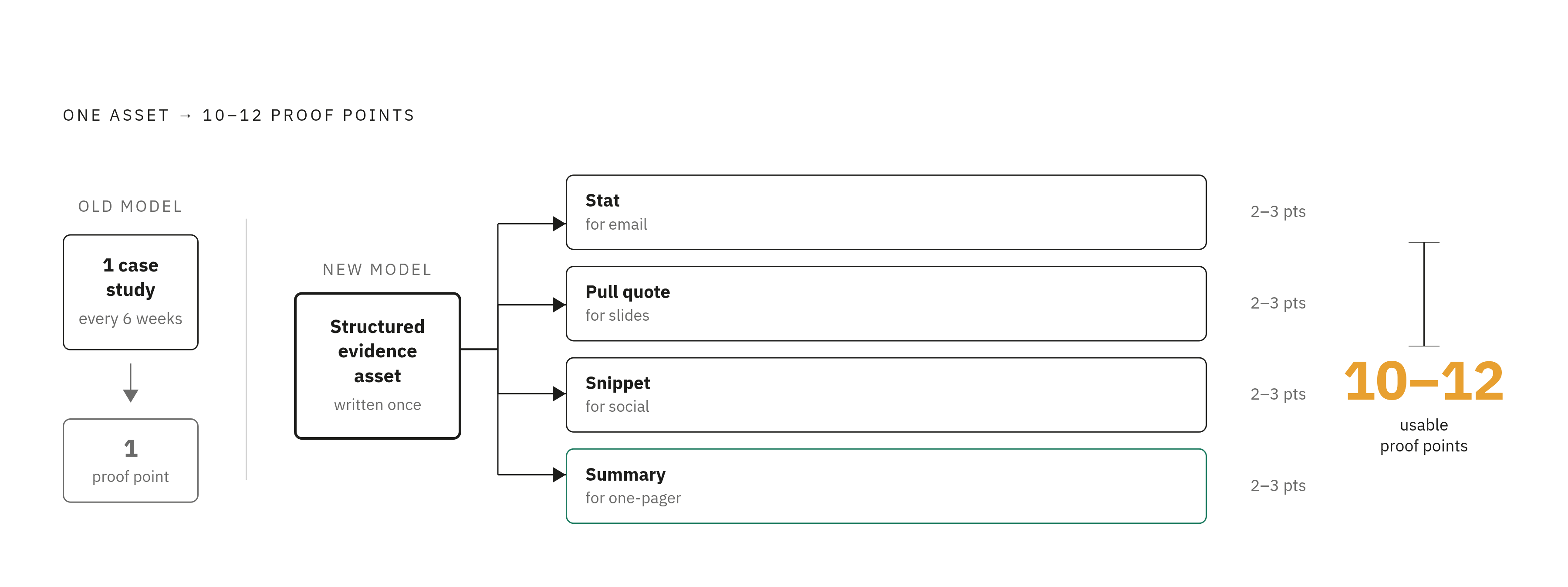
The modular approach is where most teams have a small revelation. You write the long-form story. Fine. But at the same time, you extract the stat for email, the pull quote for a slide, the snippet for social, the summary for a one-pager. You do it once, at production time, not retrofitted six months later when nobody has bandwidth and the details are fuzzy.
This changes the unit of work. Instead of producing one case study every six weeks, you produce one structured evidence asset that yields ten or twelve usable proof points across formats.
Compare that to how most Series A teams are actually running things. Sales asks for a healthcare reference on Friday afternoon. Someone Slacks the advocacy manager. The advocacy manager digs through a spreadsheet or their memory. The deal sits. That workflow holds up fine when you have five reps and the founder knows every customer personally. It falls apart the moment you have ten reps and a pipeline that spans three verticals.
Where Customer Proof Already Exists and How to Surface It Systematically
Most of the proof you need is already out there. It's just not being captured.
Sales calls. QBRs. Product demos. Onboarding check-ins. Support conversations. G2 and TrustRadius. The raw material is being generated constantly, in conversations your team is already having. Nobody is mining it.
When a customer says "this saved us 20 hours per week" on a QBR call, that number disappears unless someone flags it, tags it, and puts it somewhere findable. Whose job is that? At most Series A companies, it's nobody's job. So nobody does it.
AI-assisted capture changes that dynamic. Platforms can monitor call recordings, flag outcome statements, and tag them by industry, use case, and competitor context. The work happens in the background. The proof doesn't evaporate into the ether.
Structured surveys are the other piece. Deployed post-onboarding or at key milestones, they generate quantified outcome data at scale without depending on a customer remembering to mention something useful in a meeting. You ask directly. You get numbers.
For industries where named case studies are a non-starter, cybersecurity, financial services, healthcare, blind-but-verified testimonials are a legitimate substitute. 60% of buyers trust blind-but-verified testimonials versus 64% for named ones, according to UserEvidence's 2025 Evidence Gap report. That gap is small enough to work with. It unlocks proof in verticals that would otherwise go completely dark.
The tagging architecture matters as much as the capture itself, maybe more. Evidence indexed by industry, company size, use case, and competitor gives reps actual filters they can use. Evidence dumped in a shared Google Drive with inconsistent file names gives reps a reason to give up and write their own thing.
How to Package Evidence for the Moments That Actually Move Deals
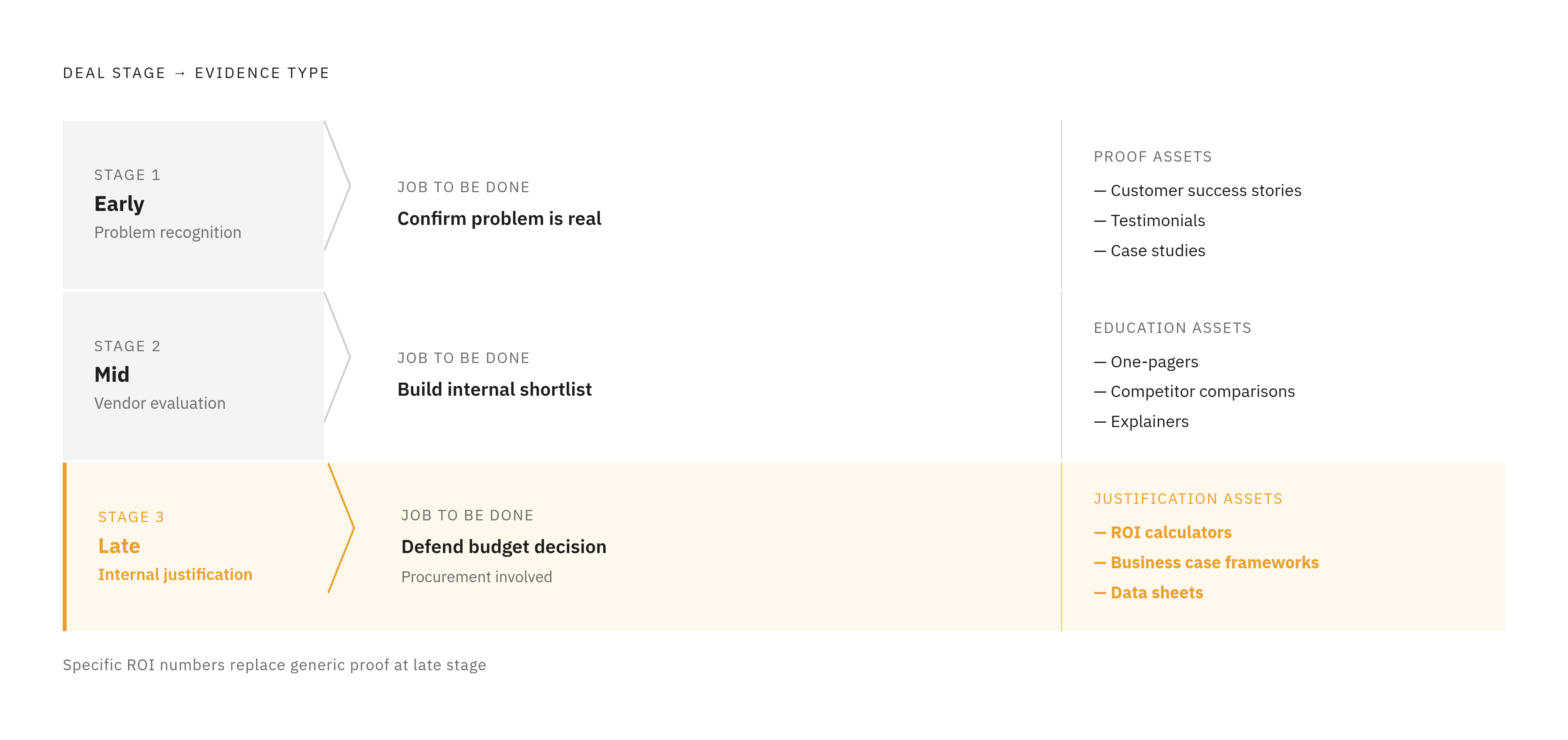
Different moments in a deal need different kinds of proof. A number that matters to a finance VP means nothing to a frontline manager doing the evaluation. Treating all evidence the same is where teams quietly leave money on the table.
Three rough categories, mapped to where they actually get used:
- Proof assets. Customer success stories, testimonials, case studies. Used in early-stage conversations and proposals. The job here is to show the product works for someone in a comparable situation.
- Education assets. One-pagers, competitor comparisons, explainers. Used mid-funnel when the buying committee expands and suddenly there are six people who need to understand what they're looking at.
- Justification assets. ROI calculators, business case frameworks, data sheets. Used late-stage when procurement and finance get involved and someone needs a number they can defend in a budget meeting.
Segmented microsites are an underused format for this. A "FinServ Proof" page or a "Why customers switched from Competitor X" collection gives reps a shareable URL that surfaces the right evidence for a specific deal context. No custom build, no ticket to marketing, no three-day wait. Just a link.
Gong hosted their entire customer proof collection as a browsable microsite. Ungated. Buyers could self-serve without requesting anything. The barrier went to zero.
The discipline that makes all of this work is atomization. Every long-form asset gets decomposed at production time into a stat, a pull quote, a short snippet, and a summary. If you skip this step, you're handing reps a quarry and asking them to carve their own stone. Most don't. They just move on.
Reference Management and Preventing Advocate Burnout as the Program Scales
Reference burnout is where most advocacy programs quietly fall apart, usually without anyone noticing until it's too late.
A small group of enthusiastic customers gets asked repeatedly. They say yes, because they like you and they want to help. Then they take a little longer to respond. Then they decline once. Then they're suddenly hard to reach. And because nobody was tracking any of this, nobody realizes it's happening until the reference pool has shrunk to two people and one of them just changed jobs.
Think about it this way. Most of us have a friend we call when we need help moving. They say yes the first time, usually the second time too. By the fourth time, they're busy that weekend. Every weekend. The relationship didn't end dramatically. It just quietly stopped being available.
The visibility problem is what makes this hard. Without tracking who has been contacted, how recently, and for which deals, burnout is invisible. By the time it becomes obvious, the damage is already done.
A reference management system worth having tracks:
- Recency of the last ask
- Deal context for each engagement, so the same customer isn't used for the same competitor comparison three times in a row
- The customer's own stated preferences for how they want to participate
- Any early signals that they're getting tired of being asked
AI reference matching addresses the human memory problem. When a rep needs a reference, the system recommends the best fit based on deal parameters and the customer's survey responses. Not just whoever the advocacy manager remembers. Scheduling routes automatically.
For a Series A startup, the advocate pool is small by definition. Ten or twenty highly referenceable customers means every unnecessary or careless ask has real cost. This is a problem you cannot defer to Series B.
Deploying Evidence Across the Buying Journey, Not Just at Proposal Stage
Most teams deploy customer proof reactively and late. A case study gets attached to a proposal. References get offered when a buyer asks. Both of those moments are already behind the curve. The deal has already developed a shape by then, and you're trying to influence it from the outside.
Evidence needs to show up earlier, in more places.
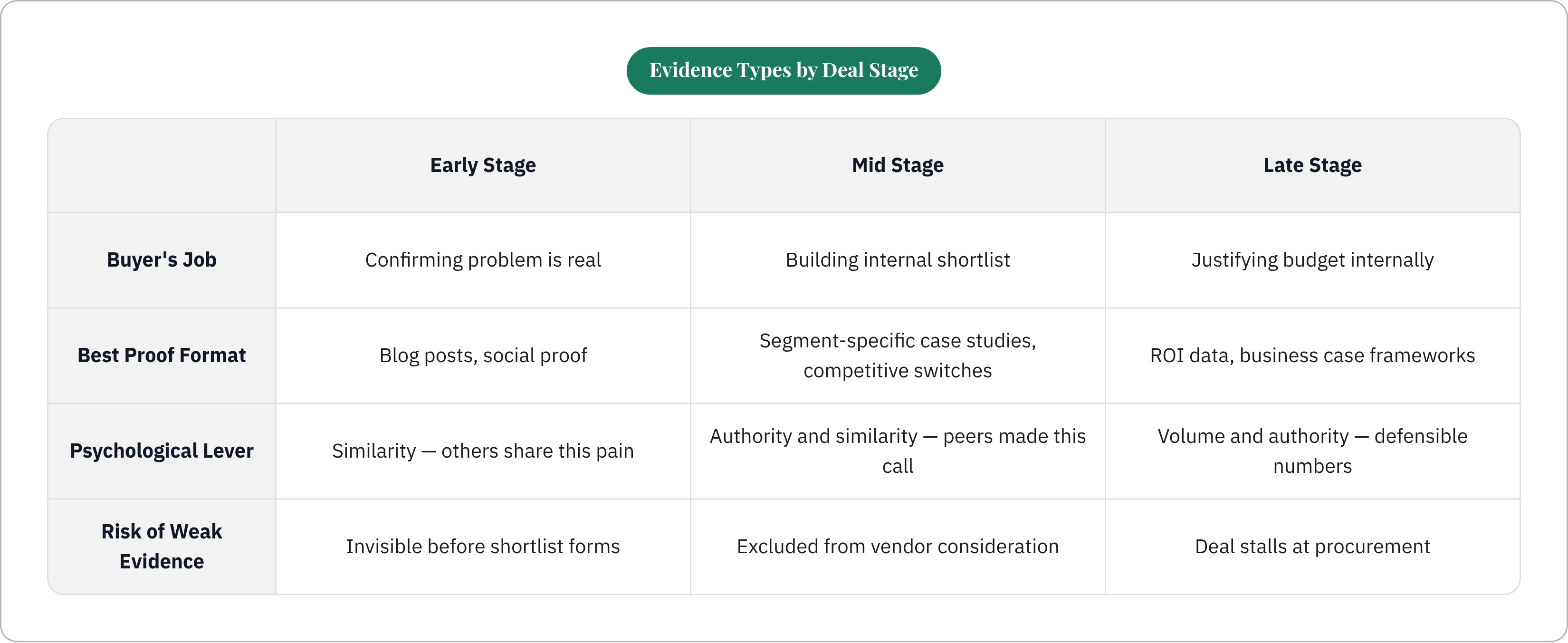
The buying journey has distinct evidence needs at each stage:
- Early (problem recognition). Blog posts and social proof that confirm the buyer's problem is real and solvable. A buyer Googling their specific pain should be finding your customers talking about solving it. If they're not, you're invisible at the moment they're most open.
- Mid (vendor evaluation). Segment-specific case studies, competitive switching stories, peer comparisons. Buyers are building their internal shortlist. They want to see someone who looks like them making the same call.
- Late (internal justification). ROI data, business case frameworks, reference calls. The economic buyer needs something they can defend in a budget conversation. Generic proof doesn't work here. Specific numbers do.
The self-directed research phase is where the gap is most expensive. Buyers consuming 13 pieces of content before talking to a rep means your evidence has to be findable and credible before the first sales conversation. Full stop.
AI search is also becoming a real distribution channel, one that a lot of B2B teams are ignoring. A growing share of purchase research now starts with an AI query. Buyers are using Perplexity, ChatGPT, and Google AI Overviews as their first step, and AI referral traffic grew 357% year-on-year by June 2025. Structured, specific customer evidence that shows up in AI-generated answers earns discovery before a search result is even clicked. Generic thought leadership does not.
Sales enablement integration is the last piece. Evidence only gets used if it's surfaced inside the tools reps are already working in. Salesforce, Seismic, Highspot, whatever your stack looks like. Tied to deal stage, not sitting in a folder nobody checks.
What a Series A Startup's Evidence Program Looks Like in Practice
You don't need a dedicated team to start. You need ownership, a capture workflow, a packaging standard, and a deployment integration. That's actually it.
Realistic starting point: one person, usually someone in customer success or content, owns the program. They define the tagging taxonomy. They establish a standing process for flagging proof in existing customer conversations. None of these are massive lifts. They're just decisions that most teams never actually make, so nothing ever gets built.
The minimum viable library is smaller than people assume. Ten to fifteen structured proof assets covering your top three verticals and top two competitor displacement scenarios is enough for reps to self-serve on the majority of deals without filing a request.
Build the feedback loop in from day one. Track which assets get used, in which deal stages, and whether those deals close. Companies with formal sales enablement programs achieve 49% higher win rates. The evidence program is the supply chain for that enablement. It's not a separate function.
The compounding effect is the real argument for starting now rather than later. Early investment in systematic evidence collection means that by Series B, the library is deep enough to cover new verticals, new competitors, and new buyer personas without starting over. The startups that treat this as a later problem don't just start late. They rebuild from zero every time the sales motion evolves, and the sales motion always evolves.
The informal system worked before the raise. The founder knew the customers, the customers knew the founder, and two logos on a deck were enough. That era is over. The startups that close the evidence gap fastest aren't the ones with the biggest marketing teams. They're the ones that built a system while it was still small enough to build well.