Turning Customer Onboarding Data into Early Case Study Content
Capture early customer wins as case study material before momentum fades.

Your best case study content is already written. It's sitting in your CSM's notes, your kickoff call recordings, and the milestone fields nobody told your content team existed. The problem isn't that you lack proof. It's that you built a wall between the people collecting it and the people who need to use it. This article is about tearing that wall down without creating a single new job.
Most case study programs work like this: wait until a customer is fully ramped, schedule an interview six months in, and try to reconstruct the emotional urgency they felt back when they were deciding to buy. By then, the numbers have blurred. The before-state is a memory. The quote you get is polished and forgettable. You publish it, sales ignores it, and you wonder why.
Here's what's actually happening. The moment a customer sees their first real win inside your product, that's your window. The energy is high, the numbers are fresh, and the language they use to describe what happened is uncoached and specific. That window closes faster than most teams realize. Onboarding data captures all of it in real time. You just need a system to route it somewhere useful.
What onboarding data looks like as case study raw material
Every case study ever written follows the same skeleton: Challenge, Solution, Results, Quote. What most teams don't realize is that each of those four slots maps almost perfectly to data their onboarding team is already collecting.
- Challenge lives in the kickoff call. It's the moment the customer tells you what failure looks like and what's at stake if this doesn't work. It's raw, pre-coached, and more credible than anything they'll say after six months of working with your team.
- Solution lives in the onboarding documentation. The configuration decisions, the implementation steps, the support tickets, the handoffs. It's already written down somewhere.
- Results live in your milestone records. Time-to-value, activation events, support ticket volume before and after. These numbers exist. They're just not being used.
- Quote lives in the 30-day check-in. That's when a customer is most likely to say something real, specific, and worth putting in a document.
The difference between "we helped them onboard faster" and "we cut their onboarding time by 67%" is not a bigger customer story. It's whether the team had a system to record the before and after. That's it. The story about an onboarding time dropping from 90 days to 30, and the productivity gains that followed, didn't come from a polished retrospective interview. It came from structured tracking that was already happening.
One honest caveat here: onboarding data alone won't give you full business context, competitive framing, or the strategic stakes the buyer was managing above the waterline. You'll need a short customer conversation to fill those gaps. But the skeleton of the story is already there. You're not starting from scratch.
According to Rocketlane's State of Customer Onboarding report, more than 40% of onboarding teams use four to six software tools at the same time. CRM, CSM platform, project management. The data isn't missing. It's fragmented. That's a routing problem, not a collection problem.
The three onboarding moments when case study content is ready to harvest
You could theoretically collect content signals continuously throughout the customer relationship. In practice, that turns into everyone's vague responsibility and nobody's actual job. Three discrete moments are better. They create accountability. They fit inside workflows that already exist.
The kickoff call
This is the richest source of Challenge language you will ever have access to. The customer is describing their pain before your messaging has had any influence on them. They haven't learned your vocabulary yet. They're speaking in their own words, which is exactly what you want in a case study.
One question worth building into every kickoff agenda: "What does failure look like if this doesn't work?" The answer to that question is the opening line of a case study. Record the call or take structured notes. Either way, that language belongs somewhere a content person can find it later.
The 30-day check-in
First measurable outcomes show up here. Activation rates. Time-to-value milestones. Early adoption signals. More importantly, the customer's emotional state is at its peak right after a first visible win. That enthusiasm produces quotes that actually sound like a human said them.
Add two questions to the standard agenda:
- "What's the clearest result you've seen so far?" (quantitative)
- "How would you describe this experience to a peer?" (qualitative)
The second question is doing more work than it looks like. "How would you describe this to a peer" is how people talk. It produces the kind of language that reads as credible in a sales conversation.
The first renewal or expansion conversation
By this point, the full arc is visible. The customer can articulate where they started, what the onboarding looked like, and what's compounded since then. Renewal intent is itself a proof point. A customer expanding is a customer who has already validated the ROI internally. You don't have to argue it. They already argued it for you.
Treat renewal as the moment to formalize a case study draft, not to start one from scratch. If you've been running the extraction system since kickoff, most of the story is already assembled. The renewal conversation fills in the ending.
Building the extraction system so onboarding data reaches content production
Here's the core dysfunction: onboarding data sits in CSM platforms, project management tools, and CRM fields that content teams never access. And onboarding managers don't think of their notes as content raw material. Why would they? Nobody told them that's what they were.
The fix is not a new tool or a new hire. It's four small changes to things that already exist.
1. A shared intake field in your CRM or CSM. One text field. The onboarding manager fills it in at the 30-day mark with the customer's first measurable win, written in the customer's own language. That's the whole field. One sentence or two.
2. A trigger rule. When an onboarding milestone is marked complete, an automated task routes to whoever owns content. That person now knows a story is ready to look at. They didn't have to go hunting.
3. A case study brief template. One page. Pre-structured around Challenge, Solution, Results, Quote. The CRM field auto-fills part of it. The content person fills in the rest from the other onboarding records.
4. A quote capture habit. Coach onboarding managers to paste verbatim customer language into a designated field instead of paraphrasing it into a status update. "Customer is happy with results" is useless. "We went live in two weeks and our team hasn't looked back" is a case study quote.
Two things to plan for before the system goes live. First, approval timelines. Legal review of customer quotes and logos can take anywhere from a day to over a month depending on the organization. Build that workflow before you have a story ready to publish, not after. Second, some industries will never produce named case studies in volume. Cybersecurity and financial services come to mind. According to UserEvidence's 2025 Evidence Gap report, 60% of buyers trust blind-but-verified testimonials versus 64% for named ones. That gap is smaller than most marketing teams assume. Anonymized onboarding data is a legitimate proof asset. Don't let the absence of a named customer become a reason not to build the system.
Why onboarding-sourced case studies close deals that polished brand stories don't
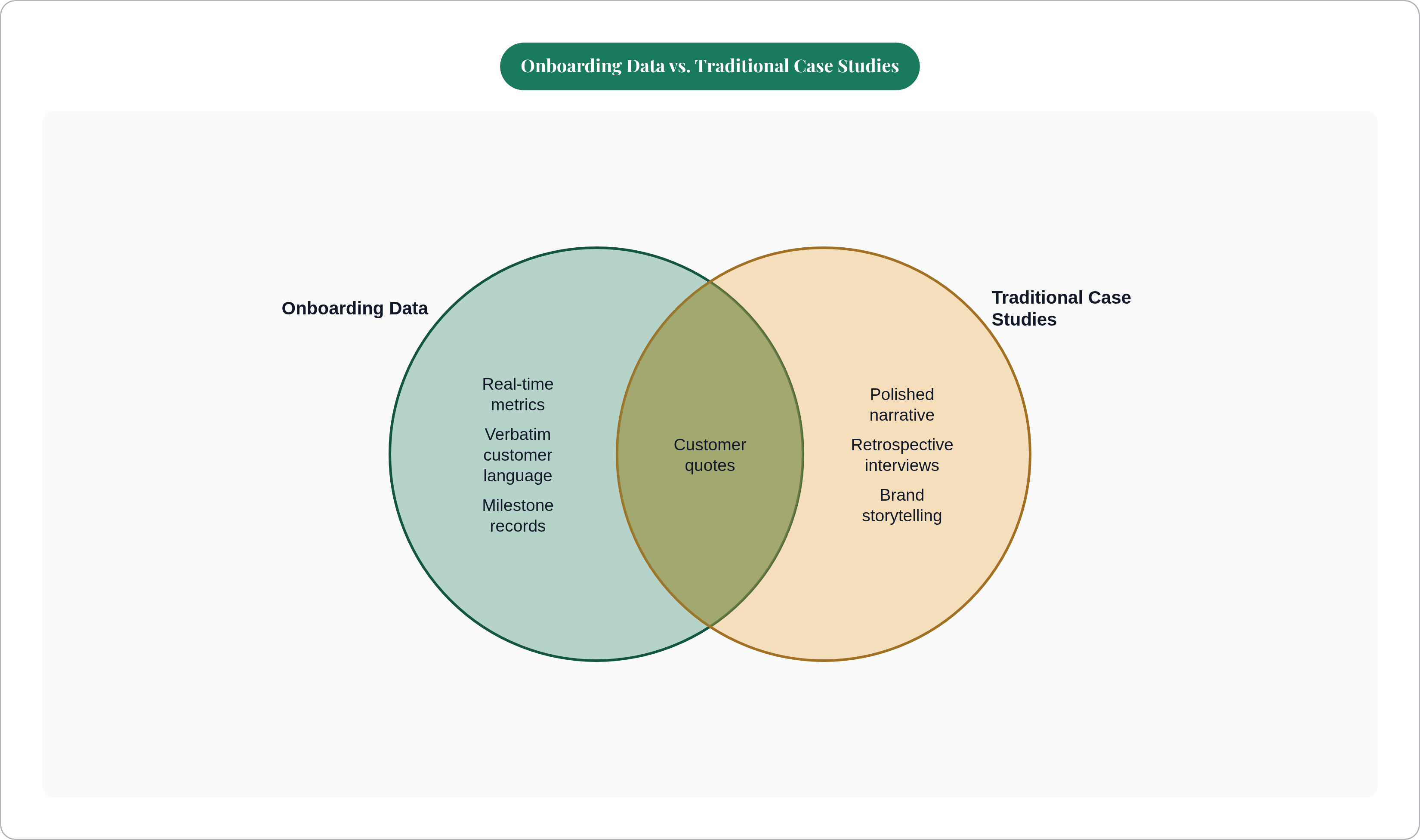
Let's be honest about what's actually happening when a buyer reads a case study. They're not reading it for the narrative arc. They're asking one question: "Does this actually work for someone like me?" If the answer isn't clear in thirty seconds, they move on.
Here's the credibility problem with most case studies. The numbers are retrospective approximations. The quotes are polished to the point of sounding like the marketing team wrote them. The story is structurally clean but emotionally flat. Buyers notice. Per UserEvidence's 2025 Evidence Gap report, 67% of B2B buyers have ruled out a vendor specifically because the evidence felt untrustworthy. Not because the product was wrong. Because the proof felt manufactured.
Onboarding-sourced content solves this in three ways.
- The numbers are early and concrete. Days to activation. Support tickets before and after. Time to first value. These aren't "approximately 30% improvement" estimates. They come from records that existed before anyone was thinking about a case study.
- The customer language is from real-time check-ins, not a polished interview conducted after they've forgotten how bad things were before.
- The story is structurally complete. Challenge at kickoff. Solution during implementation. Results at milestones. It didn't get assembled retroactively. It was captured as it happened.
The same research notes that 78% of buyers say the most important factor is proof from a customer similar to them. Same industry, same size, same role. Onboarding data tagged by vertical and persona directly serves this need. A case study that can be found by the right rep for the right deal closes deals. One that can't be found might as well not exist.
The timing math also matters. A case study produced in month two of onboarding is available for every deal that comes through in months three through twelve and beyond. Waiting for a "bigger story" is not patience. It's just latency. By the time the bigger story is ready, the deal it would have closed has already moved on.
How to structure onboarding data into a case study that sales will actually use
The format question matters more than most content teams admit. A four-page case study that arrives six months later is not the same sales tool as a one-page proof sheet that closes a deal next week. Onboarding data supports different formats at different stages of maturity.
The one-page proof sheet is the minimum viable case study. Customer snapshot. Challenge in their words. One to three quantified outcomes. One verified quote. You can build this from 30-day check-in data alone. Sales can use it in a late-stage email. It takes up one side of a page and competes favorably with a rep's two-hour daily selling window.
The full case study adds solution narrative, implementation context, and a second quote from the renewal conversation. It requires all three extraction triggers. It's the version that earns a spot on the website.
The sales snippet is a two to three sentence pull-quote with one number, formatted for use in email threads and slide decks. You can extract it from any case study without doing any additional work. This is the format reps actually use when they're in a deal.
A few structural principles worth stating plainly.
Measurable outcomes are not optional. "They saw faster onboarding" is a description. "Onboarding time dropped from 90 days to 30" is a proof point. One of those ends conversations. The other starts them.
Tag every asset at the time of creation. Persona, vertical, challenge type, product feature, outcome metric. A case study that can't be retrieved is as useless as one that was never written. The retrieval problem is not a search problem. It's a tagging problem.
Quote standards are non-negotiable. Verbatim, attributed, approved. Paraphrased quotes undermine the exact credibility the case study was built to create. Capture the exact words from the check-in call or survey. Get written approval. Log the approval in the CRM. Do not skip any of those three steps.
Keeping the system producing as the customer base grows
Once the system is running, the goal shifts from "do we have case studies" to "do we have coverage." Coverage means proof assets for the personas you sell to most, in the verticals where you win most, against the challenges your buyers care most about. Gaps in that matrix are gaps in pipeline coverage. Not a content preference.
A few things to watch for as the customer base scales.
Advocate burnout is real. Asking the same early customers to participate in case studies, webinars, reference calls, and every other proof-related request damages the relationship. It also produces diminishing-quality evidence. The system has to expand the pool of contributors as fast as it expands the library. Every new onboarding cohort is a new content cohort. If the extraction triggers are built into the process, production scales with acquisition.
The compounding argument deserves a moment. A case study produced in month two is available for every deal from month three onward. The earlier the system starts, the larger the library at any future point. There is no equivalent of starting this later that makes up for the missed inventory.
Measure the system like a sales asset, not a content program. Tag case study assets to the deals where they were used. Compare win rates on deals where a case study was shared versus deals where none was available. Track which specific stories appear most often in closed-won deals. That data tells you which customer stories to replicate next, which is actually the most valuable thing the system can produce.
One last point for teams in early stages. Your first ten to twenty onboarding customers are your primary ICP data set. The real ones, not the aspirational ones. Systematizing evidence collection now means the company's proof library is built on what's actually true about your buyers from the beginning. That's a compounding advantage that's nearly impossible to replicate if you wait.