Testimonial Examples That Convert in B2B Sales Contexts
Specific testimonials with named speakers and measurable outcomes convert better in B2B sales.

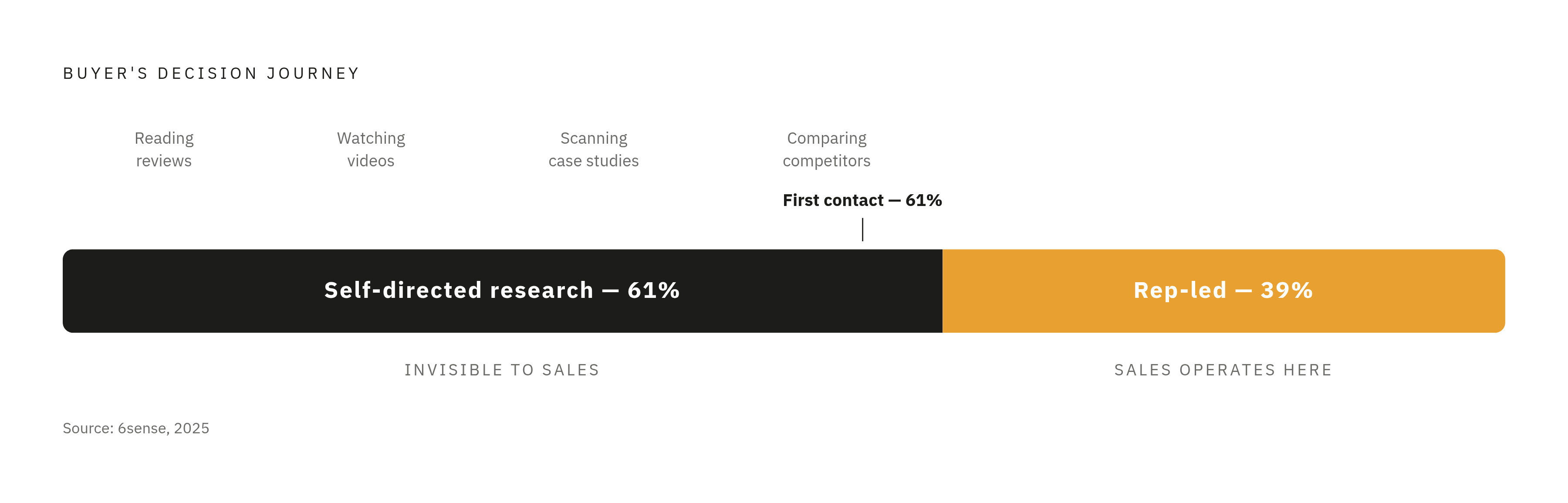
Sales teams routinely overestimate how much influence they have on a deal. By the time a buyer actually talks to your rep, they're already 61% through their decision process, per 6sense's 2025 data. That demo call? It's basically a formality. A chance for the buyer to confirm what they already mostly believe.
The real decision gets made earlier, alone, without you in the room. Buyers are reading reviews, watching a video someone posted, scanning a case study at 10pm, comparing you against the other tab they have open. That's where testimonials do the actual work.
And buyers aren't just skimming one thing. Per Voice of the Buyer 2026, buyers engage with seven to nine content formats before committing. Your testimonial is competing with analyst reports, Reddit threads, G2 reviews, and whatever a peer texted them last week. It either moves them forward or they scroll past it.
So what does a testimonial actually need to accomplish? Two very different jobs.
Job one: reduce personal risk. The individual champion needs to feel like they won't get laughed out of the next all-hands for recommending you. That's emotional. That's real.
Job two: give the champion ammunition. This is the one most vendors completely miss. The champion believes in your product. Now they have to walk into a room with the CFO, IT, legal, and whoever else has veto power. They need something they can actually cite. A number. A named outcome. Something that fits on a slide and survives a skeptical question.
"We love working with them" fails job two instantly. You cannot put that in a deck. The CFO will stare at it and ask "okay, but what did it actually do?" and your champion will have nothing.
There's also a timing dimension that matters more than most people realize. Detailed case studies and analyst citations land differently late in a deal than they do at the top of the funnel. Proof placed at the wrong stage doesn't get read. It gets skipped, not because it's bad, but because the buyer isn't ready for it yet. Placement is its own discipline.
The Structural Qualities That Make a Testimonial Credible Enough to Cite Internally
Specificity is what separates a testimonial that converts from one that just takes up space on your pricing page. That's it. The whole thing really does come down to that.
But let me make it concrete. Compare these two:
- "We saw great results after implementing the platform."
- "We increased marketing-sourced pipeline significantly in Q3 2025."
One of these can survive a CFO's follow-up question. One of these will get your champion laughed out of the room. Vague testimonials don't just fail to help. They can actually hurt, because they suggest you don't have anything real to show.
Here's what specificity actually requires in practice.
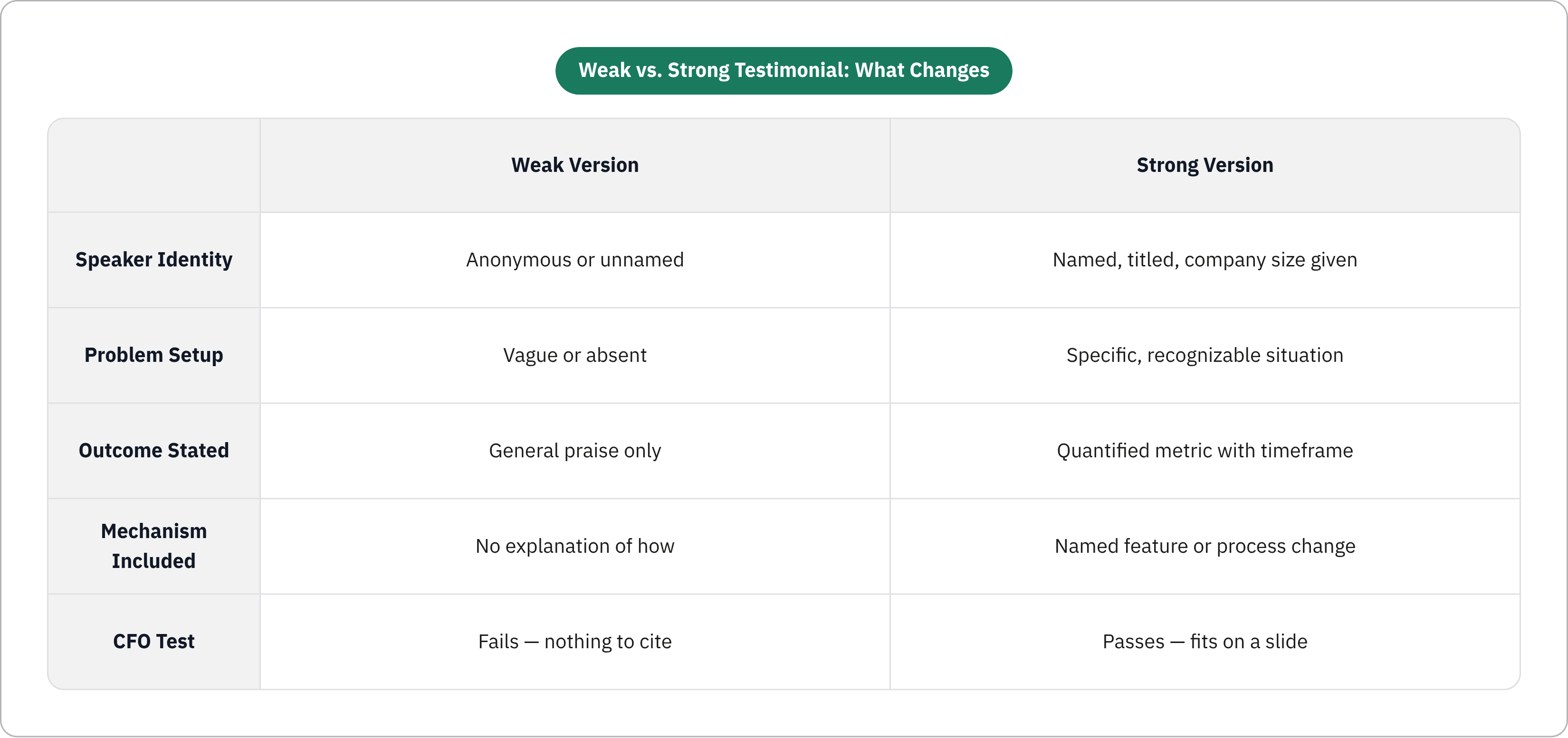
A named, titled speaker. "Director of RevOps at a 300-person SaaS company" is a trust anchor. Anonymous quotes read as either fabricated or disavowed. Neither is a great look.
A recognizable problem setup. The reader has to see their own situation in the opening line. "We were spending 12 hours a week manually reconciling reports" is projectable. "We had inefficiencies" is not. The problem description is what makes a stranger feel like this story is about them.
A specific, verifiable outcome. Numbers. A timeframe. Something a buyer could theoretically check. Per HubSpot's 2025 State of Marketing Report, testimonials with specific performance metrics generate 22% higher click-through rates than general praise. That gap is almost entirely explained by one thing: the presence of a real number.
The mechanism. This is the one everyone skips. Results happened, sure, but what made them happen? Which feature, which workflow, which process change. When a champion is in a room with a skeptical CFO who asks "okay, but how does it actually work?", the mechanism is what they reach for. If the testimonial doesn't give them that answer, they're guessing out loud in front of the decision committee. That's not a position anyone wants to be in.
For longer formats, the Challenge-Solution-Impact shape works because buyers can scan it fast. What was the problem, what specifically changed, what did the numbers look like after. Clean. Useful.
One thing worth knowing if you're building a proof library right now: buyers are increasingly using AI tools to research vendors before they ever talk to a human. Structuring your testimonials with clear entity relationships (Company X, Industry Y, Problem Z, Result W) makes them parseable by those tools. Job titles, company sizes, specific metrics in the body text. It helps humans scan. It also helps AI summarize accurately rather than paraphrase vaguely.
And a compliance note you shouldn't skip. The FTC's final rule, effective October 21, 2024, makes fabricating or AI-generating testimonials a federal issue, with penalties up to $51,744 per violation. Authenticity was always the right call. Now it's also the legally required one.
What a High-Converting Written Testimonial Looks Like, with Annotated Examples
Written testimonials still show up everywhere: pricing pages, landing pages, comparison pages, sales emails, decks. The gap between a weak one and a strong one is almost never length. It's almost always specificity and who's saying it.
Here are two versions of essentially the same testimonial.
Weak version: "This platform transformed how our team works. Highly recommend."
What's missing: a name, a role, a company, and anything resembling a result. This quote could have been written by literally anyone about literally any tool. It passes the competitor paste test with flying colors, which is a bad thing. A competitor could drop it on their homepage word for word and it would still be technically accurate.
Strong version: "[Name], VP of Sales at [Company], 200-person B2B SaaS. 'We cut our sales cycle from 6 weeks to 3 after standardizing our case study process. Our reps stopped building decks from scratch and started sending proof that matched the objection.'"
What's working: speaker credibility with title and company size, a specific quantified outcome, a named mechanism (the case study process), and context a B2B SaaS VP of Sales will immediately recognize as their own problem. A prospect reading that and running a similar sales team should think "that sounds like us." That's the reaction you're building toward.
The resemblance test is just as important as the outcome quality. A testimonial from the wrong customer segment can actually reduce trust, because the reader's internal monologue becomes "okay, but that's not my situation." Segment matching is not a nice-to-have.
Where written testimonials work hardest:
- Pricing pages, beside the relevant tier. Match the testimonial's company size to the plan's target buyer.
- Landing pages near the CTA, matched to the audience the ad targeted. Running fintech ads? Show fintech quotes.
- Comparison and alternatives pages, where the buyer is actively weighing vendors. This is prime real estate and most teams waste it.
- Sales email sequences, matched to the specific objection being addressed. Not a blast to everyone. A targeted match to the moment.
On homepage placement: three to five testimonials is the practical ceiling before cognitive load starts working against you. Having a library of a hundred or more testimonials does correlate with significantly higher overall conversions, but the homepage is a curated sample, not a warehouse. Dumping all of them there helps nobody.
Last rule, and it's not complicated. One strong, named, outcome-specific testimonial outperforms a grid of five vague ones every time. Volume and credibility are not the same thing.
Why Comparison Testimonials Outperform General Praise in Competitive Evaluations
Late in an evaluation, the buyer isn't asking "is this vendor good?" They're asking "is this vendor better than the other one I have open in the next tab?" General praise doesn't answer that question. It doesn't even try.
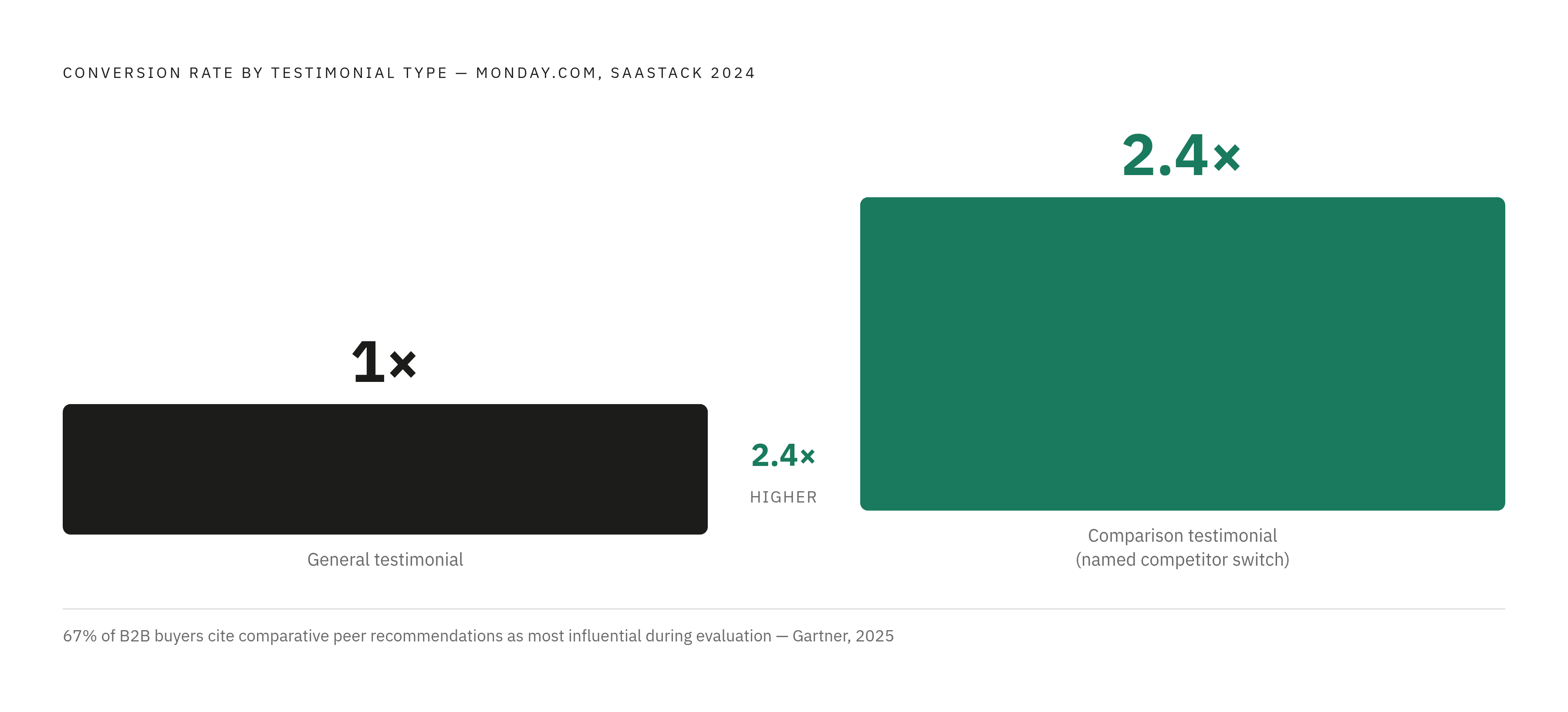
A comparison testimonial is exactly what it sounds like: a customer who switched from a named competitor, describing in plain language what actually changed. Monday.com's 2024 marketing metrics, shared at SaaStack, found that comparison testimonials from customers who switched from specific named competitors generated 2.4x higher conversion rates on landing pages than their general testimonials. The reason is simple. These testimonials answer the question the buyer is actually asking.
Per Gartner's 2025 B2B Buying Survey, 67% of B2B buyers cite peer recommendations that compare specific alternatives as the most influential content type during their evaluation phase. Not general testimonials. Comparative ones. There's a meaningful gap there.
What makes a comparison testimonial work:
- It names the prior solution. "We were using [Tool X] for three years" does a lot of setup work fast. It gives the reader an orientation point.
- It describes what was frustrating. If a current user of that same tool reads it and thinks "yes, that's exactly my problem," you just created a moment of recognition that no marketing copy can manufacture.
- It states specifically what changed. Not "we like this better." More like "we sharply reduced manual work in the first 90 days." Preference is forgettable. Outcome is quotable.
- It lets the customer do the comparison work. You don't have to say anything negative about a competitor. The customer does it for you, credibly, in their own voice, which lands completely differently than a vendor making the same claim.
Where these belong: competitor alternative pages, battle cards, and late-stage sales sequences. Not the homepage. The buyer hasn't surfaced the competitive dimension yet at that point, and leading with a comparison before it's contextually appropriate can read as defensive rather than confident.
When Video Testimonials Justify the Investment and How to Produce Them Without a $15K Budget
Video testimonials are trusted more than written reviews, and more than star ratings, per BrightLocal's 2025 Consumer Review Survey. A significant majority of executives prefer to watch rather than read when researching a vendor. That preference is already baked in. Video meets buyers where they are.
The production cost concern is real but genuinely overstated. Forty-four percent of marketers have spent tens of thousands of dollars or more on a single testimonial video, and most take over a month to produce. Both of those are choices, not requirements. The expensive version exists. So does a much cheaper one that performs nearly as well.
A lean production setup that actually works:
- One camera, one lavalier microphone, natural window light. Or a high-quality smartphone if that's what you have.
- Five to seven open-ended questions. Film for 20 to 30 minutes. Edit down to 90 to 180 seconds.
- Budget: $500 to $5,000 for most teams doing it in-house.
- Pick one outcome and one human moment to anchor the edit. Don't try to cover everything. A tight, specific video will outperform a comprehensive one almost every time.
More than half of marketers report 100%+ returns on testimonial video investment. The barrier isn't the ROI. It's the production friction, which is a process problem with a process solution.
A high-converting video testimonial follows a loose structure:
- Open with the problem. Not "I've been using this tool for two years." Something like "We were manually pulling data from four different systems every week." That's a hook. That's what makes someone keep watching.
- A specific, quotable outcome. In the customer's own words. A little rough is fine. Real is better than polished.
- Name and title on screen. Lower-third. Don't skip it. Anonymity tanks credibility even in video format.
- A close that implies recommendation without sounding scripted. "I'd tell anyone in our position to try it" lands differently than "I highly recommend this product." The first sounds like a person. The second sounds like a press release.
When does video justify the work over written? Late-stage deal support, high-ACV accounts, homepage hero placements, key landing pages. For SEO, sales email outreach, and programmatic placement, a well-structured written testimonial usually wins on effort-to-impact ratio. Match the format to the moment. Don't use a video where a quote would do the job faster.
How the Case Study Format Extends Testimonial Proof into a Full Buying Argument
A testimonial answers "did it work?" A case study answers "would it work for us?" For most buying committees, the second question is the only one that actually matters.
Among the top 58 fastest-growing SaaS companies tracked in a 2025 analysis, 88% use case studies. Companies with $20M or more in ARR publish twice as many as their smaller counterparts. The size of the library signals category seriousness. Buyers notice, even if they don't consciously register why.
The Challenge-Solution-Impact framework is the spine of every case study that actually gets read.
Challenge. Not a category pain point. A concrete situation. "We were losing deals in the final stage because reps couldn't pull the right proof fast enough." Specific enough for a reader to map their own experience onto it. "We had inefficiencies" is not a challenge. It's a placeholder.
Solution. Which features, which workflows, which processes actually changed. This is the mechanism section, and it matters most to internal champions who have to explain the decision to skeptics. If the case study can't answer "okay, but how does it actually work?", the champion is winging that answer in front of the committee.
Impact. Quantified outcomes tied to a timeframe. Revenue, pipeline, time saved, cost avoided. Something that fits in a slide without requiring interpretation.
Stanford University research found that information presented in story form is remembered up to 22 times better than isolated facts. A number without a story doesn't land the way you think it does. The narrative isn't decoration. It's the delivery mechanism that makes data stick.
Per an Edelman study from 2025, 72% of B2B decision-makers identify more strongly with success stories told from the customer's perspective. Write the case study in the customer's voice. Not yours.
Where most case studies go wrong:
- Leading with vendor capabilities instead of the customer's situation. Start with the pain. Always.
- Burying the outcome at the end. Scanners won't get there. Surface the result early, even as a pull quote at the top.
- Writing in marketing voice. A quote that sounds like a press release kills credibility faster than almost anything else. Let the customer's language be a little messy. That's what makes it believable.
Turning One Case Study into Proof Assets Across Every Stage of the Funnel
Most teams get one use out of a case study. They write it, post it to the resources page, and move on. The story sits there. It never becomes a sales email snippet. It never becomes a slide. It never shows up where buyers actually are when hesitation peaks.
One well-structured case study contains enough material for a dozen different proof deployments. The atomization is simple: your core case study is the source. Everything else is a derivative, optimized for a specific placement or moment.
What one case study can become:
- A pull quote card for sales email and LinkedIn. Thirty to fifty words, outcome first.
- A one-slide proof summary for a deck. Logo, role, metric, one-line quote. That's it.
- A short video clip (90 to 180 seconds) cut from a longer recorded interview.
- A battle card entry: this customer came from Competitor X and saw Outcome Y.
- An SEO landing page built around the customer's industry and use case. Something like "how a 200-person SaaS company cut their sales cycle significantly."
- An objection-handling snippet for sales sequences: "Here's what a RevOps director at a company your size saw when they had the same concern."
Per Content Marketing Institute's 2025 report, companies that position case studies as central nodes in content clusters achieve 43% higher organic visibility. The SEO return isn't a separate strategy you bolt on afterward. It's a byproduct of doing the atomization systematically in the first place.
The deployment principle is straightforward. Proof placed where hesitation peaks converts best. Pricing pages. Comparison pages. Late-stage nurture sequences. Those placements are higher leverage than the blog archive, which is where most case studies go to quietly expire.
And a practical note on sales reps. If a rep can't find a case study matched to a deal's industry, company size, use case, and competitor context in under two minutes, they default to the generic deck they already have. That's usually an indexing problem, not a motivation problem. Build a searchable repository and index it well. The reps will actually use it.
Building the Collection Habit So Strong Testimonials Don't Depend on Luck or Heroics
Most B2B teams run their evidence programs on vibes and panic. Someone needs a healthcare reference by Thursday. A Slack message goes out. A deal waits. The problem isn't that customers won't give testimonials. The problem is that no one built a system for capturing them.
Here's the thing: most of the raw material already exists. It's in call recordings. It's in QBR decks the customer already built. It's in G2 reviews no one ever followed up on. The job isn't to ask customers to start from scratch. It's to surface what's already there, on purpose, rather than by accident, which is exactly what Verbatim, a done-for-you service that builds and runs customer proof engines for B2B SaaS companies, handles end to end.
Where the raw material lives:
- Sales call recordings. Customers describe their before-state and what changed in their own language all the time. Most of it never gets captured because no one is listening for it.
- CS check-in notes and QBR decks. Quantified outcomes the customer already assembled, sitting in someone's Drive folder.
- G2, TrustRadius, and other review platforms. Customers who already wrote public proof, unprompted. That text can seed a more formal testimonial request with their permission.
- NPS and CSAT follow-ups. High scores with written comments are the lowest-friction entry point for a full testimonial ask.
- Renewal conversations. A customer who just renewed is, almost by definition, someone who experienced value. That moment is warm. Use it.
The collection habit needs four things to actually hold:
Trigger points. Renewal. QBR. Milestone achievement. Onboarding completion. Build a testimonial ask into those moments systematically, not whenever someone remembers to do it.
A low-friction ask. "Would you be willing to answer three questions about what changed since you started using us?" converts better than "we'd love a testimonial." Make it small. Make it easy. Transcribe what they say. Polish it. Get their approval. Done.
A shared capture system. Customer success, sales, and marketing all surface proof. None of them should be storing it in a personal folder. A shared, searchable repository indexed by industry, company size, use case, and competitor context is the infrastructure that makes everything else functional.
A quarterly review. Look at what you have. What's missing? Which verticals aren't covered? Which objections don't have a proof point yet? Gaps in your proof library are gaps in your sales motion. That framing makes it easier to get leadership to care about fixing them.
Strong testimonials don't happen because someone got lucky or chased down a customer at exactly the right moment. They happen because someone built a process that makes capturing them routine rather than heroic. The teams that figure that out stop depending on luck. In B2B sales, that's a genuinely meaningful edge.