Testimonial Video Production for B2B Sales Decks
Specific proof points from real customers outperform vague praise in late-stage sales decisions.
Most B2B buyers have already made up their minds before they ever talk to a sales rep. They've read reviews, asked peers in Slack communities, and let an AI summarize what the market thinks of your product. By the time someone is sitting across from your deck, they've done the research. Think of the sales rep as a verdict, not a first impression — they're either the last piece of evidence that confirms what the buyer already believes, or the uphill battle fighting against it.
That's exactly why a testimonial video in a sales deck isn't a polish move. It's a structural response to a trust problem. Vendor-owned content — websites, decks, one-pagers — ranks among the least trusted sources buyers consult. Peer voices rank among the most trusted. A customer on camera saying something specific and true does more work in thirty seconds than a rep saying the same thing in three minutes. The rest of this piece is about how to build that thirty seconds so it actually earns its place in the deck.
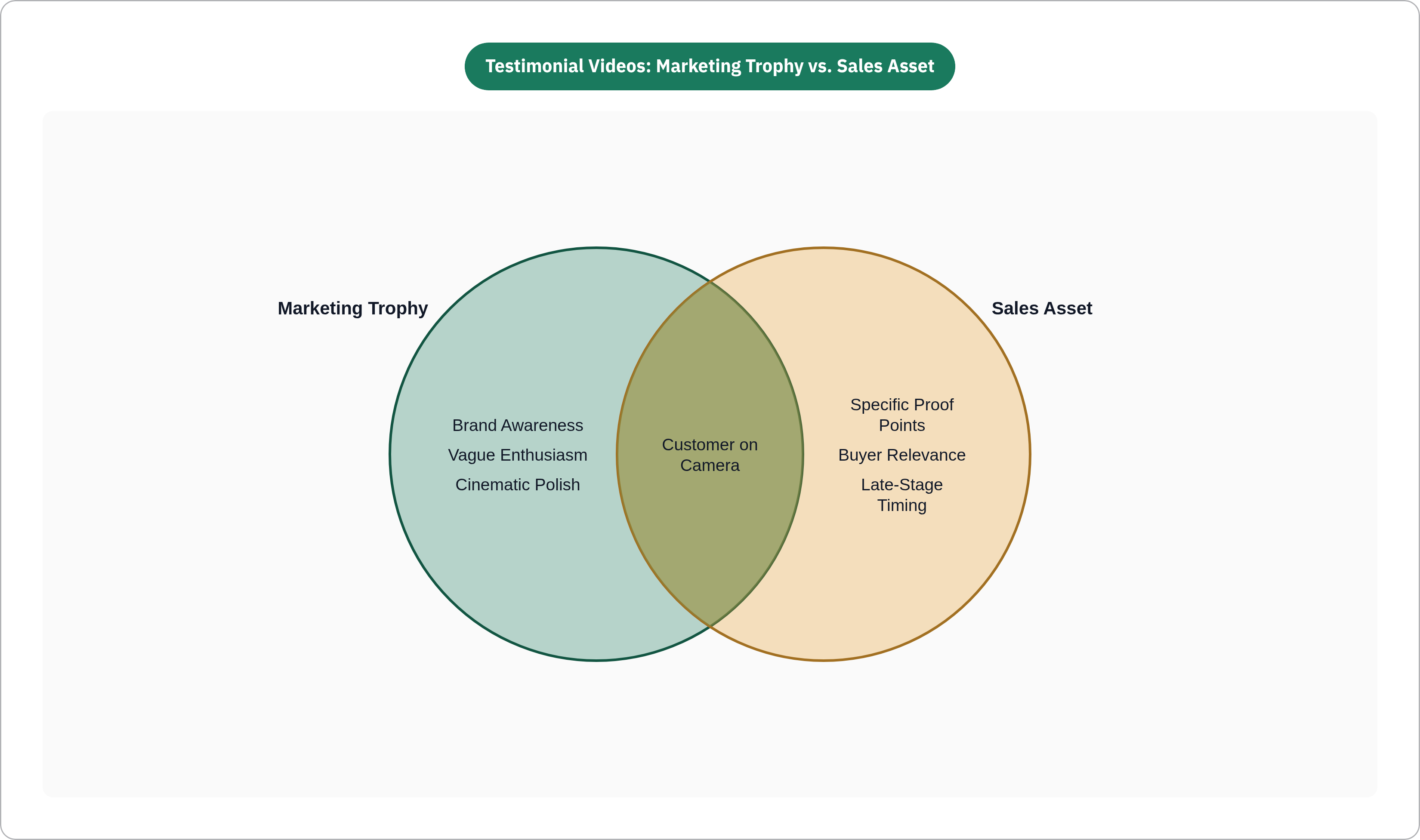
What Makes a Testimonial Video a Sales Asset Instead of a Marketing Trophy
Most testimonial videos fail the sales deck test before they're even cut together. They fail at the content level. They deliver praise when they should be delivering proof.
"They were great to work with" is a compliment. It tells a skeptical buyer nothing useful. "We cut onboarding time by more than half" is a proof point. A buyer can weigh it, compare it to their own problem, and decide whether it matters to them.
The distinction has nothing to do with production quality. A beautifully shot video full of vague enthusiasm is still a marketing trophy. It's nice to have. It doesn't move deals.
A sales-ready testimonial answers the questions a buyer is already asking when they're sitting in your demo or flipping through your deck:
- Did this work for a company like mine?
- What was the cost of the problem before they fixed it?
- What changed, and how fast?
Sales decks operate in a specific moment. Late consideration. Risk-averse audience. The buyer isn't browsing anymore. They're evaluating. The testimonial clip has to be calibrated to that moment, not to brand awareness.
That reframe — sales asset first, marketing asset second — is the lens that should govern every decision that follows.
Choosing the Right Customers to Put on Camera
The most enthusiastic customer is not automatically the most persuasive one. Enthusiasm is easy to find. Relevance is what's hard to manufacture.
Buyer relevance is the primary filter. A prospect needs to see themselves in the story. If they don't recognize the company, the problem, or the situation, the testimonial won't land no matter how compelling the outcome. Choosing the wrong customer for a clip is like giving someone directions to a city they've never heard of — technically accurate, completely useless.
Here's what relevance actually means in practice:
- Industry match matters most. Buyers weight same-industry proof far above generic success stories.
- Use case and company size follow closely. A story about a problem the buyer doesn't recognize won't resonate regardless of how impressive the result was.
- Role alignment matters too. A VP of Sales is more persuaded by a peer VP than by a happy end-user.
Sourcing the right customers isn't complicated, but it does require intention. Map your best existing customers against your most active prospect segments. Prioritize customers who achieved a measurable outcome within a recognizable timeframe. And avoid customers whose results were atypical or heavily dependent on a custom implementation. Outlier success creates credibility problems. Buyers discount it.
Two scenarios worth calling out specifically:
Regulated industries where named customers can't participate are a real constraint, but not a dead end. Blind-but-verified proof, where identity is confirmed by a third party but not published, retains nearly as much buyer trust as fully named testimonials. Participation barriers are often lower than teams assume once this option is on the table.
Complex products with multi-stakeholder buying committees are undersold by a single voice. Consider featuring the project manager, technical lead, and executive sponsor from the same client in one narrative. Each speaks to a different dimension. Operational. Technical. Strategic. One video covers the concerns of multiple committee members without requiring three separate shoots.
Designing Interview Questions That Extract Evidence Instead of Enthusiasm
Most testimonial interviews go sideways at the question stage. "Tell us about your experience with the product" sounds reasonable. It produces polished, useless answers.
Open-ended prompts invite people to talk about how they feel. You don't need feelings. You need specifics that a skeptical buyer can evaluate.
The questions that actually work are structured around a before-and-after narrative:
- What was the problem, and what was it actually costing you in time, revenue, or team capacity?
- What triggered the decision to go looking for a solution?
- What did your team need to see before they'd say yes internally?
- What changed in the first 30, 60, or 90 days?
- What's the single metric that best captures the improvement?
That third question — about internal buy-in — is particularly valuable for sales decks. It mirrors exactly what the buyer is facing right now. It shows that your product survives internal scrutiny. That's a proof point disguised as a process question.
Pre-interview prep matters as much as the questions themselves:
- Brief the customer on the goal. They're not being asked to endorse. They're being asked to narrate.
- Share the key themes in advance so they can pull specific numbers and timelines from memory, not from guesswork.
- Ask them to avoid scripted language. Authenticity on camera is more persuasive than rehearsed precision.
The Challenge → Solution → Impact arc should be the spine of the interview, not just the edit. If the customer can't articulate the challenge with specificity during the conversation, the resulting clip will underperform no matter how cleverly the footage is assembled afterward.
Production Decisions That Serve the Sales Deck, Not the Showreel
Production quality has a floor, but not an obvious ceiling. Poor audio or unstable framing erodes credibility fast. Beyond a professional baseline, additional spend on cinematic polish rarely improves conversion. This is worth saying clearly because production budgets have a way of expanding to fill whatever space you give them.
Remote vs. on-location is a real decision with real trade-offs. On-location shoots cost more and take longer — weeks versus days compared to a well-run remote format. Remote formats have become broadly accepted in B2B. Buyers don't penalize a clean, well-produced remote video. The decision should come down to subject comfort and whether the physical environment adds something meaningful to the story, not assumptions about what "looks more professional."
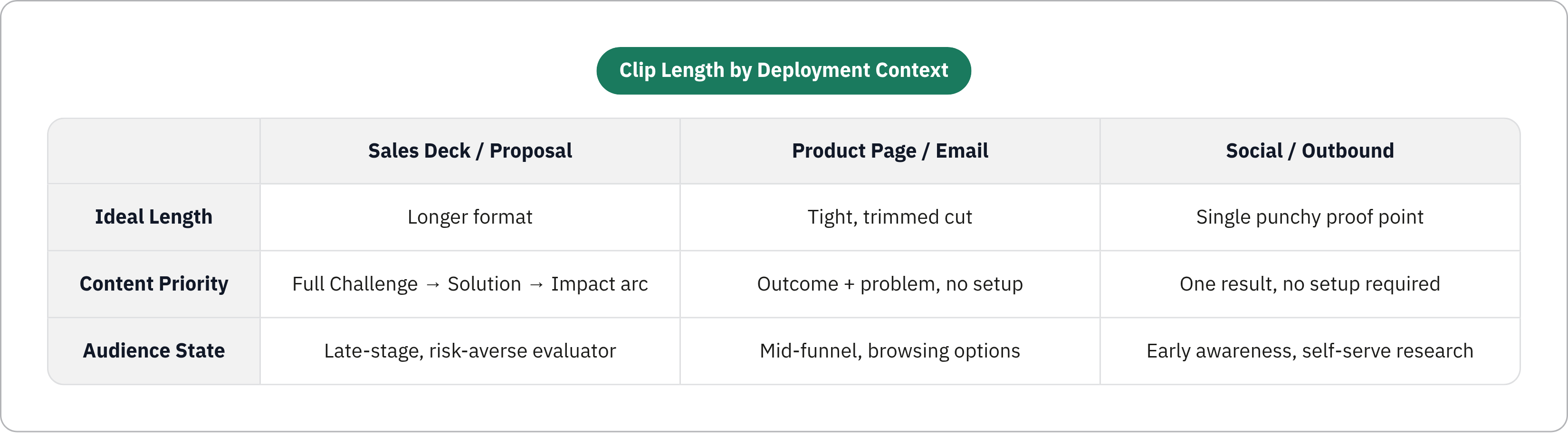
Length should match the deployment context. This isn't a style preference. It's a retention decision. Completion rates drop sharply as videos lengthen.
- Sales deck and late-stage proposal: a longer format gives enough room for the full Challenge → Solution → Impact arc.
- Product page and email nurture: a tighter cut, keeping the outcome and the problem, stripping setup.
- Social and outbound: one punchy proof point, no setup required.
Mobile formatting is no longer optional. The majority of video views happen on mobile. Plan for vertical or square edits at the time of the shoot, not as an afterthought in post. Framing decisions made on a horizontal-only assumption waste the format.
AI-assisted post-production tools like Descript are genuinely useful here. Transcript-based editing, noise removal, quick variant cuts. They reduce turnaround on clip derivatives without compromising the substance of the edit. Worth knowing about.
The most practical production principle: plan your deliverables before the shoot, not after. A single customer interview session can yield a full-length sales deck version, a short email clip, a social snippet, pull quotes for a written case study, and slide-ready still frames. That multiplication is a planning decision. It requires deliberate framing choices and question coverage during the shoot itself.
Selecting and Sequencing Clips for a Sales Deck Specifically
A testimonial slot in a sales deck is not a place for the full video. It's a place for the highest-proof moment extracted from it.
Clip selection for deck use:
- Open on the problem, not on praise. Buyers in the room are asking "is this relevant to me?" not "is this company well-liked?"
- The most persuasive clip usually contains one specific outcome stated plainly by the customer in their own words. Not narrated by a voiceover. Not summarized by the rep.
- Clips that reference the buyer's specific industry, role, or use case outperform generic ones even when the outcome described is less dramatic. Relevance beats impressiveness.
Sequencing within the deck matters more than most teams realize:
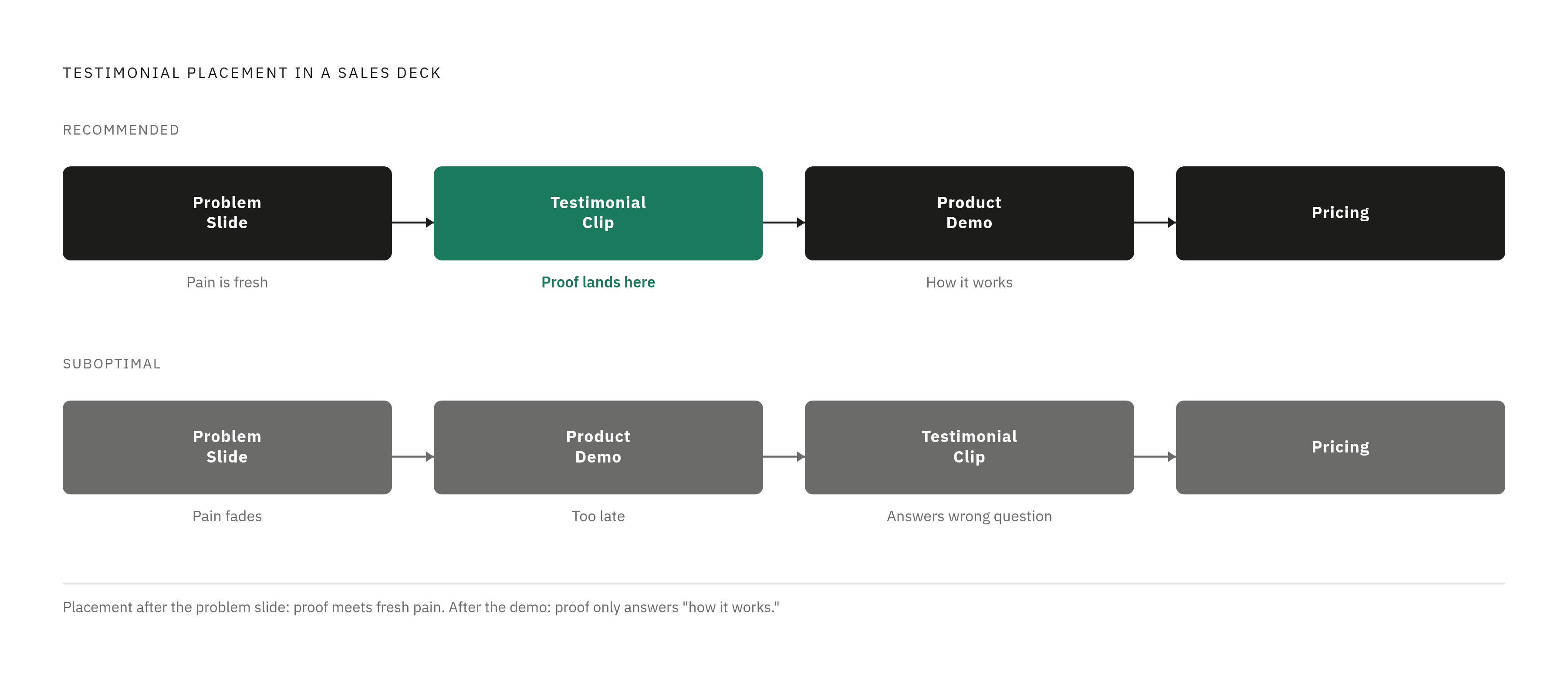
- Place the testimonial clip after the problem-framing slide, not after the product demo. The clip lands hardest when the buyer's pain is freshest. After the demo, you're answering "how does it work?" After the problem slide, you're answering "does it actually solve this?"
- For deals with large buying committees, match the clip to the primary decision-maker in the room rather than defaulting to the most senior voice available.
One more thing on memory. Buyers retain far more of a message delivered via video than the same content in written form. A thirty-second clip of a customer describing a measurable outcome will outlast a pull quote on the same slide in the buyer's recall after the meeting. That's not a small advantage. That's the whole argument for being intentional about this.
When no single clip is strong enough on its own, a short multi-voice cut can work. Three customers, roughly fifteen seconds each, each addressing one proof dimension. It functions as a composite proof moment without requiring one customer to carry the whole argument.
Building a Testimonial Video Program That Compounds Rather Than Stalls
A single testimonial video in a sales deck is a one-time bet. A segment-mapped library is a durable sales infrastructure. The difference compounds over time.
The compounding threshold works like this: the first few videos prove the concept internally. Reps see that clips move conversations. Leaders approve more budget. But what actually gives reps a match for nearly any prospect is broader coverage across industries, company sizes, and use cases. One great video helps one segment. Ten well-chosen videos help most of the pipeline.
Reactive programs stall. When the process is "sales asks, advocacy manager digs, deal waits," production never catches up with pipeline demand. It becomes a fire-drill operation. The operational upgrade is a proactive calendar. Scheduled customer conversations tied to the sales quarter rhythm, not triggered by individual deal urgency.
Capture evidence continuously, not episodically. Post-onboarding check-ins, quarterly business reviews, and renewal conversations are natural moments to surface quotable outcomes. Most go unrecorded. Short, lightly produced remote captures at these moments build the library faster than annual full-production shoots, with far less friction for the customer.
Distribution beyond the deck is where the library earns its full value. The same clip placed on third-party review platforms, shared in follow-up emails, and referenced in social posts reaches buyers during the self-serve research phase — before the deck is ever opened. Buyers routinely consult multiple sources before shortlisting a vendor. A testimonial that only lives in your sales deck misses most of the decision-making window.
FTC compliance is non-negotiable. Fabricated or AI-generated testimonials carry significant legal risk and destroy credibility faster than real proof builds it. The rule is simple: only publish what a real customer actually said and consented to share.
On the operational side, Verbatim addresses the gap that stalls most programs — the part between having a customer conversation and having a sales-ready, organized asset. Verbatim is a managed case study and testimonial service that handles the end-to-end work of capturing, producing, and organizing customer proof for B2B SaaS companies, so the library grows in proportion to the pipeline rather than lagging behind it.
The program that compounds is the one built around a system, not a sprint. Scheduled captures. Deliberate segment mapping. Distribution that reaches buyers before a rep ever enters the room. That's the version worth building.