Proof of Concept Template for B2B Software Evaluations
A structured POC template prevents deals from stalling silently.
Most B2B software evaluations fail quietly. The deal doesn't blow up. It just stops moving. The champion goes dark. The follow-up emails get shorter. Then one day you get a two-line reply saying they've decided to "stay the course." Which is code for "we ran out of steam and defaulted to the status quo."
I've watched this happen to well-resourced sales teams with genuinely good products. The problem is almost never the software. It's the process. Or the complete lack of one.
A proof of concept template, done right, is the structure that replaces the heroics. It's what turns a free trial into a documented, mutual commitment (with clear owners, measurable outcomes, and an actual path to a signature). This piece walks you through how to build one that works.
What Separates a POC from a Pilot, and Why the Distinction Matters for Your Template
This is the part most sales teams skip, and it costs them later.
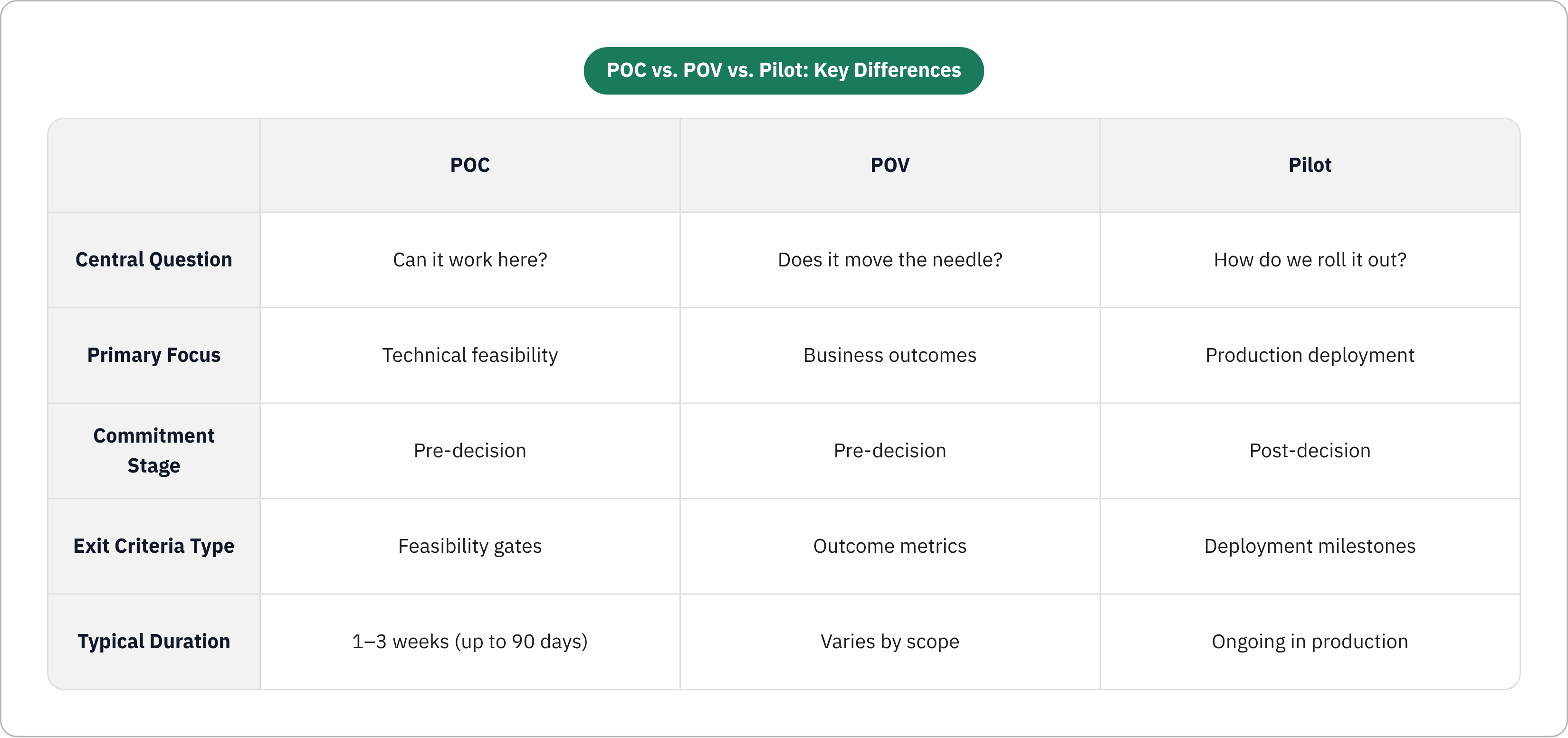
A POC (proof of concept) answers one question: can this technology work in our environment? You're validating feasibility. You're using the buyer's real data, their actual configuration, their specific integration requirements. It's controlled, time-boxed, and the bar is technical proof.
A POV (proof of value) asks a different question: does working technology actually move the needle? The shift is from "can it?" to "does it?" You're measuring business outcomes now, not just functionality.
A pilot is what happens after someone has already decided to buy. You're running the solution in production. Scope, timeline, success all look different because the commitment has already been made.
Why does this matter for your template? Because each phase needs different exit criteria. A POC template needs feasibility gates. A POV template needs outcome metrics. If you blend them without realizing it, you end up with a document that doesn't clearly answer either question. That ambiguity is exactly where deals go to die.
On timing: most SaaS POCs run somewhere between one and three weeks. Add serious integration complexity, and you're looking at 30 to 90 days for enterprise evaluations. Set those expectations in writing before the POC starts.
Here's the framing that has to be in your document: the POC ends when agreed criteria are met, not when the calendar runs out. That one sentence changes the entire conversation. It tells the buyer this is outcome-driven, not time-driven. And it gives you a legitimate reason to close the loop instead of letting things drift.
The Mutual Success Criteria That Anchor Every Section of the Template
Success criteria are a specific, measurable test with a pass/fail outcome — not a feature checklist. That's the most common mistake I see.
A feature checklist says "validate email deliverability." A success criterion says "email deliverability rate above a high threshold on a large-volume send test using the buyer's domain, measured in platform logs by the end of week two." One is a task. The other is a test with a pass/fail outcome.
Every well-written criterion has five components:
- Specific metric — what you're measuring
- Baseline — where things stand today
- Target — the number that constitutes success
- Measurement method — how you'll know
- Owner — who's responsible for capturing the result
You also want to tie each criterion to a stakeholder need. Technical teams care about integration stability. Operations cares about workflow efficiency. Finance cares about ROI. Every person in a buying group (and there are typically six to ten of them) should be able to look at the success criteria table and see their concern addressed somewhere in it.
If you're familiar with MEDDPICC, you already know where this fits. Success criteria are the "M" in Metrics. Your POC documentation and your deal qualification process are doing the same work here. That overlap is intentional.
I worked on a marketing automation POC that covered a 500,000-contact migration, a Salesforce integration, a full campaign recreation, and custom dashboard setup. The criteria included deliverability above 98% and marketer satisfaction scores measured by a short survey at the end of the evaluation. It ran 60 days. It closed at $250K. The criteria made that possible because both sides knew exactly what "done" looked like before we started.
The word "mutual" is doing real work here. The buyer's team signs off on the criteria before the POC begins. That single act converts a free trial into something that feels contractually adjacent. It's not legally binding. But psychologically, it changes the commitment level on both sides.
The Nine-Section Template Structure and What Each Section Actually Does
I'm going to walk through each section. None of these are decorative. If you find yourself tempted to skip one, that's usually a sign you need it most.
Section 1. Executive Summary. One paragraph. Buyer-authored, or at minimum buyer-approved. It states the business problem and what a successful POC will prove. If your champion can't write this paragraph, you don't have a champion yet.
Section 2. Scope and Boundaries. What's in scope. What's explicitly out of scope. Which integrations you're testing, which you're not. The exclusions are just as important as the inclusions. Making them visible is the only thing that prevents scope creep from eating your SE alive.
Section 3. Mutual Success Criteria. The table from the previous section. Metrics, baselines, targets, owners, measurement dates. This is the center of gravity for the entire document.
Section 4. Stakeholder Map and Roles. On the buyer side: economic buyer, technical lead, champion, end users. On the vendor side: AE, SE, implementation support. Every role gets a name, not just a title. A job title with no name attached to it means no accountability. "VP of Engineering is the technical lead" tells you nothing. "Marcus Chen is the technical lead" tells you who to call.
Section 5. Timeline and Milestone Map. Here's the standard path adapted for a POC deal:
Evaluation → success criteria agreed → POC start → midpoint review → results vs. criteria → stakeholder alignment → business case → commercials → legal → signature
Each milestone is a validation gate, not a calendar event. It closes with documented sign-off. If you can't get sign-off on a milestone, that's not an admin problem. That's a deal health signal.
Section 6. Resource Commitments. What the buyer is putting in: access, data, personnel time. What you're putting in: implementation support, response SLAs, dedicated contacts. Both sides have skin in the game, and both sides can see that in writing.
Section 7. Risk and Dependency Log. Known technical risks. Integration dependencies. Data readiness issues. The point of this section is to surface problems before they become excuses for delay. "We didn't know our data was that messy" is not a reason to extend the POC indefinitely. It's a reason you should have had this conversation in week one.
Section 8. Escalation Triggers. Explicit conditions that fire an escalation. For example: no POC extension without exec sponsor access, or buyer delay on any milestone beyond two weeks triggers a formal check-in at the senior level. Frame these as guardrails that protect both sides. Because they do. Nobody wants to spend 60 days on a POC that was already dead at day 30.
Section 9. Exit Conditions and Next Steps. Three scenarios:
- Criteria are met. The deal moves to commercials.
- Criteria are partially met. You've defined a remediation path or a clean exit.
- No decision. You've defined what that looks like and how it's handled.
This section is what makes the template a closing tool. Removing ambiguity from the end state is the entire point.
How a Shared Action Plan Converts the Template Into a Live Deal Management Tool
The template is the structure. The mutual action plan (MAP) is the engine.
Think of the MAP as the operational layer on top of the template. It's a living document: objectives, specific action items, owners, due dates. You update it within 24 hours of every buyer call. Both sides have access. The buyer can edit it.
This matters enormously when you're managing a deal with six to ten stakeholders. One shared document replaces the fragmented email threads where information goes to get lost and decisions go to get delayed. Deals with a shared action plan close at meaningfully higher rates than deals without one. The data on this is consistent across multiple studies of B2B sales performance.
Practically: the MAP lives in a shared workspace. A live document both sides can see in real time, rather than an email attachment or a PDF that gets forwarded four times.
Here's the thing about the MAP that most people miss: it's also your early warning system. A milestone that goes two weeks without buyer action is not just a minor inconvenience. It's a signal. The MAP makes that visible. Your escalation triggers from Section 8 of the template fire here.
One more thing worth naming directly: a growing share of B2B buyers (Gartner put this above 60% in 2025) prefer a mostly rep-free buying experience. The MAP gives self-directed buyers a structured path to follow without requiring constant vendor hand-holding. If your buyers want to move independently, give them a well-organized document and clear next steps. Let them run.
Running the Midpoint Review Without Letting It Become a Check-In
The midpoint review has one job: reset alignment. It is not a demo replay. It is not a relationship call. It is a structured conversation about whether this POC is still on track and whether the economic buyer still sees the path to value.
Before the meeting, the vendor should own this prep:
- Compile results against each success criterion with a red/yellow/green status
- Identify any criterion at risk and bring a remediation proposal
- Know the buyer's current position on each open blocker
In the meeting itself, you need answers to three specific questions:
- Are the results so far aligned with what the buyer expected to see?
- Is anything blocking the remaining criteria from being met?
- Assuming criteria are met, what does the path to signature look like?
That third question is what separates a midpoint review from a check-in. A check-in ends with "great, talk soon." A midpoint review ends with a documented answer to "what happens next."
When the midpoint reveals real misalignment, that moment is your decision point. You either renegotiate scope (in writing) or you exit cleanly. A POC that continues past a known misalignment is a free implementation. And it will still not close.
After the meeting: update the MAP. Capture any scope adjustments in writing. Get buyer confirmation via async sign-off (even a reply email counts). This protects both parties and keeps the gate logic from collapsing.
Turning a Completed POC Into a Case Study That Closes the Next Deal
Here's something that took me longer to appreciate than it should have: a completed POC is a pre-built case study. All the raw material is already there. You have the baseline metrics, the target, the actual result, the integration context, the timeline, and a named stakeholder who signed off on all of it.
Among the fastest-growing SaaS companies, the dominant case study format is Challenge-Solution-Impact. Your POC template maps directly onto that structure. The scope section is the Challenge. The success criteria are the Solution. The exit results are the Impact. You're reformatting documentation you already have.
I worked with a team that ran an analytics POC that produced a 33% improvement in forecast accuracy. That became a replicable proof point for every subsequent prospect in the same vertical. A closed deal and a durable asset.
To make it reusable, you need to capture the right things immediately post-POC:
- Exact metrics with baselines and timeframes (vague outcomes don't travel)
- Buyer quotes tied to specific outcomes, not generic praise
- Integration details that matter to similar prospects
Case studies tailored to specific personas drive significantly higher engagement than generic versions (Gartner, 2025). POC records are persona-specific by design. The technical lead's success criteria are different from the economic buyer's. You have both. Use them separately.
One structured post-POC debrief interview can produce a long-form case study, a one-page sales summary, pull quotes for outreach, and vertical-specific proof points. That's four assets from one 45-minute conversation. Teams that run frequent POCs accumulate proof faster than most content processes can package it. Services like Verbatim are built specifically to close that gap. Verbatim is a done-for-you service that builds and runs customer case study and testimonial proof engines for B2B SaaS companies, turning completed evaluations into qualified pipeline without adding headcount to do the work.
Building a POC Process That Gets Better With Each Deal Cycle
The first version of your template will have gaps. That's not a failure. It's expected. Some success criteria will be too vague to measure. Some escalation triggers will fire too late. Some exit conditions will get contested in ways you didn't anticipate.
After every closed POC, review three things:
- Which criteria proved hardest to measure, and why
- Where the MAP showed the most buyer delay, and at which milestones
- Which exit conditions were disputed or ambiguous
These become your template improvements. Version it. Date it. Track what changed and why.
The compounding advantage is real. Teams with an improving, versioned POC process close faster not because they're working harder, but because they've eliminated the ambiguity that drags on earlier-stage deals. Each POC they run is cleaner than the last.
A large share of B2B buyers — a large majority — say proof of success with similar customers is the most important factor in their evaluation. A POC process that systematically captures and redistributes that proof becomes a durable competitive advantage. A moat that strengthens over time.
The practical starting point: build the template in whatever workspace both sides will actually use. A shared doc, a deal room, a purpose-built tool. Then run one real POC with it before you optimize anything. The first real use will teach you more than any planning session ever will.
Social proof generated through structured POCs doesn't depreciate the way ad spend does. Each completed evaluation strengthens the evidence base for the next one. You're closing deals and building a machine.