What Is Customer Advocacy in a B2B Go-to-Market Motion
Turning satisfied customers into visible proof sources before sales enters the room.

By the time your sales rep gets on a discovery call, the buyer has already formed an opinion about you. That's the uncomfortable truth sitting at the center of modern B2B sales — like an uninvited guest who arrived before the party started and already told everyone what to think. Customer advocacy is the practice of systematically turning satisfied customers into active proof sources that shape that opinion before your rep ever enters the picture. It lives inside the pipeline, not inside your brand deck. And understanding it properly means understanding where it actually does its work: in the spaces your sales team cannot reach.
By the Time Sales Shows Up, the Decision Is Half Made
Sales teams are built for conversations. The problem is that the most consequential part of the buying journey happens before any conversation takes place.
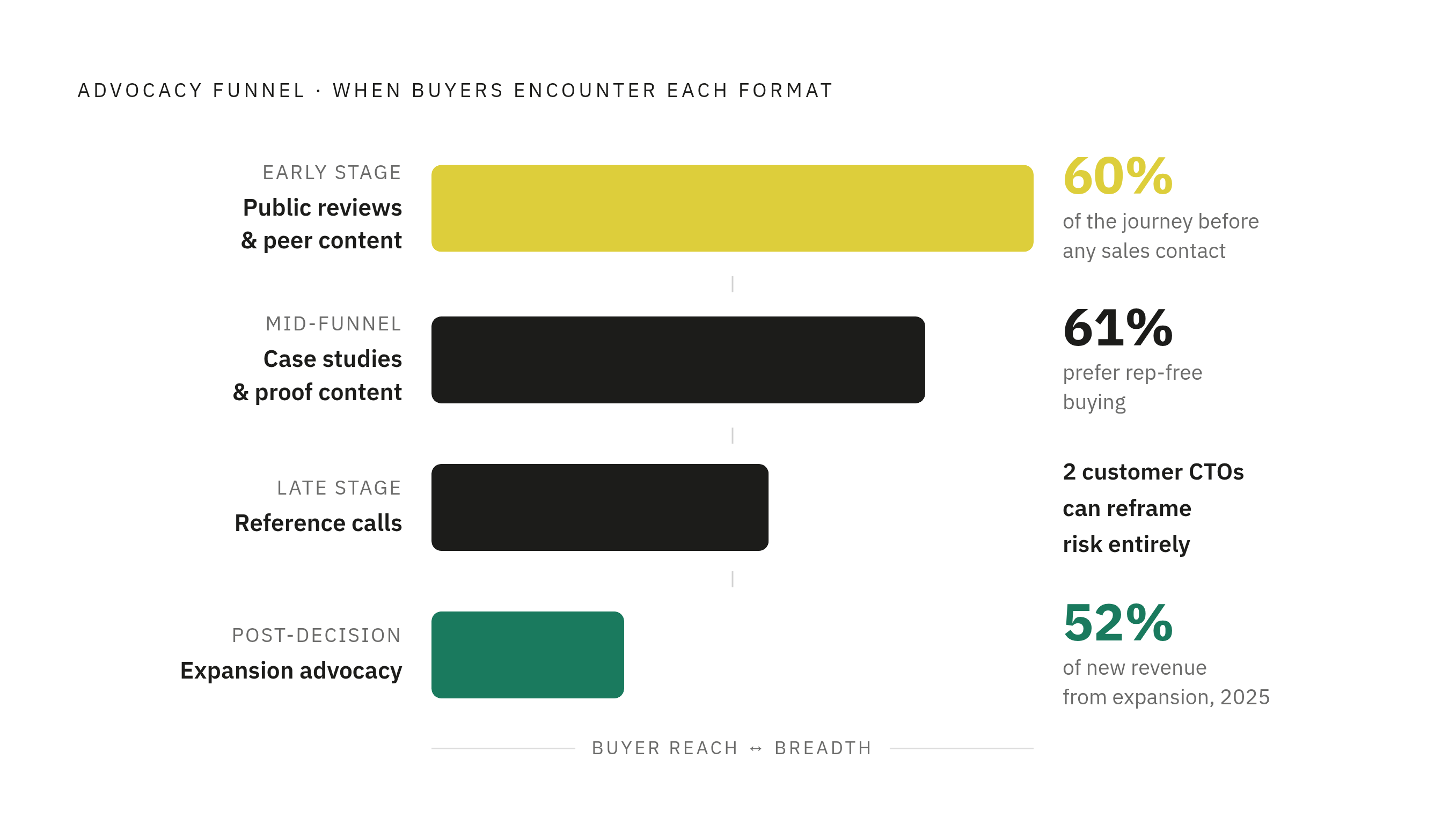
Per G2, roughly 60% of B2B buyers complete significant research without ever speaking to a vendor's sales team. The decision frame is already forming in peer content, review platforms, and referral conversations. And according to Gartner, buyers spend only about 17% of their total purchase time meeting with potential suppliers. When they're comparing multiple vendors, that drops to as low as 5% or 6% per rep.
That means:
- Most of the buying journey is happening in places sales cannot directly enter
- Peer networks, review sites, community forums, and referral conversations are doing the heavy lifting
- The short list is often set before the first demo request
This is where advocates operate. They are present in those spaces organically, with credibility no vendor-produced content can replicate. If advocacy fails to reach buyers in the research phase, the vendor will not get a fair hearing once the short list forms.
There's also a distinction worth making upfront. Satisfaction is internal. Advocacy is public, reputational, and commercial. A happy customer who stays quiet does zero GTM work. The goal isn't to make customers happy. It's to turn that happiness into something visible, specific, and deployable. Put another way: a satisfied customer is a candle; an advocate is a spotlight.
What Customer Advocacy Actually Consists of in a GTM Motion
Advocacy isn't one thing. It's a set of structured behaviors customers perform on your behalf. In a B2B context, that shows up in several forms:
- Written case studies and success stories. The most controllable and deployable format. Vendor-structured, customer-voiced.
- Public reviews on G2, TrustRadius, and Capterra. Third-party validated, persistent, and searchable. Buyers find these on their own.
- Reference calls. Live, buyer-to-buyer conversations in late-stage deals. High trust, high stakes.
- Peer referrals. Direct introductions into new accounts or buying committees. The warmest possible entry.
- Speaking appearances, co-authored content, community participation. Slower to produce, but longer-lasting credibility signals.
- Video testimonials. Consistently the highest-performing format. Among the top 58 fastest-growing SaaS companies analyzed in 2025, more than a third featured them prominently.
What all of these share: they are customer-voiced, buyer-trusted, and vendor-distributed. The vendor facilitates. The credibility belongs to the customer.
What they are not: a referral incentive program, a loyalty scheme, or a brand ambassador arrangement. Those are transactional. Advocacy is reputational.
The line that separates strong advocacy from weak is specificity. If a competitor could paste the same testimonial onto their site unchanged, it is decoration, not proof. Weak testimonials are like a master key — they open nothing because they fit everything.
Where in the Buying Journey Advocacy Does Its Heaviest Work
Advocacy is not uniformly useful across the funnel. Different forms intervene at different moments. Deploying the wrong proof at the wrong stage wastes it.
Early stage, research phase. Public reviews and peer-generated content shape the initial consideration set. This is where that 60% of the journey without sales contact happens. Your advocates are the only ones who can reach these buyers.
Mid-funnel, active evaluation. Case studies and success stories do conversion work that reps used to handle personally. About 61% of B2B buyers, per a 2024 Gartner survey, prefer a rep-free buying experience. And nearly three quarters actively avoid vendors who send irrelevant outreach. Structured proof fills that gap.
Late stage, risk reduction. Reference calls address the final objection: "Can I trust this vendor to deliver for someone like me?" This is where a competitor bringing two customer CTOs into a deal can reframe the entire risk calculation for a buying committee.
Post-decision, expansion. Advocacy compounds. Customers who advocate also expand. And customer expansion accounts for 52% of new revenue in 2025, per the Ebsta and Pavilion GTM Benchmarks. Advocacy isn't just acquisition work. It is a retention and growth motion too.
The through-line here is that advocacy is layered, not linear. It needs to be engineered for each stage, not deployed reactively when a deal is already in trouble.
Why Advocacy Programs Produce Measurably Different Outcomes Than Informal Customer Goodwill
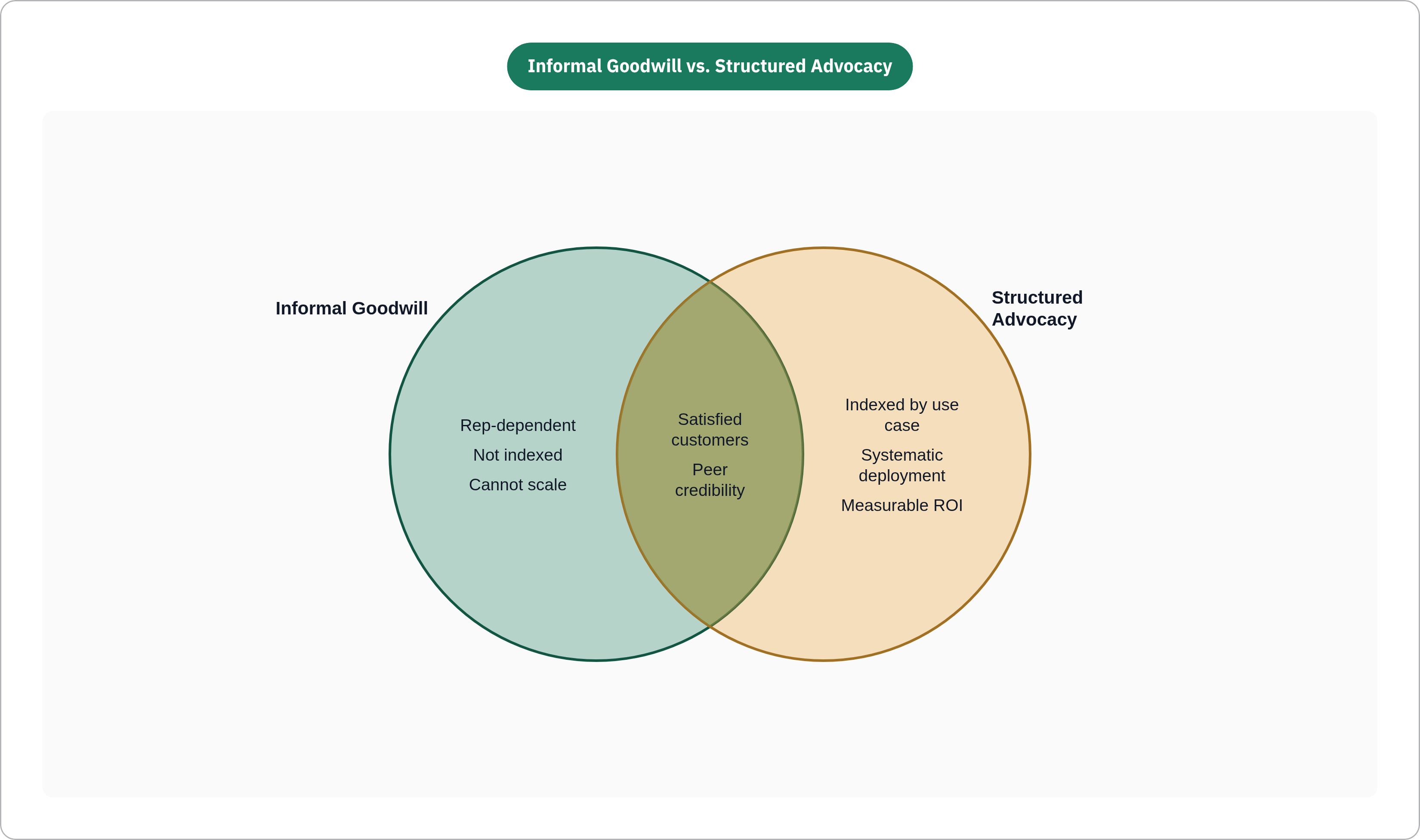
There is a measured, compounding revenue gap between "our customers like us" and a structured advocacy program.
Per Gainsight's Customer Health Benchmarks, B2B SaaS companies with formal advocacy programs and meaningful customer participation rates grow 23% faster than those without. Research from Influitive shows that 89% of companies with established programs report higher ROI than those running without one.
In enterprise sales specifically, structured advocacy tied to late-stage deal intervention has produced measurable win-rate improvement. The performance gap is not explained by product quality alone. It is explained by systematic evidence deployment: the right customer proof, matched to the right buyer, at the right stage.
What informal goodwill cannot do is instructive:
- It cannot be indexed by use case
- It cannot be pulled for a specific competitor objection
- It cannot be deployed at scale across a distributed sales team
Informal goodwill stays locked in the heads of individual reps who happen to know a happy customer. It does not travel. It does not scale. And when that rep leaves, it disappears entirely.
The Structural Failure That Makes Most Advocacy Programs Underperform
Most B2B companies have advocacy in some form. Almost none have it as a system.
The reactive loop is painfully familiar. Sales needs a reference. Someone messages the advocacy manager. The advocacy manager searches a spreadsheet. The deal waits. The right customer never surfaces in time.
Per UserEvidence's 2025 Evidence Gap report, 67% of B2B buyers have ruled out a vendor due to untrustworthy or insufficient evidence. The absence of the right proof is itself a disqualifier. It is not neutral.
A few structural failure modes that show up repeatedly:
Advocate burnout. Without rotation and coordination, the same handful of willing customers get asked again and again. They eventually go quiet. The program collapses to zero.
The library problem. Companies that collect case studies rarely index them usably. A sales rep facing a healthcare CFO objection cannot quickly find the right proof if the asset library is organized by publish date. It needs to be queryable by industry, persona, use case, and competitor.
The collection problem. Evidence is gathered at random, after the fact, when someone remembers to ask. Rather than at systematic milestones like onboarding completion, first major win, or renewal.
About 74% of buyers check at least two review sites before making a decision, per BrightLocal's 2025 survey. A fragmented, reactive evidence base fails across every single one of those touchpoints simultaneously.
What a Systematic Customer Advocacy Engine Looks Like in Practice
A systematic engine has three operational components: collection, organization, and deployment. All three run continuously, not project by project.
Collection. Capturing evidence at defined customer milestones. First meaningful outcome. Renewal. Expansion. Product launch. Not waiting for a sales crisis.
Channels that feed this include in-app surveys, email sequences, call recording analysis (Gong works well here), review platform prompts, and customer success touchpoints. You want format breadth too: written case studies, video case studies, review excerpts, reference call availability, referral willingness. Different assets for different deployment moments.
Organization. A searchable, indexed library. Queryable by industry, company size, use case, buyer persona, objection type, and competitor. Any rep should be able to pull the right proof in under two minutes.
Named and anonymous stories belong in the same library. Some customers will decline attribution. But specific metrics and industry context carry real credibility even without a logo. The library also needs a refresh cadence, every 6 to 12 months, or triggered by a new logo, new feature, or new region. Buyers notice stale evidence.
Deployment. Proof placed where hesitation peaks. Pricing pages. Comparison pages. Late-stage sales sequences. Objection-handling libraries. Retargeting creative. Not buried on a case study hub that buyers have to go find themselves.
Platforms that operationalize parts of this include UserEvidence for evidence management, CRM-integrated reference management tools, G2 and TrustRadius review programs, and managed services like Verbatim, a done-for-you case study and testimonial service that builds and runs customer proof engines for B2B SaaS companies.
Measurement should track assisted revenue, influenced pipeline, and sales usage rates. Page views alone tell you almost nothing useful.
How Case Studies Function as the Anchor Asset in an Advocacy System
Case studies are the only advocacy format that is simultaneously searchable, shareable, scalable, and structurally controlled by the vendor. They are the connective tissue.
Among the top 58 fastest-growing SaaS companies in 2025, the vast majority use case studies, averaging 45 per company. And roughly half feature them on the homepage within one click.
Structure determines performance. Ninety-three percent of those companies use a Challenge-Solution-Impact framework. That narrative arc matters because information presented as stories is retained far better than isolated facts, a finding that has held up across multiple decades of research.
A high-performing case study contains:
- A headline leading with a measurable result, not the vendor's product name
- A snapshot box above the fold: industry, company size, region, products used, key KPIs
- A Situation, Trigger, Barrier, Solution, Results flow that mirrors the buyer's own journey back to them
- A proof pack: customer quote, before-and-after comparison, supporting diagram
Per McKinsey's 2025 Digital Marketing Report, case studies with clear before-and-after contrasts achieve meaningfully higher persuasive power than those without. And per an Edelman study from 2025, the majority of B2B decision-makers identify more strongly with stories that center the customer's perspective rather than the vendor's capabilities.
A single customer story should ship as a web page, a PDF, and a short video of 60 to 120 seconds that opens with the result line. Not produced once and filed.
Each well-structured case study continues generating pipeline for months after publication. The asset does not expire the way a campaign does.
How Advocacy Integrates with Organic Discovery to Reach Buyers Before Outreach
There's a useful rule of thumb in B2B marketing: at any given moment, only about 5% of your addressable market is actively evaluating solutions. Advocacy distributed through organic channels earns the right to be on the short list when the other 95% eventually enters market.
Where advocacy surfaces organically:
- Review platforms. G2, TrustRadius, Capterra. Persistent, third-party validated, and the first stop for buyers in research mode.
- SEO-indexed case studies. Structured proof pages that rank for problem-aware and solution-aware queries. These work while you sleep.
- AI-powered search. Per G2's 2025 Buyer Behavior Report, leads originating through AI-powered search convert roughly 40% better than those from traditional search, because buyers encounter credible third-party content earlier in their journey.
- Community and peer networks. Customer voices in Slack communities, LinkedIn threads, and practitioner forums carry weight no vendor content can replicate.
G2 Trust Badges and verified review excerpts embedded on pricing and comparison pages reduce friction for self-serve buyers making decisions without ever talking to sales. These are small moves with outsized effect.
At scale, structured community advocacy programs have produced documented results. Cisco and Khoros built a program where engineers published nearly half again as much content internally, drove over one million annual community interactions, and delivered tens of millions of dollars in case deflection. Advocacy compounds beyond individual asset performance when the system is designed to let it.
The organic and advocacy engines reinforce each other. More structured customer stories mean more indexed, discoverable proof, which means more buyers arriving pre-informed and pre-sold, which means shorter sales cycles.
What Separates Companies That Build Durable Advocacy Capacity from Those That Don't
Advocacy is not a campaign with a launch date and a wrap report. It is an ongoing system. And the companies that build durable capacity treat it that way.
The compounding logic is worth sitting with. Each new case study, review, and reference call makes the next one easier to get. Customers see their peers on record and become more willing to go on record themselves. The library grows. The system becomes self-reinforcing. Companies that start late don't just have fewer assets. They have less momentum. Think of it like compound interest: the earlier you start, the less work each individual deposit has to do.
The organizational commitment that makes this possible looks like:
- Cross-functional ownership. Customer success identifies candidates. Marketing produces and distributes. Sales deploys and reports back on what worked and what didn't.
- Systematic collection cadence. Built into the customer journey at defined milestones. Not triggered by a panicked Slack message when a deal is at risk.
- A production process that moves fast enough to be useful. Raw customer conversations converted into structured, indexed assets quickly enough to keep pace with the sales team's actual needs. Not a weeks-long editorial bottleneck.
The companies that get this right do not treat advocacy as something that happens after the real work is done. They build it into the motion from the start. The ones that fall short end up with a spreadsheet of happy customers they can never quite reach when it counts.