Objection-Specific Content Mapping for Sales Reps
The right asset—not the right words—moves stalled deals forward.

Most sales training treats objections like a communication problem. The rep just needs better words, a tighter reframe, a slicker script. But here's what I've watched happen hundreds of times in real deals: the rep has the right instinct, knows exactly what the buyer needs to hear, and still loses the moment. Not because they said the wrong thing. Because they sent the wrong asset. Or nothing at all.
That's a structural problem. And you can't fix a structural problem with a pep talk.
The buyers who raise objections on your call have usually been sitting with those concerns for weeks. They've been researching independently, building (or failing to build) internal consensus, comparing you to alternatives. The large majority of the purchase journey happens without a rep in the room. So by the time someone says "the price feels high" or "now isn't the right time," a verbal counter-argument is almost never going to undo that. What moves a stalled deal is proof. The right proof, in a format the buyer can actually share with the stakeholders the rep will never meet.
That's what an objection-specific content map does. It's not a script. It's infrastructure.
The Real Reason Objections Cluster the Way They Do
Objections feel random in the moment. They're not. Across industries, deal sizes, and buying teams, they concentrate around a small number of recurring concerns.
- Price and value. The number feels too high. The underlying issue is almost never that the number is wrong. It's that the value story hasn't landed.
- Timing. "Not right now" usually masks budget cycles, internal politics, or competing priorities. Genuine indifference is rarer than it seems.
- Need and fit. The prospect isn't convinced the problem is real enough, urgent enough, or large enough to justify action.
- Authority and alignment. The person in the conversation isn't the decision-maker, or the buying group hasn't reached internal consensus yet.
- Trust and risk. The prospect isn't sure the vendor will actually deliver. This one is especially sharp for newer or less-known companies.
Here's what's worth flagging: authority and alignment objections are now among the most common late-stage deal killers in B2B, according to Apollo's objection-handling research. And yet most sales content is built almost entirely for price objections. That mismatch alone explains a lot of stalled pipelines.
Each cluster needs a different kind of proof. A financial objection needs ROI evidence. A trust objection needs a verified customer story. An alignment objection needs something the champion can circulate internally without the rep. Getting the right proof to the right person starts with understanding which objection you're actually dealing with. This taxonomy is the backbone of everything that follows.
What a Content Map Actually Is and How to Build One
A content map is a documented pairing of each objection type to the specific asset (or assets) best suited to address it. Organized so reps can retrieve the right thing without having to think about it in the moment.
The map has three columns:
- Objection trigger (what the buyer said or signaled)
- Content asset (the specific piece, not just the category)
- Intended recipient (the rep's direct contact, the CFO who hasn't appeared yet, the full buying committee)
That third column is the one most teams forget. It matters because the person who raises the objection is often not the person who needs to be convinced.
Building it starts with data, not assumptions
- Pull closed-lost reasons from your CRM and group them against the five clusters above.
- Interview reps on the objections they hear most and what they currently send in response.
- Identify the gaps: where are reps improvising? Where are they sending nothing?
Pre-call prep turns the map from a reference document into a habit. If a rep can look at an account's size, industry, and deal stage before a call and predict the likely objection, they show up with the right asset already pulled. That's a different conversation than scrambling on Slack after the call.
Two rules that keep the map honest. First, only include assets that actually exist or can be produced quickly. A map full of phantom entries creates more dysfunction than no map at all. Second, someone has to own it. Without a named owner, the map decays within a quarter. I've seen it happen every time.
Which Content Types Actually Resolve Which Objections
This is where most teams go wrong. They have content. They just use it for the wrong objection.
Price and value
Best asset: An ROI calculator or case study that leads with cost savings and payback period, not product features.
The case study needs a before-and-after financial framing the prospect can replicate for their own situation. If they can plug in their own numbers, even roughly, the value story becomes theirs, not yours.
What doesn't work: A feature comparison sheet. That reinforces the product-focused framing that created the value gap in the first place.
Timing
Best asset: A short-form piece (a one-pager or a stat card) that quantifies the cost of delay. What was the customer losing each quarter before they acted?
Risk-of-inaction framing works better here than urgency framing. Urgency feels like a sales tactic. Showing the buyer what delay is actively costing them makes the delay itself the problem.
Need and fit
Best asset: A customer story from a company that initially wasn't sure it had the problem. The "we almost didn't buy" narrative. That story does something a product pitch can't: it gives the skeptical prospect permission to recognize themselves.
A short diagnostic piece (a checklist, a self-assessment) also works well here because it lets the prospect confirm the problem exists on their own terms, not yours.
Authority and alignment
Best asset: Content designed to be forwarded, not consumed on the call. An executive summary. A one-page business case template. A slide the champion can present internally without the rep present.
Gartner research has found that buying groups who reached internal consensus were substantially more likely to rate their purchase as high-quality. Content that helps your champion build that consensus isn't just a nice-to-have. It's directly tied to deal quality.
Video testimonials from peer executives carry real weight here. A CFO hears from another CFO, not a marketing asset.
Trust and risk
Best asset: A verified customer story from the same industry or company type. Ideally with a named contact and a specific outcome.
For regulated industries where named attribution isn't possible, a verified but anonymous testimonial (authorship confirmed, company name withheld) still earns meaningful buyer trust. Only marginally less than a fully attributed one. A security review document, compliance checklist, or reference call offer belongs here too.
One rule across all types
The asset has to be in a format the buyer can actually share. A PDF, a short video, a one-pager. Not a long blog post. Not a portal link that requires a login. If sharing it creates friction, it won't get shared.
Why Case Studies Do More Objection Work Than Any Other Single Asset
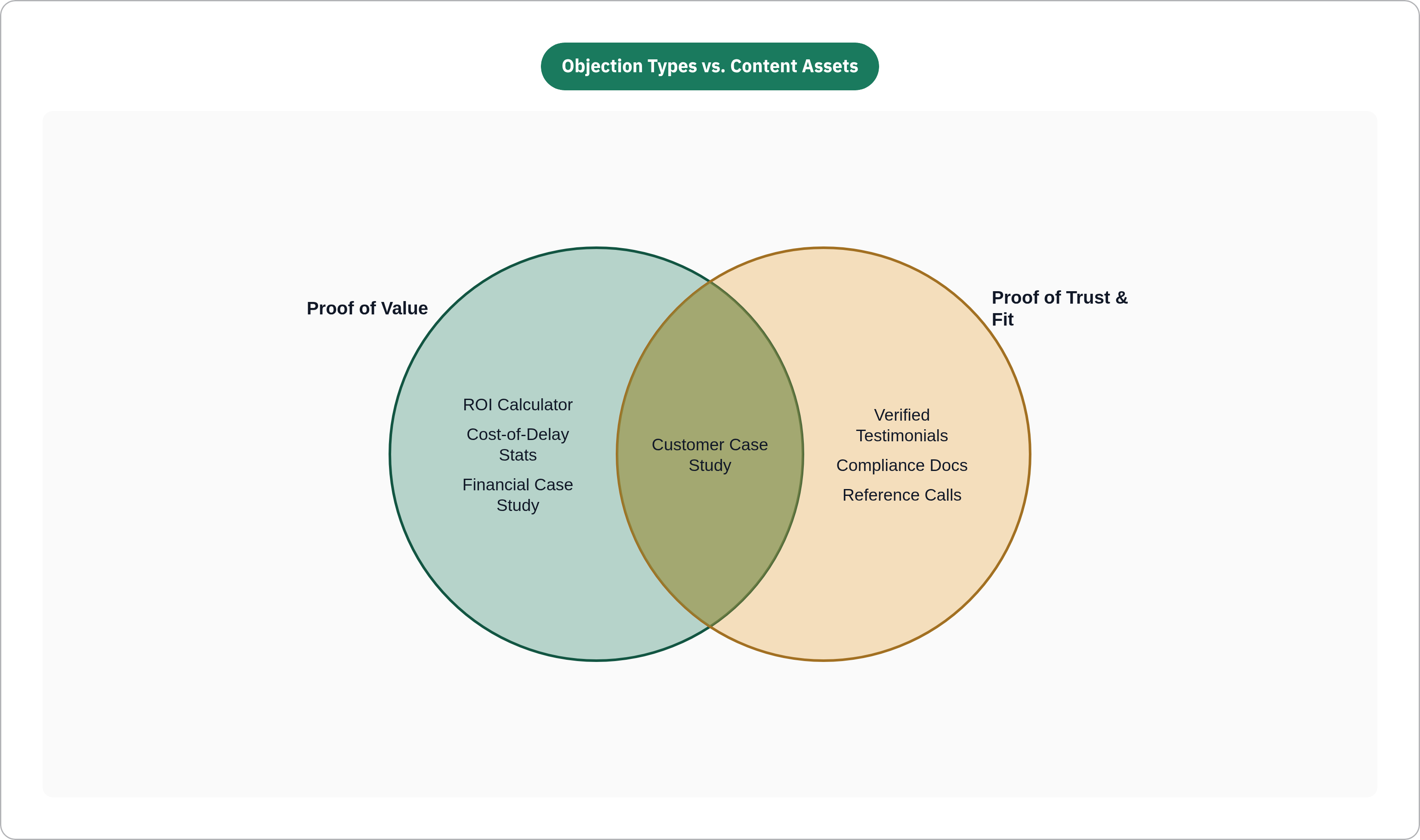
Case studies show up across multiple objection types because they carry proof of value, proof of fit, and social proof all in one piece. No other format does that.
Analysis of what reps actually request from their marketing and enablement teams shows that case studies, customer stories, and similar-company comparisons make up the large majority of those requests. The demand signal is already there. The supply is usually the constraint.
What makes a case study resolve an objection versus just building background credibility
- It must name the specific problem the customer had. Not a generic pain point. A situation the prospect recognizes as their own.
- It must show a measurable before-and-after. Even qualitative works: "we cut the process from weeks to days" is enough if a hard number isn't available.
- It must include enough company context (industry, size, complexity) that the prospect can self-identify as a fit.
The enablement kit model
One customer story can yield a full set of objection-specific assets without a new interview or new writing.
- A long-form case study for trust and due diligence
- A one-page summary for the champion to circulate internally
- A pull quote card for async outreach
- A short video clip for authority objections (the customer's CFO on camera, speaking to your CFO prospect)
That's four assets from one source. Most teams treat those as four separate production projects. They're not.
The sourcing problem nobody talks about
Most companies have happy customers. Very few have a system for capturing their story at the right moment. Satisfaction fades as a motivation to participate, so the best capture window is shortly after a successful outcome. Wait six months and the customer has moved on mentally, even if they're still happy.
Measuring whether case studies are actually working
Track how often a specific asset appears in closed-won versus closed-lost deals. That CRM attribution tells you which stories are actually moving pipeline, which should drive which stories get produced next. If a case study is sitting in your library and never appearing in won deals, something is wrong with the asset, the label, or the distribution.
The Distribution Failure That Makes Good Assets Invisible
Here's the most demoralizing version of this problem: the asset exists. The rep just can't find it in the moment they need it.
What reps actually do when they can't find the right asset: they send their personal favorite (usually a generic one), they ask on Slack and wait, or they improvise verbally. All three leave the objection partly unresolved.
Where assets go to die:
- A shared drive with no taxonomy
- A marketing portal reps don't check
- An email thread from six months ago that nobody can surface
What good distribution actually looks like
- Assets surfaced inside the tools reps already use. CRM, email, Slack. Not in a separate system requiring a separate login.
- Filterable by objection type, industry, company size, deal stage, and competitor. So the rep finds the right asset, not just any asset.
- Named and labeled to match the objection, not the content format. "CFO ROI one-pager" instead of "Case Study Q3."
A content map only creates value if it's embedded in the rep's actual workflow. A document in a folder is not a system.
Distribution is also where the map gets tested. If reps keep skipping a recommended asset, one of two things is true: either it doesn't match the objection, or it's in a format buyers won't engage with. Both are signals to update the map.
How to Audit What Your Team Actually Has Before Building Anything New
The instinct when you see a content gap is to produce something new. Resist that. Start with an inventory.
List every asset the team currently has. Tag each one against the five objection clusters. What you'll usually find:
- Price and value: Some ROI content exists, but it leads with features rather than financial outcomes. Needs reframing, not replacement.
- Trust and risk: A handful of case studies exist but they're formatted for the website, not for sales deployment. Need a one-page derivative, not a new interview.
- Authority and alignment: Almost always the biggest gap. Very few teams produce content explicitly designed for internal champion circulation. This is the one that surprises people every time.
- Timing: Usually nothing. This is the most consistently underserved objection type in almost every content library I've ever seen.
After tagging, plot the map and identify which objection buckets are empty. Those are your production priorities. Not the buckets that already have three assets.
Repurposing is faster than producing from scratch. An existing customer story can yield the one-pager for authority objections and the stat card for timing objections without any new source material.
One more thing: flag old assets alongside gaps. An asset that's more than two years old may be doing active harm for trust objections. A dated case study signals the company hasn't grown, hasn't won new customers worth writing about. Update those before you produce something entirely new.
Making the Map a Living System Rather Than a One-Time Project
A content map built once and never touched reflects last year's objection patterns. Markets shift. Competitors change. New stakeholder types emerge. The map has to keep up.
The feedback loop that keeps it current
- Reps flag objections the map doesn't cover yet. A lightweight Slack channel or a single CRM field is enough.
- Win/loss reviews surface which assets appeared in closed-won deals and which objections went unanswered in losses.
- A quarterly review of the map against current closed-lost reasons from CRM keeps the taxonomy grounded in actual deal data, not someone's memory of what objections used to look like.
Avoiding advocate burnout
When the same few happy customers get asked to participate in case studies repeatedly, the pipeline of new proof dries up fast. Systematize who gets asked, when, and for what format. Spread the load. Protect the advocates who are already participating. The system only works if there are always new stories coming in.
The compounding effect
As the asset library grows and reps develop habits around the map, the time from "objection raised" to "proof delivered" shrinks. Deals that used to stall for a week while a rep hunted for the right asset start moving faster. That's not a soft benefit. It shows up in pipeline velocity.
The map is ultimately an infrastructure decision, not a content production decision. It requires someone who owns it, a process that feeds it, and reps who trust it enough to use it consistently.
The test of whether it's working is simple: reps stop improvising and start deploying. And closed-won rates on previously stalled deals start to move. That's the whole point.