Social Proof in B2B Pricing Pages That Reduce Sales Cycle Length
Strategic social proof placement cuts B2B sales cycles by answering unspoken buyer objections early.
The average B2B sales cycle in 2024 ran about 25% longer than it did five years earlier. That is not a pandemic hangover or a one-bad-macro-year blip. It is structural, and the structure has been shifting for a while.
For deals over $250k, every single one now takes more than six months to close. That is the segment where a pricing page carries the most weight. It is also where unanswered objections are the most expensive.
Here is what is actually happening inside those longer cycles. The buying group is bigger. You are typically dealing with six to ten stakeholders, sometimes more, and most of them will never get on a call with your rep. They are doing independent research. Each one is forming their own opinion, gathering their own questions, and either finding answers or not.
Roughly 61% of B2B buyers in 2024 preferred a rep-free buying experience. That number is not an edge case. It means the pricing page is now doing the job that a discovery call used to do — and a pricing page that fails to answer the right questions is like a salesperson who only talks about themselves.
So when a stakeholder lands on your pricing page and cannot find evidence that your product works for a company like theirs, they do not email your sales team. They leave. Or they stay quiet while the deal stalls. The risk is not just slow cycles — it is deals dying without anyone ever voicing the objection that was sitting right there, unanswered, on the page.
What social proof is doing on a pricing page, then, is not decoration. It is a credibility signal in the specific, functional sense — objection resolution before the objection is spoken out loud.
The Objections Buyers Are Actually Trying to Resolve on a Pricing Page
There are three questions your pricing page visitor is asking. They are not asking them out loud. They probably would not frame them this cleanly. But they are there.
The first: "Does this work for someone like me?" Industry, company size, use case. If a buyer cannot find themselves somewhere in your customer evidence, the page quietly signals that it was built for someone else.
The second: "Is the price I'm seeing the real price?" Buyers have been burned. Implementation fees, seat limits, add-ons that turned a reasonable-looking quote into a budget nightmare. They are not necessarily angry about cost — they are angry about ambiguity. Suspicion of hidden costs is one of the most consistent drivers of pricing page abandonment, and it is almost never addressed directly.
The third is the hardest one: "Can I justify this internally?" The person reading your pricing page is often not the final approver. They need to take something back to their manager, their CFO, or their procurement team. They need a story they can repurpose in a meeting you will never be invited to.
This is why B2B case studies, when done well, punch so far above their weight. They answer all three questions at once. A good case study shows a similar company, demonstrates real outcomes, and hands the buyer a narrative they can walk into the next internal alignment meeting with.
The problem is that most case studies are written to avoid embarrassment rather than to create recognition. They say the client wanted to "improve operational efficiency." The real story is usually that contracts were falling through the cracks and they were losing enterprise deals because of it. Writing toward the actual pain, not the sanitized version, is what makes a buyer feel seen instead of marketed to. The difference between a bad case study and a good one is the difference between a foggy window and a mirror — one obscures, the other reflects.
Gartner found that when buyers identified supplier content as genuinely helpful, they were 2.8 times more likely to experience high purchase ease and three times more likely to buy a larger deal with less regret. Useful content at the pricing stage does not just convert. It converts bigger, cleaner deals.
Which Social Proof Formats Belong on a Pricing Page and What Each One Resolves
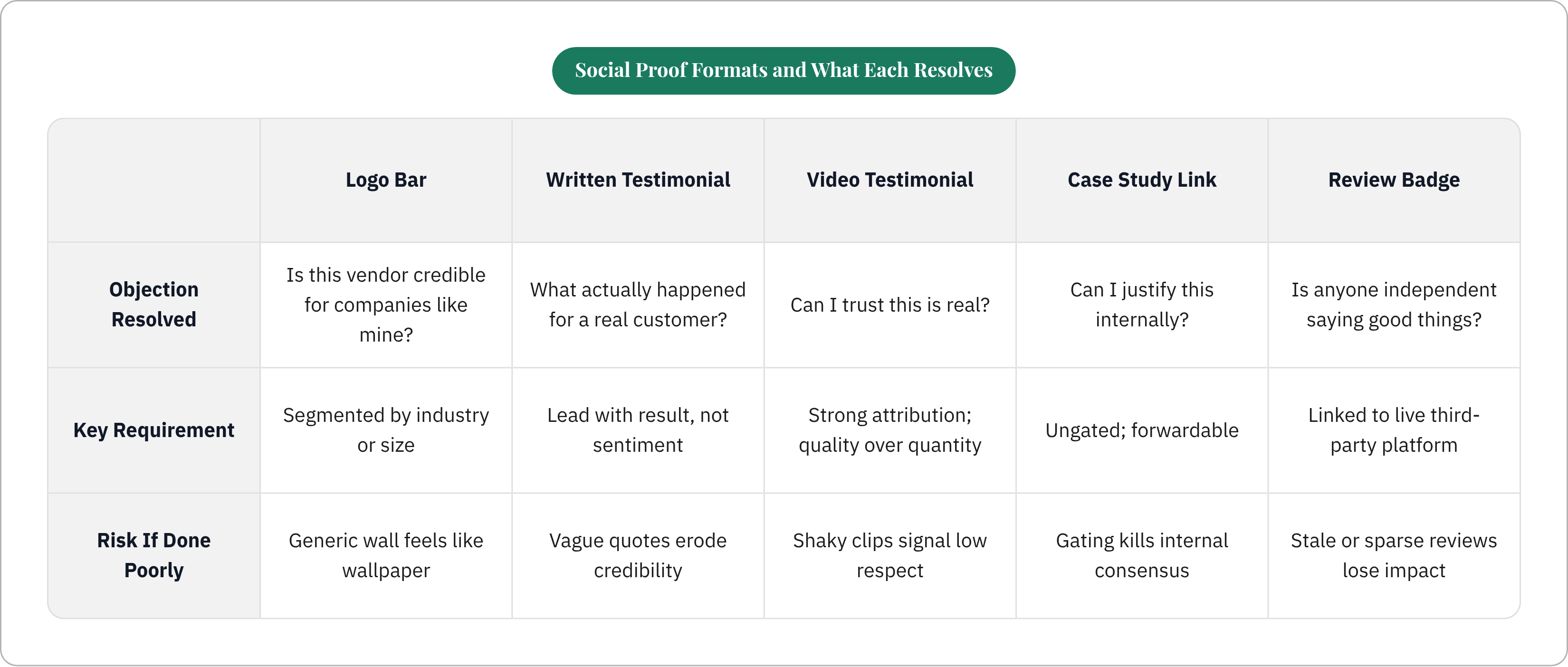
Not all social proof is doing the same job. Each format is answering a different question.
Customer logo bars resolve one thing: "Is this vendor credible and used by companies like mine?" A wall of household-name logos is impressive but low-signal if the buyer works at a 200-person logistics company and everything they see is Fortune 500 retail. Logos segmented by industry, company size, or use case carry actual information. A generic logo wall is better than nothing, but it is closer to wallpaper than evidence.
Outcome-specific written testimonials resolve: "What actually happened for a real customer?" The structure is simple. Name, title, company, headshot. Not anonymous. The quote should lead with a result, not a sentiment. "We loved the interface" is a reaction. "We cut contract review from 11 days to three" is proof.
Video testimonials resolve something text cannot fully replicate: "Can I trust that this is real?" There is an emotional register in a real person talking on camera that written quotes simply cannot manufacture. For high-ticket tiers and enterprise CTAs, trust requirements scale with deal size, and video is disproportionately valuable there. One strong, well-attributed video beats a gallery of shaky, poorly-lit clips. Production quality signals how much you respect your customer's time and your own credibility.
Case study links resolve: "I need to justify this to someone above me." The buyer three levels below the person who signs the check needs something they can forward, drop in a Slack channel, or paste into a slide deck. A case study is that thing. Do not gate them. Gating case studies at the pricing stage is one of the more self-defeating moves in B2B marketing — you are creating friction at the exact moment someone is trying to build internal consensus. Let it travel freely.
Third-party review badges resolve: "Is anyone independent saying good things?" Review platforms like G2 and Capterra are consistently among the top sources that influence vendor shortlists. A badge is not just a vanity signal. It connects your pricing page to the research the buyer probably already did before they arrived. There is a secondary effect worth knowing: review platforms increasingly appear in AI-generated search responses, which means investment in third-party reviews compounds beyond your pricing page and feeds the research buyers do much earlier in the process.
Where on the Pricing Page Each Proof Type Should Sit
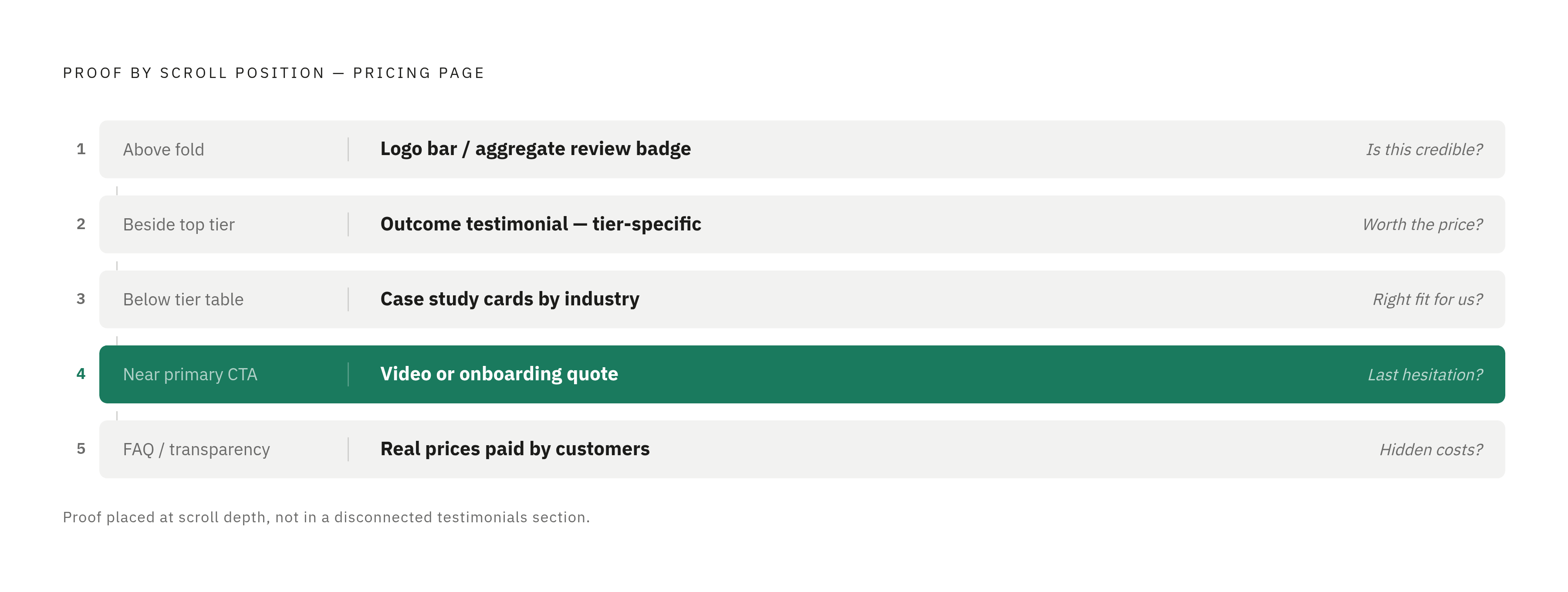
Placement is not aesthetic. It is functional.
Buyers move through a pricing page in a fairly predictable sequence: headline, tier comparison, CTA, fine print. Social proof needs to interrupt that sequence at the right moments, rather than sit in a designated "testimonials island" that most buyers never actually scroll to.
Above the fold. Put your logo bar or an aggregate review badge here. Something like "Rated 4.8 on G2 by 600+ B2B teams" works well. The job is to reduce bounce before the buyer has spent any real cognitive energy on tier comparisons. They need to know they are in a credible place before they do the work of evaluating what you are selling.
Adjacent to your most popular or highest-value tier. A short outcome quote from a customer who actually bought that tier. Make it specific to that tier's use case. Proof sitting right next to a CTA amplifies whatever pull the CTA already has.
Below the tier comparison table. Two or three case study summary cards, segmented by industry or company type so different buyer personas each see themselves reflected. Each card should show the company name, the core problem, the quantified outcome, and a link to the full story.
Near the primary CTA. A video testimonial or a quote about ease of onboarding belongs here. This is the last-moment hesitation zone. A story told in someone else's voice, sitting right next to the button, is meaningfully more useful than a feature bullet at that scroll position.
In the FAQ or pricing transparency section. This is where you resolve the hidden-cost objection head-on. Specificity about what customers actually paid and what they got eliminates the suspicion that drives abandonment.
The logic throughout is the same: match the proof to the question the buyer is asking at that scroll position, not to the section that was easiest to build.
What Makes a Testimonial or Case Study Actually Useful at the Pricing Stage
Specificity is the whole game. "We saved time" is not proof. "We cut contract review from 11 days to three" is proof. Vague claims do not just underperform at the pricing stage — they actively erode credibility because the buyer is in evaluation mode. Vagueness feels like a dodge.
The minimum viable structure for any case study is a before/after frame:
- What was broken, expensive, or embarrassing before
- What specifically changed after implementation
- The quantified outcome, in real numbers
Case studies built around that arc achieve meaningfully higher persuasive impact than those without it. That is a structural difference, not a writing style preference.
Attribution is non-negotiable. Name, title, company, headshot. Anonymous quotes carry almost no weight at the vendor-evaluation stage. A buyer comparing you to two other vendors has no reason to trust a quote from someone who does not visibly exist.
The emotional dimension is real, even in B2B. Emotional resonance in this context does not mean sentimental. It means naming the real pain state. "We were losing enterprise deals because prospects couldn't verify our track record" lands harder than "we wanted to improve our sales process." The first one sounds like something a real person said at 10pm before a board meeting. The second sounds like a press release.
The story should belong to the customer, not to you. Decision-makers identify far more strongly with success stories told from the customer's perspective than from the vendor's. That is a conversion principle, not a soft content preference.
How to Source and Produce Pricing-Page Proof Without Burning Your Best Customers
Here is an honest observation about how most B2B companies actually handle customer evidence. The same three customers get asked for everything. They are great advocates. They say yes once. Then twice. Then they quietly stop responding because nobody wants to be a professional reference in perpetuity.
Advocacy burnout is a real production risk. It is directly connected to deals stalling. When the right reference is not available at the right moment, the deal waits.
Timing is the most underused lever in this entire process. Customers feel most enthusiastic right after a significant win or a smooth onboarding. That is the window. Waiting six months until the relationship has settled into routine lets the initial excitement fade into just-another-vendor energy.
An analysis of how sales reps actually use customer proof tools internally found that requests for case studies, customer stories, and similar-company lists made up two-thirds of all queries. The internal demand for proof is already enormous. The supply chain is what is broken.
A production workflow that avoids burnout looks something like this:
- Build collection checkpoints into the engagement itself, not as a separate ask after the relationship has cooled
- Start with a short-form quote with full attribution. It is easier to get than a full case study, gets something live faster, and can be expanded later
- Make the approval loop fast and low-friction. Enthusiasm has a shelf life. A three-week approval process kills it.
Repurposing is the ROI multiplier most teams underuse. One strong case study video becomes a written page, a PDF, deck slides, a follow-up email, LinkedIn clips, and a pricing-page pull-quote. One customer interview, properly distributed, covers multiple proof formats without requiring additional asks from the same person.
On gating: gate longer research reports if you want. Keep customer stories and quotes freely accessible. Gated case studies on a pricing page create exactly the kind of friction you are trying to remove.
The Compounding Effect When Pricing-Page Proof Is Connected to the Rest of the Sales Motion
A case study on your pricing page is not just a pricing page asset. That is worth sitting with for a second.
B2B buyers consume a significant amount of content before making a purchase decision. Your pricing page is one node in a longer journey. The proof that lives there can do work at every other node if you let it.
The same case study can:
- Be sent by a rep after a discovery call to a stakeholder who was not in the room
- Be indexed by search engines and surfaced to buyers who have not found your pricing page yet
- Be shared by the customer advocate on LinkedIn, reaching peers who trust peer recommendations far more than they trust vendor content
Proof that lives on third-party platforms feeds AI-assisted research before a buyer ever reaches your site. Your pricing-page social proof strategy and your SEO strategy and your review-site strategy are, functionally, the same strategy. They just usually live in different Slack channels and get different budget conversations.
Sales reps armed with the right proof close faster. The proof resolves an objection that would otherwise require a follow-up call, a scheduling cycle, another call, and another follow-up. Every friction point you remove is a week you are not losing.
Strong customer evidence also makes sales outreach more effective earlier in the funnel. Research consistently shows that decision-makers are more receptive to outreach when the company already has visible, substantive proof of results. Proof assets built for the pricing page double as material that opens doors before a buyer has started an active evaluation.
Stop treating pricing-page social proof as a one-time page optimization. Treat it as the most visible output of an ongoing customer evidence engine, and some B2B SaaS teams outsource that engine entirely to managed services like Verbatim, a done-for-you operation that handles case study and testimonial production end to end so sales teams always have current proof to deploy. The page gets better every time a new story is collected. It gets better every time an old one is updated with fresher numbers. Every strong case study you publish today is doing work on a deal that has not started yet — which is a bit like planting a tree in the shade of which you will never sit, except in B2B, you absolutely will sit in that shade, usually in Q4 when pipeline is thin and you are grateful for every story you had the foresight to collect six months earlier.