Demand Generation Campaign Structure for Early-Stage B2B
Buyers form vendor preferences during anonymous research before ever talking to sales.

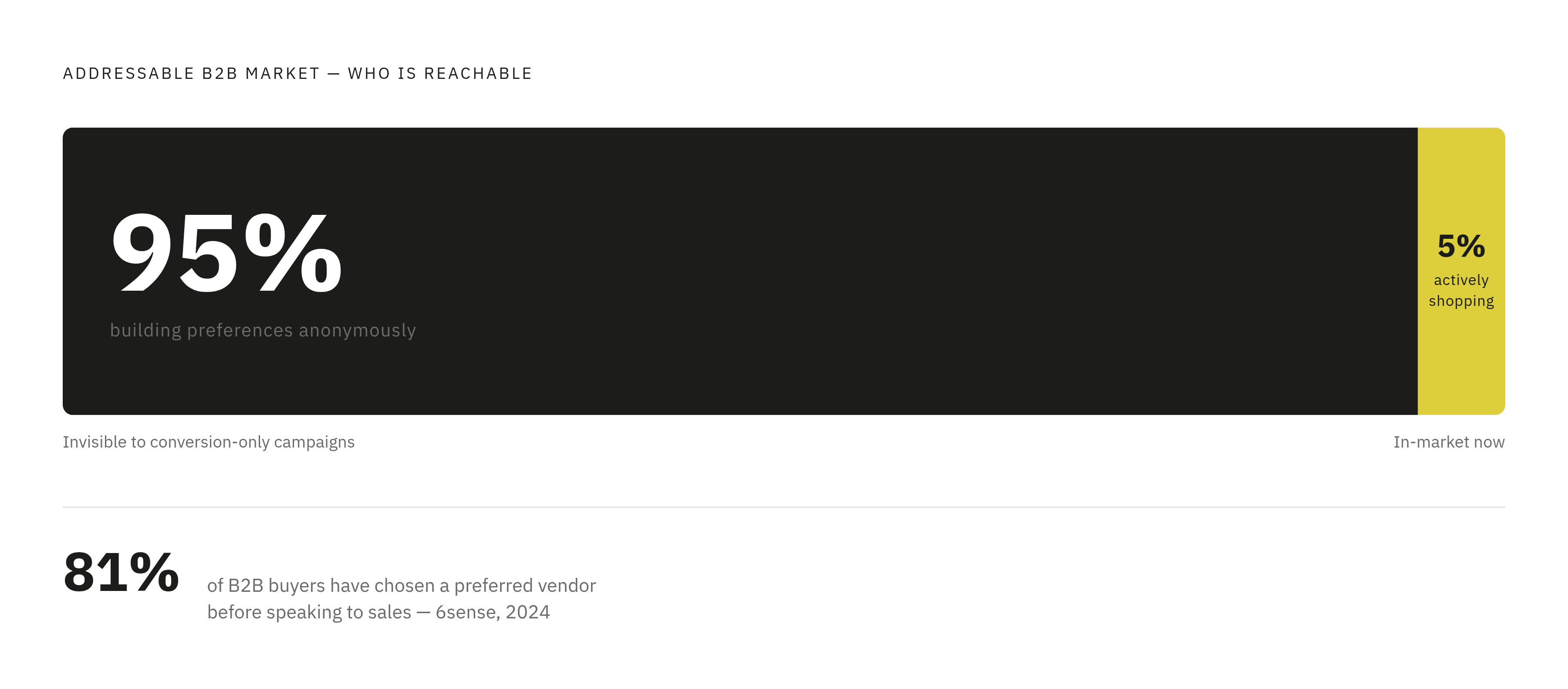
The B2B Institute put a number on something most experienced marketers already feel in their bones: at any given moment, only about 5% of your addressable market is actively shopping. Five percent.
So a demand gen motion built entirely around capturing in-market buyers is, by definition, fighting over a small, expensive slice of the pie while ignoring the other 95%. That 95% is not invisible or unreachable. They are simply not ready yet.
And they are not sitting still while they wait.
- They are building mental shortlists
- Reading comparison content
- Watching how your competitors show up
- Forming opinions about your category before they have ever visited your website
6sense's 2024 B2B buyer research found that 81% of B2B buyers have already chosen a preferred vendor before they ever speak to a sales rep. The preference forms during anonymous research. Before any hand-raise. Before any demo request. Before any conversation with your team.
If your campaign only activates when someone fills out a form, you have already lost most of the race before you knew it started.
The structural implication is not subtle. Your campaign has to be present and credible during the pre-contact phase, not just at the moment of inquiry. You need to separate your campaign goals by buyer readiness. Awareness for the 95%. Conversion infrastructure for the 5%. Both running in parallel from day one.
The most common early-stage mistake is treating demand gen like a light switch. Flip it on when pipeline looks thin. Flip it off when things feel okay. The problem with that is the 95% who will eventually become the 5% arrive cold, uneducated, and often with a competitor's name already in their head.
What this calls for is a three-layer structure. Create demand for the 95%. Capture demand from the in-market 5%. Convert demand with proof that actually closes. Each layer has a different goal, a different content type, and a different way you measure whether it is working.
The Three-Layer Campaign Architecture and How the Layers Connect
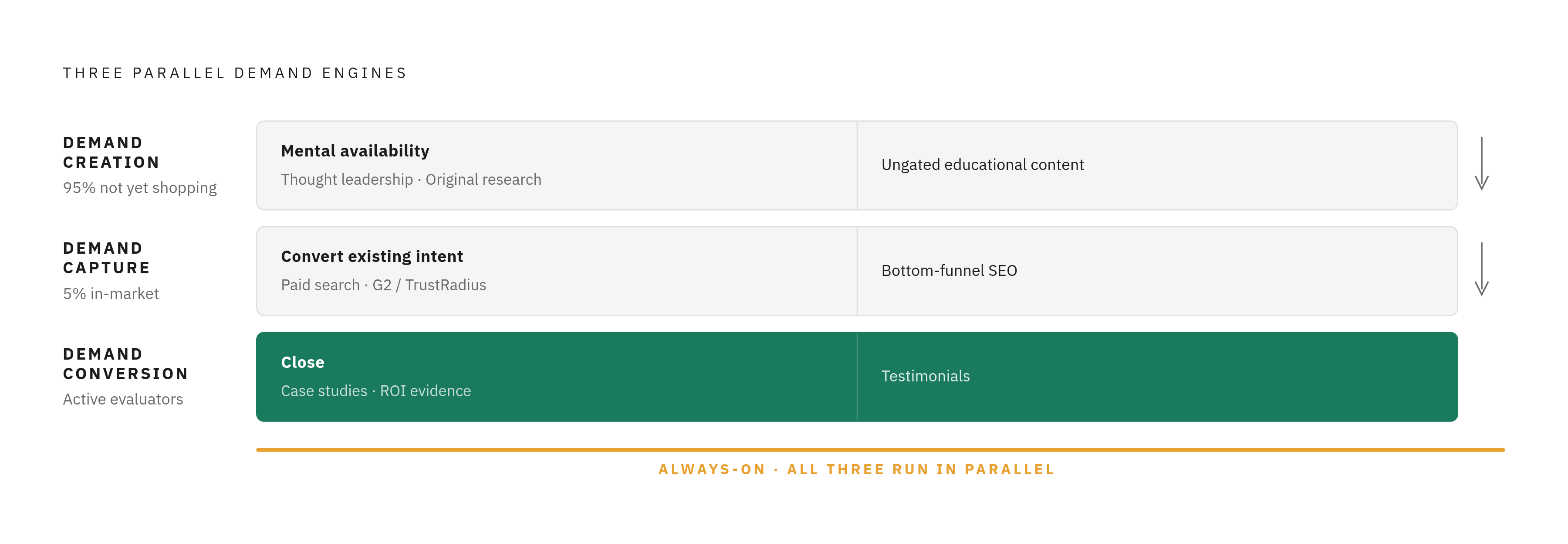
Think of this less like a funnel and more like three engines running simultaneously. They serve different audiences, but they are built to hand buyers from one to the next without friction.
Layer 1: Demand Creation
This layer is for buyers who are not looking yet. The goal is mental availability. Being on the shortlist when that 5% window eventually opens for a given buyer. This is not about generating leads, and if you measure it that way you will defund it before it has a chance to work.
What belongs here:
- Ungated educational content
- Thought leadership and original research
- Consistent social presence
- Industry newsletters and communities where your buyers actually spend time
You are not asking for anything in Layer 1. You are depositing trust.
Layer 2: Demand Capture
This layer is for buyers who have entered active research mode. The goal shifts entirely. You are no longer building awareness. You are converting intent that already exists.
This is where paid search earns its budget. Where your G2 and TrustRadius profiles actually matter. Where bottom-funnel SEO does real work.
B2B buyers typically consume somewhere between three and seven pieces of content before reaching out, often more. Your capture infrastructure has to be present across that entire research trail. Generic positioning loses here. A competitor with a relevant case study or a strong peer review will beat you at this stage even if your product is genuinely better.
Layer 3: Demand Conversion
This is the proof layer. Case studies, ROI evidence, customer testimonials, sales-ready assets. It lives at the intersection of marketing output and sales enablement. It is not a separate project someone owns in a silo. It is shared infrastructure.
The three layers are not phases you move through and complete in sequence. They run simultaneously. What changes is the content type, the channel, and how you measure success in each one.
The connective tissue between layers matters as much as the layers themselves. A buyer who enters through a Layer 1 piece should encounter Layer 2 nurture naturally. By the time they are evaluating in Layer 3, they should already be holding proof that resolves the objections they have not even voiced out loud yet.
On budget allocation, a reasonable starting point for early-stage teams looks something like:
- Roughly 40% on paid and capture
- 30% on content and SEO
- 20% on events and webinars
- 10% on tools
Revisit and adjust every 90-day sprint based on what the data is actually telling you, not what the plan assumed.
Building the Content Capsule That Serves All Three Layers
Early-stage teams cannot produce everything. Trying to is how you end up with a content library full of awareness posts and nothing useful at mid- or bottom-funnel.
A content capsule is a deliberately small, strategically complete set of pieces that covers the full buyer journey. Think of it like a capsule wardrobe. Every piece earns its place by serving multiple stages and multiple channels. Nothing decorative. Nothing that exists just because someone had a vague hunch it would perform.
Here is what the core capsule looks like for an early-stage B2B team:
- Two or three ungated long-form pieces targeting buyer-stage keywords at the top of funnel. These drive search discovery and establish category credibility.
- One or two comparison or evaluation guides at the middle of funnel. These intercept buyers who are actively weighing options.
- Two or three customer case studies at the bottom of funnel. The proof layer. Publish them ungated.
- One original data or research asset. This earns citations, feeds AI-driven discovery, and sets you apart from everyone recycling the same third-party stats.
The multiplier is repurposability. Every capsule piece should fragment into social content, sales snippets, email nurture, and presentation slides. One production effort, many distribution moments. This is how a lean team punches above its weight without burning out.
Topic selection has to be disciplined, and it cannot be driven by keyword volume alone or by what the team finds interesting. It should be driven by actual buyer intelligence: sales call recordings, lost deal post-mortems, language pulled directly from G2 reviews. That is where the real questions live.
The research asset is not optional. Content Marketing Institute's 2025 findings put the conversion rate advantage for marketers who publish original research at 64% higher than those relying on aggregated content. That single asset works harder than almost anything else in the capsule.
Measure the capsule on pipeline influence and cost per MQL. Not pageviews. A post with 500 visits producing 15 MQLs is a better asset than a post with 5,000 visits and zero conversions. Full stop.
Why Case Studies Are the Conversion Infrastructure, Not the Marketing Decoration
Case studies are the most underbuilt, most undervalued asset in early-stage B2B, and the gap between what teams invest in them and what buyers actually want from them is genuinely strange once you see it.
Research consistently cited in B2B buying behavior studies puts it at 73% of buyers identifying case studies as the most influential content type when making a purchase decision. Not whitepapers. Not thought leadership. Not video. Peer success stories. Evidence that someone like them already solved the problem you claim to solve.
Go back to that 81% figure. Buyers are choosing their preferred vendor before they ever talk to sales. That means your case studies are doing selling work with no salesperson in the room. They are being read, shared internally, and evaluated by people you will never meet, before anyone decides whether to include you on a demo shortlist.
There is also something worth understanding about why the story format specifically works. Research attributed to cognitive psychologist Jerome Bruner found that information presented as a story is retained far better than isolated facts, with some estimates putting the retention difference as high as 22 times. The narrative structure of a case study is not an aesthetic preference. It is functional. Stories are the scaffolding memory climbs.
Most case studies fail for predictable structural reasons:
- No named customer or specific pain point. The person who is supposed to be the "hero" is missing.
- Features listed without connecting them to outcomes. All "what," no "why it mattered."
- No hard metrics. Buyers cannot build an internal business case from vague claims.
- Corporate tone that strips out the customer's actual voice. Edelman's 2025 research found that 72% of B2B decision-makers connect more strongly with stories told from the customer's own perspective.
The structural requirement: at least one case study per major buyer persona or industry vertical you are actively pursuing. Depth in one category beats shallow breadth across a dozen weak examples every time.
On gating: publish case studies as ungated web pages. Gating them reduces access for the 81% doing anonymous research, which is exactly the audience case studies need to reach. Reserve gating for methodology guides and original research.
The modern case study is also not a PDF. It is an ecosystem. A long-form web page in the range of 1,200 to 1,500 words. A short video. Social snippets. A sales presentation slide. A one-pager for late-stage conversations. Demand Gen Report's 2025 findings put the engagement advantage for interactive case studies at 31% higher than static formats. Build accordingly.
Sourcing and Producing Customer Stories at the Pace the Sales Cycle Demands
The bottleneck is almost never customer willingness. Customers who got real results are usually happy to talk about it. The bottleneck is the absence of a system that captures those stories while the details are still fresh and the enthusiasm is still there.
Right now, in most early-stage companies, the stories exist. They are just scattered.
They live in an account manager's memory. In a quarterly business review deck no one archived. In a Slack thread from six months ago. In a support ticket that mentioned a win in passing. None of it is documented. All of it is aging. And the longer you wait, the more the specifics blur into the kind of vague, generic summaries that buyers immediately distrust.
Two internal sources unlock the pipeline immediately:
- Customer success. They know who achieved strong results and who would advocate publicly.
- Sales. They hear the same objections on repeat. They know exactly which proof points would have closed a deal they lost. Build the case study brief from that intelligence, not from what marketing thinks sounds compelling.
Production principle: capture once, produce into every format the sales enablement motion requires. One interview, many outputs. Not a separate asset project for each channel.
The compliance layer is non-negotiable before you scale distribution. The FTC's August 2024 ruling on AI-generated reviews makes attribution and approval documentation a legal requirement. Violations carry penalties up to $51,744 per incident. Using a customer logo or quote without documented written approval damages the relationship and creates real skepticism about the entire program internally.
For industries where customers cannot go on the record, anonymous-but-verified proof is a legitimate alternative. Do not skip the story. Change the format.
The structural framework that works best for B2B customer stories mirrors the Hero's Journey, adapted for a business context:
- Status quo and the challenge that disrupted it
- The triggering moment that started the search for a solution
- The evaluation process, including the obstacles and alternatives considered
- The resolution, with measurable outcome
The customer is the protagonist. The vendor is the solution they found. Not the hero. The solution.
The Nurture Layer: Keeping the 95% Engaged Between Their Entry and Their Buying Moment
Here is the gap most early-stage campaigns leave wide open. A buyer finds a piece of awareness content. They find it useful. There is no designed next step. So they leave. They disappear until they are ready to buy, and when that moment comes, they have spent the intervening months running into a competitor who had a better trail in place.
Nurture is not email drip for its own sake. It is a designed sequence that moves a buyer from category awareness to vendor preference by surfacing the right proof at the right readiness stage.
Map your content to the stage:
- Early nurture (awareness to consideration): Educational content, original research, category-defining frameworks. Build credibility without pushing.
- Mid nurture (consideration to evaluation): Comparison content, use-case-specific case studies, ROI frameworks. Answer the questions buyers are asking internally when they are trying to build a business case for their own organization.
- Late nurture (evaluation to decision): Persona-matched customer stories, implementation detail, peer reviews. Resolve final objections without requiring a sales call.
Gating strategy directly shapes the quality of the nurture trail. The Starr Conspiracy Benchmark Panel from Q3 2024 put engagement rates at 2.4% for gated content versus 8.7% for ungated. Over-gating starves your nurture sequence of the engaged audience it needs to function.
Gate only your highest-value assets: original research, tools, templates. Let educational and proof content run ungated to maximize the surface area buyers walk through before they ever speak to you.
Pipeline360's 2025 State of B2B Pipeline Growth report found that 71% of buyers engage with B2B content before speaking to sales, but only 29% of marketers rate their content as very effective. That gap is a sequencing problem. More content will not fix it. Better sequencing will.
The Sales-Editorial Intelligence Loop That Keeps the Campaign Calibrated
Sales teams are in daily conversation with the exact buyers your campaign is trying to reach. Their call recordings and lost-deal post-mortems are the most accurate buyer research available. Most marketing teams never look at them.
The disconnect follows a predictable pattern. Marketing produces content based on keyword research and editorial instinct. Sales is addressing entirely different objections using entirely different language. The two libraries never merge, and the campaign drifts further from what buyers actually need with every passing quarter.
In practice, the loop works like this:
- Regular cadence between content and sales. Review call recordings. Analyze common objections. Map the questions that surface most often in late-stage deals.
- Each recurring question becomes a content brief. You are turning the most valuable sales intelligence into the most relevant assets in the library.
- Case study requests follow the same logic. Which vertical, which persona, which objection is costing deals? That is the next case study to produce.
Measurement alignment is what holds the loop together. Both teams need shared definitions of lead quality. Marketing optimizing for cost per lead while sales reports those leads as irrelevant is not a personnel problem. It is a broken feedback loop. Fix the architecture before you touch the headcount.
The output of a working loop is a searchable proof library tagged by vertical, product line, and use case. Any salesperson can surface the right story for the right conversation in real time, not days later after three Slack messages and a missed reply.
B2B companies that publish content consistently generate around 67% more leads than those that do not, but that number only holds when the content is targeting buyer-stage keywords with clear calls to action. The loop is what keeps those choices grounded in what buyers actually need, rather than what the team assumes they need from inside a conference room.
How AI-Driven Discovery Changes Where Early-Stage Campaigns Need to Be Present
Something material has shifted in how early-stage buyers find vendors, and most demand gen playbooks have yet to catch up to it.
A growing segment of B2B buyers now begin their research inside AI tools. They are typing questions into ChatGPT, Perplexity, and similar platforms before they ever run a traditional search. The nature of that research is different. It is conversational, contextual, and often category-level. "What tools help with X?" "How do companies typically solve Y?" "What should I look for in a Z vendor?"
The answers those tools surface are drawn from training data and real-time web content, not from ad spend. Which means the campaign infrastructure that matters most for AI-driven discovery is the same infrastructure that serves the 95% in the first place: ungated, substantive, well-structured content that clearly establishes category expertise.
A few things this demands in practice:
- Original research and data assets get disproportionate lift. AI tools cite and surface original data far more readily than aggregated or derivative content. The research asset in your content capsule is not just a lead gen play anymore. It is an AI visibility play.
- Depth beats breadth. A thorough, well-organized long-form piece on a specific buyer problem is more likely to surface in an AI-generated answer than a shallow cluster of shorter posts on related topics.
- Structure and clarity matter technically. AI tools parse well-structured content more effectively. Headers, clear definitions, and specific claims that can be extracted as direct answers all increase the likelihood of appearing in a generated response.
- Brand mentions in third-party content compound. When peer review platforms, industry publications, and customer stories reference your brand in context, AI tools pick up on those signals. Getting customers on the record is not just a conversion play. It is a discovery play.
A campaign built correctly for the 95% is also, largely, a campaign built for the environment AI tools are trained on. Credible, ungated, substantive content about real buyer problems. That is what works in both worlds, and it is the same work either way.