Converting Blog Readers into Sales Conversations
Embed customer proof directly in blog posts to answer the question every buyer silently asks.

This piece is about why blog readers stall out before ever booking a call, and what fixes it: proof, embedded directly in the content, that answers the one question every buyer is silently asking. That question is "has this worked for someone like me?" Most B2B content never answers it, which is why traffic keeps climbing while the sales calendar stays empty.
Buyers today do most of their homework before a rep ever says hello. They read your blog the way they'd sit in on a sales call, if sales calls didn't require scheduling and small talk. And when it comes to how they'd rather get info from you, editorial content beats an ad every time; nobody wakes up hoping to see a banner. But here's the catch: they're rarely reading just one post, and they stack up a handful before they reach out, so any single article isn't the whole pitch. It's one scene in a longer movie, auditioning for a callback.
Reminds me of a marketing director I once heard about — let's call her Dana — who tracked a single enterprise buyer's activity and found the buyer had read fourteen blog posts, three case studies, and a pricing page twice before ever filling out a form. Dana joked that the buyer had basically read the company's entire memoir before agreeing to a first date.
Why most blog posts generate traffic but not conversations
Most blog posts are really good at answering "what" and "how," but they're much worse at answering "has this worked for someone like me?" That's the quiet question every reader is asking, and it never shows up in the comments section, because nobody wants to admit they're still deciding whether to trust you.
Generic thought leadership gets you category awareness at best, and congratulations, the reader now knows your industry exists — that's not the same as picking you.
Traffic without conversion is a signal problem, like a lighthouse that's very bright but pointed at the wrong stretch of ocean. The content is reaching plenty of people; it's just not sorting the tire-kickers from the ready-to-buy. And the thing missing, nine times out of ten, is specificity: the industry, the company size, the exact flavor of headache you solved.
Posts that stop at "here's an interesting insight" leave the reader to connect the dots alone. Buyers who have to do that math themselves usually just... don't, since indecision defaults to inaction every time. A lot of leads never convert, and weak qualification baked into the content itself is a big reason why. Cranking out more posts rarely solves it; making the posts you already have carry proof that a reader can actually check against their own situation does.
What "embedded proof" means and why it differs from linking to a case study page
Embedded proof lives inside the post, not one click away, not tucked behind a "see our case studies" link at the bottom of the page that nine out of ten readers will never touch.
Here's the distinction, plain and simple:
Quarantined proof sits on a case study page, and only people who already believe enough to go looking will find it. Embedded proof shows up mid-argument, right when a skeptical reader is thinking "sure, but does this actually work?"
Good embedded proof has four parts: a named or clearly described customer, a problem stated the way that customer would actually say it (not your marketing version of it), a specific outcome, and enough company detail that the reader thinks "wait, that's basically us." Miss that last piece and you've written a fortune cookie, not proof.
Vague proof fails the same way vague claims do. "A mid-market SaaS company saw great results" tells the reader nothing they can use, and shorter is often better here: two honest sentences of proof, dropped in the right spot, beat a three-page case study that 95% of readers will never click through to read.
Why did the vague testimonial get kicked out of the meeting? Nobody could tell what it actually did for a living.

How to match the right proof to the right post by buyer stage
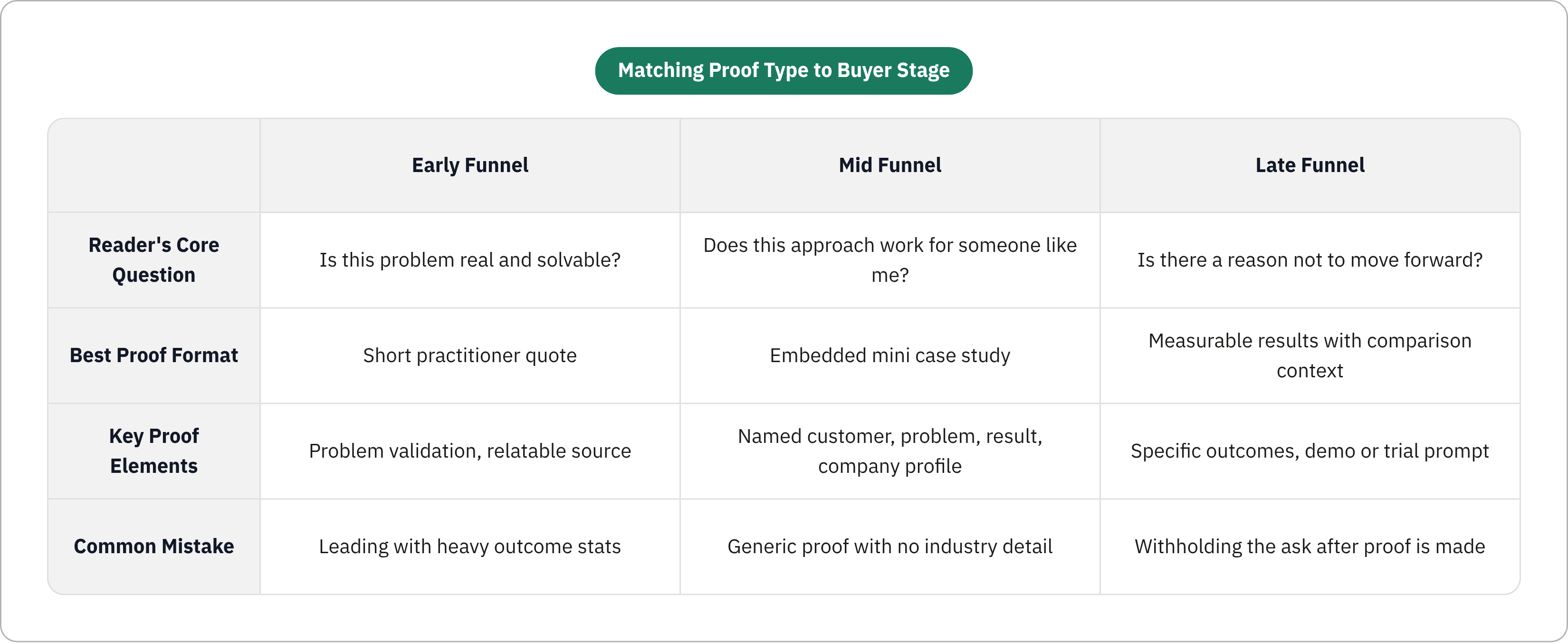
Not every post needs the same kind of proof, because not every reader is asking the same question yet.
Early-funnel readers are just figuring out they have a problem. What they need is confirmation that the problem is real and that other people have solved it, so a short practitioner quote works better than a heavy outcome-driven case study. Throwing "we increased revenue 340%" at someone who just Googled "why is my pipeline stalling" is like handing someone a wedding ring on the first date — too much, too soon.
Mid-funnel readers already believe the problem is worth solving. Now they want to know if this specific approach works for someone in their shoes. This is where the embedded mini case study earns its keep: named customer, problem, result, company profile they can recognize themselves in.
Late-funnel readers are close, mentally halfway through the checkout line and just looking for a reason not to bail. Give them measurable results and comparison context, and it's fair game to point them at a demo or a trial, because the proof has already done the convincing.
The mistake most teams make is treating every post like it's mid-funnel and loading it with conversion-grade proof. To an early-stage reader, that reads as pressure, not help. It's like proposing marriage on a first coffee date — technically sincere, deeply premature.
The case for named proof — and what to do when you can't use it
Named proof is still the gold standard: real company, real name, verifiable result, and nothing beats it.
But the gap between named and unnamed-but-verified proof is smaller than most marketing teams assume. According to UserEvidence's 2025 Evidence Gap report, buyers trust verified-but-unnamed testimonials only slightly less than named ones. That's good news if you sell into industries where nobody's legal team will let a customer go on record.
Blind-but-verified proof means a third party confirms the customer is real and the outcome is accurate, without publishing the name. Common in financial services, cybersecurity, anywhere compliance makes marketing's life difficult. What still has to stay intact is the specificity: the problem, the industry, the company size, the result. Strip that out too, and you're back to a fortune cookie.
Other options when a named case study isn't in the cards: aggregated outcome data pulled across your customer base ("across implementations in this industry, teams consistently see..."), practitioner quotes attributed by role and industry instead of name, or mentions on third-party review sites that buyers can go verify themselves.
Worth knowing: the FTC's 2024 rule against fake and AI-generated reviews draws a clear line. Blind-but-verified proof is legitimate, while a composite testimonial your content team invented over lunch is not — and it's not a gray area either.
If you're early-stage with a short customer list, don't panic. One or two sharply specific stories will outperform a whole library of vague ones.
Building proof collection as a repeatable system, not a one-off request
Here's the scene that plays out at most companies: sales needs a reference in fintech, someone starts digging through Slack, the customer advocacy person opens a spreadsheet they haven't touched in months, and the deal sits there waiting. Not exactly a well-oiled machine.
Treat proof collection like engineering treats a deployment pipeline. Defined triggers, clear owners, predictable output — that's the whole idea.
A minimum viable version looks like this:
Pick a lifecycle trigger, like three months post-onboarding, as your cue to reach out. Use a short survey or interview template that captures the problem, the fix, and the outcome in the customer's own words. Route everything into a library tagged by industry, company size, use case, and result, so sales can find what they need in under two minutes instead of forty. And refresh it regularly; a proof library that never gets updated is basically a museum exhibit.
Most teams can get their first usable piece of proof into the system within weeks of starting this kind of outreach. Speed to first asset matters more than getting it perfect.
The best part is the compounding effect. Proof gathered for one deal turns into content for three blog posts, and those posts surface three more prospects. Those prospects become three more proof sources. It's less a funnel and more a flywheel that feeds itself.
Tools exist for exactly this problem, turning raw customer conversations into structured, deal-ready case studies without needing a full-time content team babysitting a spreadsheet.
How to write a blog post so that proof pulls readers toward a next step
Structure matters more than most writers give it credit for. Open with the problem stated in the reader's own words, not your category jargon. Then build out the argument or the how-to, because that's the part that earns their attention in the first place.
Drop the proof right after your recommendation, at the exact moment the reader is thinking "okay, but really?" That's the point of highest doubt, and it's exactly where proof does the most work. Proof tacked on at the very end, like a trophy on a shelf, gets skimmed or skipped entirely.
One well-placed proof point beats three stacked in a sidebar nobody reads. This is a placement game more than a numbers game.
Close with a next step that actually matches where the reader is. That doesn't always mean "book a demo." Sometimes it's more evidence, sometimes it's a related case study, sometimes it's a diagnostic question that gets them thinking about their own setup.
CTA design comes down to one rule: it should feel like the next sentence, not a sudden left turn into sales mode. Early-funnel posts can offer more proof ("see how three companies in your industry handled this"). Mid-funnel posts can offer a conversation, and late-funnel posts can just ask for the meeting, because by then, the proof has already made the case.
Don't bury proof in a footnote, don't use it only as a decorative pull quote with zero context, and don't put your CTA before the reader's seen any evidence at all. Also worth remembering: AI tools are increasingly how buyers research vendors, so structuring your proof with clear entity relationships (customer type, problem, result) helps those tools surface and cite it accurately. Write for the human and the machine reading over their shoulder.
Distributing proof beyond the blog so it reaches buyers before they find you
A case study sitting only on your website is invisible to a buyer who hasn't found your website yet. Obvious when you say it out loud, but somehow still a blind spot for a lot of content teams.
Buyers are increasingly building their vendor shortlist using AI assistants and review platforms, and those systems pull from consensus across the internet, not just whatever you've published on your own domain. G2's 2025 Buyer Behavior Report puts software review sites and AI chatbots among the top sources shaping which vendors even make the shortlist.
The multiplier effect is real: the same piece of proof, spread across a review platform, a partner site, a practitioner community, and a third-party publication, reaches buyers earlier and with more trust than it ever would sitting alone on your blog.
Where to focus: third-party review platforms like G2 and Capterra, since they're buyer-trusted, AI-indexed, and independently verified. Industry publications and practitioner communities, since that's where your buyers hang out before they start comparing vendors. Partner and integration ecosystems, which lend you a bit of borrowed credibility. And newsletter syndication, which delivers proof to someone who's already in learning mode, not sales-avoidance mode.
The blog post itself becomes a distribution asset too. A post with a strong embedded proof story gets shared by the customer it features, forwarded by sales reps in email threads, and passed around in communities by advocates. Every share extends your reach without costing you another dollar in content spend.
Measuring whether the proof-embedded content is actually moving pipeline
Traffic and time-on-page tell you people are reading, but they don't tell you anyone's picking up the phone because of it.
The metrics that actually matter here: CTA click-through rate broken out by post and by buyer stage, so you know which posts are actually prompting action. Lead quality from content-sourced contacts, measured against your average lead, not just against zero. Time-to-conversation, meaning how many sessions it takes before someone requests a demo or responds to outreach. And whether sales reps are actually pulling your embedded case studies into live deals, and whether that correlates with faster closes.
Attribution here is messy, no way around it, since first-touch and last-touch models both botch the reality of someone reading five posts over three weeks before reaching out. A simple "how did you hear about us" field on the demo form catches what your analytics dashboard can't.
One leading indicator beats almost everything else: if sales reps start dropping your blog posts into deal threads without being asked to, that's the content doing its job. Nobody has to tell them to use something that's actually useful.
There's a compounding argument for sticking with this, too. A well-built post with strong embedded proof, ranking for a high-intent search term, keeps generating conversations long after you've stopped thinking about it. That's the return most one-off case study pages never get.
Still, none of this matters if you can't tie the content back to revenue. Content that can't be connected to a pipeline outcome isn't worth the hours it took to write, and that connection has to be built into your measurement setup before the post goes live, not bolted on after someone in a leadership meeting asks "so, did this work?"