Content Attribution Models for B2B Revenue Teams
Pick the attribution model that matches your sales cycle before your CRM picks one for you.

Here's the failure mode, in one sentence: B2B teams grab whatever attribution model came free with their CRM and slap it onto a buyer journey it was never built to explain. Not because the models are hard, but because nobody stopped to ask if the model fits the deal.
Attribution ties marketing touchpoints to revenue: pipeline created, pipeline influenced, deal velocity. Sounds tidy until you realize half the room can't agree on what "influenced" even means. I've sat in QBRs where two people pulled the "same" report and got different numbers, because one was counting sourced pipeline and the other was counting influenced, and nobody had told them those are different animals.
Sourced pipeline means marketing opened the deal with the first meaningful touch. Influenced pipeline means marketing showed up somewhere along the way, no matter who opened it. 6sense's 2025 benchmark of 716 B2B practitioners found 57% of marketers track both side by side, which is the right instinct, but only if everyone agrees which number governs which chart before the meeting starts.
Now here's the part that actually trips people up. Attribution doesn't tell you what caused a deal to close; it tells you what touchpoints happened to be sitting nearby when the deal closed. Correlation, not causation. Treat it like gospel and you'll end up funding whatever's visible, not whatever's working.
And visibility is the real problem here, not the math. Salesforce's 2024 data found 91% of CRM data is incomplete. Missing contact-to-opportunity links snap multi-touch models before they even start counting, and inconsistent campaign naming turns your channel report into a guessing game. That's a plumbing issue, not a model issue, and no attribution framework, however clever, unclogs a pipe.
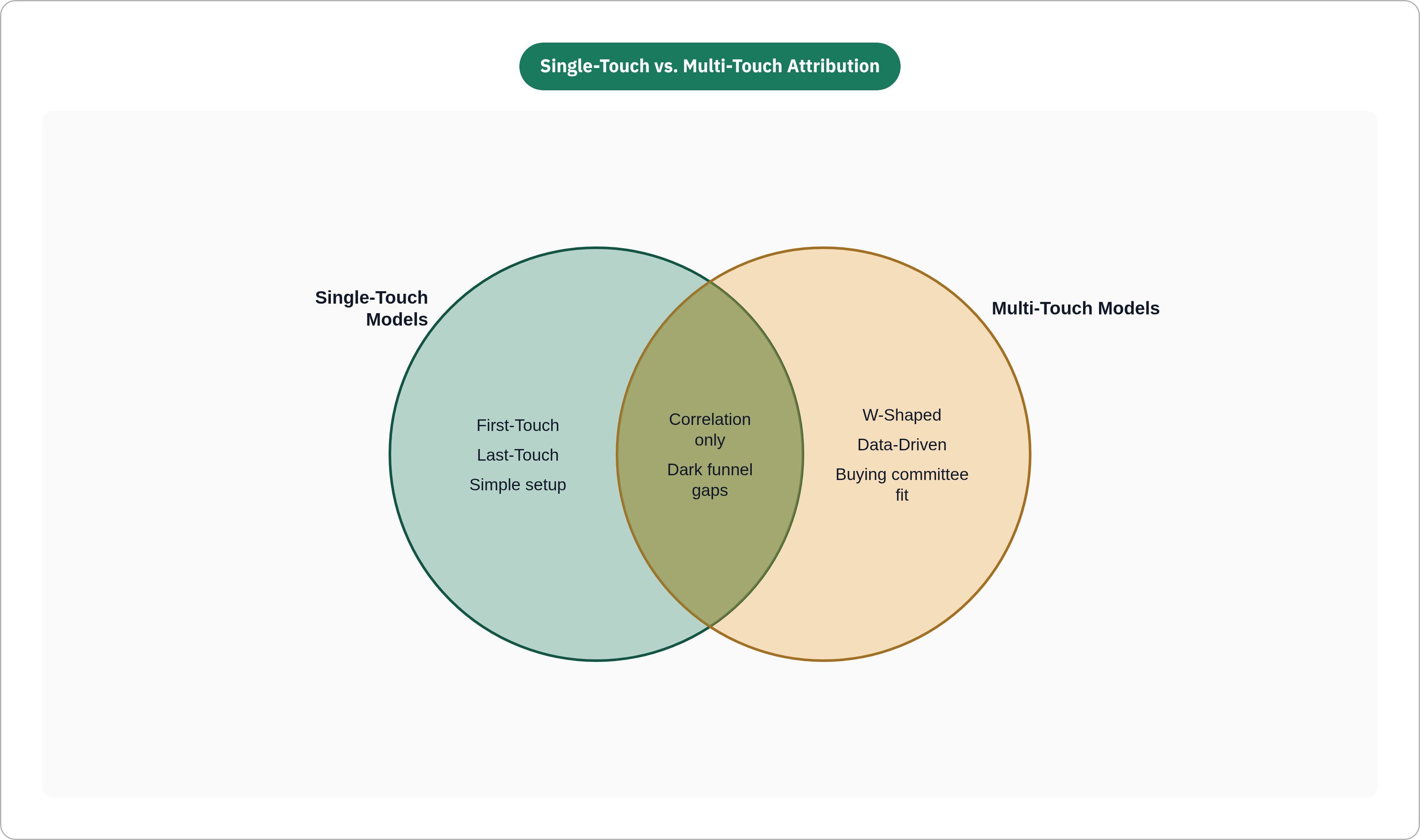
Then there's the dark funnel, which is exactly as spooky as it sounds. Peer Slack threads, private community shares, some buyer asking ChatGPT to summarize your competitor's pricing page — none of it leaves a trace. Every model on this list, including the fancy machine-learning one three sections from now, is working off an incomplete map. Keep that in your back pocket before you trust any single number too much.
The single-touch models: first-touch and last-touch, and when each one tells the truth
First-touch gives all the credit to whatever brought the account in the door. Good for exactly one question: what's generating awareness among accounts we hadn't touched yet? That's the job, full stop.
Ask it anything else and it falls apart. Take a six-month nurture cycle with a buying committee of eleven people on the email thread: first-touch just points back at a blog post someone skimmed in month one and calls it a day. Gartner's 2024 research puts 80% of the B2B buying journey as self-directed, happening entirely before a prospect shows up in your CRM, and first-touch can't see any of that either. So it's blind twice over, not once.
Last-touch flips it: whatever happened right before the deal got created or closed takes the trophy. Fine for short cycles and small buying groups, where "what closes deals" is a fair question to ask. Try it on an enterprise deal running 211 days with 76 tracked touchpoints (per the 2026 benchmark), though, and last-touch hands everything to a demo request, ignoring the case study that quietly did the real convincing three months back.
Content usually eats the loss here. Articles, comparison guides, anything living in the murky middle of the funnel gets treated like static, because last-touch only has eyes for the finish line. Then marketing gets asked in a Monday meeting why the "content program isn't working," and the honest answer is that the measuring stick is nearsighted, not the content.
Both models still earn a place at the table, narrowly. Ask them a bounded question and they'll answer it straight. Ask them to be your whole attribution strategy and they'll mislead you with total, cheerful confidence.
Linear and time-decay attribution: distributing credit across the full journey
Linear splits credit evenly across every tracked touchpoint. No favorites, no assumptions, which makes it the model you reach for when you genuinely don't know yet what matters, or you just want a baseline read on which channels show up in your closed deals at all.
It's a decent gut check, and it'll surprise you. I've seen linear reveal webinars sitting in a large share of closed deals that last-touch never gave a single dollar of credit. The cost of that honesty: linear treats a cold display ad exactly the same as a late-stage case study an economic buyer read the night before signing. Equal credit for wildly unequal moments — that flattening is the price of the model's simplicity, and it's a real price.
Time-decay tries to fix the recency problem by weighting touchpoints more heavily the closer they sit to close. Works fine on short cycles, or when the team genuinely believes late-stage activity is what tips deals over, especially if your top-of-funnel tracking is shaky anyway. Why weight data you don't trust in the first place?
Long enterprise cycles are where time-decay commits the same sin as last-touch, just wearing a nicer suit. A touchpoint at day 180 of a 211-day journey gets almost nothing, even if it's the exact asset that changed a VP's mind. Quick gut check: if your time-decay report looks suspiciously like your last-touch report, your cycle's too short for the decay curve to matter, and you've built a more complicated version of the same blunt tool.
U-shaped and W-shaped attribution: built for buying committee journeys
U-shaped, also called position-based, weights two moments heavily, usually 40% each: first touch, and the touch that generated the lead. The remaining 20% gets split across everything in between. The logic's simple enough: getting on the radar and becoming a qualified lead are the two moments that matter.
Fine for teams with a clean MQL stage and a demand-gen focus. Where it falls apart is later in the deal, because it has nothing to say about opportunity creation. That means the mid-funnel case study that actually pushed a lead into an active deal gets shrugged off entirely.
W-shaped patches that hole. Opportunity creation joins first touch and lead creation as a third heavily-weighted position, and everything else splits the leftovers. It's the first model here that tries to honor more than one make-or-break moment in the journey. Given that larger deals now involve a median of 11.2 stakeholders (per the 2026 benchmark), that's not a nice-to-have anymore.
W-shaped tends to fit B2B SaaS companies with defined MQL and SQL stages, cycles running 60 to 180 days, and a revenue number sales and marketing both get held to. Both U-shaped and W-shaped rest on the same bet: some moments change a deal's trajectory more than others, and your model needs to reflect where those moments sit in your cycle, not some template pulled from a vendor's blog post.
Data-driven attribution: what it requires before it earns its credibility
Data-driven, or algorithmic, attribution throws out the predetermined weights entirely. Machine learning looks at which combinations of touchpoints statistically correlate with closed revenue and hands out credit accordingly. Nobody decides first touch is worth 40% — the data decides.
The appeal is obvious. It adapts to how your buyers actually move instead of encoding whatever assumptions your team walked in with. The catch, and it's a big one, is that most teams skip the homework that makes the output trustworthy in the first place.
It needs real deal volume, not a handful of closed-won deals a quarter, but enough to train a model that isn't just reacting to noise. It also needs clean CRM data, and remember that 91% figure from Salesforce: a model trained on a mess doesn't clean the mess up; it learns the mess and repeats it back to you with more confidence than it's earned.
It also needs governance: documented assumptions, a human review cadence, drift monitoring over time. Analysis of ML attribution deployments at large B2B organizations, via Harvard Business School Online in 2024, found this governance layer is what actually makes the outputs defensible in a board meeting. Skip it and you've built a black box nobody can explain when the CFO asks why the number moved.
That same research found machine-learning attribution has gone from experimental to operational at large organizations running 50-plus active campaigns a quarter. This is an enterprise tool. A twelve-person startup running three campaigns a month doesn't have the deal volume to feed it, and forcing the issue just produces a confident-looking model built on sand.
How buyer journey shape should drive model selection
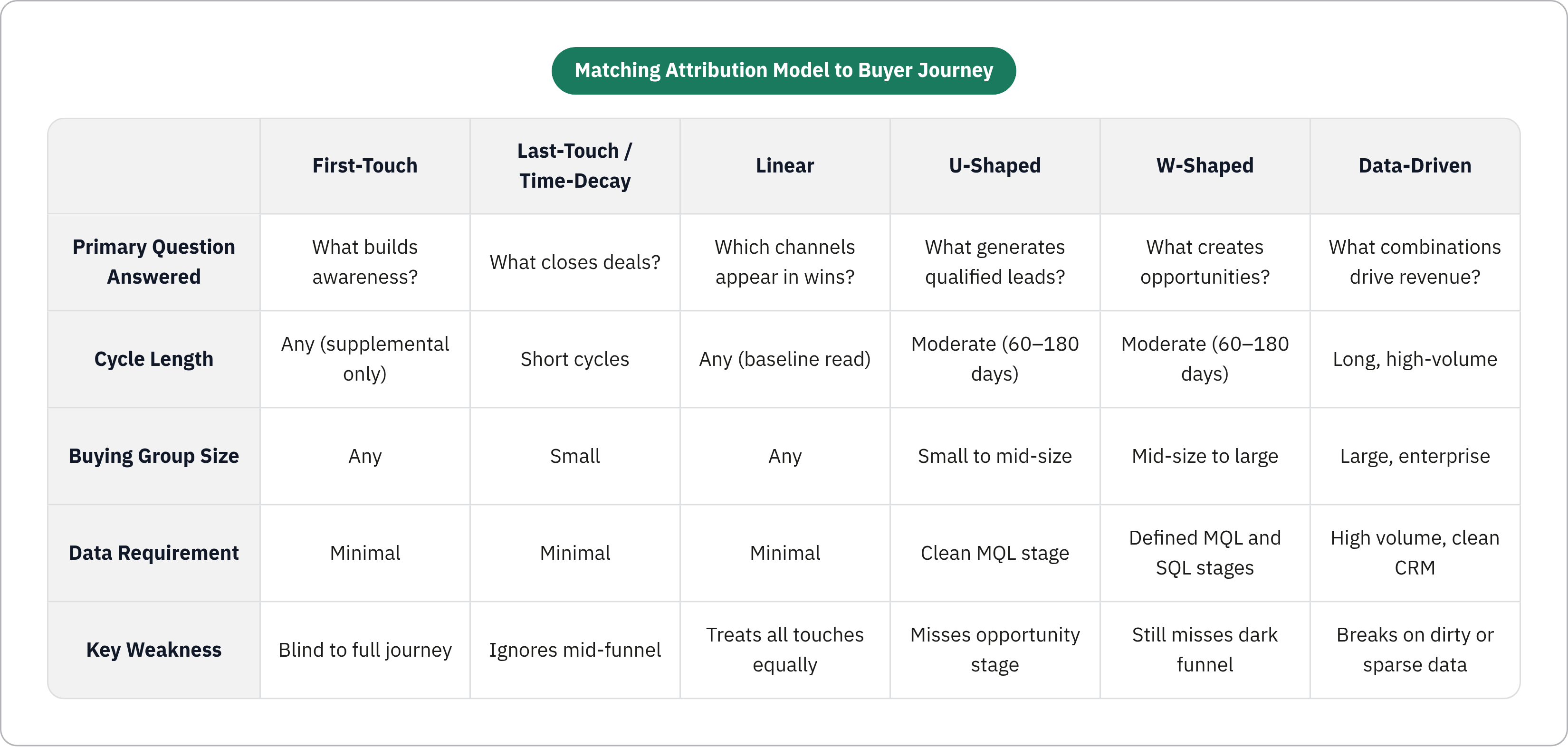
Company size doesn't pick your model, and neither does your tech stack. The shape of your buyer's journey does, so ask a few blunt questions before you open a dashboard: how long is the cycle, really? How many people sit in the buying committee? Where does the deal actually speed up or stall out? And what's the one business question you're trying to answer this quarter?
From there it's fairly mechanical. Short cycle, small buying group, conversion is the question: last-touch or time-decay gets it done. Early-stage team with no strong hypothesis yet: linear as a baseline. Defined MQL stage, moderate cycle, demand-gen focus: U-shaped. Shared revenue target, opportunity stage matters, 60-to-180-day cycle: W-shaped. High deal volume, clean data, enterprise campaign scale: data-driven, governance built in from day one. And if the only thing you care about is what brought the account in the door, first-touch works, but only as a supplement, never as the main event.
HubSpot's 2024 State of Marketing report found companies with strong attribution practices see 15 to 20% improvements in marketing ROI, just from redirecting spend toward what's actually working. That gain comes from matching the model to the journey, not from picking whatever model has the fanciest name on the slide.
The more durable move, in my experience, is running multiple models side by side and reading the gaps between them as information. That's likely part of why 57% of B2B marketers already track sourced and influenced pipeline together, per those 6sense numbers. None of it matters, though, if sales and marketing haven't agreed on definitions ahead of time. A model nobody trusts is just an expensive chart nobody looks at twice.
Where case studies and content assets sit in the attribution picture
Case studies don't sit in one tidy stage of the funnel. They show up everywhere. Roughly 80% of B2B buyers read them during research, and 42% say they're valuable in both the middle and late stages of buying — that's a load-bearing wall running through the whole structure, not a bottom-of-funnel afterthought.
Which is exactly why last-touch and time-decay treat them so badly. A case study read on day 90 of a 211-day cycle gets next to nothing under either model, even if it's the exact document that talked a nervous procurement lead off the ledge. Switch to W-shaped or data-driven attribution, though, and that same asset suddenly counts as a real pipeline contributor instead of a line item marketing has to defend every quarter.
The dark funnel makes it worse. A prospect who reads your case study because a colleague shared it in a private Slack channel leaves no trackable footprint at all. For any go-to-market motion built heavily on content, influenced pipeline gets structurally undercounted, and no amount of modeling sophistication fixes a touchpoint that was never logged to begin with.
There's a multi-stakeholder wrinkle too. The CFO wants proof of ROI. The CTO wants proof it won't break anything, and procurement wants proof it won't torch next year's budget. One case study might move all three, through different channels, at different times, and a model tracking only one contact per account misses most of that entirely.
So for content teams, model choice isn't just a reporting decision, it's existential. Discount mid-funnel content systematically and that content gets defunded, not because it isn't working, but because the model is structurally incapable of seeing it work. Case studies built to land at specific deal stages (which is the whole idea behind turning customer conversations into structured proof points, the approach Verbatim takes) only prove their worth if the attribution model underneath can actually credit a mid-funnel touch. Model selection sits upstream of content strategy, whether or not anyone on the content team realizes it.
The operational steps that make any model usable in practice
Fix the data first, always. Associate every known contact with its open opportunity in the CRM, and standardize campaign naming so channel rollups actually roll up. Go find your missing opportunity-creation dates, too, because a timeline with holes in it can't be patched by any model, however sophisticated.
Get sales and marketing to agree on sourced versus influenced before the first report ever runs, not after. Arguing about definitions once the numbers are already out just poisons the model's credibility with both sides, permanently, and you'll spend the next two quarters relitigating a spreadsheet instead of acting on it.
Start with a question, not a model. "Which channels bring in net-new accounts" points you toward a first-touch supplemental view, while "what's accelerating deals already in pipeline" points toward influenced attribution, W-shaped or linear. The question picks the model; the model doesn't pick itself.
Run at least two models side by side, always. The gap between a first-touch report and a W-shaped report on the exact same deals will show you, in plain numbers, where mid-funnel influence is getting written off. And if you're running anything algorithmic, build in a human review cadence from day one; documented assumptions and drift monitoring aren't governance theater, they're the difference between a model you can defend to a board and one you can't, per that Harvard Business School Online analysis.
Clari Labs found 87% of enterprises missed their targets in 2025. Most weren't short on budget. Plenty were pouring money into whatever channel their attribution model claimed was winning, which usually just meant it was the easiest channel to measure, not the one doing the actual work. Attribution was always deciding where next quarter's budget lands, whether anyone in the room says that part out loud or not.