Editorial Calendar Alignment with Sales Cycle Stages
Align your content calendar to buyer stages, not the quarterly grid.
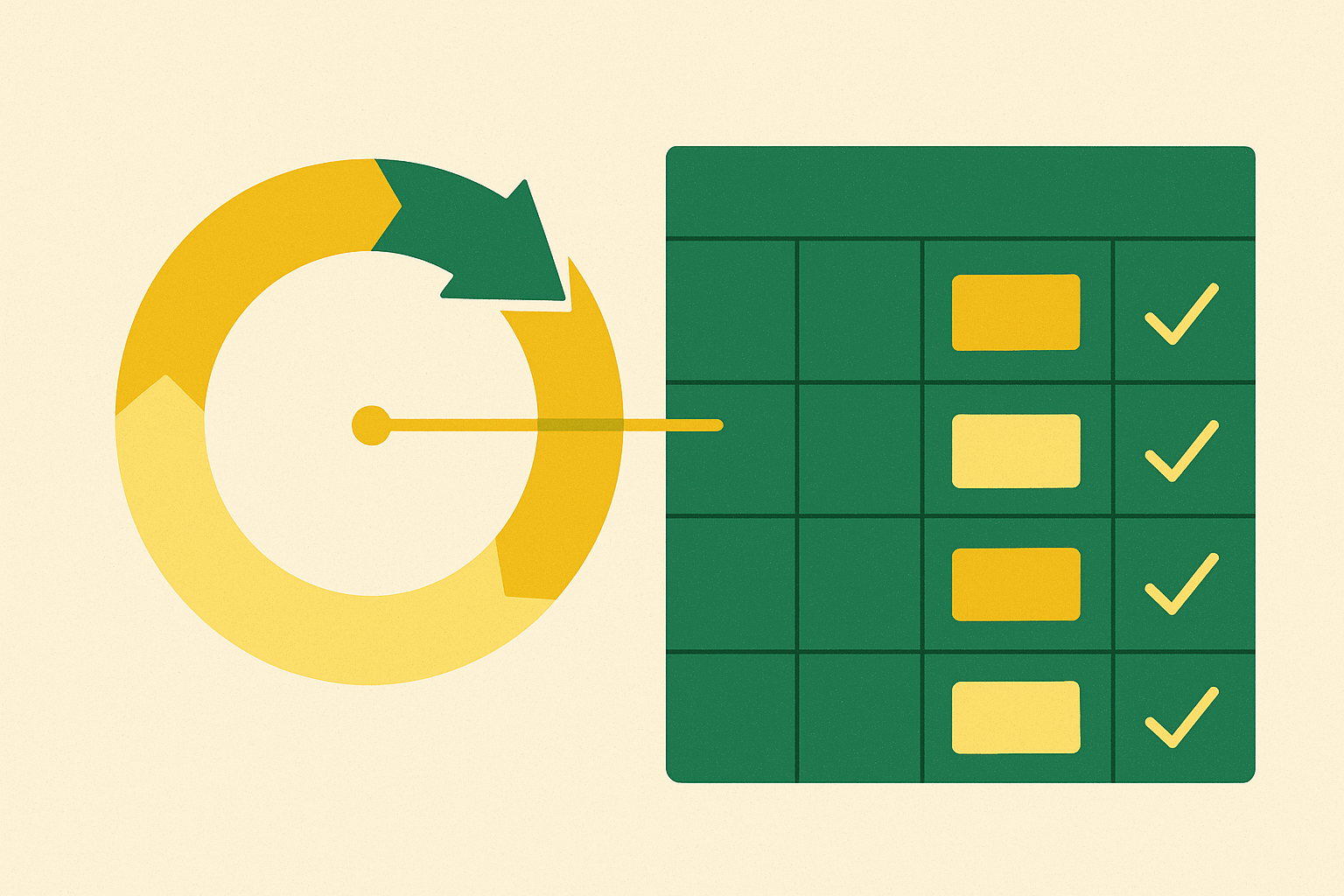
Here's how most editorial calendars actually get made: somebody asks "what feels interesting this quarter?" and whatever answer sticks becomes the plan. Buyer intent signals, pipeline stage gaps, actual behavior from actual ICPs? None of that shows up. What shows up is a guess, dressed in a spreadsheet, wearing a lanyard that says "strategy."
Then the content publishes on schedule and pipeline doesn't budge, even as traffic climbs while deals stay flat. I've watched this happen at three different companies, and it's the same story every time: nobody planned for the buyer, they planned for the calendar grid.
The Content Marketing Institute has tracked this for years, and the finding holds up: only a small slice of top-performing B2B marketers have a documented content strategy written down anywhere. Everyone else is improvising, topic to topic, vibes to vibes. Teams that map out a year ahead do grow faster, but only when the map is built around what a buyer needs at each point in their decision, not a junk drawer of "topics we like this month."
Worth untangling early, because almost every team I've talked to blurs this: an editorial calendar is strategy, covering quarterly themes, stage alignment, pipeline targets, the whole skeleton. A content calendar is just the execution layer sitting on top of it, what publishes when and who's on the hook for it. You need both, since they're not the same document, and treating them like they are is how sales-cycle mapping quietly disappears from the process altogether.
A large chunk of everything published on the internet gets exactly zero organic traffic from Google, ever. Publishing more without tying it to a buyer stage doesn't fix that math, it just makes the pile bigger. Making more content was never the fix. The fix is boring: take the content you're already planning to make and actually assign it to a stage in the buyer's decision, so there's something useful waiting for the right person at the right moment instead of a wall of blog posts nobody asked for.
The sales cycle stages as an editorial map, and what buyers need at each phase
Three stages, and three completely different heads a buyer is living inside. Treat them the same and you'll bore the person who's ready to compare vendors while overwhelming the one who just figured out they have a problem twenty minutes ago.
Awareness (TOFU): something's wrong, and the buyer knows it, but they've never heard of you and don't particularly care to yet. Content here names the problem out loud, and nobody's pitching anything.
Consideration (MOFU): now they're shopping, building a shortlist, squinting at options. Content has to prove fit and show what's different, without turning into a brochure nobody requested.
Decision (BOFU): the choice is basically made already, and what's left is nerves. Content here has to kill doubt and give the internal champion enough ammunition to defend the purchase to their boss.
Different topics at each stage, obviously, but also different formats, different channels, different calls to action. The real job of an editorial calendar is matching your publishing rhythm to how buyers actually spend their time, and that time is never split evenly across the three stages. Most B2B teams dump their budget into TOFU, blog traffic, brand video, top-of-funnel everything, and let MOFU and BOFU starve, which is exactly backwards since that's where the decision actually happens. It's like buying a billboard on the highway and forgetting to staff the register.
A rhythm that actually works: map tactical content one to three months out, keep a bigger strategic roadmap running six to twelve months ahead, and leave a real chunk of the calendar (a meaningful chunk) open for whatever the market throws at you that you couldn't have predicted back in January.
And sales needs a seat here, not a courtesy invite. Reps hear the same three objections every single week without fail, and they already know which proof point flips a deal. That's data your editorial calendar can't manufacture on its own, no matter how good your keyword research is.
Awareness-stage content: earning attention from buyers who don't know you yet
The job here isn't to sell anything. It's to get found, and to make the buyer's problem feel real and nameable, maybe for the first time, well before your product enters the conversation. Less "here's our solution," more "here's the thing you've been feeling and couldn't quite put into words."
What actually earns that attention:
- Guides built around problem-definition keywords, not solution keywords. Someone searching "why is my churn rate rising" is in a completely different headspace than someone searching "best churn prevention software," and treating those two searches the same is how you lose both of them.
- Thought leadership that names a dynamic the buyer's already stuck inside, without pretending to have the fix yet.
- Video and social, since a majority of marketers keep shifting budget toward video, and LinkedIn remains the highest-value distribution channel in B2B by a wide margin.
- Broad customer stories where the buyer recognizes their own situation on the page, no product knowledge required.
Awareness content is a long game, plain and simple, and something you publish this week might not earn its keep for six months. That's the deal you're signing up for, and it's exactly why starting early pays off later.
The trap, and I see this constantly, is content that just stops, with no next step, no related guide, no CTA hinting at rising intent. It ends, the reader closes the tab, and that's it. Traffic shows up and evaporates instead of turning into pipeline. Every piece needs an onramp somewhere nearby: a comparison guide one click away, a case study that fits, a checklist worth an email address.
Consideration-stage content: giving evaluating buyers the evidence to build a shortlist
By now the buyer's already done the hard part on their own. They know the problem, they know the category, and they're squinting at three or four vendors trying to figure out who's actually telling the truth. Your job is to make that squinting easier.
What earns trust at this stage:
- Comparison pages and "alternative to X" content, because buyers are typing "X vs Y" into Google right now, this exact minute, and most companies leave that search term completely uncontested despite how much intent is sitting there.
- Webinars and demos built around one specific use case instead of a generic product tour that nobody remembers by lunch.
- Case studies matched to the buyer's industry; most B2B buyers lean on case studies while researching, and they carry real weight in both the middle and late stages, not just at the finish line.
- ROI calculators that let the buyer model the value themselves, on their own time, before a rep ever gets looped in.
Case studies earn a structural role here specifically. MOFU case studies should zero in on one solution category or use case rather than telling the sweeping brand story. Tag by vertical, by company size, by problem solved, so the right story surfaces for the right evaluator without anyone digging through a folder. A manufacturing buyer shouldn't have to guess whether you've solved their exact headache before.
This content takes real time to build well, comparison guides and case studies eat weeks, not days, so plan them two to three months ahead of whatever quarter needs the pipeline lift. Loop in sales while you're at it: when reps keep hearing "how are you different from [competitor]" on calls, that's the comparison page that gets built next, not the one someone thought sounded interesting in a brainstorm.
Decision-stage content: what closes deals that are already nearly closed
At BOFU, the category's decided, and what's left is nerve, plain fear of picking wrong, and that fear can kill a deal that was, by every reasonable measure, already won.
The Google/Motista B2B Emotion Study found something worth sitting with: B2B buyers are up to eight times more likely to choose a vendor they feel some emotional pull toward. Proof that reads like a real human story does more work here than a spec sheet ever will, no contest.
What actually resolves doubt at this stage:
- Detailed case studies with a named stakeholder, a specific number, and an honest before-and-after. The Challenge-Solution-Result shape earns trust precisely because it doesn't pretend the problem was easy to solve.
- A ready bench of reference customers, sorted and available, so a last-minute reference request doesn't stall a deal sitting two signatures from closed.
- Security docs, compliance certs, SLA details, since procurement and legal raise objections marketing almost never thinks about until it's too late.
- Testimonials sitting right next to the actual pricing plan the buyer's evaluating, not buried three clicks away on a separate page.
- One-pagers and ROI decks built for the internal champion, the person who has to walk into a room full of VPs and defend this purchase using your words, not theirs.
A large majority of B2B decision-makers say case studies meaningfully shape the purchase decision, per Content Marketing Institute research, and yet only a small slice of companies actually use them well. That gap is the whole opportunity, and most of your competitors haven't closed it either, so you don't need to be perfect. You just need to show up where they didn't.
One thing worth planning around: BOFU content usually doesn't "publish" the way a blog post does. It lives in a sales library and gets pulled out mid-conversation. Your calendar still needs to account for making it, even though it never touches a public URL.
Why the case study is the connective tissue across all three stages
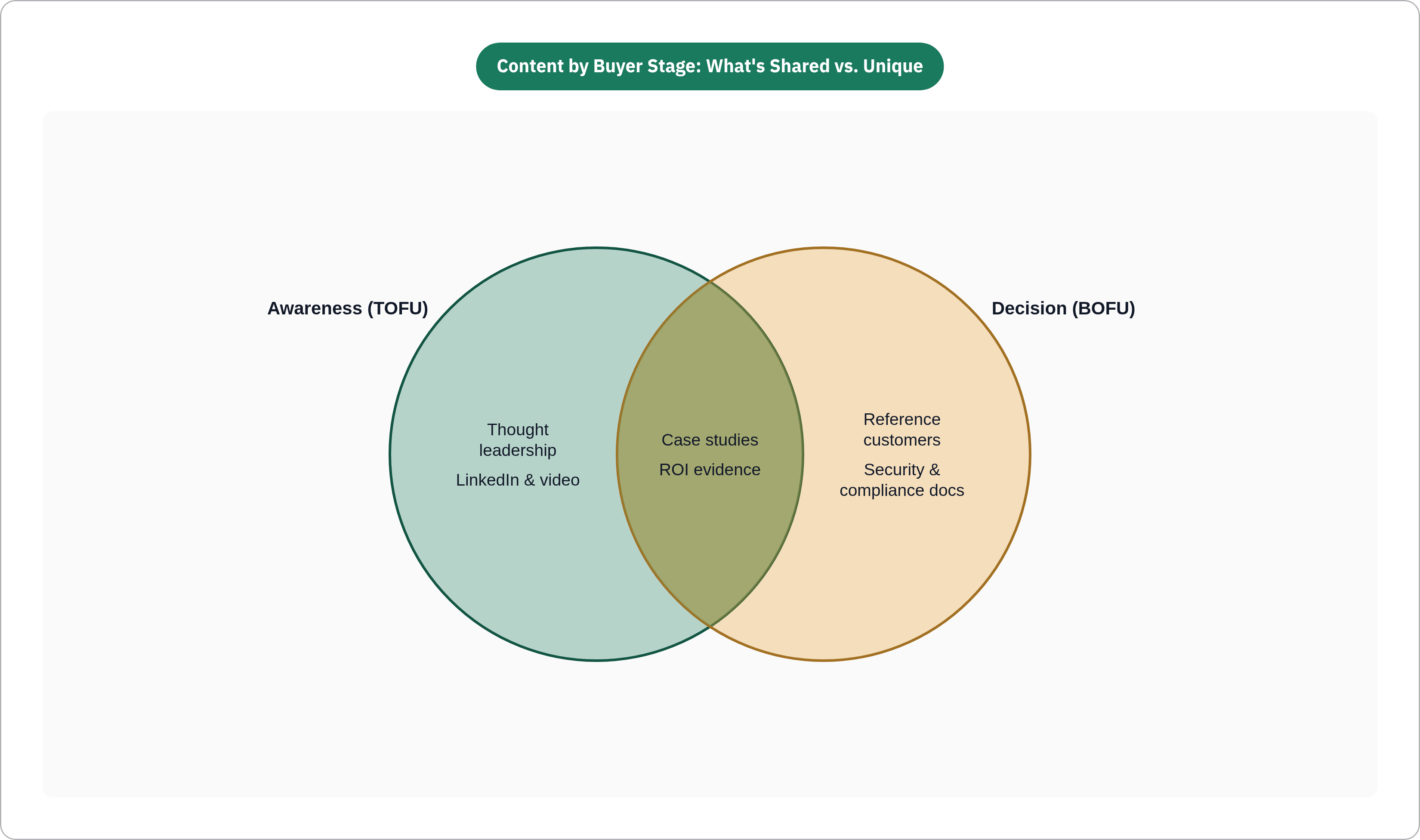
Most teams file case studies under "late-stage asset," something sales grabs once a buyer's already halfway sold. That's half the story, and honestly the less useful half.
Case studies rank among the most-used content types in B2B marketing, according to Content Marketing Institute data. But using them isn't the same thing as deploying them well. The same customer story can carry weight at every stage, if you're willing to cut it up and reformat it instead of publishing once and calling it finished.
- TOFU: one stat, one insight, lifted out and dropped into a blog post or a LinkedIn update, problem-first, with zero product language anywhere near it.
- MOFU: the full case study, tagged by industry and use case, surfacing exactly where a buyer is comparing options.
- BOFU: the whole narrative, named executive, hard ROI number, and a CTA to talk to someone in a nearly identical situation, handed straight to a rep mid-deal.
Stanford's research on narrative and memory found that information delivered as a story sticks dramatically better than the same fact presented on its own, and it's not close. A metric sitting alone on a features page moves nobody, while that same number, wrapped inside a customer's actual story, is what closes the deal.
So treat case studies as a recurring content type, not a project you knock out twice a year and forget about. A static library goes stale fast, and buyers want proof from someone who looks like them, in their segment, recently, not from 2019. SaaS companies have gotten a lot better at volume here; most have figured out how to produce case studies at scale. What separates the good ones from the forgettable ones now is specificity, and where you actually put the story once it's written.
Building a social proof system that keeps the evidence pipeline full
Here's the failure pattern almost every company falls into, without exception: a customer says something nice on a call, someone screenshots it, and that screenshot becomes the entire testimonial strategy. Reactive, occasional, thin.
UserEvidence's 2025 Evidence Gap report found a large share of B2B buyers have ruled out a vendor outright because the proof on offer felt thin or hard to trust. That's not a rounding error in a dashboard somewhere. That's lost revenue with a name attached to it.
A system that actually keeps pace looks something like this:
- Trigger-based nomination. A strong NPS score, a smooth delivery, a signed renewal, any of these should automatically flag that customer for a case study conversation. Nobody should have to remember to ask.
- CS and sales as sourcing partners, not afterthoughts. Customer success knows exactly who's thriving right now, and sales knows exactly which objection needs a proof point to die on the spot. Both should feed directly into the editorial calendar instead of living in a Slack channel nobody opens.
- One shared dashboard. Story status, writer assigned, publish date, segment tag. Nothing fancy, but it's the difference between a predictable cadence and a graveyard of half-finished drafts.
When a great customer won't go on record (and this happens more than anyone likes to admit), anonymize it. Swap the logo for "a national manufacturing company" and let the transformation do the talking instead of the brand name.
Placement matters just as much as production. Proof shouldn't live only on a "Customers" page that three people visit a month.
- Pricing pages, with testimonials matched to the exact plan the buyer's looking at
- Comparison pages, with switching stories from people who actually left a competitor
- Nurture sequences, where proof gets its own dedicated send instead of an afterthought tacked onto the bottom of an email
- Live deals, where reps pull proof by segment and objection, not by whatever happened to publish most recently
Then measure it honestly, with no vanity metrics allowed. Do opportunities that touched a case study close at a better rate than the ones that didn't? Do pages with segment-matched proof convert better than the generic ones? When you ask reps, unprompted, why a deal closed, do they mention a customer story on their own?
How to sequence and cadence content across stages in the actual calendar
Content investment should roughly track how buyers spend their time, and for most B2B cycles that means MOFU and BOFU are chronically underfunded next to how much love TOFU gets. Fixing that split is most of the battle right there.
A workable quarterly rhythm: start by auditing the pipeline for stage gaps. Where are deals stalling, and what comparison or proof content is sales asking for that flatly doesn't exist yet? Plan around the majority of content three-plus months out, and hold a substantial portion in reserve for whatever shows up uninvited, a competitor's move, a pricing change, a deal signal nobody could've seen coming in January.
Win rates across B2B have been sliding for a while now. Recent GTM benchmark data, built off hundreds of thousands of tracked opportunities, puts average win rates around 19%. Run the math on that and you need well over five times pipeline coverage just to hit quota with any reliability. Content that isn't converting at every stage isn't a minor inefficiency at that point, it's a structural hole in the pipeline, and it's costing quota.
Build BOFU assets, the case studies, the reference libraries, the ROI decks, on a fixed cadence, even though they rarely show up on a public blog calendar anywhere. Build MOFU comparison content two to three months ahead of whenever pipeline actually needs the lift. And let awareness content run long and slow in the background the whole time, because that's the layer doing invisible work six months before a deal ever lands on a rep's desk.
Buyers make most of their decision before a salesperson ever says hello. The question worth asking isn't whether your content is involved in that decision. It's already involved, whether you planned for it or not, and the only real choice is whether it's steering on purpose.