G2 and Capterra Review Strategy for Pipeline-Stage B2B Buyers
G2's dominance means your review profile now decides deals before sales even knows they exist.

G2 finished swallowing Capterra, Software Advice, and GetApp in the first quarter of 2026, and now one company sits on roughly 6 million verified reviews covering more than 10,000 vendors across about 2,000 categories. That's somewhere north of half the entire B2B software review surface, controlled by a single owner. The rest of this piece is about what that means for a buyer who's already deep into a deal, and what you need to do about it before your competitor figures it out first.
Where pipeline-stage buyers actually are when they find your reviews
Quick gut check: when's the last time you googled something before asking an AI chatbot first? If you're like the growing majority of B2B software buyers, it's been a while. As of a March 2026 G2 survey of over a thousand buyers, 51% now start their research with a chatbot more often than a search engine, up from 29% less than a year earlier. That's not a gradual shift. That's the floor giving way.
But chatbots don't close the trust gap on their own. In that same survey, 45% of buyers said citations from review sites were the most confidence-inspiring thing they could see in an AI-generated answer. So review content is doing two jobs now: it's the thing a human reads, and it's the raw material an AI quotes back to convince someone else.
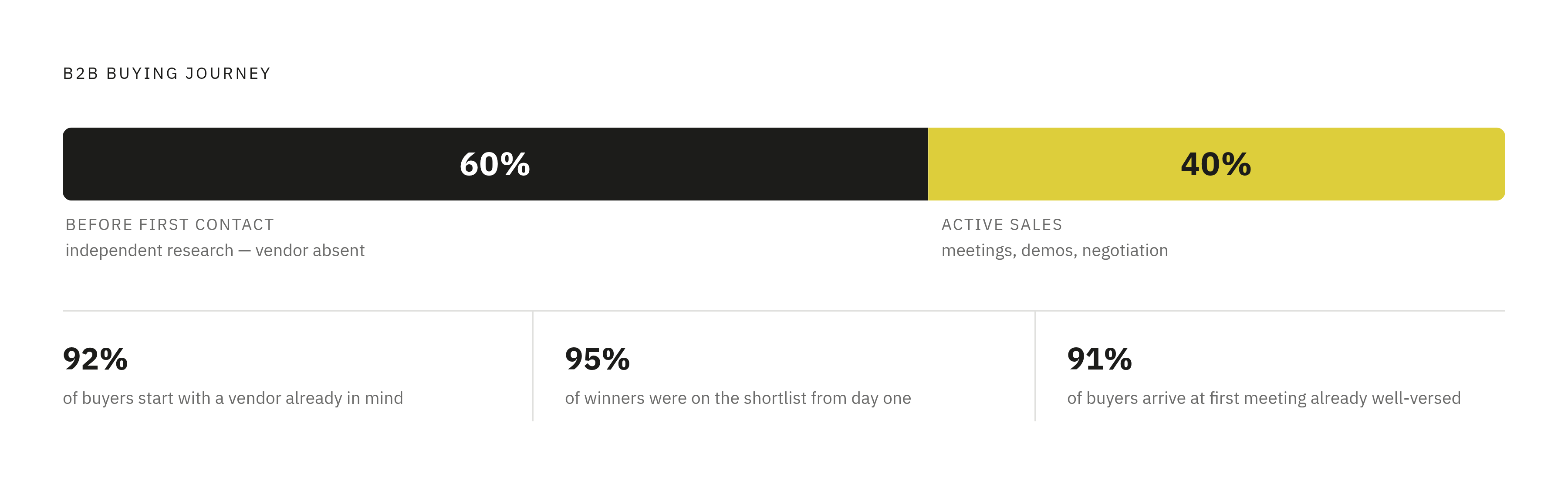
Here's the part that should worry any sales leader who thinks reviews are a top-of-funnel, brand-awareness nicety: by the time a buyer talks to you, they're mostly done deciding. 6sense's 2025 Buyer Experience Report puts independent research at roughly 60% of the total buying journey, completed before a vendor ever gets a call. Wynter found 91% of buyers show up to that first sales meeting already well-versed in who you are. And 69% of buyers ended up picking a different vendor than they originally intended, because a chatbot steered them somewhere else.
Most buyers, 92% according to 6sense, start with a vendor already in mind, and 95% of eventual winners were on that buyer's shortlist from day one. Translation: your review presence isn't influencing a decision, it's pre-deciding one, weeks before your SDR even knows the account exists. And that shortlist is getting shorter. G2's 2024 Buyer Behavior Report found the share of buyers considering four to seven products dropped from 45% to 31% in a single year.
Add in the generational shift. Over seven in ten B2B buyers are now Millennials or Gen Z, and younger buyers lean on peer input more than Boomers do (57% versus 49%) while moving through the funnel 41% faster. Speed plus peer-dependence is a combination that punishes any vendor whose review profile looks like it hasn't been touched since the last product launch.
Net effect: reviews get read after the demo and before the contract is signed, quietly, with no line item in your CRM to show it happened. A thin or stale profile loses you deals nobody will ever tag as "review-influenced," because nobody's watching for it.
What review presence actually has to do to convert a buyer who is already evaluating
By pipeline stage, nobody's discovering you anymore. They're checking your work.
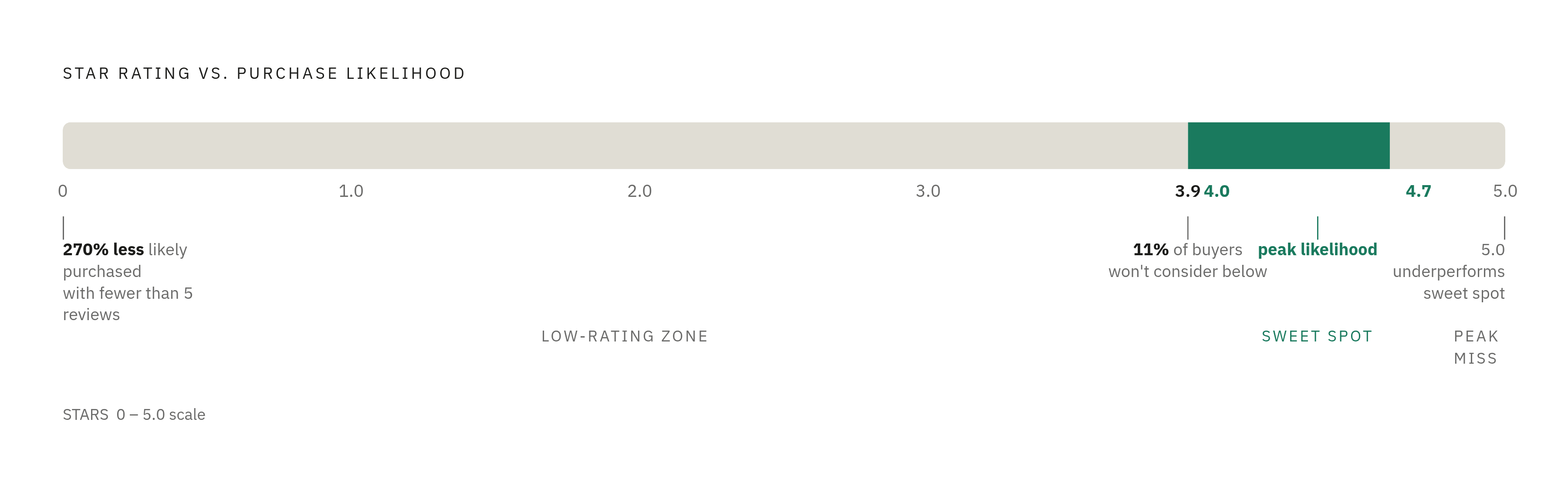
There's a floor below which a profile actively hurts you. Spiegel Research Center found products with five or more reviews are 270% more likely to get purchased than ones with zero. Below that, silence reads as absence, and absence reads as risk. On the other end, Spiegel also found buyers cap out fast: 11% won't touch a vendor rated under 3.9 stars, and purchase likelihood actually peaks in the 4.0 to 4.7 range, not at a perfect five. A flawless score with three reviews doesn't look impressive. It looks staged.
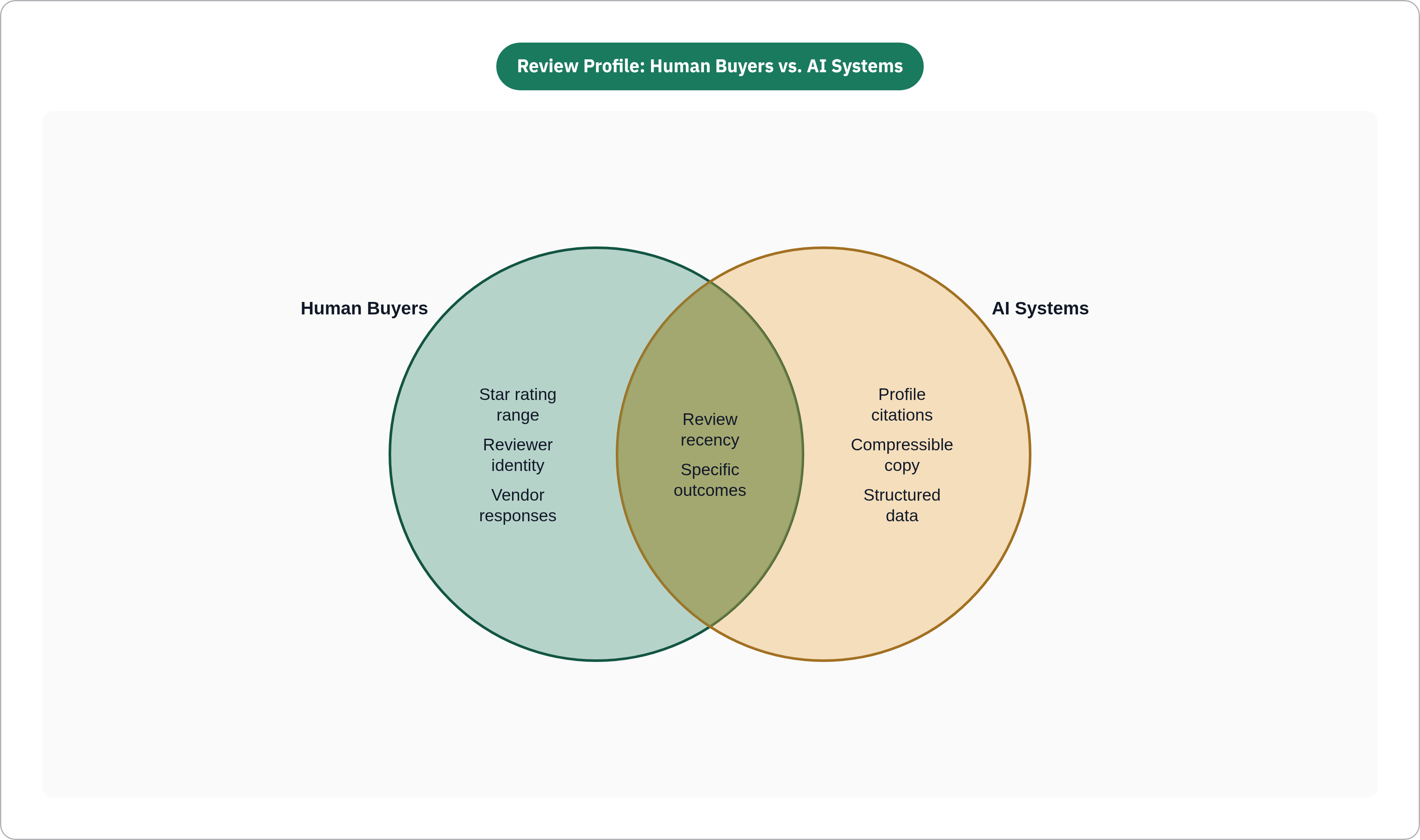
Recency matters just as much as volume. Category leaders don't let their review counts go stale; G2's internal 2026 data shows roughly 31 new reviews landing daily across just the top six products in competitive categories. That's not vanity metric chasing. Both human buyers and AI systems read a recent review as proof the product is alive and being used right now, not sitting on a shelf.
Specificity is the other half of the equation, and it's where most profiles quietly fail. "It replaced our old attribution tool in six weeks" is a sentence an AI can quote. "Great tool, highly recommend" is a sentence an AI has nothing to do with. A buyer scanning your reviews at pipeline stage isn't looking for enthusiasm; they're looking for a mirror; someone at a company their size, in their industry, solving their exact problem.
That mirror matters more than most vendors realize, because the audience reading your reviews isn't only human anymore. G2 reports that 80% of its product profiles now get cited by AI systems more often than they're viewed directly by a person. A profile written only for a human scanning it top to bottom is already behind.
So when a pipeline-stage buyer opens your profile, they're checking a short, specific list: do reviewers look like me, how recent is the newest one, how does this vendor respond when someone's unhappy, and what does the comparison grid say next to the other vendor I'm also looking at.
How to generate reviews that do work at the pipeline stage, not just pad your star rating
Volume gets you in the door. It does not close anything. Quality and variety are what actually move a buyer who's already comparing you to a named competitor.
Start with who you ask. Go after customers whose profile matches the ICP of the buyers stuck in your pipeline right now, meaning same company size, same use case, same starting pain point. Timing matters too: the best moment to ask is right after a win, an implementation that landed, a QBR where the customer reported a real number, or a renewal that came with an expansion. And don't ignore the customers who've already agreed to a referral call or a case study. They've told you, in effect, that they're willing to say nice things in public. Use that.
The ask itself shapes the output. A blank text box produces a blank, generic review, every time. Give reviewers something to react to: what were you trying to fix, what changed once you started using this, how long did it take. Structure in the prompt becomes specificity in the answer, and specificity is the whole point.
Treat review generation like a system, not a one-off campaign. A single push gets you a spike, followed by a long, visible gap, and that gap is just as obvious to an AI scraper as it is to a human buyer scrolling dates. Build the ask into things that already repeat: onboarding graduation, first renewal, an expansion conversation. Both G2 and Capterra allow incentives, gift cards, a charity donation, some branded swag, as long as the incentive isn't tied to writing something positive and the arrangement is disclosed. That's a legitimate way to cut friction without manufacturing sentiment you don't actually have.
And don't run from the bad ones. A specific, thoughtful reply to a piece of criticism often builds more trust with an evaluating buyer than a wall of uncontested five-star reviews ever could, because it answers a question the buyer is actually asking: how does this company treat people when things go wrong. Respond fast, acknowledge the specific complaint, say what changed, and invite the person offline. That exchange is the actual sales asset, not the star rating sitting above it.
Profile optimization as a conversion surface for buyers already in evaluation
Think of your G2 or Capterra profile as a landing page you don't own the server for, but you can still engineer every inch of it.
Category selection is the first lever, and it's the one people skip. Every relevant category you claim is another place you show up in a comparison search; skip one and you've handed a buyer's comparison view to whoever did claim it. The profile description deserves the same scrutiny. A pipeline-stage buyer isn't reading it to learn what your product does. They already know. They're reading to confirm it solves their specific problem, so write around outcomes (what changes, by how much, for whom) instead of a feature list they've already memorized from your website.
Feature comparison completeness sounds like busywork until you remember it feeds the head-to-head "Compare" tool buyers use when they're down to two finalists. Leave gaps in your matrix and you've handed the competitor sitting next to you a structural advantage, for free, without them lifting a finger.
Most platforms let you curate which reviews get surfaced up front. Use that to highlight the ones matching your typical late-stage deal profile, not just the ones with the shiniest star count. And don't underestimate badges, Leader, High Performer, Most Implementable, and the like. They travel. A badge on your website or in a sales deck signals an independently adjudicated ranking to a buyer who's never even visited the review site, which is most of them.
Last thing: since the majority of profile views now come from AI systems summarizing you in one sentence rather than a person scrolling the whole page, write the copy to survive that compression. If your best claim needs four sentences of context to make sense, an AI summary will drop it, and so will the buyer reading the AI's summary.
Using G2 Buyer Intent to act on pipeline-stage signals before a competitor does
The consolidation did one genuinely useful thing for vendors: G2 Buyer Intent now rolls up research activity across G2, Capterra, Software Advice, and GetApp into a single view, at no added cost to existing subscribers. A buyer quietly comparing you to someone else on Capterra now shows up in the same feed as a G2 profile visit. That used to be four separate blind spots. Now it's one dashboard.
Not all signals carry the same urgency, though. An account in your CRM that suddenly starts researching a named competitor is a deal at risk, right now, today. An account just browsing your category, without ever landing on your profile, is still shortlisting, not deciding; treat it that way. But an account looking at a direct comparison page between you and a specific competitor is about as close to a final decision as intent data gets. That's the signal you build a process around, not the one you let sit in a dashboard nobody checks on Fridays.
The operational move is simple to describe and easy to skip: match intent signals against open opportunities already in your CRM, then trigger something specific, not a generic "checking in" email, but outreach that speaks directly to the competitor or comparison the buyer was actually looking at.
There's real money behind doing this well. FlippingBook built a structured G2 program and reported a 111% sales increase, with G2-sourced leads converting to sales conversations at 33%, against 25% from other channels. That gap is the compounding effect of intent data stacked on top of a review presence that was already strong.
And this isn't a game only reserved for the biggest logo in the category. Intent data surfaces in-market accounts regardless of brand recognition, which is exactly why smaller vendors have used review site presence and intent signals to compete against far better-funded rivals, and why Expandi got to $7M in annual recurring revenue in 20 months despite entering a crowded category. Brand budget helps. It's not the whole game anymore.
Deploying reviews as active sales collateral during the deal, not just as passive profile content
Most vendors build a strong profile and then stop, as if the job ends once the stars are visible. It doesn't. The real gap is distribution: getting that proof in front of a specific buyer at the specific moment they're deciding, instead of hoping they stumble onto it themselves.
There's a handful of moments in a live deal where a review does more work than another slide in your deck. Right after a demo, send a curated set of reviews from customers in the same vertical or size bracket, pulled out and given context, not just a link back to your profile for the buyer to dig through themselves. When intent data flags that a buyer is comparing you against a named competitor, hand your rep reviews that speak to that exact comparison. Outcome-specific beats generic every time.
Then there's the internal champion, the person on the buyer's side who has to sell your product upward to people who never sat in on your demo. Give them something to circulate: a one-pager of reviews from similarly sized companies, formatted like a sales asset instead of a screenshot. With an average of 11 to 14 stakeholders involved in complex B2B purchases according to 6sense's 2025 research, that champion is rarely the only vote in the room, and each stakeholder, IT, finance, the end user, wants peer proof aimed at their own specific worry, not a one-size-fits-all pitch.
A review, at its core, is a case study that got compressed down to a paragraph. When a deal needs more than a paragraph's worth of proof, that same review is the natural entry point into a fuller customer story, one that walks through the problem, what the customer actually did about it, and what came out the other side. The customer conversations that produce good review content are frequently the same raw material a fuller case study would draw from, which means the work of gathering one doesn't have to be separate from the work of building the other.
Measuring review site contribution to pipeline so the channel stays funded
VP of Sales says G2 and Capterra are "just brand stuff." Sound familiar? If there's no clean line from review site to closed deal, that VP isn't being unreasonable. They're being accurate about your measurement, not the channel.
Fixing that starts with something unglamorous: UTM parameters on every outbound link coming off your review profiles, tagged by source (G2 versus Capterra), medium (review-site), and campaign (profile, badge, comparison-grid). Skip this and every click off your profile lands in your analytics tool as unlabeled direct traffic, which is functionally the same as no data at all.
Sourced leads are only half the picture, and arguably the smaller half. The more important number is influenced pipeline: a lead already sitting in your CRM, mid-deal, who visits your review profile between the demo and the signature. That's not a new lead you can claim credit for sourcing. It's an existing deal that got materially nudged, and if you're only counting sourced leads, you're systematically undercounting what this channel is actually doing for you, every single quarter, quietly, in the background, while somebody upstairs debates whether to renew the subscription.