Case Study Production Workflow for a Two-Person Marketing Team
Two-person teams can ship monthly case studies by dividing work into stages.

A two-person marketing team can turn out one solid case study a month without either person burning out, but only if the work gets split into stages instead of living inside one person's inbox. That's the whole argument here. Most teams treat "case study production" as a single, monolithic task owned by whoever's least busy that week, and that's exactly why the pipeline dies the moment that person goes on vacation or gets pulled onto a launch.
B2B buyers do most of their homework before a salesperson ever gets a call on the calendar, somewhere in the range of 60 to 70 percent of the research happens in the dark. Case studies are the thing doing the heavy lifting during that silent phase, and buyers know it: case studies consistently rank among the top resources B2B buyers turn to while researching a purchase. Nobody's debating whether the content matters. What's broken is the assembly line behind it.
Deciding which customers belong in the production queue first
A case study only works if the reader sees themselves in it. Not "a company like yours," but this specific customer, with this specific problem, described in their own words, followed by a real number and a real timeframe. If a competitor could lift the same sentence and paste it onto their own site, it's not proof of anything. It's just seasoning.
So before anyone books an interview, someone has to pick the right customer. That means watching for signals: unprompted praise buried in a support ticket, an NPS score that clears the bar, an expansion deal that just closed, a customer who's already agreed to hop on a sales call as a reference. Those are the tells. A happy customer who never says anything unprompted is nice to have, but they're not going to write your headline metric for you.
Split the ownership here cleanly. One person owns the customer relationship and makes the ask, because that ask needs to come from someone the customer already trusts. The other person preps the brief, so by the time the ask lands, there's no scramble, no "let me get back to you on what this involves."
Before the queue gets built, run every candidate through four questions:
- Does this customer sit in an ICP segment where proof is thin or missing entirely?
- Can they point to a real, measurable outcome, time saved, revenue added, cost cut, with an actual number attached?
- Will they go on record, publicly, by name?
- Does their industry or size match a segment currently active in the pipeline?
Segment coverage should be what drives priority, not convenience. It's tempting to grab whoever answers the email fastest, but the customer who's easiest to reach isn't always the one your pipeline needs proof from. The output of this whole stage is small and unglamorous: a ranked list of five to ten names, one owner assigned, ready to go.
Structuring the interview so the draft writes itself
Unstructured interviews produce a warm, glowing conversation and basically nothing usable. The customer says things like "it's been great" and "way faster than before," and then the writer has to go back, hat in hand, asking for the actual number the customer just gestured at. That second round of emails is where customers start losing patience, and where good case studies quietly die in someone's drafts folder.
Fix it before the call starts. Send the customer a one-page brief in advance: three or four questions they'll be asked, what the finished piece looks like, and exactly what they'll get to approve. While that's out, pull whatever account data already exists, renewal history, support ticket volume, usage numbers, so the interview becomes about confirming a number instead of guessing one from memory.
The interview itself maps to a structure that shows up in the vast majority of strong B2B case studies, Challenge, Solution, Impact:
- Challenge: What was breaking, and what had already been tried? Get the before-state in their own language, not a paraphrase.
- Solution: How did they actually roll it out? Process detail beats feature praise every time.
- Impact: What changed, and how do they know? If someone says "a lot faster," the follow-up is always the same: faster than what, by how much, over what period?
- Quote harvest: Ask them to describe it to a peer at another company. Whatever they say next is the quote. It'll sound nothing like something a marketer would write, which is exactly why it works.
Ask directly for two numbers: how long implementation took, and how long until the first measurable result showed up. Time-to-value is the metric buyers are optimizing for right now, and those two figures alone will do more persuasive work than almost anything else in the finished piece.
One more rule, and it's non-negotiable: the person running the call should not also be typing notes. The interviewer needs to be listening for the follow-up question, not hunting for the right key. Assign a second person to record and clean up the transcript. When the stage wraps, hand off a timestamped transcript with three things flagged: the core narrative, the best quote, and the key metric.
Turning one interview into a structured draft without starting from a blank page
Strong case studies tend to share the same eight bones: a hook of a title, a short executive summary, customer context (who they are, not a corporate bio), the challenge in the customer's own words, the solution described as a process, quantified impact with a timeframe attached, a voice-of-customer quote that the customer actually said out loud, and a call to action. Skip one of these and the piece feels thinner, even if the reader can't say why.
Keep it tight. Top-performing B2B SaaS case studies average around 965 words, which is short enough that it doesn't need a table of contents. This is a focused document, not a whitepaper wearing a costume.
Lead with the payoff, always. The reMarkable and Stripe case study opens with the headline number, fraud cut by 99 percent, no warm-up required. Toyota Connected's case study with Twilio Flex leads with how fast the proof-of-concept ran (a single day) and the operational metrics that followed (average handle time down 18 percent, after-call work down 13 percent). Readers get the payoff before they've committed to reading the rest, which is precisely the point.
A pre-built brief template, one that maps transcript sections directly onto case study sections, turns the draft into a fill-in-the-blanks exercise instead of an architecture problem. And whoever writes the first draft should not be whoever ran the interview. Coming to the transcript cold produces a cleaner narrative, and it catches the gaps an interviewer will have unconsciously smoothed over during the actual conversation.
AI drafting tools speed this up, but only for teams that already built the structure and the brand voice standards first. Feed a raw transcript into a model with no scaffolding and the output reads generic, requiring a rewrite that erases whatever time was supposedly saved. The template is what makes the AI assist worth anything at all.
Cap the review cycle at two rounds: one pass from the relationship owner checking facts, one pass from the customer approving quotes and numbers. Front-loading the brief before the interview is what keeps this from turning into round four, five, six.
Multiplying one case study into the assets sales actually deploys
Most of what marketing publishes never gets touched by a sales team, and the reason is usually a format mismatch. Sales needs something they can drop into a live deal in thirty seconds. A long-form page with a hero image isn't always that thing.
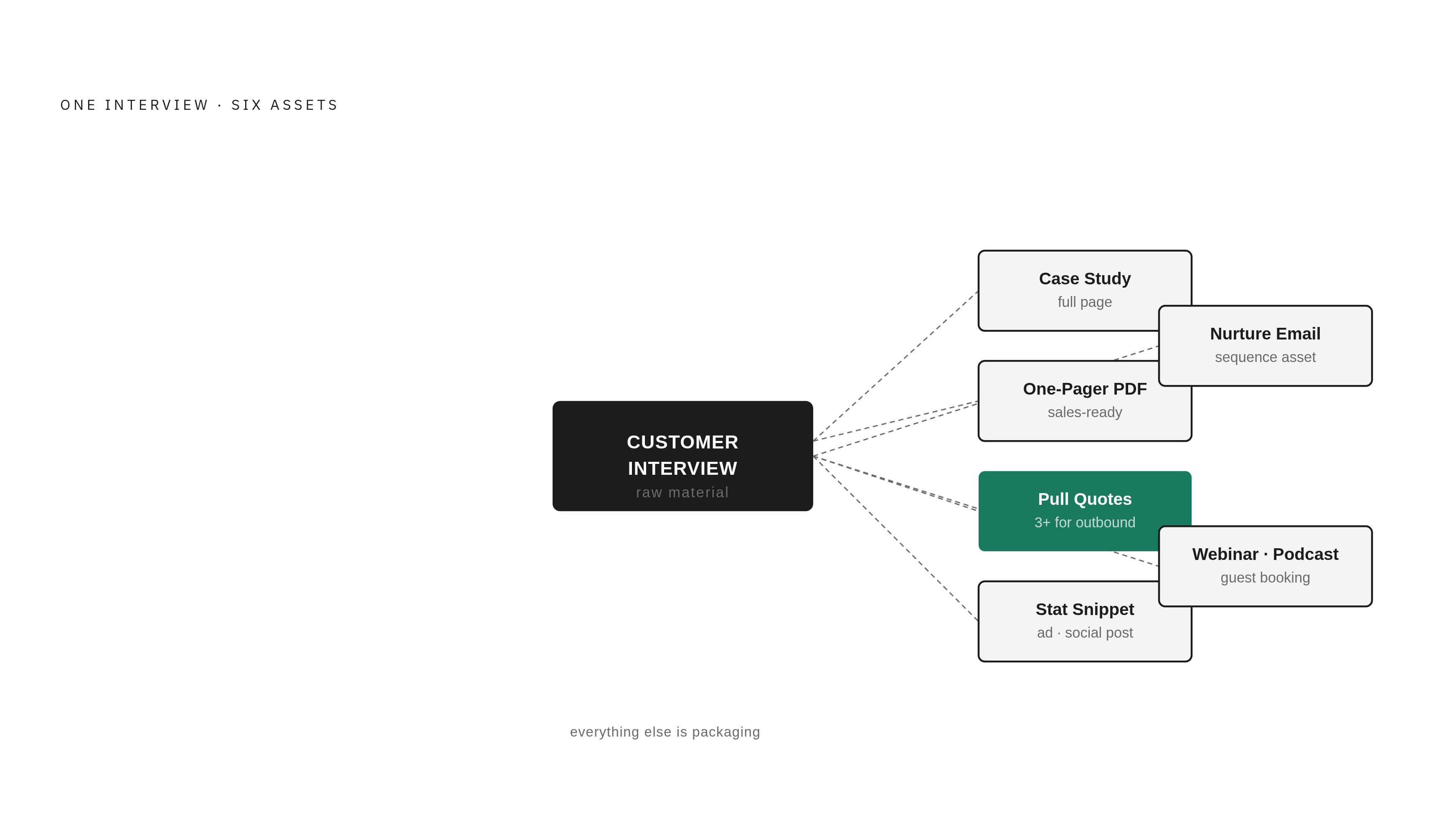
One interview should generate more than one artifact. Realistically, it produces a full case study page, a sales-friendly one-pager PDF, at least three pull quotes ready for outbound sequences or slide decks, a single stat formatted for an ad or a social post, a nurture email, and maybe a webinar or podcast guest booking down the line. The interview is the raw material. Everything after that is packaging.
Documented best practice for 2025 treats "multi-asset by default" as the standard: one scannable web page, one PDF one-pager, one 60 to 90 second video, all from a single production event. A broader pyramid approach works alongside this, take the comprehensive base case study and cut shorter, targeted versions for specific personas or objections, a healthcare-segment one-pager pulled from the same source material, for instance.
Concentration matters here too: engagement with sales content tends to cluster around a small share of available assets. That's not a reason to publish less. It's a signal to figure out which formats sales actually reaches for, and make those the default output instead of a nice-to-have.
Split ownership again. The writer packages the web page and the PDF. The relationship owner checks with sales on which derivatives matter most for deals in motion right now, so marketing isn't guessing at formats nobody asked for. Research on outbound sequences finds that organizations that build case studies systematically into their outreach see meaningfully higher response rates than standard product-pitch messaging — SalesLoft data puts that lift at 32 percent. That lift only shows up if sales actually has the asset in hand, in a format they can paste into an email without editing it first.
Tag every finished piece by industry, company size, use case, and the objection it answers. A searchable library beats the alternative, someone scrambling in Slack asking if anyone has a case study for a mid-market healthcare prospect, forty-five minutes before a call.
Distributing case studies so they reach buyers at the moment they're deciding
Case studies belong at the decision stage, not buried three pages deep in a blog archive. A buyer who's ready to sign doesn't want to fill out a form to read proof a sales rep is already sharing with them directly. Gate mid-funnel and lower-funnel assets only when the lead capture is worth the friction it creates, and recognize that friction at the wrong moment costs more than the lead is worth.
Some channels compound. Some need constant feeding. SEO-indexed case study pages fall into the first bucket: organic visibility grows as the library grows, and among companies with smaller monthly visitor counts, case study volume tracks closely with overall traffic. Among the fastest-growing B2B SaaS companies studied, 88 percent published case studies, averaging 45 apiece. That's not a small side project. That's a content category treated as core infrastructure.
Sales sequences are where the response-rate lift actually shows up, a pull quote or a one-pager dropped into the follow-up email after a demo. Verbatim, a managed case study and testimonial service for B2B SaaS companies, is one option teams use when they need that material produced consistently without adding headcount. Nurture tracks work similarly, matching a case study to the prospect's industry at the exact point they're comparing vendors. Cold outbound gets the leanest version: a single stat, specific and credible, used as the hook line in a first-touch email.
None of this works without credibility attached. UserEvidence's 2025 Evidence Gap report found that 67 percent of buyers have ruled out a vendor over evidence they didn't trust. Named customers, real numbers, quotes attributed to an actual person, that's what makes distribution worth the effort. Distribute polished nonsense widely and it just travels further before someone catches it.
Attribution is messier than a last-click report can capture. Proof assets rarely show up cleanly in that data. What's worth tracking instead: do opportunities that engaged with case study content close at a higher rate, do pages with segment-matched proof convert better than generic ones, and how often does a prospect mention a customer story unprompted. Split ownership here too, relationship owner handles sales-channel distribution and coordinates active-deal use, writer owns the SEO page and the nurture email version. Clean lines keep two people from duplicating effort or, worse, both assuming the other one's got it.
Running the repeating cycle so output stays consistent without adding headcount
One published case study a month is a realistic pace for two people juggling everything else on their plate, assuming the template is clean and the customer queue never runs dry. Cadence breaks for a small number of predictable reasons: an empty queue because nobody owns sourcing, an approval cycle that drags because the customer wasn't briefed early, a draft review that turns into a rewrite instead of a quick approval.
The infrastructure a two-person team actually needs isn't complicated. A short style guide and a case study template, written down before the first draft ever gets started, not improvised after the third one goes sideways. A single tracker, one row per case study, columns for customer name, segment, interview date, draft due, approval status, publish date, and which derivative assets got made. Without something like that, status updates eat time that should be going toward the next interview, project managers who rely on manual status compiling report losing well over a day a week to it. A standing monthly check rounds it out: which stage is stalled, which published pieces sales is actually using, which segments still have zero proof coverage.
The system compounds. Each new case study strengthens the library, feeds organic search, and hands sales one more asset to work with. That's the case for starting the system now and sustaining a steady pace, rather than chasing a mythical perfect case study once a quarter and calling it a strategy.
If the bottleneck turns out to be writing time, and not customer access or judgment calls about which segment needs proof, that's the moment to bring in a freelance writer at the draft stage. That keeps both core team members focused on the stages only they can actually own, sourcing and relationships, strategy and distribution, instead of stretching one generalist across every single stage until something snaps.
Measure the whole engine by pipeline influence and deal velocity, not pageviews. Content Marketing Institute's 2024 research found 56 percent of B2B marketers still struggle to tie their content work back to revenue. Two metrics that connect straight to the pipeline give this function a defensible budget line, which matters most exactly when the team eventually grows past two people.