Competitor Battle Cards Sourced from Customer Churn Interviews
Churned customers reveal why competitors actually won, not what exit surveys guess.

Churned customers are your best competitive intelligence source. Not your win/loss interviews. Not your competitive scans. Not what your reps hear in discovery calls. The customers who already left, who used your product long enough to have real opinions, and who switched to someone else. Those people will tell you things no one else can. Think of them as a mirror your competitors never meant to hand you. This piece shows you exactly how to get that intelligence out of them and turn it into battlecards your reps will actually open during a live deal.
Why exit surveys produce the wrong competitive picture
Here is the core problem with exit surveys: they cannot ask follow-up questions.
A customer clicks "budget constraints" and moves on with their day. You mark it as budget. Nobody finds out that the real reason was that onboarding took three months longer than promised, the team lost confidence, and a competitor's rep showed up at exactly the right moment with a lower renewal number.
A 2024 analysis of 847 B2B churn cases found that exit survey responses matched the actual underlying churn driver in only 31% of cases. That means nearly 70% of the time, companies are recording the wrong reason for losing a customer.
The competitive intelligence implication is brutal. If you are building battlecards from survey data, you are building them to address objections that did not cause the churn. You are preparing your reps for a fight that already happened somewhere else — like a doctor who only reads the chart and never sees the patient.
The misattributions follow predictable patterns:
- Customers write "budget" when the real story is that implementation broke and the ROI never materialized
- Customers write "missing features" when the real story is that support went dark for six weeks
- Customers write "team change" when a competitor offered meaningfully better pricing at renewal and the new team lead took it
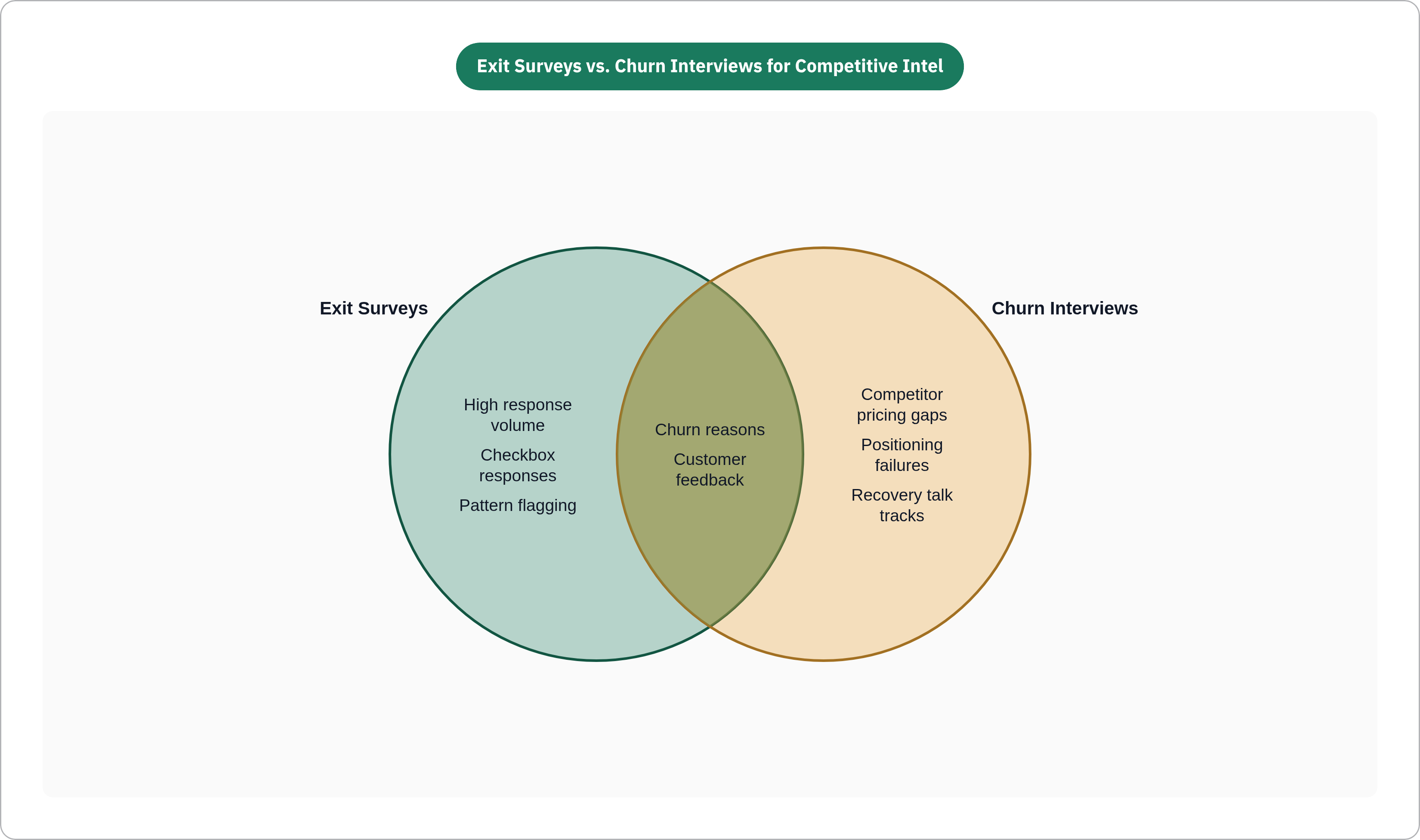
None of those are captured in a checkbox. They feed no useful competitive intelligence. Surveys are fine for volume, for seeing patterns across hundreds of responses, for flagging gross problems. They are not fine for understanding why a competitor beat you. That requires a conversation.
How to run a churn interview that extracts competitive intelligence
Start by adjusting your expectations on response rate. Even a 10 to 15 percent response rate on churn outreach produces enough interviews across a quarter to find real patterns. You do not need perfect response rates to start. Just start.
Who sends the request matters more than most teams realize. A request coming from the sales rep who owned the account tends to get higher response rates in more systematic programs. A CS-led outreach can feel less threatening, especially if the customer relationship ended on neutral terms rather than bad ones. Test both. See what works for your customer base.
The interview framework
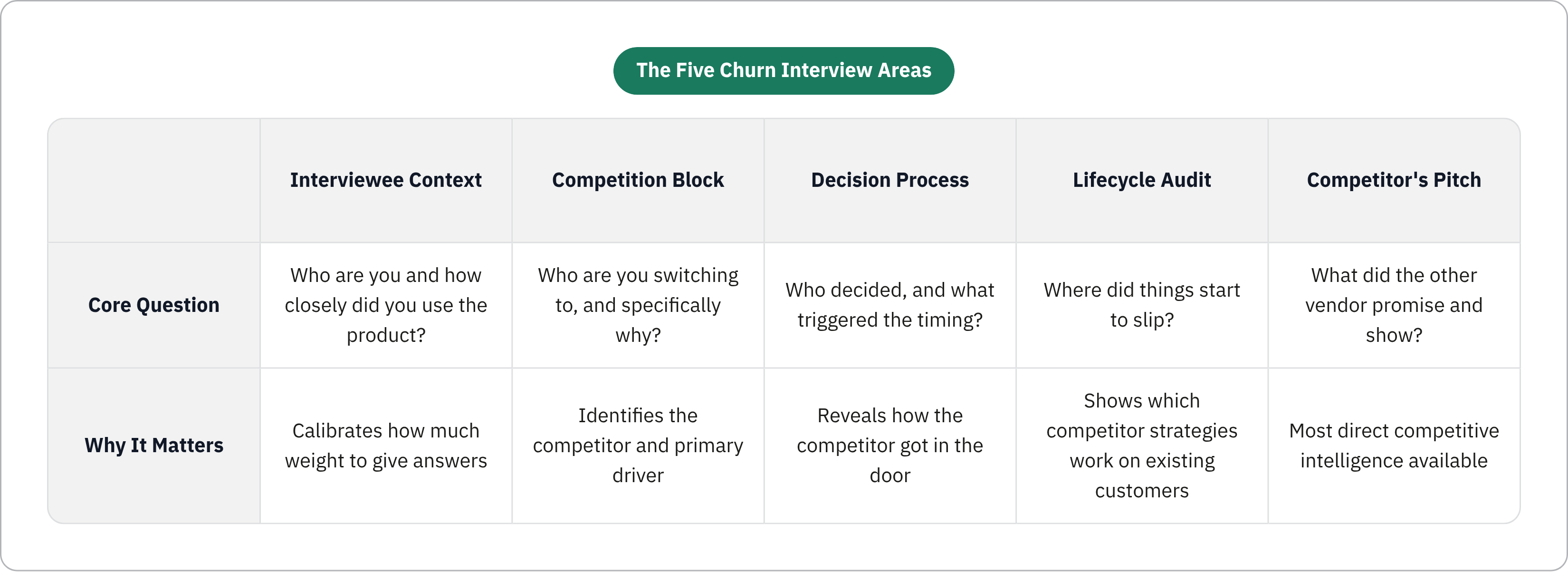
A good churn interview covers five areas, in roughly this order:
- Interviewee context. What was their role? How closely did they use the product day to day? Who else was involved in the switching decision? You need to know how much weight to put on their answers before you can use them.
- Competition block. Are they switching to a specific competitor, or are they stepping away from the category entirely? If there is a competitor, what specifically drove that choice? Push on "specifically." The first answer is usually too general.
- Decision process. Who owned the final call? What triggered the timing? What other options did they evaluate? This tells you how the competitor got in the door and what they had to do to win.
- Lifecycle audit. Where did things start to slip? Was it onboarding? Adoption? A specific support interaction? A pricing conversation at renewal? The answer to this question tells you which competitor strategies are working on customers who already bought from you.
- Competitor's pitch. What did the other vendor promise? What did they show that got people nodding? This is the most direct competitive intelligence you will get anywhere.
A 20-minute interview at a $25,000-plus ACV produces somewhere around eight to twelve pages of transcribed insight. That is enough material to update multiple battlecard sections, flag pricing issues to leadership, and feed a sales coaching session.
Tone is everything
The interview should feel like a debrief, not a retention call. Acknowledge that the relationship is ending. Make clear you are not calling to win them back. Customers who feel heard give more specific competitive detail. Customers who feel like they are being sold to give you nothing useful.
Avoid pitching a comeback. Do not send a survey as a follow-up to a declined interview request and call it equivalent. It is not.
On tooling
Teams running a high volume of churn interviews a quarter have enough qualitative material to justify structured tooling. AI-moderated buyer interview platforms, CRM-integrated call review tools like Gong or Chorus, and traditional research firms each serve different budget and volume thresholds. The right choice depends on how many interviews you are running and whether you have someone to synthesize what comes back.
What churned customers actually reveal and how to categorize it
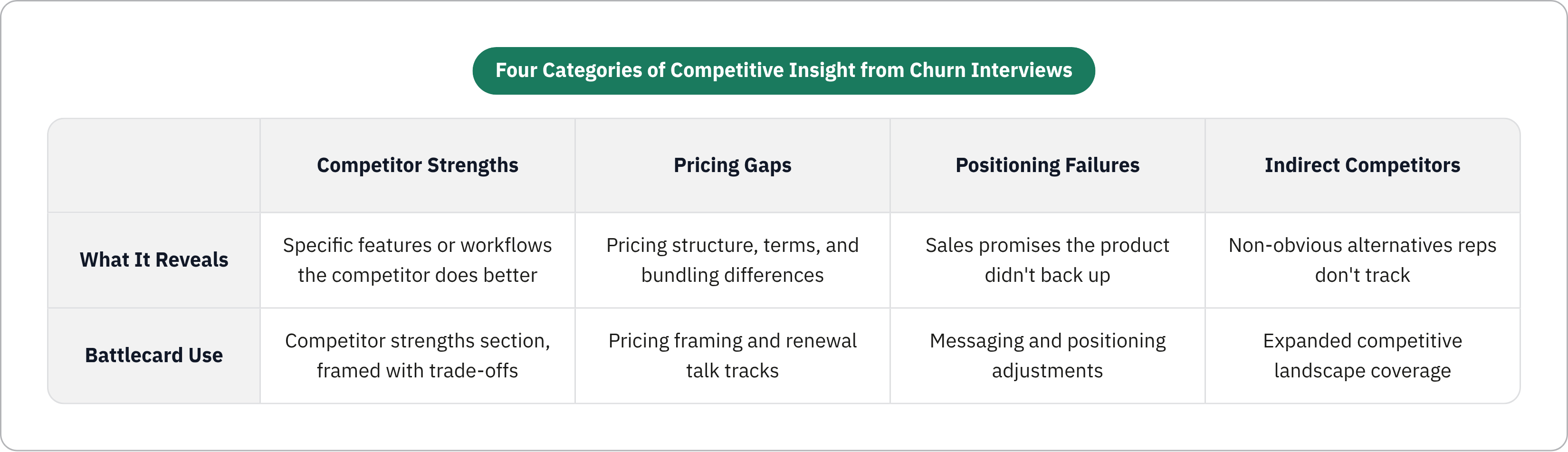
A churned customer who switched to a competitor has done something a prospect at the evaluation stage cannot do. They have lived with your product. Then they lived with theirs. Their comparison is not speculative. It is empirical.
That makes the intelligence different in kind, not just in degree.
Churn interviews reliably surface four categories of competitive insight:
Competitor strengths. Specific features, workflows, or experiences the competitor does better. Not vague. Not "their UI is cleaner." The real stuff: "their onboarding is self-serve and we were live in two weeks, compared to three months with you."
Pricing gaps. Not just "they were cheaper." The structure of the gap. Seat-based pricing versus usage-based. How renewal terms are framed. What is bundled versus what costs extra. This is the pricing intelligence your finance and sales teams need but almost never have clearly.
Positioning failures. Language your team used during the sale that did not match what implementation actually delivered. Promises made in the pitch that the product never backed up. This one is uncomfortable. It is also some of the most actionable intelligence you will find.
Indirect competitors. This one surprises teams every time. Customers are often replacing your product with something your sales team does not track as a competitor at all. A spreadsheet. A different category of tool. A homegrown process. Athenahealth discovered this through their own churn interview work: indirect competitors were showing up as viable alternatives in ways their win/loss program had never flagged.
Only around 29 percent of sales reps feel they have adequate competitive information, and reps can accurately identify only a fraction of the factors buyers actually cite in competitive decisions. Churn interviews are the correction for that gap.
Tag everything at capture. Which competitor. Which deal stage it applies to. Which customer segment the churned account represents. That tagging is what turns interview transcripts into usable intelligence rather than a folder full of notes nobody opens.
Also: separate "competitor had better X" (feature intelligence) from "competitor promised Y and we never countered it" (positioning intelligence). They feed different parts of the battlecard and require different responses.
Structuring a battlecard that reps will use mid-call
Here is why most battlecards fail. They were built from internet research and internal assumptions. They address objections marketing expected, not objections buyers actually raise. Reps use them once, find nothing that matches their conversation, and never open them again. It is like preparing for a chess match by studying checkers.
Format is the second failure. If a rep has to scroll during a live call, the battlecard will not get used. One screen. That is the constraint.
Static PDFs are the wrong format. Battlecards need to be modular, searchable, and updated more frequently than quarterly. The competitive landscape moves faster than that.
The nine sections a complete battlecard covers:
- Competitor overview (one paragraph, not a novel)
- Their genuine strengths, populated directly from churn interview intelligence
- Their weaknesses and gaps
- Head-to-head feature comparison
- Common objections and responses, in the buyer's own language, pulled from interview transcripts
- Landmine questions reps can use to surface the competitor's weaknesses
- Recovery talk tracks for "we already switched to them" moments
- Customer win stories relevant to this competitive matchup
- Pricing framing: how to address the gap without just discounting
The FIA structure
Each battlecard entry should follow a Fact, Impact, Act format:
- Fact: The competitive insight and where it came from (churn interview intelligence)
- Impact: When this matters in a deal and why a buyer will care
- Act: The specific talk track, question, or follow-up the rep should use
That third element is the one most battlecards skip. They give reps information but no instruction. The act is the instruction.
Recovery talk tracks deserve special attention. The moment a prospect says "we actually just switched from you to them" is the stomach-drop moment most reps are unprepared for. The sequence that works: acknowledge without defensiveness, name the trade-off they likely accepted when they switched, and then reference a comparable customer who faced the same choice. Churn intelligence gives you the vocabulary for all three steps, because you have already heard it from someone who made that exact move.
How to write competitor strengths into a battlecard without undermining the rep
The fastest way to destroy rep credibility in a live deal is to hand them a battlecard that dismisses a competitor's real strengths with vague language. Buyers who know the competitor's product will call it out immediately. The rep looks uninformed. The deal gets harder.
The omission trap is just as bad. Companies skip the competitor strengths section entirely, or write something like "they have some features we don't." That is not useful. That is a placeholder where intelligence should be.
Churn interview data is the right source for this section precisely because it comes from customers who used both products. Not from a sales team's gut feel. Not from a marketing team's competitive scan. From people with actual side-by-side experience.
How to frame a competitor strength without ceding the deal:
- Acknowledge the strength specifically and without spin
- Identify which buyer profile or use case it matters most for
- Show where the trade-off appears: what does the competitor sacrifice to deliver that strength?
- Reference the segment or use case where your approach wins despite that gap
When ten churned customers cited the same competitor strength, that pattern is more credible than one rep's anecdote. And a rep using churn-sourced intelligence can say so. "We've heard this from customers who've been on both platforms." That sentence does something a feature comparison table cannot do.
The goal is not to win every argument. The goal is to arm the rep to have an honest, informed conversation that a buyer trusts. That kind of conversation closes more deals than a defensive one.
The feedback loop that keeps battlecards current
A well-built battlecard from six months ago is a partially wrong battlecard today. Competitors update pricing. They ship features. They change their pitch. The competitive landscape does not wait for your quarterly review cycle.
Teams with regularly updated competitive materials win significantly more competitive deals than those working from outdated or nonexistent resources, according to research on win/loss programs. The update cadence matters as much as the initial build. Gartner data on rigorous win/loss programs suggests they can boost win rates by up to 50 percent. That compounding effect comes from the loop, not from a single well-crafted card you built once and forgot about.
Churn interviews, run consistently, feed four things continuously:
- Battlecard updates: New competitor language, pricing changes, feature gaps cited in recent churns
- Product roadmap input: Feature gaps that appear repeatedly across interviews get escalated to product. This is how competitive intelligence becomes product strategy.
- Sales training: Which objections are tripping reps up, surfaced from patterns across multiple conversations
- Competitive positioning adjustments: Messaging that is not landing, identified before it costs more deals
Practical cadence: Review churn interview transcripts monthly. Update battlecards for your two or three highest-volume competitive matchups. Flag pricing or positioning changes for immediate update rather than holding them for a quarterly cycle.
Assign ownership. This is the piece most teams skip and then wonder why the loop breaks. Battlecard currency requires one person accountable for the update cycle. Without that, you end up with a folder full of transcripts, a team that knows the transcripts exist, and battlecards that quietly go stale.
Turning churn interview quotes into sales-ready proof
A well-run churn interview captures specific language. What the competitor promised. How the experience compared to expectations. What the switching cost actually felt like. That language is usable in more places than the battlecard alone.
Per TrustRadius research, 83 percent of B2B buyers trust peer experiences more than vendor statements. A rep citing a real customer who evaluated the same competitor and made a specific decision carries more weight than a rep citing a feature comparison table. Every churn interview is a potential source of that kind of proof.
Where churn-sourced intelligence surfaces in sales assets:
- Competitive comparison pages: Specific, attributed language about why customers chose you over a named competitor, or what the real trade-off looked like for customers who went the other way
- Late-stage deal one-pagers: A brief customer story from someone who evaluated the same competitor the prospect is looking at
- Win stories in the battlecard itself: "A company in your position switched from [competitor] and here is what changed"
Not every churned customer will go on record. That is fine. The intelligence from their interviews still feeds the battlecard framing and talk tracks even when a named quote is unavailable. The goal is the pattern. Attribution is a bonus.
One conversation, handled well, can generate a battlecard update, a recovery talk track, a competitive positioning quote, and a comparison page data point. That is not a bad return on a 20-minute call.