Video Case Studies vs Written Case Studies for B2B Sales
Pick the format based on where the buyer sits in your sales pipeline.

Video versus written case studies isn't a taste question — it's a deployment question, and, most sales teams get the sequencing backwards. The right answer changes depending on where the buyer sits in the pipeline, and, treating this like a format war (pick the "better" one and build a whole library around it) is exactly how you end up with a shelf full of assets and no idea which one to send on a Tuesday afternoon when a deal's stuck.
Here's the thing nobody says out loud: a case study exists to close a deal, not to win a design award. Once that's settled, the "which format is better" debate stops making sense. The real question never changes: does this piece of evidence move this specific deal forward, at this specific stage, for this specific buyer? Budget and timeline matter, but, they're downstream of that question, not upstream of it.
Both formats work. Picking wrong isn't the actual risk. The real failure mode is dumber than that: producing something polished and then shipping it with zero thought to where in the funnel it needs to land.
What B2B buyers actually do with case studies during a purchase
Buyers don't stumble onto case studies by accident. They go hunting for them, the way you'd search "best plumber near me" at midnight with a pipe actively leaking. Up to 80% of customers actively look for relevant case studies during the buying process, and, 62% of decision-makers say they rely more heavily on practical content like case studies. That's due diligence with a search bar attached.
They're reading for one thing: does this vendor understand a problem shaped like theirs? Roughly 78% of buyers say the single most important factor is proof from a similar customer, matched on industry, size, or role. A gorgeous case study about the wrong customer is still the wrong case study, and matching beats polish, every time.
There's also a routing problem most sales teams underestimate. Deals don't move through one person, they move through a champion, then a director, then someone in finance who's never seen the demo and never will. Whatever evidence lands with the champion has to survive that whole relay. Video has a real edge here: B2B buyers are 44% more likely to forward a product video to a colleague than a brochure, which sits at an 18% share rate. Written content can be genuinely great and still die quietly in somebody's inbox, because nobody wants to be the person who forwards a PDF.
None of it matters if the proof smells fake. Some 67% of B2B buyers say they've ruled out a vendor entirely because the evidence felt untrustworthy. That's the toll booth standing before format even gets to enter the conversation.
What video does that written content structurally cannot
Video's advantage was never about production value. A face and a voice do something no font or clever pull-quote fakes, since buyers see the actual person and catch the tone shift when someone talks about a rough onboarding that eventually got fixed. They read body language a page just can't carry. An unscripted answer to a good question sounds like a peer talking, while a written testimonial, no matter how carefully attributed, always risks reading like an ad with a name stapled to it.
The retention math backs this up hard. People retain 95% of a message delivered through video, compared to about 10% through text, which isn't a small gap, it's a different category of memory. Stanford research found information delivered as narrative gets remembered up to 22 times better than the same information delivered as isolated facts. Video functions as a narrative delivery machine in a way a bulleted list never gets to be.
There's an emotional layer buyers rarely admit to, but, clearly act on anyway. The Google and Motista B2B Emotion Study found B2B buyers are up to 8 times more likely to pick a vendor they feel some emotional connection to. Turns out "rational buyer" is mostly a story people tell themselves after the decision's already made.
The preference numbers settle it further: 53% of B2B buyers say they prefer video case studies, only 29% say the same for written testimonials, and 61% say video helped them actually understand a complicated product versus 35% who say the same about written material. Add in that 72% of buyers say video shapes who makes the shortlist, and the format is earning consideration, not just eyeballs.
But, video has a leash, and the leash is short. The sweet spot runs 45 to 90 seconds, with a 74% completion rate; push past two minutes and completion drops to 49%. Video works when the story compresses down to something tight, and it falls apart the moment you ask it to carry depth.
What written case studies do that video structurally cannot
Depth. That's the whole argument. Complex integrations, step-by-step implementation, architecture diagrams, the exact API calls that turned a migration from a nightmare into a Tuesday, none of that survives a 90-second cut. Written format lets the specific thing get said at the specific length it needs, with a diagram sitting next to it when the sentence alone can't do the job alone.
Late-stage buyers doing due diligence aren't trying to watch something, they're trying to extract something: a number, a claim, a sentence they can paste straight into a slide for their CFO. Written case studies are skimmable, annotatable, quotable. Video lacks all of that unless somebody transcribes it, and, at that point, congratulations, a written case study just got made anyway, the long way around.
There's a compounding benefit that has nothing to do with any single sales conversation. A well-built written case study can rank for search terms buyers are typing into Google late at night while they're supposed to be doing literally anything else, and that traffic keeps arriving long after publish day, in a way a hosted video simply doesn't replicate.
Then there's the math, and it's not close: something like 5 to 10 written case studies can get produced for the cost of a single professional video. nearly all top-growing B2B SaaS companies structure their case studies around Challenge, Solution, Impact, a framework that's fundamentally written in nature (try narrating that structure in 90 seconds without sounding like a movie trailer voiceover). Written case studies typically run kickoff to publish in 1 to 3 weeks; video runs 4 to 8 in its traditional form. When sales needs proof by Friday, that gap is the whole ballgame.
Scale tells the same story from a different angle. Top-growing B2B SaaS companies average 45 case studies each, with the great majority running a case study program at all, and written reaches that scale because the unit economics actually allow for it. Named customers, real titles, real company logos, carry a credibility that anonymized quotes never quite manage, at a volume only written format can realistically sustain.
How pipeline stage should determine which format goes into a deal
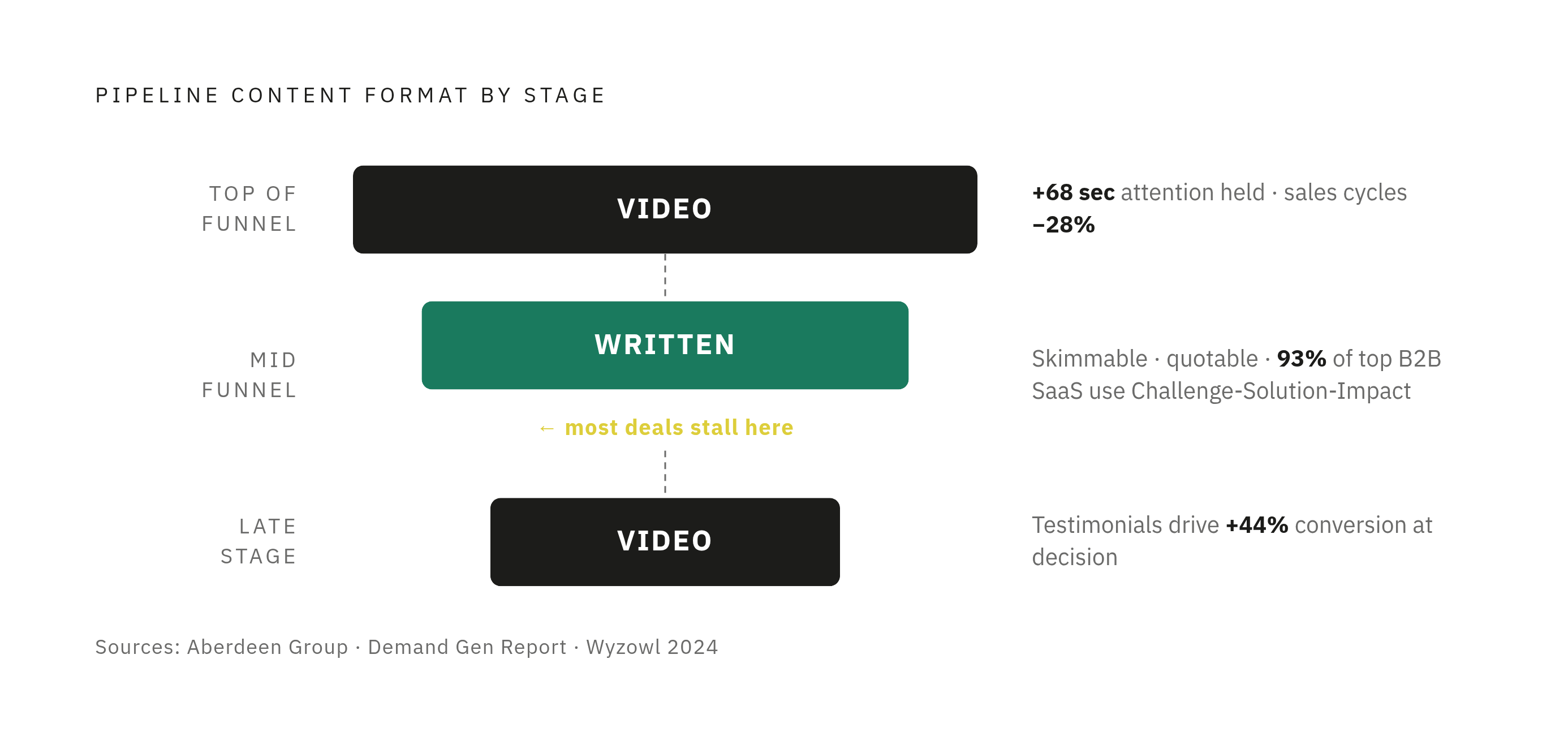
Ask where in the deal this thing needs to do its job. That question alone kills most format debates before they start.
Top of funnel. The buyer is scanning, not reading, attention is thin, and nobody's heard of the vendor yet. Video wins here, with embedded video holding attention for roughly 68 seconds longer on case study pages. An industry-matched clip, thirty seconds of someone who looks like the buyer's own customer describing a problem the buyer recognizes on sight, builds trust before anyone's ready to evaluate anything. Aberdeen Group found that video content shortens B2B sales cycles by 28%, and most of that compression happens right here, moving someone from "never heard of you" to "worth a call" faster than a paragraph ever could.
Mid-funnel. The buyer is comparing vendors now and building an internal case to justify the spend, and, this is written territory, full stop. A champion pulling numbers out of a case study to paste into a business case deck needs something skimmable and structured, not a video they'd have to re-watch and transcribe by hand at 9pm. Technical buyers want depth a short video can't hold: integration specifics, methodology, the actual mechanics behind the outcome. That near-universal adoption rate for Challenge-Solution-Impact isn't a coincidence, it mirrors exactly how evaluation-stage buyers already organize their own thinking.
Late stage. The economic buyer or legal shows up, and, the deal risks turning into an abstract argument about risk instead of a decision about value. A short outcome video, a real person naming a real result, cuts through committee skepticism in a way a PDF never manages. Videos featuring testimonials have been shown to drive 44% higher conversion rates at the decision stage, and the job here is permission, plain and simple: if it worked for them, it'll work for us.
Put together, the best-run programs build three assets from one customer story: an early clip for credibility, a written case study for evaluation, a tight outcome video for closing. Same customer, three jobs, three moments in the deal.
Production reality: what each format actually costs and demands from an early-stage team
Strategy's cheap to talk about. Producing the assets is where teams actually get stuck, usually around week three, staring at an invoice.
Video costs come in tiers. DIY or internal recording runs $500 to $2,000, fine for a raw testimonial capture, usually too rough for a deal-stage send to a CFO. Mid-tier professional production, crew, editing, graphics, runs $5,000 to $15,000, and that's the realistic range for most B2B video work. High-end cinematic production runs past $50,000; industry benchmarks put full on-location shoots specifically at $14,000 to $20,000. Traditional on-location production takes 6 to 8 weeks start to finish, while remote-recorded formats compress that to 1 to 2 weeks, a real option when sales can't wait two months for proof to exist. Across all video types, planning to delivery runs 4 to 8 weeks.
Written case studies finish in 1 to 3 weeks, mostly gated by approval cycles and how fast the customer replies to an email. That asymmetry, cheap and fast against expensive and slow, is exactly why 88% of top B2B SaaS companies run case study programs at all, making case studies the base layer of their evidence library, not as an afterthought.
Early-stage teams chasing enterprise-grade video budgets before they've got the pipeline to justify it are solving the wrong problem entirely. Build the written library first, and save video for the accounts worth the spend, or the one customer story that keeps repeating across deals like a greatest hit. Only a minority of top-growing B2B SaaS companies even run video case studies; the majority win with written as the core format and video as the accent, not the headliner.
The actual bottleneck usually isn't the budget line, it's getting a customer on a call before their attention drifts somewhere else. A system for collecting evidence matters as much as the production budget behind it, maybe more.
Building a format strategy instead of picking a format winner
The goal was never a one-time production decision. A format mix that matches pipeline stage, rebuilt as a habit instead of a project that finishes and gets forgotten, is what actually holds up.
One good customer conversation, recorded properly, becomes three things: a written case study for evaluation-stage deals, a short clip for early-funnel credibility, a pull-quote reps drop into cold outreach. One recording session, structured to pay off three separate ways. It also matches how buyers actually behave, since some want the detailed document and others want the thirty-second version, and neither one is wrong for wanting what they want.
Most teams don't have an evidence gap. They have a system gap. Sales asks for a healthcare reference on Thursday, and, someone starts frantically scrolling Slack hoping a happy customer mentioned something usable three months back. A better setup surfaces these stories from account reviews and sales calls before anyone's under deadline pressure, so the case study already exists before the deal that needs it does.
The customer conversation itself should serve both formats at once. Ask for hard metrics and outcomes, because written needs the numbers, and ask open, loose questions that invite an unscripted answer, because video needs the human moment a script kills on contact. Record all of it, every minute, since that single recording becomes raw material for everything downstream.
Story selection should follow sales, not convenience. Which verticals are actually sitting in pipeline right now? Which objections keep showing up, and at what stage do they show up? Which outcomes actually land with an economic buyer who's never met the team? Answer those three honestly, and, the case study calendar basically writes itself.
Software built to structure these conversations into deal-ready assets closes the gap between having happy customers and having evidence a rep can actually send at 4pm on a Thursday. And, the payoff compounds: research from Genesys Growth found that authentic, multi-format social proof, video and written working together, can lift B2B SaaS conversion by up to 270%. That number comes from building a system that never has to choose between the two in the first place.