Content Repurposing System From One Interview to Eight Assets
Extract eight content formats from a single recorded interview.
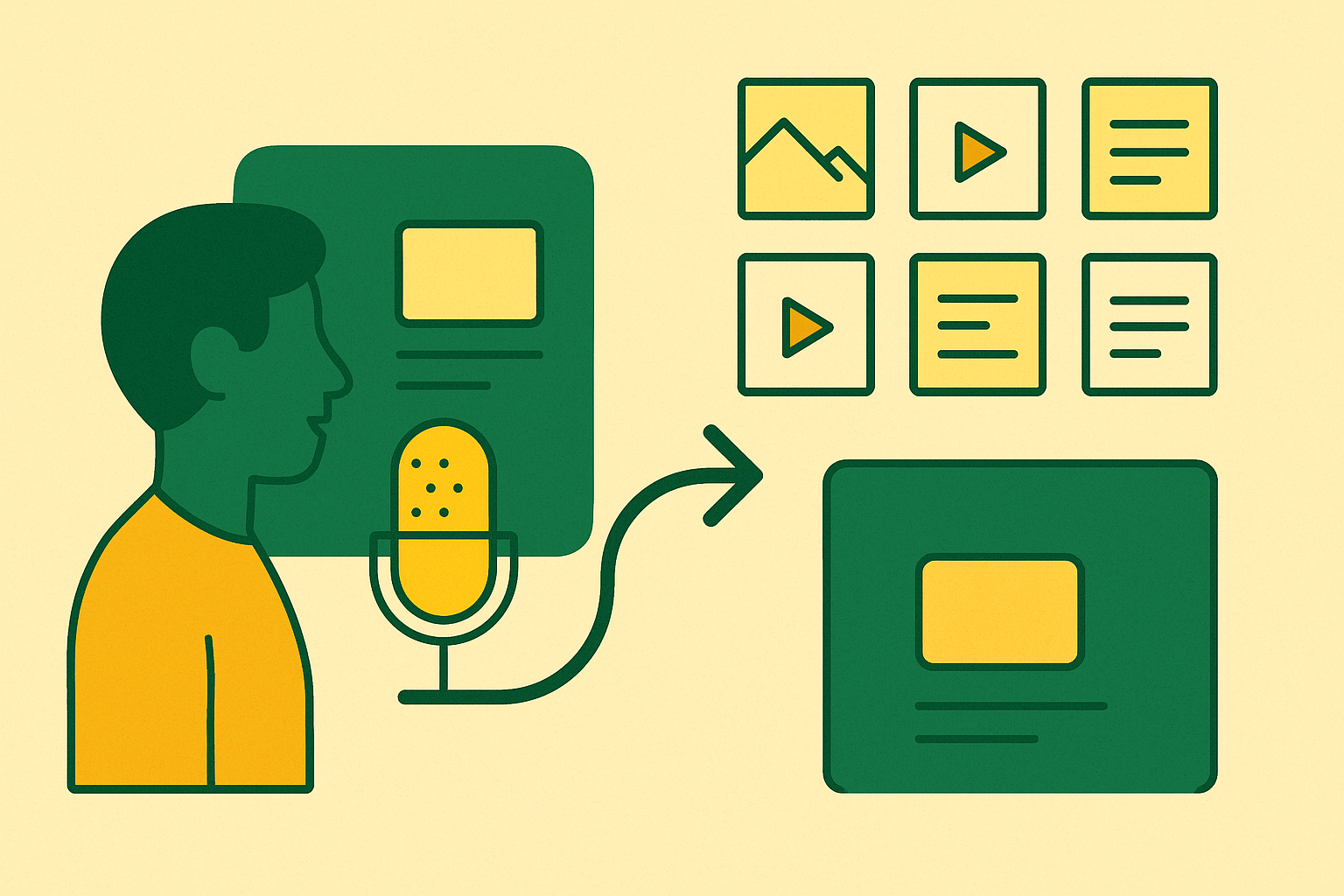
Eight assets from one interview, recorded once. Instead of a blog post and some scraps rotting in a shared drive, you get a blog post, a case study, video clips, a podcast episode, quote graphics, a newsletter, and an infographic, all pulled from a conversation that's probably sitting on someone's hard drive right now. Most teams record the interview, publish the one obvious piece, and let the rest of the tape die of neglect. That's a math problem, and the math is bad. That's a math problem, and the math is bad.
Most teams treat an interview like it's already a blog post, one argument, one format, done. Wrong instinct. A blog post is a closed loop. It makes its point, it ends, there's nothing left to wring out of it once it's live. An interview is the opposite animal: messy, tangential, and the tangent is usually where the good stuff hides. A typical long-form conversation contains a problem framing, a process walkthrough, hard numbers, strong opinions, and a closing line worth stealing for a headline. That's eight to ten separable arguments sitting in one file, waiting for someone to notice them, and most teams notice exactly one.
Pierre Herubel's 30/70 rule, laid out on Substack in 2025, argues a content workflow should run 30% new creation and 70% repurposing from what already exists. Most teams run that ratio backwards. They stay starved for ideas while sitting on hours of usable footage nobody touched twice. Typeface's 2025 research backs this up from another angle: 37% of B2B marketers cite repurposing itself as a challenge, and 39% say they can't produce enough content, period. Both numbers point at the same bottleneck: the gap between hitting record and shipping the fifth format. It's the gap between hitting record and shipping the fifth format. A separate 55% say it's hard to make content that actually drives conversions, which tracks: content made under volume pressure comes out generic, and generic content doesn't move buyers. Specific content does. The fix is building a system that extracts everything already sitting in the ones already on file. It's building a system that extracts everything already sitting in the ones already on file.
Building the extraction foundation before any asset gets made
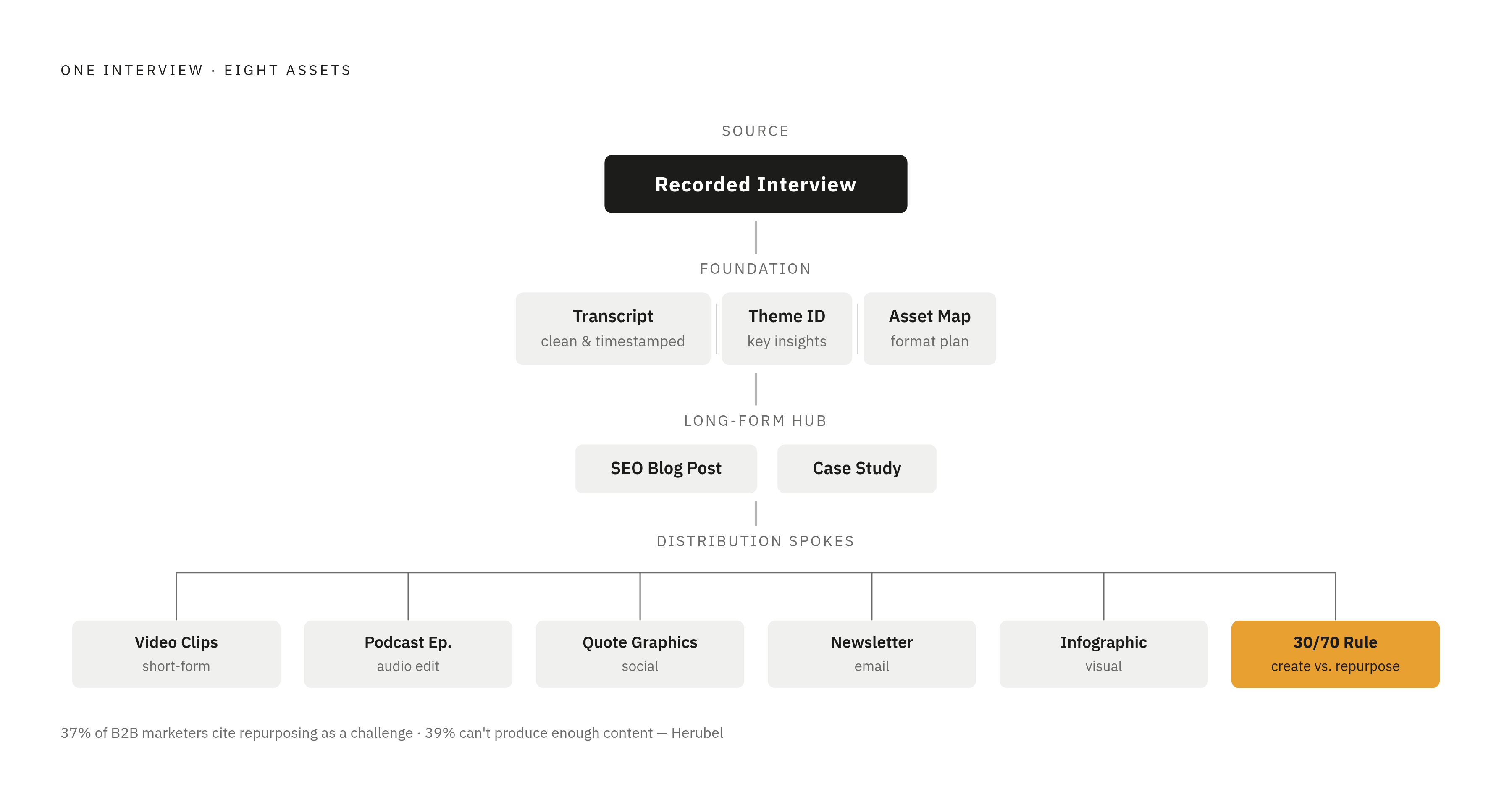
Everything downstream depends on one unglamorous artifact: a clean transcript. Skip this step, or half-do it, and the whole system stalls out around asset three, usually with someone re-listening to forty minutes of audio trying to remember who said the good line. That person is never having a good day.
Transcription comes first, and it comes immediately, not whenever someone gets around to it. Upload the recording to an AI transcription tool right after the interview wraps, while it's fresh, before it gets buried in a folder called "Q3 stuff" that nobody opens again. Speaker labels are not optional here. Without them, someone has to re-listen to the whole thing just to attribute a single quote, which defeats the entire point of extracting anything in the first place. ScreenApp handles transcription, screen recording, and clipping in one place. Descript lets you edit audio and video like a text document. Trint is built for teams collaborating on one shared transcript. Rev.com offers human transcription with a 99% accuracy guarantee, which matters when the material is technical or sensitive enough that a mistake actually costs something.
Next: theme identification. Run the clean transcript through an AI summarizer, not to write anything yet, just to map what's actually in there. The target is five to ten distinct claims, stories, or proof points, each sturdy enough to carry its own asset on its own. Flag anything answering: what was broken before, what they tried that flopped, what specific result they got, what they'd tell a friend in the same spot. Those four questions map almost exactly onto the seven asset types below. That's not a coincidence, it's the whole design.
Then asset mapping, before a single word gets written. Each theme gets assigned to the format it actually fits, and forcing the wrong fit is where good material goes to die. A detailed process walkthrough belongs in a blog post or infographic. A quote graphic can't hold that much nuance, and trying to force it there is how you end up with a graphic nobody can read at a glance. A simple checklist here keeps repurposing from turning ad hoc, which is usually how teams end up making the easy two assets and quietly ghosting the other five.
One more move, and it costs nothing extra: record both video and audio during the interview itself. That single decision hands over the raw material for two entire assets later, without ever scheduling a second call nobody has time for.
Asset 1: the long-form SEO blog post that anchors the whole system
The blog post goes first because it's the only asset on this list that compounds. Organic traffic keeps arriving months after the publish date, and every other asset can link back to it. That makes the blog post the hub the rest of the system orbits.
An interview offers something most blog posts fake: real quotes, real numbers, a situation someone actually lived through instead of one a marketer reverse-engineered from a keyword list. Content that reads like thought leadership draws on real quotes, real numbers, and a situation someone actually lived through, while content that reads like a press release in a trench coat does not. The interview's natural back-and-forth also outlines the post for free. Each theme cluster from the extraction step becomes an H2, almost without trying.
A workable structure looks like this: a headline built around the search intent the interview actually addresses, an opening that states the problem in the interviewee's own words, H2 sections mirroring the theme map, quotes doing the argument's heavy lifting instead of sitting there as decoration, an FAQ pulled from questions that came up naturally in conversation (which happens to be exactly the format Google likes pulling into featured snippets), and internal links closing the loop back to the rest of the system.
HubSpot's research points to long-form posts, 2,500 words and up, as the format driving the most organic traffic among written content. A solid interview supplies enough raw material to clear that bar without padding, and padding is the only unacceptable way to hit a word count. It's how a reader figures out three paragraphs in that nothing else is coming.
One rule, and it's not up for debate: never publish the raw transcript. Reframe it as a standalone article with its own beginning and end. Nobody wants to read a conversation they weren't part of. They want the resource built from it.
Asset 2: the customer case study built from the same conversation
A customer interview is already shaped like a case study before anyone touches it. The problem, the decision, the rollout, the outcome: it's all sitting in the recording, roughly in order. The job here is extraction, and it might be the easiest job on this entire list.
This asset punches well above its weight. Demand Gen Report's Content Preferences Survey found case studies were the most relied-on content type in the middle of the buying funnel, cited by 78% of respondents. Separately, OpenView and DocSend's sales content analysis found case studies carry an 83% average completion rate, the highest of any sales content format measured. People who start a case study tend to finish it. That's rare enough to build a whole strategy around.
Structure it as Problem, Solution, Result, and don't get clever with it. The before state: what the customer was trying to do, what kept breaking, what that failure actually cost them in time or money. The decision: how they weighed options, and why this one won. The implementation: what actually happened during rollout, and the more specific this gets, the more trust it earns. The after state: named numbers, not adjectives. "Improved significantly" says nothing at all. "Cut the cycle from six weeks to ten days" says everything, and it's the sentence that gets forwarded internally on the buyer's side.
Keep the customer as the hero, full stop. The product is the tool that helped them win, not the main character, and that framing reads as more honest to a prospect currently living through the exact same problem. Treat the case study as a sales asset first and a website asset second: it belongs in a rep's inbox during an active deal, not sitting on a webpage hoping to get discovered by accident. The same interview material becomes a PDF, a one-pager, and a slide deck without a second round of writing. Build a repeatable intake process that turns a recorded conversation straight into a structured draft, and case studies stop starting from a blank page. Every customer conversation ends up producing a usable proof point instead of just polite goodwill.
Asset 3: short-form video clips for platform-native distribution
If the interview was filmed, the clips already exist. Nobody has to create anything new here, just find what's already good and cut it loose.
A strong clip runs 15 to 60 seconds and carries exactly one complete idea, with a clean start and a clean finish. Look for a strong opinion, a data point that raises an eyebrow, or a moment where the interviewee describes something with real texture, the kind a summary can't fake. Animated captions aren't a nice-to-have here, they're load-bearing. A large share of short-form video is watched without sound, so the text has to carry the entire argument by itself.
Platform fit changes the cut, and treating every platform the same is the fastest way to waste a good clip. Different platforms suit different clip styles, and matching the cut to the platform's native expectations is how a good clip survives the feed. Vizard.ai scans footage for shareable moments and formats them per platform automatically; ScreenApp earns a second mention here for combining transcription with clipping in one workflow.
A single 45-minute interview can realistically produce several distinct clips, and each one has to stand entirely on its own. Nobody watching a 30-second clip on their commute is going digging for three others for context. Every clip should end with a clear pointer back to the blog post or case study, which makes short-form video the spoke and the long-form asset the hub it was always meant to be.
Asset 4: a podcast episode extracted from the audio track
If audio got captured during the interview, turning it into a podcast episode takes very little extra work. Not zero effort. Close enough to zero that skipping it is a choice, and a lazy one.
Build it with a short recorded intro, 15 to 30 seconds, framing what the conversation covers and why it's worth someone's time, pulled straight from the theme map built earlier. Add a short outro pointing listeners to the full blog post or case study. Do light audio cleanup if it's rough, though B2B audiences aren't expecting studio-grade production anyway. Audiograms, short clips paired with a waveform graphic, do for podcasts what video clips do for interviews: the social-native cut of the longer asset.
The format builds trust text can't fake. Hearing someone's actual voice, the pause before a hard question, the emphasis on the number that mattered most to them, carries weight a pull-quote on a slide simply doesn't have. Pushing the episode to Apple Podcasts, Spotify, and LinkedIn puts the same conversation in front of an audience that will never type a single search query related to it. A blog post structurally can't reach that audience on its own.
Asset 5: quote graphics that make the interviewee's best lines shareable
Quote graphics need no design skill and no new writing. The transcript already has the material sitting in it, usually in a line the interviewee tossed off without thinking twice. That's why it works.
Look for one full idea under 30 words: a claim that pushes against a common assumption, a precise result ("we cut our cycle from six weeks to ten days"), or a moment of candor too honest to have survived a press release. Build a branded Canva template with the interviewee's headshot, name, title, and company, one quote per graphic, no exceptions. Resist adding context. If the line needs a paragraph of setup to land, it's the wrong line, full stop.
Platform logic varies, and ignoring that is how a good quote dies quietly in the wrong feed. On LinkedIn, tag the interviewee directly, which puts the graphic in front of their network too, not just the publisher's. Instagram works when the interviewee already carries name recognition in their field. On X, quote graphics consistently out-reshare plain text.
The upside isn't just distribution, it's incentive. The interviewee generally wants to share a graphic that makes them look sharp, so the piece spreads without a dollar of ad spend behind it. Free distribution, and the interviewee did the marketing without realizing it.
Asset 6: an email newsletter edition built around the interview's core argument
Email is the place to take the single sharpest argument from the interview and make it land in one person's inbox like it was written for them specifically. In a sense, it was.
Open with one claim from the interview, specific enough to make someone stop scrolling mid-thumb. Follow with two or three paragraphs explaining why that claim matters to the reader right now. Center the email on a direct quote. Close with a clear link to the full blog post or case study for anyone who wants the whole story instead of the highlight reel.
Email earns its spot with hard numbers behind it: research finds a large majority of B2B companies cite it as their top lead generation channel. For deals with long evaluation windows, which describes most B2B deals, email nurture is what keeps a lead warm in the gap between one sales call and the next.
The tone should read like a recommendation from someone who found something worth reading. "Here's what stood out this week and why" beats "our new post is live" every single time. One interview supports a primary edition right away, and if the conversation touched multiple themes, a second edition two or three weeks later stretches the material without ever repeating a line.
Asset 7: an infographic or data visualization for interviews heavy on process or numbers
Not every interview earns an infographic. Forcing one is how B2B marketing ends up with infographics nobody reads and nobody remembers. This format only pulls its weight when the conversation includes a repeatable process, a clear before-and-after, or several numbers connecting into one story.
Good candidates: a step-by-step workflow the interviewee walked through ("here's how onboarding actually runs"), a comparison of the old method against the new one, or a handful of metrics telling one connected story (time saved, cost dropped, volume climbed). The design has to work without any outside context. Someone who never heard a second of the interview should get the full point from the visual alone, no caption required, no asterisk.
Distribution favors a few specific spots, and spraying it everywhere dilutes it. LinkedIn does well, especially when the process is specific enough to an industry that peers want to pass it along. Embedded inside the blog post, it gives skimmers a reason to slow down, which improves time on page more than another paragraph would. And in a slide deck or sales presentation, a well-built process visual becomes a standalone sales tool, completely detached from the interview that spawned it in the first place. Canva is a common starting point for this kind of work. No dedicated design software required, and no excuse to skip it either.