Measuring Organic Content ROI Without Last-Click Attribution
Multi-touch attribution reveals organic content's true influence beyond last-click's undercount.
Organic content ROI is broken the moment last-click attribution enters the picture. Last-click hands full credit to the final touch before conversion, and in B2B, that final touch is almost never the article, guide, or case study that started the whole thing. The buyer read something months ago, forgot the URL, and came back through a branded search. Last-click sees the branded search. It never sees the article.
The zero-click and AI search shift worsens the measurement gap
Google's own research puts the average buyer at around a dozen searches before they ever engage with a brand. Last-click credits one touch out of twelve and calls it a day.
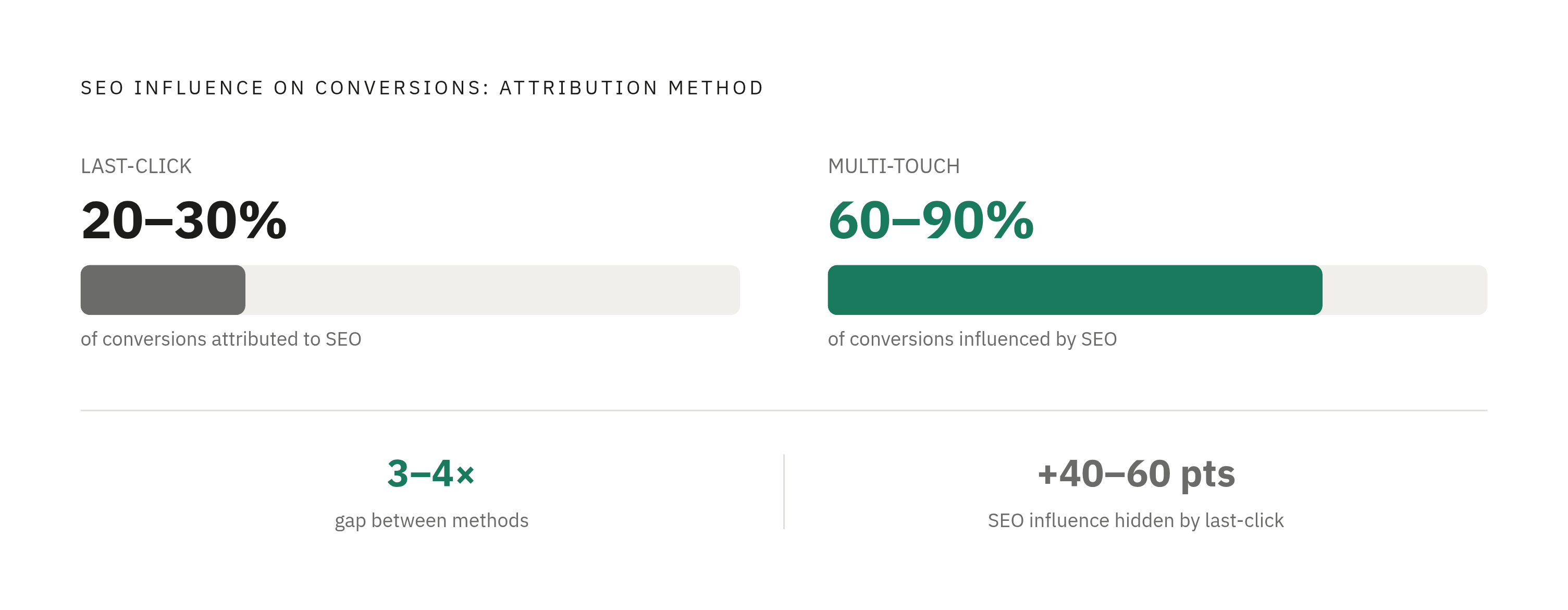
The undercount is not small. Search Engine Journal research cited by Fifty Five and Five found multi-touch attribution shows SEO influencing 60 to 90% of total conversions, while last-click shows only 20 to 30%. That's a three-to-four-times gap between what content actually does and what the report says it does. Layering privacy changes on top makes roughly 10 to 20% of true organic traffic go missing from analytics before any attribution model even gets applied. Then add sales cycle timing: someone reads a case study in January and signs in March, and a 30-day measurement window has already written that case study off as irrelevant by the time the deal closes.
None of this is a rounding error. ROI measurement consistently ranks as the top challenge for marketing teams across the industry. It's a problem that reaches beyond content nerds arguing about it at conferences, hitting most of the industry defending budgets with numbers that dramatically understate what the channel does. That's most of the industry defending budgets with numbers that dramatically understate what the channel does, and budgets get cut on that bad evidence.
And it's getting worse, fast. SparkToro's 2024 study found 58.5% of US Google searches ended with no click to the open web. By early 2026, SparkToro reported fewer than a third of Google searches resulted in a click, and an independent analysis put the zero-click rate closer to 68%. A research organization's 2025 study found that when an AI summary shows up, users click a traditional result just 8% of the time, versus 15% when there's no summary. Only 1% click a link inside the summary itself. Gartner projects traditional search volume will drop 25% by 2026 as AI assistants soak up queries that used to hit a search bar.
Content can shape an AI answer, shift how a buyer thinks about a category, and get cited by name, all without ever producing a session in analytics. Think of it like a billboard on the highway. Almost nobody pulls over to buy the thing on the sign, but plenty of people remember it later at the store. Score the billboard only by cars that stop, and it looks worthless. Almost nobody pulls over to buy the thing on the sign, but plenty of people remember it later at the store, so the billboard isn't worthless even though scoring it only by cars that stop makes it look that way. Fewer clicks, more influence per click: that's the new math, and click-based measurement is more misleading now than at any point before. The answer is measuring influence and revenue in a different way, not panic. It's measuring influence and revenue in a different way.
The five streams of value organic content generates
Most content reporting captures exactly one thing: direct revenue from buyers who clicked through and converted in the same session. That's stream one, and it's the smallest of the five.
Stream two is pipeline influence: deals where the buyer read content somewhere along the way, even if it wasn't the final touch. Stream three is organic traffic value, the media-value equivalent of what those visits would have cost through paid search, a savings rather than a conversion. Stream four is AI citation value, the estimated worth of getting named in an AI summary or one of several AI chat assistants' answers, influence that leaves no click trail whatsoever. Stream five is brand lift, the rise in branded search volume that content exposure drives across channels over time.
Content Marketing Institute's research found only 12% of B2B content teams beat their own goals, and measurement blind spots across these four missing streams are a major reason why. It matters because the economics differ so much by channel: organic lead conversion runs at 14.6%, against 1.7% for outbound. That gap is invisible if a team only counts direct last-click conversions.
The traffic value math alone can flip a program's story. Under the Fifty Five and Five framework, a healthy volume of monthly organic clicks, priced against a realistic PPC cost-per-click, can produce a 367% return on content spend before a single conversion gets counted. A content program that looks mediocre under stream one alone can look like one of the strongest lines in the marketing budget once all five streams are on the table. The content didn't change. The measurement did.
Building the measurement stack that replaces last-click
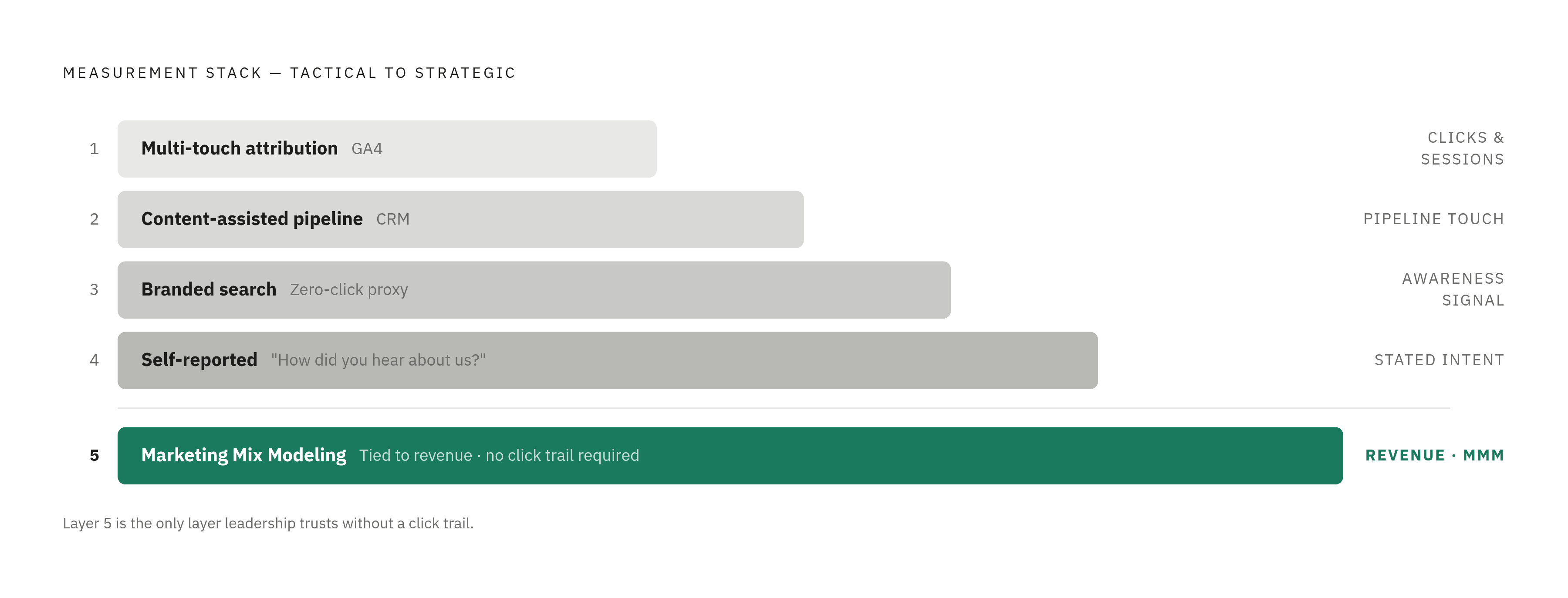
Five layers, stacked from the tactical to the strategic.
Layer one is multi-touch attribution in GA4. Switch from last-click to data-driven attribution if that hasn't happened yet, configure organic as a first-touch source, and look at conversion paths where organic shows up anywhere in the sequence, not just at the end. Teams that need CRM-level detail add a tool like Bizible or Dreamdata on top.
Layer two is content-assisted pipeline inside the CRM. Tag leads with first-touch and multi-touch data the moment they enter HubSpot or Salesforce, using UTM parameters and landing page history. Content-assisted pipeline means any opportunity that touched organic content before or during the sales cycle, last touch or not. Measure across a longer window than 30 days, since that better matches how B2B buying works, and tie organic touches to real orders and lifetime value rather than shallow micro-conversions.
Layer three is branded search as a stand-in for zero-click influence. When AI answers absorb demand that used to show up as a click, a lot of that influence resurfaces later as a direct branded search. A lift in branded search volume tied to a content push is a fair proxy for influence no session can capture. Share of Search, the metric tied to Les Binet's work, correlates strongly with market share, so a rise in share of search after an SEO push is a brand signal to track on its own.
Layer four is self-reported attribution. A plain "how did you hear about us?" field at signup or checkout catches discovery paths, including AI and zero-click ones, that no script can see. Post-purchase surveys reveal a real gap between what analytics reports and what buyers say actually happened.
Layer five is Marketing Mix Modeling, the layer built for executives. MMM uses statistical modeling to estimate SEO's real lift on revenue with no click trail required, isolating what content investment actually contributed to revenue outcomes. It tends to be the model leadership trusts most, since it ties straight to revenue instead of sessions.
Pull GA4 page-level reports across all five layers and find the small set of posts driving most of the assisted and direct conversions. A relatively small set of pages typically drives an outsized share of organic pipeline. Report on those first, in depth, before spreading attention thin across everything else.
The ROI formula and benchmarks that make content defensible to leadership
The formula itself is simple: ROI equals revenue attributed to content, minus total content costs, divided by total content costs, times 100. What counts as cost is what people get wrong. It's not just what a freelancer charged per post. It's writer fees, tools, editorial time, and distribution spend, the full investment.
A solid B2B return is around 3:1. Top performers hit 4:1 or better. Another useful number for the leadership deck is organic CAC: total content production cost divided by organic-sourced customers. That figure tends to improve over time, since old posts keep ranking and pulling in traffic without new spend, an advantage paid CAC just can't replicate no matter how it's optimized.
Timing matters as much as the math. SEO investments typically take many months to reach positive ROI, but a program measured on a quarterly window will almost always look like a loser, because that window is shorter than the buying cycle it's trying to measure.
There's a defensive case too, one most ROI models leave out. If a brand holds a set of valuable keyword positions and loses them, the revenue at risk from that loss can be quantified in dollars. SEO ROI is about what it protects from competitors as well as what content wins. It's also about what it protects from competitors. And the cost of skipping all this isn't zero: Research via layerfive.com found 47% of marketing budget gets wasted due to poor data visibility and bad attribution. Reporting branded search lift, assisted pipeline, and citation share every month, right alongside plain old sessions, is what turns content from a line item leadership questions into an asset leadership starts to trust.
Case studies as a high-signal pipeline asset in the measurement stack
Case studies are the cleanest test of pipeline-influence measurement, because of when buyers actually read them. Research has found that the large majority of B2B buyers have already picked a preferred vendor before ever speaking to a rep, so the case study did its work during anonymous research, a phase that last-click attribution can't see.
The data backs up how spread out that influence is: Research consistently shows the majority of B2B buyers use case studies during their research, finding them valuable across multiple stages of the buying process. Case studies are a thread running through the whole journey, not a single-moment asset. It's a thread running through the whole journey.
One useful signal from the field: close rates on deals where a rep shared proof content in the first 30 days ran roughly double the close rate of deals where they didn't, based on one practitioner account comparing CRM outcomes. That's the kind of side-by-side comparison that makes a case study's pipeline role concrete instead of theoretical.
Publish case studies as open web pages, not gated downloads. Gating cuts off the large share of buyers doing anonymous research before they've ever filled out a form, which is exactly the audience case studies are supposed to reach. To fold case studies into the measurement stack: track which case study pages show up in GA4's assisted-conversion paths, tag CRM opportunities where the buyer visited one before or during the sales cycle, compare close rates and deal speed for opportunities with that engagement against those without, and use self-reported attribution to catch what the tracking missed. A well-built case study, with specific numbers and a real customer voice, is also exactly the kind of page AI answer engines pull from for category questions, so branded search lift after publishing is a reasonable stand-in for that citation effect. One strong case study per major buyer persona or vertical also makes it possible to compare pipeline influence segment by segment, instead of one blurry average.
Building the social proof and content collection engine that keeps the measurement stack fed
Social proof might be the most requested, least systematized asset in B2B marketing. Every sales rep wants a case study for their exact deal. Almost no company has a repeatable way to produce one on demand.
Skipping this raises costs in pipeline, not just in a marketing report. A meaningful share of B2B buyers have ruled out a vendor because the evidence backing them felt untrustworthy or stale. A thin proof library is a lost-deal problem, not a branding problem. It's a lost-deal problem.
Fixing it starts with timing. Automate nomination requests right after a strong NPS score, a successful delivery, or a contract renewal, so a good story never slips through because nobody remembered to ask for it. Sales needs a seat at the table here too, not just as a user of the content but as a source for it, since reps know which pain points and outcomes actually swing a deal. Tying a simple request process to project milestones is the kind of structural change that makes ongoing production actually sustainable, rather than a scramble every time someone in marketing needed a new story for a slide.
Placement matters as much as production. Proof belongs on landing pages near the call to action, matched to the audience the ad targeted. It belongs on pricing pages next to the plan someone's deciding on. It belongs on comparison pages where a buyer is actively weighing one vendor against another, and in sales conversations at the exact moment an objection comes up.
Measuring the payoff follows the same pattern as case studies: compare conversion rates on pages with segment-matched proof against pages without it, compare close rates for opportunities that touched proof content, and use self-reported attribution to catch stories the tracking stack never saw. The return compounds. A proof library that keeps growing gives the measurement stack more signal every quarter, which makes the pipeline-influence case to leadership stronger each time it's presented, a compounding effect that a one-off case study project sitting alone on a resources page never gets close to. Research from 2POINT Content Marketing ROI found only about a third of marketers can accurately measure content marketing ROI. Building both the collection engine and the measurement stack puts a team ahead of most of the field, and that gap doesn't close on its own.