Compounding Content vs Paid Ads for B2B Customer Acquisition
Content builds lasting pipeline while paid ads stop working the moment you stop spending.
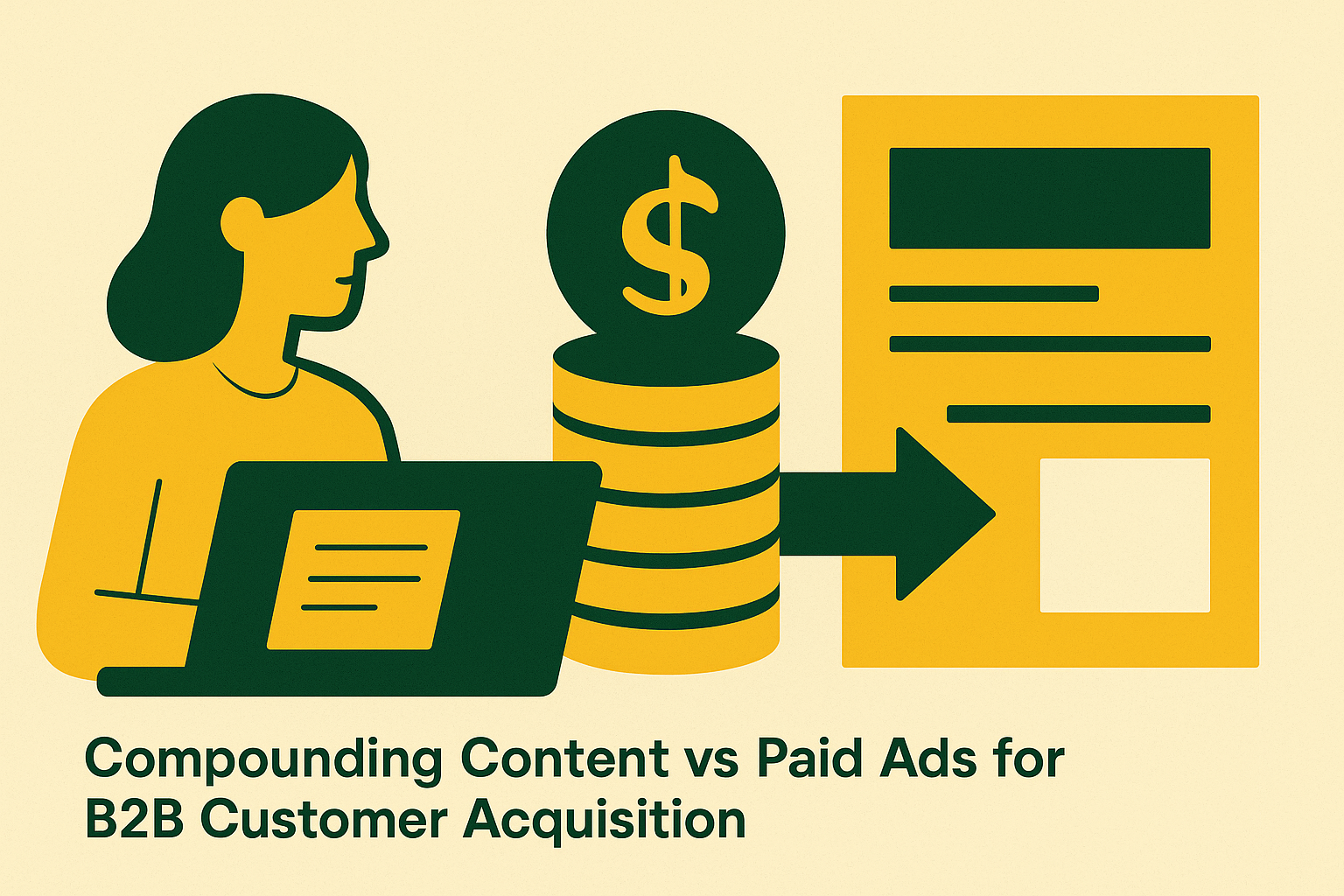
The core question in B2B customer acquisition is which channel builds durable advantage over time. It's which one you'll still be paying for in three years, and what you'll have to show for it. Paid ads buy pipeline that vanishes the moment the budget does. Content builds something that keeps generating leads long after the invoice for writing it clears.
Most marketing teams still run this debate through the wrong metrics: click-through rate, cost per lead, conversion percentage. Those numbers matter, sure, but they miss the structural difference underneath. Paid spend depreciates the second you stop feeding it. Content, done right, appreciates. It's the difference between renting an audience and owning one.
Paid ads work like a treadmill bolted to a bathroom scale: step off, and the number stops moving, but you haven't gone anywhere. Every dollar in produces a proportional amount of pipeline out, and the relationship holds steady right up until the campaign ends. Then it's zero. No residual traffic, no leftover leads, no asset sitting on the balance sheet.
Compounding content flips that relationship. A blog post, a guide, a case study published today keeps pulling in search traffic and filling forms for years, mostly on its own. The cost was mostly upfront. The return curve runs the opposite direction from the spend curve, and that gap between them is where the whole argument lives.
Nobody's saying paid is useless, and anybody who tells you that hasn't run a launch. But the two channels answer different questions on different timelines. What follows is the actual math behind that difference, and what it should mean for how a B2B team splits its budget across 12, 24, and 36 months.
Why paid ads are getting structurally harder, not just more expensive
Start with the number everyone already feels in their gut: Google Ads cost per lead climbed 5.13% in 2025, landing at $70.11, according to customer acquisition cost benchmarks compiled by genesysgrowth.com. That follows a 25% jump in 2024. Two years, one direction, no sign of leveling off.
If cost were the only problem, teams could just budget around it. Raise the number, keep the leads flowing. But lead quality has been sliding at the same time costs climb, which is the part that actually breaks the model. iOS privacy changes and the slow death of third-party cookies have made targeting sloppier across the board, so hitting the same qualified audience now takes more spend than it used to.
And the leads that do come through convert worse. Per LeadSpot's 2025 benchmarks, leads from Google and LinkedIn ads turn into sales-qualified opportunities at rates 2 to 3 times lower than leads that originate from content. Put another way: content-sourced leads convert into sales-qualified opportunities at roughly 2 to 3 times the rate of paid ones. That structural gap in lead quality is baked into the channel itself, far beyond a rounding error.
Buyers have also gotten better at tuning ads out. Forrester data cited in LeadSpot's report shows people, business professionals included, avoid ads on websites, apps, video platforms, search engines, and social feeds at higher rates than they avoid ads on TV or radio. Digital ad fatigue is a measurable trend in performance data. It's measurable, and it's rising.
Meanwhile the money keeps flowing in anyway. Gartner's 2024 CMO Spend Survey found media now eats 28% of marketing budgets, with 57% of that going digital. That spend isn't producing proportional returns, it's producing more spend next quarter to hit the same numbers.
Here's the timing problem underneath all of it: one McKinsey study, cited in LeadSpot's research, found that 95% of B2B marketing content gets ignored by buyers. Most paid impressions land on people who aren't buying anything, not this month, maybe not this year. You're not just paying more for attention. You're paying more for attention from people who don't need what you're selling yet.
None of this means paid campaigns are broken or that the people running them are bad at their jobs. It means a channel with zero residual value, run as the primary engine indefinitely, gets more expensive every single quarter with no floor in sight. A performance problem this deep in the channel resists any optimization meant to fix it. It's the structure of the channel itself.
What the ROI curves actually look like when content compounds over 36 months
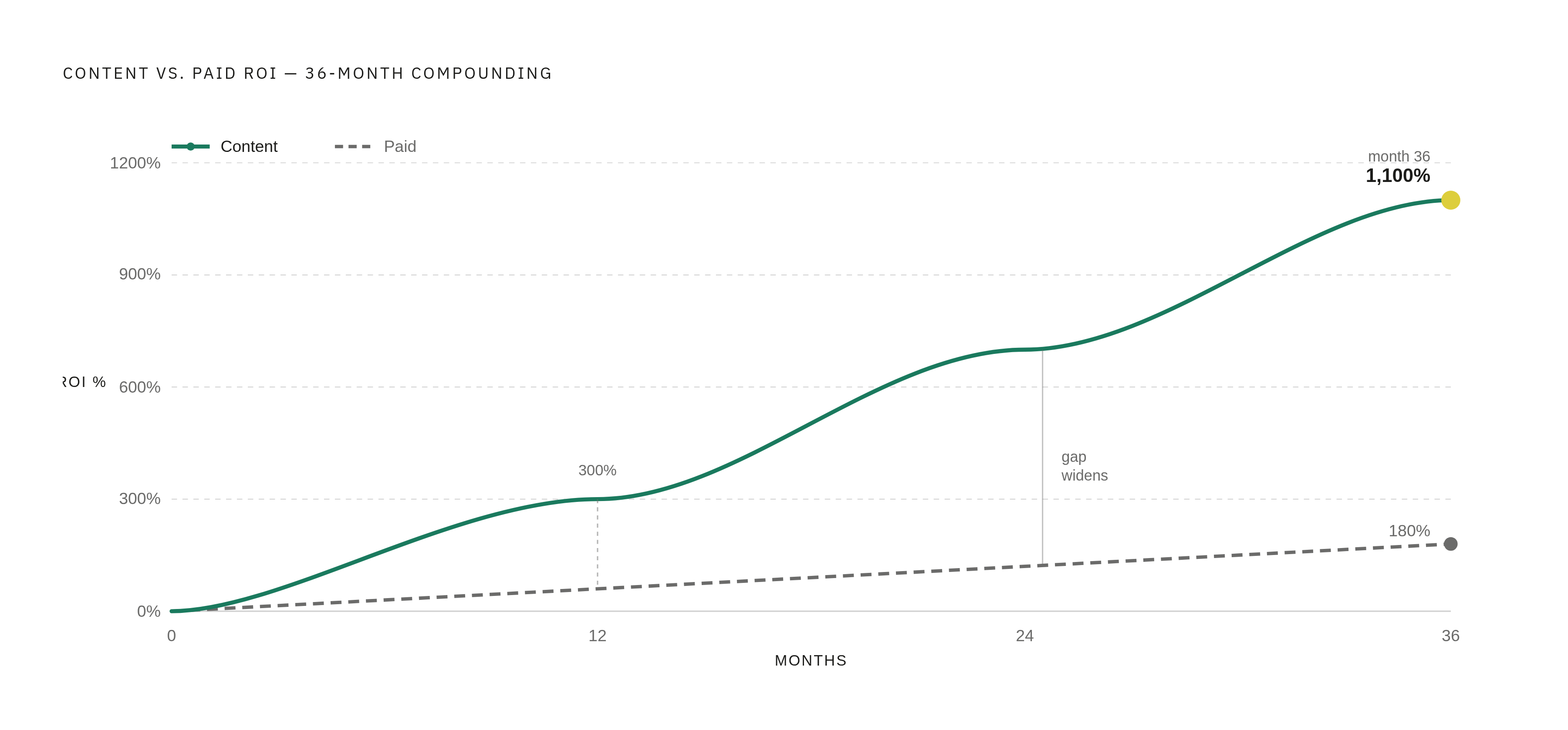
Content's payoff isn't fast, but it isn't small either. Per Averi's 2026 B2B SaaS benchmarks, three-year average content ROI lands around 844%, with SEO specifically averaging 702% compounding return over the same window.
The shape of that curve matters more than the endpoint. It's not a straight line climbing steadily upward, it accelerates. Averi's analysis puts ROI at roughly 300% by month 12, 700% by month 24, and 1,100% by month 36. Each year outpaces the one before it, on the same body of published work, without a second round of spend to get there.
That acceleration shows up asset by asset, too. Per omnibound.ai's Content Marketing ROI Statistics, a well-ranked post pulls in 60% more traffic in months 7 through 12 than it did in its first six months alive. Nobody touched it, nobody re-optimized it, it just kept climbing on its own.
Set that against paid's return: $1.80 back per $1 spent, with LinkedIn out in front for B2B specifically, per Averi's channel benchmarks. Content's average sits around $3 per $1 spent, and email, a related compounding channel driven by personalization, returns closer to $42 per $1 spent. The pattern holds across formats. Compounding isn't a quirk of blog SEO, it's a property of any asset that keeps working after you stop paying for it.
Search-driven revenue backs this up at scale. Per salesfully.com's analysis, SEO contributes 44.6% of B2B revenue, more than double any other single channel, with organic listings pulling in 8.5 times more clicks than paid ones.
Here's the honest part nobody likes to hear: content takes 3 to 6 months to show real ROI, and 6 to 9 months to hit its full stride. That lag is exactly why so many teams quit right before the curve bends upward. Zapier's content program is a useful anchor here. Per Averi's analysis, factoring in a three-year lifetime-value multiplier, Zapier's content work produced a 454% ROI. This real company stuck around long enough to watch the compounding kick in, well past any hypothetical case study.
How CAC trajectories diverge between organic content and paid channels over time
Here's the piece that gets buried under all the ROI talk: it's not just how much return each channel produces, it's what direction the cost curve is heading. SEO, content, and nurture sequences all trend cheaper over time as the library of assets builds up. Paid ads stay flat, dollar in, lead out, same ratio next year as this one. The mix between those two curve shapes is what actually determines long-term acquisition cost, not any single quarter's numbers.
Organic isn't automatically the cheap option out of the gate, either, and that's worth sitting with for a second. First Page Sage data puts B2B organic search CAC anywhere from $647 for thought-leadership content down to $1,786 for bare-bones SEO work. Paid B2B search averages $802 in comparison, which lands right inside that organic range. Organic doesn't win on day one. It wins because its cost keeps falling while paid's cost sits still, or climbs.
Business Ignites frames the endgame well with a simple comparison: a company acquiring customers at $400 through organic content versus $3,500 through paid ads, same lifetime value on both sides, ends up with wildly different margins, something like a 20x return on ad spend against roughly 2.3x. Same customer, same revenue, completely different economics depending on how they got in the door.
And costs aren't holding still industry-wide either. Multiple studies cited in Genesys Growth's 2026 benchmarks show customer acquisition cost up 60% over five years across the board. Teams still running paid as their main channel are eating that 60% increase with nothing offsetting it, no asset appreciating in the background to soften the blow.
The metric that actually governs the health of any of this is the ratio between lifetime value and acquisition cost. For B2B service businesses, 4:1 or better is considered healthy. Drop below 3:1 and acquisition costs start eating your margin alive. Paid-primary models sit closer to that line by default, because their CAC never improves on its own.
So the real question is whether organic still pays off after the spreadsheet stops being the whole picture. It's whether the trend line for each channel is heading down or sideways. That trajectory, not the snapshot, is the actual budget conversation.
Why organic search leads close at a higher rate than paid leads, and what that means for pipeline quality
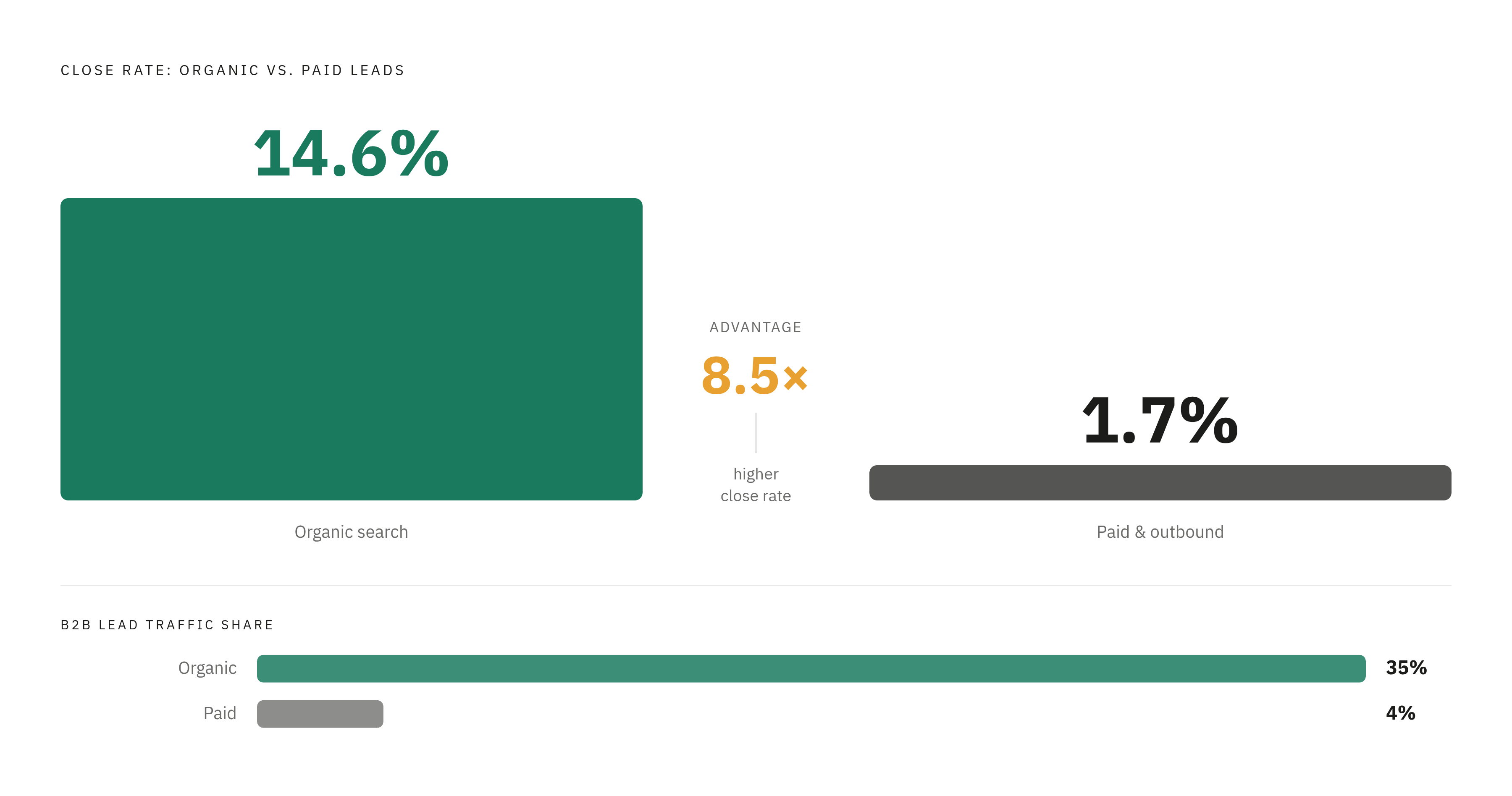
Organic and paid leads don't just cost differently, they close differently, and the gap is enormous. Per First Page Sage's B2B Content Marketing Benchmarks 2026, cited in Salesfully's analysis, organic search drives 35% of all B2B lead traffic against paid's 4%. And organic leads close at an average rate of 14.6%, compared to 1.7% for outbound and paid combined. That's an 8.5 times close-rate advantage sitting on organic's side of the ledger.
The reason isn't mysterious once you think about it. Someone who found a company through organic search went looking, read something, formed an opinion, all before a sales rep ever said a word. The conversation starts from a position of trust that a cold-clicked ad simply can't match. Paid, by design, optimizes for volume. It's built to get clicks, not conviction, so the buyer clicking through usually knows less and trusts less at that exact moment.
Buyer skepticism toward ad-flavored content runs deep, too. The Insight Collective's B2B Tech Buying Report found 44% of B2B buyers trust impartial third-party content over vendor-produced material, with a significant additional share agreeing strongly. Add those together and you're looking at a substantial majority of buyers who instinctively distrust anything that smells like a pitch.
There's a newer wrinkle here worth flagging: B2B buyers are increasingly using tools like ChatGPT somewhere in their purchase process, and the content pulled into those AI summaries tends to be the same authoritative, well-sourced material that already wins at organic search. The channel is shifting, the underlying advantage isn't.
Put together, this means content compounds into cheaper leads and more leads over time. It's leads that need less convincing, close faster, and require less sales effort per deal, which stacks on top of the raw cost advantage rather than replacing it. Case studies specifically carry a lot of that weight: per Growleads research, 62% of B2B decision-makers lean more heavily on practical proof like case studies than on other content types, and a large share of buyers go looking for relevant case studies somewhere during their purchase process.
The content quality threshold that now separates compounding returns from wasted production spend
Google's algorithm updates through 2024 and 2025 have made the bar for what actually ranks a lot less forgiving. Per Business Ignites' analysis, the updates reward real expertise, an original point of view, and demonstrable authority, and they punish thin, generic writing no matter how it got made, generated with automated help or otherwise. Adequate used to be enough. It isn't anymore.
The teams winning with content in 2026 are, counterintuitively, publishing less. Fewer pieces, each one sharper, more specific, more grounded in actual data, built for one defined audience instead of everyone in general.
Original research sits at the top of that pile for a reason: it can't be copied. Per salesfully.com's analysis, marketers who publish original research see 64% higher conversion rates and 61% stronger organic traffic than those who don't. A competitor can rewrite your blog post in an afternoon. They can't rerun your survey.
Search itself is also changing shape. AI-powered tools like Google's AI Overviews, ChatGPT, and Perplexity now surface answers directly instead of just links, and they pull from sources that read as genuinely authoritative. Content built to answer a specific buyer question head-on has a real shot at getting picked up there. Content stuffed with keywords for keyword's sake mostly doesn't.
None of this makes low-quality content free just because the writing itself was cheap. There's still the labor cost of producing it and the opportunity cost of the publishing slot it took up, the time and attention that could've gone toward something that actually ranks. Volume without a quality floor isn't an investment, it's a sunk cost with extra steps.
Customer evidence, case studies, testimonials, outcome stories, sidesteps most of this problem entirely. It is inherently original by nature (nobody else has this customer's results), it can't be faked by an AI model, and it answers the exact question a skeptical buyer is actually asking: does this thing work for someone like them. That makes it one of the safer content bets in an increasingly unforgiving landscape.
What a compounding content engine looks like in practice for a B2B team
A content engine that actually compounds isn't a content calendar with better intentions. It runs on four parts working together: collecting customer evidence, turning it into structured content, distributing and optimizing that content for search, and handing usable pieces of it to sales.
Start with the evidence, because it's usually just sitting there unused. Customer wins live in account manager notes, quarterly business reviews, and random Slack threads, forgotten the moment the meeting ends. Per SpotonMedia's 2026 guide, the fix is a regular check-in cadence built specifically to surface those outcomes and get permission to turn them into public stories.
That content needs to map to where a buyer actually is, not get created at random because someone had a slow Tuesday. A practical case study framework splits it cleanly: broad industry-use-case stories for the top of the funnel, specific product or solution stories once a buyer's further along. Then it all needs a home, a library sorted by vertical, product line, and use case, so a rep can pull the right proof for the right prospect without digging through six shared drives.
One good customer interview shouldn't produce one asset. Per Scopic Studios' framework, a single conversation can become a written case study, a short video clip, a blog post, a slide for the sales deck, and a quick social proof snippet, each one reaching a different buyer at a different moment. And each format has a job in the sales cycle. Per MarketScale, an industry-matched clip builds early credibility, a written case study earns its keep during evaluation, and a short outcome video knocks down hesitation right before the deal closes.
There's a repeatable loop underneath all of it, too. Find satisfied customers through surveys or NPS scores, get them engaged, turn their sentiment into a structured asset, then push that asset out through sales and reference channels. And proof doesn't have to be named to work: named customer stories carry more specificity and weight, but anonymous, verified testimonials still hold up fine in industries where customers won't go on record.
Specificity is what turns a nice story into a sales tool. SpotonMedia's guide points to a case study about a multi-hospital health system, QuicksortRx, that tracked $5 million in savings. A reader doesn't finish that thinking "nice story." They think "what would that be worth for us." That's the difference between content and an asset.
And skipping this work has a real cost, not a hypothetical one. Per research on B2B buying behavior shows a significant share of buyers have ruled out a vendor specifically because the proof they saw felt untrustworthy or thin. Not having a system for this actively works against you. It's actively losing deals somewhere right now.
When paid ads still belong in a B2B budget, and what role they should play
None of this means cutting paid spend to zero. Paid has two things content simply can't match: speed and precise targeting. A team launching in a new market, testing a new offer, or needing pipeline inside a tight window can get results from paid in weeks. Content on the same timeline gets nothing done.
Paid campaigns also double as market research, and that part gets underrated constantly. A well-run campaign tells you fast what messaging lands, which audience responds, and whether an offer has legs, feedback that sharpens every other channel, content included, before a team sinks months into writing something built on the wrong pitch.
That makes paid a legitimate bridge. Content takes 3 to 6 months to show real ROI and 6 to 9 to hit full stride, so running a modest paid budget to cover pipeline while that engine gets built is a sound strategic move. It's the sound move.
The mistake shows up when the bridge quietly becomes the destination. Paid-as-primary, indefinitely, is a treadmill: spend more each quarter for the same result, and the second the budget dries up, so does the pipeline. Nothing left behind, nothing to show for the years of spend.
Per Security Boulevard's 2026 Growth Marketing Channel Analysis, cited in Salesfully's research, the approach that actually works layers paid on top of content that's already proving itself organically, not paid instead of it. Once a piece of content is already pulling organic traffic and real engagement on its own, putting paid dollars behind that exact asset tends to outperform a cold paid campaign built from scratch, since the message and the audience are already validated.
The budget question, then, is how paid and content work together across time. It's how much of the mix sits in a channel that compounds without you, and how much sits in one that needs feeding every single month to stay alive.
Sources
- Content Marketing ROI Benchmarks for B2B SaaS (2026 Data)
- Customer Acquisition Cost Benchmarks — 44 Statistics Every Marketing Leader Should Know in 2026
- Is Your Marketing Budget Working Against You? Why B2B Content Beats Paid Ads in 2026 — And How to Build the Engine That Compounds
- Content Syndication vs Paid Ads in B2B SaaS: 2025 Benchmarks, Conversion Rates, and Cost Analysis - LeadSpot
- Content Marketing ROI Statistics (2026): 54+ Data Points on Returns, Channels, Formats, and Measurement
- Content Marketing vs Paid Ads: Which Acquisition Channel Has the Better Margin? | Business Ignite