Topic Cluster Architecture for B2B Lead Generation
Organize content in layers so each piece moves buyers closer to signing.

B2B buyers don't Google something once and buy. They circle a problem for weeks, sometimes months, reading a stack of overlapping content before anyone from sales hears their name. Topic cluster architecture works for lead generation not because it flatters a search algorithm, but because it copies the actual shape of that research process, and a well-built cluster can be built on purpose to move someone from "wait, what's the category here" to "send the contract."
That shift matters because the balance of power already moved. Buyers now finish most of the legwork before a rep ever gets on the phone. Some estimates put that figure as high as 70% of the journey done solo, in the dark, without a salesperson in the room. Add in that a large share of B2B buyers now run their early research through ChatGPT or a similar tool as part of their purchase journey, and you get buyers who show up already half-taught, asking sharp, specific questions instead of generic ones. A lot of marketing leaders will also tell you the journey doesn't even start on Google anymore. It starts in a private Slack channel, a LinkedIn DM, a niche forum where someone asks "has anyone actually used this thing." One blog post can't intercept a buyer moving through all of that. The content has to be laid out the way the research is laid out, in stages, with each stage doing a different job. The competition is the buyer's own inertia and existing habits. It's the buyer's own browser history, and if your content doesn't match the shape of that search, it just gets skipped.
What topic cluster architecture actually is and how its parts connect
A topic cluster has three moving pieces, a pillar page, a set of cluster posts, and the internal links that stitch them together.
The pillar page covers the core topic in real depth, and it's a destination in its own right, not a directory. It should carry a conversion offer (a demo, a download, something with a next step attached), target a keyword with actual search volume behind it, and keep outbound links to a minimum so attention doesn't leak off the page.
Cluster posts are the spokes. Each one targets a narrower, longer-tail version of the topic, goes deep on one specific angle, and links back to the pillar. That link pattern is doing real work: it tells a search engine which page is the authority and which pages are supporting cast. A typical cluster runs enough posts around one pillar to show real range on the topic without stretching so thin that nothing on the site ranks for anything.
Skip this structure and you get a common, avoidable mess: two or three pages on the same site quietly competing for the same keyword, canceling each other out instead of reinforcing one another. The cluster forces a division of labor. Every page has one job. And the internal linking does double duty here, signaling topical depth to search engines while also giving a human reader somewhere obvious to click next instead of bouncing back to Google.
Knowing the shape of the thing is step one. Where it actually pulls in leads is a separate question.
Where the lead generation lever sits inside the cluster
The pillar page is where conversion happens. The cluster posts are the qualification engine, the machinery that filters and warms up visitors before routing the right ones to that pillar.
The pillar page needs a real offer sitting on it, not a generic "contact us" form nobody fills out on purpose. A demo request, a download, an actual call booked, something with weight. The cluster posts build the trust and context that make that offer worth taking. Ironpaper has reported doubling organic search lead rates for B2B clients running this model, and the mechanism behind that comes down to relevance and structure. It's concentrated authority: a buyer knee-deep in one specific problem trusts the site that seems to have written the book on it, even if that site doesn't outrank a bigger competitor on ten other unrelated terms.
Content's slice of B2B lead sources grew noticeably through 2025, climbing from 28% in January to 38% by September, according to The Digital Bloom's 2025 report, which lines up with most B2B marketers already saying content is their top inbound channel. The cluster model is a familiar, well-established idea here. It's the structural, deliberate version of what a lot of teams are already doing halfway, on instinct, without a map.
Traffic without a conversion offer sitting at the center is just visitors passing through. It's just an audience. The pillar page's offer is the hinge the whole thing swings on.
Mapping cluster content to buyer journey stages so each piece does a specific job
A cluster is a deliberately structured hierarchy of related posts. It's a funnel, and each layer has a specific job to do.
Top-of-funnel posts catch people who don't know yet what category of solution they're even looking for. These are problem-aware, question-format pieces, built to intercept broad, high-volume search terms and educate first.
Middle-of-funnel posts are for people comparing options and building an internal case to their own boss. These target "how to choose," "X vs Y," "best for [specific use case]" type queries, the searches people run once they've accepted they have a problem and started shopping solutions.
Bottom-of-funnel posts, plus the pillar itself, are where buyers who don't need more education show up looking for confidence instead. This is where case studies with real numbers, plain documentation of what the product actually does, and proof-heavy content carry the weight. The guidance here is blunt: give buyers everything they need to build a case for choosing you internally, because at this stage the content isn't marketing anymore, it's doing sales' job for them.
Map the cluster to actual buyer questions at each stage before writing a single post. Do that mapping honestly and it'll show you gaps, whole funnel stages nobody's covered, as clearly as it shows opportunity. For early-stage teams especially, build the middle and bottom of the funnel first. Those posts support live sales conversations and speed up closes. Top-of-funnel content compounds, but it compounds slowly, and it won't close a single deal by itself next quarter.
The framework tells you what to build. Proof is what makes the bottom of it actually convert.
Why the decision-stage layer of the cluster lives or dies on verifiable proof
A large share of B2B buyers, 67% according to UserEvidence's 2025 Evidence Gap report, say they've ruled out a vendor specifically because the evidence on offer felt untrustworthy. That's a hard conversion drop. That's active disqualification, a buyer crossing a name off the list.
Nobody at the decision stage wants more education. They want proof the problem's been solved before, for someone who looks like them. Case studies are, by a wide margin, the most-requested proof format at this stage, Peerbound found they make up the bulk of all proof requests sales makes to marketing, which means they belong in the cluster's foundation, not tacked on as an afterthought blog post nobody links to. The ones that land hardest are specific: what the problem was, what the buyer decided, what the work involved, and a real number at the end, something like a 40% jump in project efficiency within six months, not a vague "great experience working with the team" quote.
Sales reps already know this. Peerbound found two-thirds of all proof requests sales makes to marketing are for case studies, customer stories, or comparable company lists. That content is already being pulled into live deals. The cluster's job is to make it easy to find and easy to hand off.
On distribution: keeping case studies ungated tends to widen reach, and a partial gate (a visible summary, a full PDF behind a form) is worth testing if lead capture matters more than raw reach. And for regulated industries where naming a customer outright isn't an option, a blind-but-verified approach, where a third party confirms the customer's identity without publishing it, still earns a surprising amount of trust: 60% versus 64% for fully named proof, per the same 2025 Evidence Gap report. That's a much smaller gap than most marketers assume going in.
The FTC's August 2024 rule on AI-generated and fake reviews (effective October 21, 2024) carries penalties up to $51,744 per incident. Authenticity in this layer now functions as a ranking signal as much as a trust question. It's a compliance one, and the cluster's proof layer needs to run on real, unedited customer voice, full stop.
Tracking cluster performance as pipeline contribution, not traffic volume
Traffic numbers, impressions, social shares, all of that is a leading indicator, not a result. A cluster that can't show its fingerprints on qualified leads and real opportunities is a cluster that eventually loses its budget line.
A useful gut check: if marketing's share of total pipeline looks thin, something structural needs fixing, and content architecture is usually part of that fix. The scale of the problem gets sharper when you look at win rates. The Ebsta and Pavilion 2025 GTM Benchmarks report, built on 655,000 opportunities and $48 billion in pipeline, put average B2B win rates at 19%. Run the math on that and it means over 5x pipeline coverage just to hit quota. A cluster pumping out volume with no qualification behind it doesn't ease that pressure. It makes it worse, because now sales is chasing more unqualified noise.
Real attribution looks like tracking which cluster posts a contact reads before turning into an MQL, then figuring out which posts show up most often in the paths of deals that actually closed. Use that to decide what gets written next. Build what converts, not what's fastest to knock out on a Tuesday afternoon.
HubSpot's 2026 State of Marketing report named website and blog content tied with SEO as the top ROI-driving channel for B2B brands in 2025. But that ROI only shows up if the tracking's in place from day one, not bolted on after the fact once someone in finance asks for proof. Webinar signups can serve as a useful mid-funnel checkpoint that stretches the cluster's reach past straight form fills.
Attribution turns a stack of blog posts into a business asset leadership can actually defend in a budget meeting. But none of this pays off overnight, and most teams badly underestimate the runway.
How long organic cluster growth actually takes and what the trajectory looks like
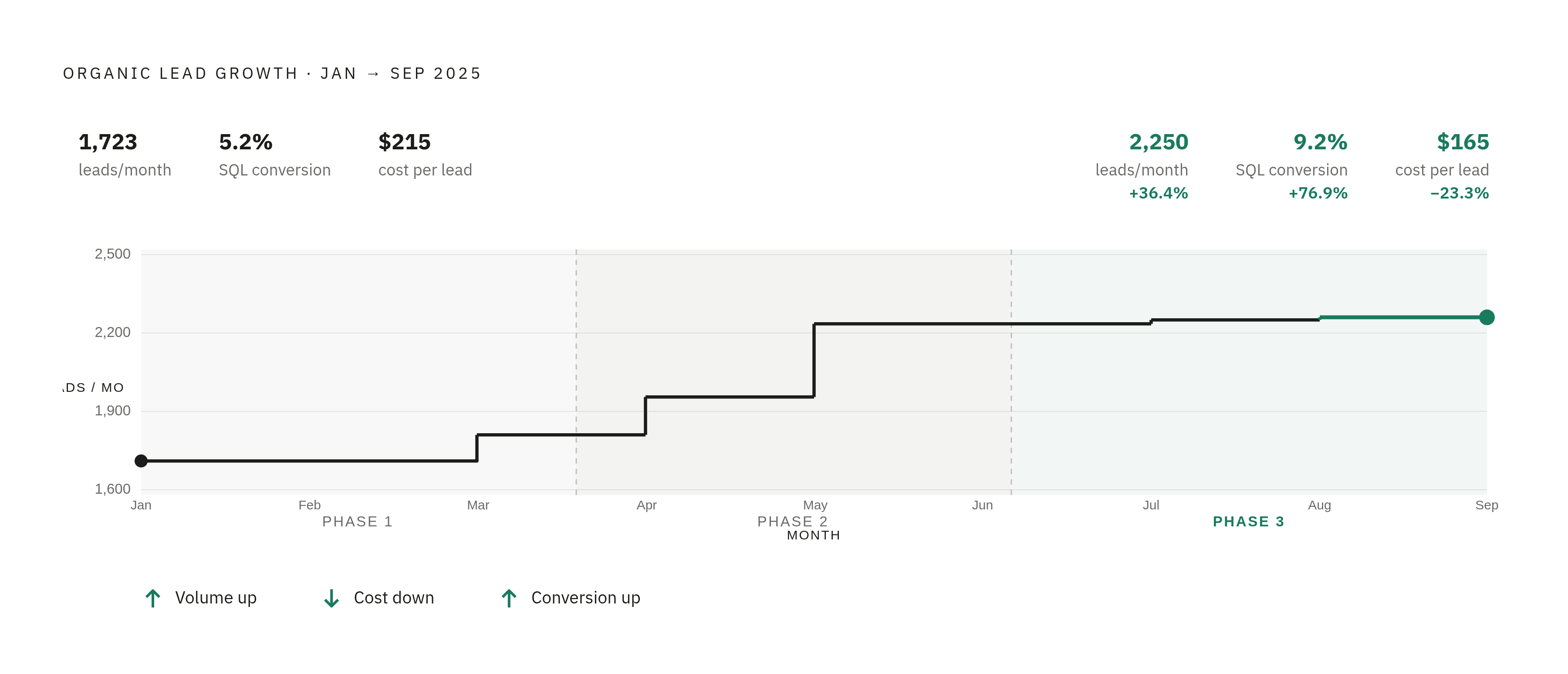
The Digital Bloom's 2025 B2B Organic Lead Growth report tracked this across three distinct phases from January through September, and the shape of it is worth knowing before anyone sets expectations with leadership.
Phase one, Q1 2025, looked unremarkable. January started at 1,650 leads, a 5.2% SQL conversion rate, and $215 cost per lead. Average monthly leads across the quarter were 1,723, with month-over-month growth around 4.7%. February gave the first hint of life, with SQL conversion nudging up to 5.5%. Channel mix that January still leaned heavily on paid: content marketing at 28%, LinkedIn at 22%, organic search 18%, email 15%, paid ads 12%, events and webinars the remaining 5%. The lesson from this phase is simple and a little uncomfortable: early cluster performance looks flat, even boring, and a lot of teams quit right here, mistaking a slow start for a dead end.
Phase two, Q2, is where the curve bends. Average monthly leads climbed to 2,017, a 17.0% jump over Q1. Content's share of lead sources rose to 36% by June, and paid ads' share of the channel mix shrank as organic sources grew. The real signal shows up over time, as organic authority builds, the mix tilts hard toward content and away from paid, and cost per lead drops while quality climbs at the same time, not one at the expense of the other.
Phase three, Q3, is where it compounds for real. September closed at 2,250 leads, a 36.4% jump from January's starting point. SQL conversion rose 76.9% over that same window (5.2% up to 9.2%), while cost per lead dropped 23.3% (from $215 down to $165). Volume, quality, and efficiency all moved in the same direction at once. That's the whole argument for cluster architecture over paid acquisition in one sentence: paid buys you volume and gives none of it back once the budget's off. A cluster keeps paying rent long after the writing's done.
Set the runway at 6 to 9 months before that compounding shows up, and set expectations with leadership at the outset, not halfway through Q2 when someone's asking why the graph still looks flat.
How to sequence a topic cluster build when resources are limited
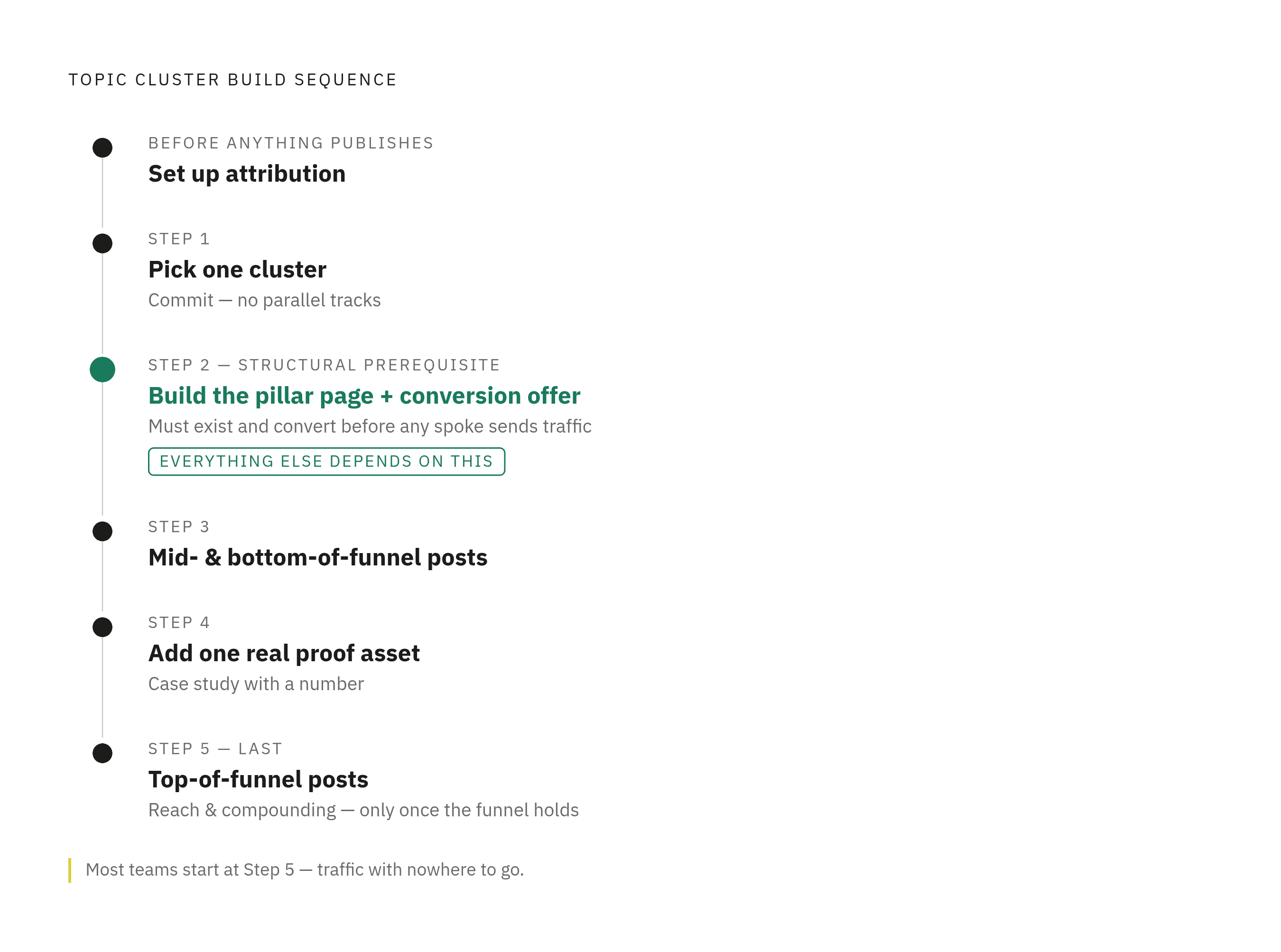
Most teams build the easiest content first, which means top-of-funnel posts, because they're quick to write and don't require touching a customer for a quote. That's exactly backwards. Top-of-funnel is also the slowest thing in the cluster to convert. Start at the bottom and build outward instead.
Step 1: Pick one cluster. Not three, not "a few, see what sticks." Authority builds faster on one narrow topic covered well than on five topics covered thinly.
Step 2: Build the pillar page, with its actual conversion offer, before writing a single cluster post. The hub has to exist and already convert before any spoke sends traffic its way.
Step 3: Write the middle and bottom-of-funnel posts first. These are the ones that show up in the paths of deals that actually close, and the ones sales can use in a live conversation next week.
Step 4: Get at least one real proof asset into the cluster, a case study or a customer outcome post with a number attached. This is the piece that earns trust right when a buyer's closest to deciding.
Step 5: Only now add the top-of-funnel posts, for reach and long-term compounding volume. These take the longest to rank and the longest to pay off, so they go last, not first.
Step 6: Set up attribution before anything publishes. Track which posts show up in MQL paths and won-deal paths starting week one, not six months later when someone finally asks "did any of this work."
As the cluster matures, organizations that automate lead qualification based on how prospects engage with topic content report gains of 30 to 50% in sales development efficiency. Engagement on cluster content stops being a vanity metric at that point and starts acting as a real qualification signal.
For a lot of early-stage teams, the honest constraint isn't the strategy, it's the output. Turning out 8 to 10 well-built cluster posts per pillar takes sustained, consistent writing, and a generalist who's good at one piece of this (say, SEO, but not sales context, or vice versa) usually underperforms a specialist who can hold both at once. The cluster is never really finished, either. New questions keep showing up from buyers, competitors start publishing into the same space, and case studies go stale as the numbers in them age out. Treat it as an engine that needs fuel on a schedule, not a project with a finish line.