Content Repurposing Systems for Lean B2B Teams
Plan your pillar asset before you record, not after you need filler content.

Content repurposing fails for most lean B2B teams because they design it after the fact instead of before. The pattern is depressingly common: a calendar gap opens up, someone panics, and an old blog post gets chopped into a LinkedIn update an hour before it's due. That's recycling under deadline. It is not a system, and it doesn't compound the way one would.
The difference matters more than it sounds. Recycling produces diminishing returns because it's reactive, patched together, no plan behind it. A real repurposing system multiplies one asset into a quarter's worth of content, and it does that because the decisions get made before anyone hits record, not after the post already went live. A 45-minute webinar watched live by 200 people can reach 10,000 once it's broken into platform-native clips. The content spend already happened. The multiplier lives entirely in the system wrapped around it.
What qualifies as a pillar asset worth building a system around
Not everything long-form deserves to be called a pillar. A 600-word blog post gives you one quote and then, honestly, nothing else. It's tapped out before you've started.
A real pillar asset can be split into pieces that each stand on their own. Recorded interviews and podcasts qualify easily. A 40-minute conversation usually holds eight to ten separate arguments, and each one is a seed for something else. Original research reports work the same way: every data point, every chart, every finding can be pulled out and atomized on its own. Webinars belong here too, and for a specific reason beyond the content itself. Webinars convert 20 to 40% of registrants into MQLs, which makes the source asset valuable twice over, once for the education and once for the conversions it generates directly. Detailed teardowns, long-form guides, and in-depth case studies round out the list.
Before recording or writing anything, ask one question: what are the five things someone could walk away with, each one complete on its own? Cognism's framework makes this explicit. Pick one high-value asset with a clear point of view and original data behind it, then lock a single source-of-truth document covering every claim, every stat, every visual, every citation, and every approval needed.
Case studies deserve a spot on this list, and not as an afterthought. They're among the top three most-used B2B content formats. Per Sopro, 75% of B2B marketers use them. A single strong customer story can turn into clips, quotes, slides, emails, and sales enablement material, all at once, all from one interview.
Planning the pillar means planning everything downstream of it. That's the part people skip. The system gets designed at this stage, not after the post is already published and someone's scrambling to find something worth reusing.
The PADR loop: the four-step operating system that turns one asset into a quarter of content
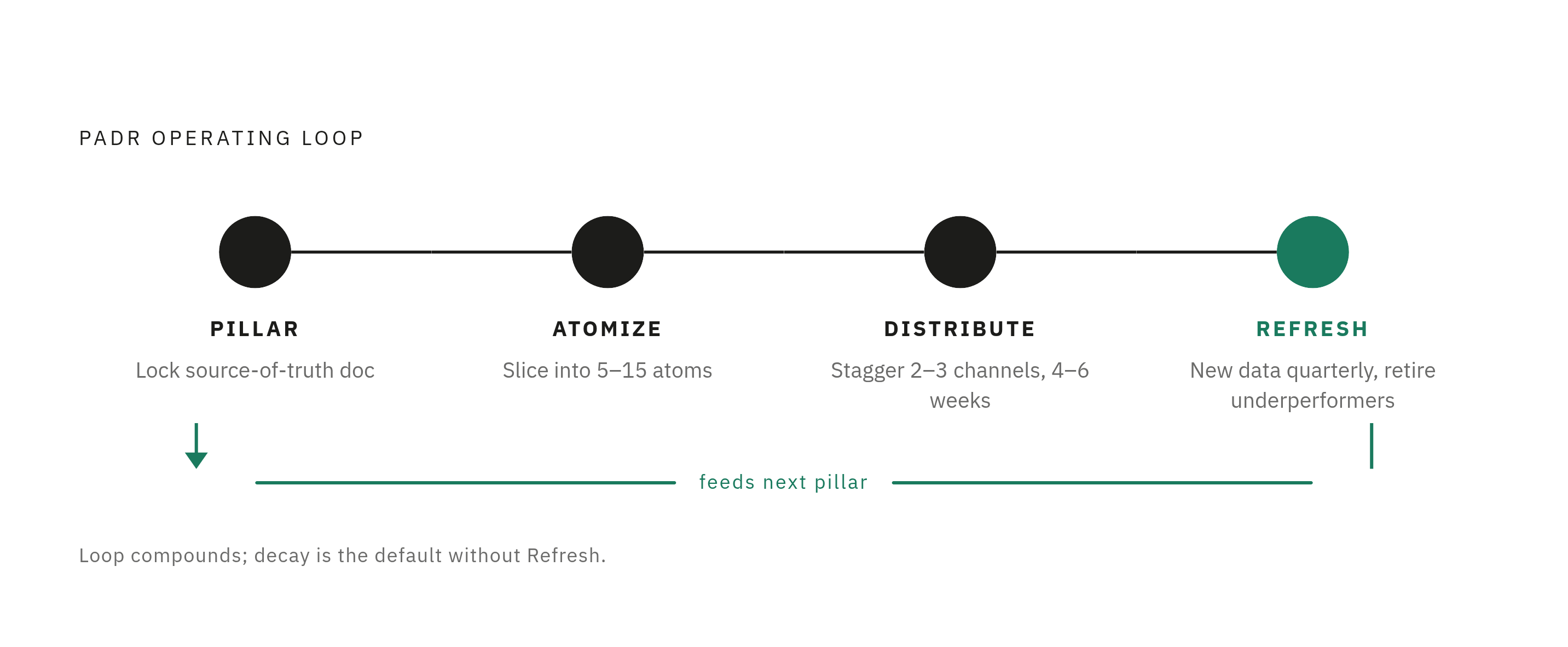
PADR stands for Pillar, Atomize, Distribute, Refresh. It's Cognism's framework, currently in use, not a whiteboard theory.
Pillar comes first: lock the source-of-truth document. Approved claims, stats, visuals, citations, sign-offs from whoever needs to sign off. Define the ideal customer profile, the core pain point, the promise being made, and the three narratives that will repeat across every derivative that follows. Before atomizing anything, clear it with the stakeholder checklist: subject matter expert, legal or compliance, brand, and SEO. All four, before step two begins.
Atomize means slicing the pillar into five to fifteen distinct pieces, referred to as atoms. Key charts, quotes, insights, mini how-tos, each one mapped to one or two priority formats: a carousel, a blog section, an email, a short video. Write the one-sentence takeaway for each atom before anything else. That sentence becomes the hook for whatever format it turns into. An "atom card" (takeaway, asset link, CTA, owner, due date) keeps this from turning into chaos.
Distribute is where discipline beats enthusiasm. Pick two or three channels where the audience already spends time, LinkedIn, a newsletter, a sales enablement library, and stagger releases over four to six weeks. Every CTA threads back to the pillar or a softly-gated version of it. UTM standards and a naming convention, set on day one, keep reporting clean later. A weekly "repurpose hour" blocked on the calendar keeps the queue moving without anyone needing to be a hero about it.
Refresh closes the loop. Add new data or quotes quarterly, merge thin derivative pages, retire whatever's underperforming. Re-cut the best atoms into evergreen guides or comparisons. Surface the updated date and reviewer name, both signal freshness for search. A refresh tracker (Last Reviewed, Next Review, Owner, Impact) stops the whole system from quietly rotting.
Cognism's own measurement standard skips vanity numbers entirely: assisted pipeline, influenced opportunities, channel lift. Views and impressions don't make the cut.
How the video-to-text and atomization strategies work in practice
Video-to-text repurposing pays off fastest when the pillar is a recorded interview, webinar, or podcast. The process runs in four steps, and skipping any one of them shows.
Transcribe first, using an AI tool for speed. For technical B2B subject matter, human-assisted transcription catches industry terms the automated tools tend to mangle. Then edit aggressively: cut filler words, restructure for readability, add subheadings and pull quotes. The transcript is raw material. It is not a draft, and publishing it as one is an instant tell that no editing happened.
Reframe the piece as a standalone article, with its own intro, its own conclusion, its own logic. Nobody wants to read a transcript formatted with paragraph breaks and told it's a blog post. Then enhance it: screenshots, embedded clips, infographics, and keywords chosen for organic discovery. Cognism's own example is instructive here. When the team repurposed a blog post on the B2B sales process into a YouTube video, they didn't read the post to camera. They rewrote the script to make it more conversational, more fun, built for the format instead of just recited into it.
The atomization side works on a similar principle, just at higher volume. Each atom gets optimized for one channel and one attention span: a LinkedIn carousel, a 60-second clip, an email teaser, a pull-quote for a sales one-pager. The goal isn't a single push announcing the webinar happened. It's a sustained drip of small, sharp insights, each one pointing back at the pillar. A single webinar can throw off ten or more distinct social assets this way, each one native to wherever it's landing.
Format matters more than volume here. Cognism's YouTube example makes the point cleanly: the channel decides the shape, the argument underneath stays exactly the same. Case studies follow their own atomization path, particularly useful for sales teams. A written case study can become a short outcome video, a pull-quote graphic, a slide for a deck, and an email snippet matched to a specific industry, each one aimed at a different deal stage and a different persona instead of blasted out generically.
Ownership and workflow: the operational decisions that determine whether the system runs or stalls
Here's where most lean teams quietly fall apart. The workflow looks great on a slide. Then nobody owns any single stage of it, and it dies somewhere between the transcript and the LinkedIn post.
Cognism's framework doesn't leave this ambiguous: assign a named person to each stage of PADR. Not a team, not "marketing," an actual human being who's accountable if the atom card sits untouched for two weeks. For a team of one or two, the atom card itself (owner, due date, CTA, asset link) makes that accountability visible instead of assumed.
The next decision is whether to build this in-house or send pieces of it out. Most in-house teams don't have spare capacity sitting around for video clipping, captioning, and platform-specific formatting, so the question becomes which constraint actually needs solving.
A few managed services solve different pieces of this puzzle. Dasho takes one long-form video and turns it into 10 short-form clips, captioned and platform-formatted, checked against a Brand Card before delivery, for $350 per set with a 5-business-day turnaround. It's built for teams (or agencies managing multiple client brands) where brand governance actually matters. Repurpose.io handles format conversion and cross-platform posting as a workflow tool your team runs directly, with no editorial review layer built in. Lately.ai uses AI to pull social copy candidates out of long-form written content, blog posts, reports, transcripts, and its sense of brand voice is shaped by the training content fed into it. Castmagic converts podcast or audio content into show notes, blog posts, LinkedIn posts, and email newsletters, a good fit for any team running a regular audio program. Vidyo.ai finds engaging moments in long-form video and auto-generates captioned clips fast and cheap, though there's no governance layer and output quality shifts depending on the source footage.
If brand governance is the constraint keeping someone up at night, pay for the service with a governance layer built in. Revision rounds on client work cost more than whatever the cheaper tool would have saved. If budget is the real constraint and the team can absorb some editing themselves, automation tools bring the cost per output down considerably.
For teams keeping generation in-house, a few tools show up again and again. Tofu is an all-in-one AI marketing platform built to generate on-brand content across email, web, blog, social, and decks, with an "AI brain" that learns voice and repurposes across formats, probably the strongest option for teams trying to scale across channels while staying consistent. Jasper offers templates for blogs, ads, and emails with brand voice settings, though planning and distribution stay entirely manual. Copy.ai automates the blog-to-social-snippet pipeline in one pass, fast, but the output needs editing and the integrations are limited. ChatGPT is the free or cheap starting point with no built-in marketing memory, so consistency depends entirely on how disciplined the prompts are.
When evaluating any of these, the same criteria apply across the board: what content types it supports, how personalized the output actually is, how well it automates the repurposing itself, how easy it is to use, and whether it scales with a team instead of just one person's laptop. Lock the workflow first. Choose tools that fit the stages already decided on, not the other way around.
Where customer stories fit in the repurposing system and why they earn priority pillar status
Case studies rank among the most effective B2B content formats. Eighty percent of B2B buyers use them during research, and 42% say they're valuable at both the middle and late stages of a buying decision. That's a wider window than almost any other format gets.
They do something unusual: build credibility early and accelerate deals late, at the same time, from the same asset. Worth remembering that the average B2B buying group now runs 8.2 stakeholders deep, so a case study sitting as a single PDF is badly under-leveraged. It could reach each one of those stakeholders in the format they actually prefer to consume, instead of hoping everyone reads the same document.
A case study worth atomizing has three things: clear metrics, a named customer (with permission secured), and a story that makes the client the hero, not a list of features dressed up as a narrative. QuicksortRx is a useful reference point here, a case study built around a multi-hospital health system that achieved $5 million in tracked savings. That number alone earns a spot in a deck, a video clip, a one-liner, and a battle card, simultaneously, without needing embellishment.
The bottleneck is real, though. A traditional written case study takes six to twelve weeks once customer review, legal sign-off, and quote approval all get factored in. That timeline is exactly why systematic collection and a repeatable production framework aren't optional for a lean team, they're the only way the math works. Spendgo is the clearest illustration of what happens when this gets fixed. Years of strong customer relationships sat invisible until they got systematized using a Challenge, Solution, Impact framework and made repeatable. Spendgo was later acquired by Olo in December 2025.
The atomization path for a case study runs in a specific sequence: written case study, then a 90-second outcome video for late-stage hesitation, a pull-quote graphic for LinkedIn, an industry-matched email snippet for early outreach, a slide for the sales deck, and a battle card one-liner. Per Taggbox's 2025 data, 84% of B2B buyers report higher trust in brands that feature real customer voices, which is exactly why the video derivative is worth the extra production effort. Sales reps then deploy each piece by persona and deal stage: the industry-matched clip early, the written study during evaluation, the outcome video when a deal is stalling near the finish line.
Gong.io's case study built around PitchBook gets cited often for exactly this reason: clear narrative and quantifiable impact that make the asset easy to deploy across a sales cycle. And gating these assets behind a form cuts their reach for no good reason. Keep case studies publicly accessible so they surface in organic search and in AI-powered search interfaces, both of which are increasingly where buyers actually look first.
Connecting repurposed content to pipeline, not just reach
Repurposed content that feeds owned channels consistently tends to compound over time, which is why connecting output to pipeline metrics matters more than chasing reach. The content itself works. What breaks down, more often, is the conversion architecture sitting underneath it.
Traffic, impressions, and social shares are leading indicators. They are not pipeline metrics, and a content program that can't point to qualified leads, opportunities, or revenue stays permanently exposed to the next budget cut, no matter how good the engagement numbers look on a slide.
The win-rate picture makes this urgent rather than theoretical. The Ebsta x Pavilion 2025 GTM Benchmarks report, built on 655,000 opportunities and $48 billion in pipeline, recorded average B2B win rates falling to 19%, down from 29% the year before. At a 19% win rate, teams need substantial pipeline coverage just to hit quota with any reliability. That's the number that turns deal-accelerating content, the atomized case study, the battle card, the outcome video, from a nice-to-have into something closer to structural necessity. MQL-generating content fills the funnel. Deal-accelerating content is what gets deals through it.