Social Proof Distribution by Deal Stage in B2B Sales
Customize proof assets to each buyer's stage, not the deal.
B2B buying is self-directed now, and the shortlist gets built before a sales rep ever says hello. By the time anyone picks up the phone, the buyer has already formed opinions through peer conversations, professional platforms, and AI-mediated research. Highspot's 2026 analysis of B2B sales states that today's buyers arrive informed and opinionated, and by the time a seller enters the conversation, much of the story has already taken shape. That's a quiet way of saying the sales rep used to be the narrator of the deal, and now they're walking in mid-chapter. Proof assets, the case studies, reviews, and testimonials scattered across the internet, are doing the selling long before anyone books a meeting, so sequencing and format are the whole game, not details to sort out later.
The case study sent at every stage that kills deals instead of closing them
Firing off the same case study to every prospect regardless of where they sit in the buying process doesn't just fail to help. It actively signals that nobody's paying attention. Fifty-three percent of sellers report their sales process got slowed down or hurt by a lack of relevant, specific customer evidence. That's more than half the sales force working with ammunition that doesn't fit the gun.
Picture a buyer in early awareness, someone who hasn't even fully named their problem yet, getting handed a detailed ROI case study. They don't feel informed. They feel like a dish sold cold at a drive-through. Trust erodes before it has a chance to form. Now flip it: a buyer deep into evaluation, trying to defend a purchase to a committee, gets handed a logo wall and a vague testimonial. There's nothing there to defend with. The champion is sent into battle with a rubber sword.
A structural detail makes the problem harder than it looks: buying committees aren't one person moving through one stage, but several people moving through several stages at once, often in the same week. A finance stakeholder might be in full evaluation mode while the technical reviewer just found out the product exists. One case study, sent once, cannot possibly serve both. The fix isn't piling on more assets; it's mapping the assets that already exist to the specific question each buyer is asking at that specific moment, something the rest of this piece walks through stage by stage.
How awareness-stage proof earns a shortlist spot before the first meeting
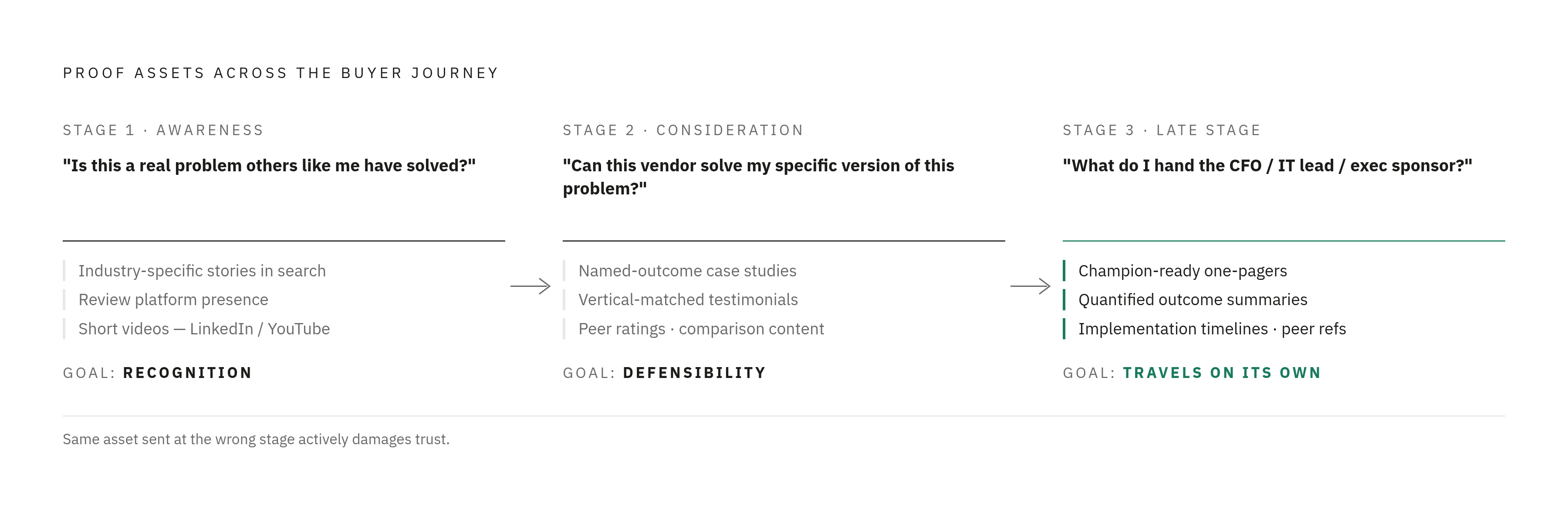
At the awareness stage, the buyer's question is simple: is this a real problem other companies like mine have actually solved? Proof that answers that question earns a spot on the shortlist. Proof that tries to answer "why our product specifically" gets ignored, because nobody's asked that yet.
It's targeted, searchable proof sitting exactly where a buyer goes looking for it, not a brand awareness campaign with a bigger budget. Industry-specific customer stories that surface in search results, peer validation sitting on review platforms, short videos showing a recognizable problem getting solved: these are the formats that do the job at this stage. Tremendous's 2026 B2B social media strategy guide describes the goal cleanly: build category authority and become memorable for when the buyer finally has the problem in front of them. Selling too hard, too early, collapses the very trust the proof is supposed to build. It's the business equivalent of proposing marriage on a first date. Technically you said the thing, but nobody's saying yes.
Tremendous also maps out where this proof needs to live in 2026. LinkedIn is where buyers compare notes and validate shortlists, largely through the personal brands and voices of executives and employees. YouTube works like a search engine for anyone researching product demos or customer interviews. Reddit has become a significant source for AI citations and buyer validation, and a brand with no presence in the relevant communities is simply invisible to a growing share of generative search results. That's three very different rooms, and the proof has to be tailored to fit the norms of each one.
Specificity still matters here, just not in the way it will later. The buyer doesn't need the exact metric yet. They need to recognize their own industry, their own company size, their own headache, in the story being told. Recognition is the job. Once that shortlist spot is earned and the buyer moves into active evaluation, the proof's job changes from being memorable to being defensible.
Proof that moves buyers through the consideration phase
Consideration is where the shortlist gets stress-tested. The buyer's question shifts from "is this a real problem" to something sharper: can this vendor solve the buyer's specific version of this problem, and can the buyer actually trust what they're claiming? A generic testimonial can't answer that. A detailed, vertically matched, outcome-specific case study can.
The formats that carry weight here get more detailed by design: case studies with named outcomes, peer ratings on review platforms, direct comparison content, and video testimonials from customers in similar roles or industries.
By this stage, several stakeholders are evaluating the same deal for completely different reasons, at the same time. A practitioner wants to know the product fits their actual use case. A manager wants evidence that other teams adopted it without a revolt. A finance stakeholder wants the cost justified in numbers they can defend upward. One generic case study cannot serve all three audiences, because they're not even asking the same question. Highspot's analysis makes the point directly: winning sellers adapt as decision-making expands across the committee, and a static proof library that can't be filtered or surfaced on demand leaves reps stuck fumbling for the right story while a stakeholder waits on the line. Once the committee is sold, though, the job isn't finished. The next stage is about arming the champion to convince everyone else.
The late-stage proof job: arming the champion to sell internally
At late stage, the person reading the case study often isn't the person who needs convincing. The champion is usually already sold. The real audience is everyone the champion still has to win over internally, many of whom have never spoken to a sales rep or opened a single piece of vendor content. The champion's question at this point is practical and a little stressful: what does the champion actually hand to the CFO, the IT lead, or the executive sponsor to get this across the finish line?
That proof has to work without a rep standing next to it to explain anything. Highspot's 2026 analysis captures the stakes precisely: great B2B sales execution requires precise communication that connects solution value to business impact across longer sales cycles and complex, multi-stakeholder deal environments. The champion needs something that travels on its own, like a care package sent into enemy territory.
Specificity is the whole ballgame at this point. A customer calling a product "transformative" hands a CFO nothing to evaluate, it's a compliment, not evidence. A customer explaining that the product replaced two other tools, cut a specific operational cost, or delivered a measurable result gives that same CFO something to actually hold onto in a budget meeting. The formats built for this job include champion-ready one-pagers, named case studies with quantified outcomes, implementation timelines, security and compliance documentation, and peer references who can speak to a comparable business situation. For companies whose customers won't go on the record by name, blind-but-verified testimonials still carry most of that trust, close to what a named reference delivers, which makes them a legitimate late-stage asset when a named one isn't available.
Two things quietly sink deals at this stage. One is age: a case study that's clearly a few years old raises the question of whether the results still hold up, or whether the customer relationship has gone quiet since. The other is contradiction: if the one-pager the champion shares says something different from what the website claims or what the rep said on the call, the deal can unravel in the final committee review over a detail nobody even meant to get wrong. Proof has to stay consistent across every surface it appears on, or it turns into a liability.
Why proof libraries fail at the moment of use
Plenty of sales teams have proof libraries stacked with case studies, testimonials, and decks. Most of them still lose deals to the same three failures: the right asset can't be found, it's too old to be believable, or it's too generic to match what this particular buyer needs right now.
Findability breaks first. Under deal pressure, reps grab whatever they can find fast, which is rarely the most relevant thing available, because most proof libraries are built like an archive instead of a toolkit a rep can use mid-call. Highspot's analysis names the structural fix directly: scaling B2B sales strategies requires marketing, enablement, RevOps, and sales working from the same facts, with timely prompts that help reps respond to what the buyer just said. A folder with forty PDFs sorted by publish date does none of that.
Freshness breaks next. A library where the newest story is pushing a year old, and where a large share of the content hasn't been updated in longer than that, quietly tells a skeptical buyer one of two things: either the results stopped, or the relationship did. Neither reads well in a final committee review.
Specificity breaks third. Marketing teams often build proof libraries for their own purposes, one polished flagship story per segment, which works fine for a website but falls apart the moment a rep needs the story that matches this buyer's exact industry, company size, and use case. That gap between what's on file and what the moment actually calls for is where deals quietly stall out.
Format is the last failure, and it's the most avoidable. A rep who needs a 90-second proof point to drop into a Slack thread with a champion has no use for a six-page PDF, no matter how good the content inside it is. Strong proof trapped in the wrong format is proof nobody will ever open. None of this gets fixed by producing more content. It gets fixed by building a system that puts the right asset in front of the right rep at the right moment.
Building a proof distribution system that matches the right asset to the right moment
A proof distribution system that actually shortens deal cycles needs three parts working together: a production engine that captures outcomes right at the source, a library built for sales retrieval instead of marketing display, and a deal-stage map that tells reps exactly which asset to pull and when. Skip any one of the three and the other two end up compensating for it badly.
Production comes first, chronologically and in importance. The best moment to collect a case study is shortly after a measurable win, while the details are sharp and the customer is still genuinely excited about it. Wait six months and both the specifics and the enthusiasm start to fade, the way a good story gets flatter every time it's retold secondhand. Story collection belongs inside the customer success journey as a standard milestone, not a scramble marketing starts when a deck runs dry. One well-run customer interview can be cut into a written case study, a handful of short video clips, standalone quotable proof points, and social content, all from a single conversation. Produce once, cut many: it's how a library stays current without needing a bigger team behind it.
The library itself needs to be organized around how a rep actually works, not how a marketing team likes to present things. That means sorting by industry, company size, use case, deal stage, and format, not by publish date or product line. Companies doing this well lean on multi-dimensional filtering. Slack filters its proof by industry, department, business size, and region. Gong filters by use case, industry, company size, and region. That structure makes a specific piece of proof findable in the middle of a live deal. If an asset can't be pulled up in under two minutes while a rep is mid-conversation, it won't get used, full stop. That makes the library's design a sales enablement decision, not a piece of marketing housekeeping to get around to eventually.
The stage map turns a well-organized library into something reps can act on without guessing. At awareness, the job is surfacing industry-matched stories through search and review platforms, where the goal is recognition. At consideration, the job is deploying detailed case studies, video testimonials, and segment-filtered reviews that hold up under scrutiny from multiple stakeholders at once. At late stage, the job is handing over champion-ready one-pagers, named outcome summaries, and verifiable peer references built to survive a CFO's skepticism without a rep in the room to defend them. Highspot's 2026 framework backs this up in practice: reps who can pull tailored resources and evidence of value at each decision stage keep complex evaluations moving toward a decision, closing the information gaps that stall momentum.
None of this needs to start big. Teams building this from nothing are better off starting with four well-structured, stage-mapped assets than with a sprawling library of generic ones nobody can match to a real buyer. Depth and retrievability beat volume every time. Building the system this way doesn't just close individual deals faster. Every new customer win adds another data point to an evidence base that keeps compounding, which is the real argument for treating proof distribution as infrastructure rather than a one-off project somebody owns until they get reassigned.