Proof Gaps That Stall B2B Deals in Regulated Industries
Committees reject deals lacking documented proof that reviewers can inspect and defend.
Regulated B2B deals stall when proof of good results goes no further than the sales conversation. The product may have won over the champion, but the committee still needs evidence it can inspect, share, and defend. Closing that proof gap takes more than a persuasive case study. It takes a system that puts documented, relevant results in front of each reviewer when the decision depends on them.
Why regulated B2B deals stall at the committee stage, not the product stage
The champion believed, the demo went well, and then the deal went quiet. The seller has answered the product questions, but the champion now faces a different job. They must win approval from the CFO, VP of Operations, legal, and procurement, including people who never attended the demo. Those reviewers need something sturdier than an enthusiastic recap.
Forrester’s December 2024 State of Business Buying puts the typical B2B purchasing committee at 13 people, with 89% of purchases involving two or more departments. That makes the internal sale a substantial part of the buying process. In regulated industries, compliance, legal, and security add scrutiny because finding risk is their job. Even a product demo that wins people over cannot answer every question those teams have to ask.
The champion also has personal credibility on the line. Without shareable proof, they must either delay the internal discussion or defend claims they cannot substantiate. Neither choice helps the deal move. The champion needs evidence that can do useful work in a meeting the seller will never attend.
What makes regulated industries a harder proving ground than standard B2B
Regulated buying is evidence-gated because approval requires more than agreement that a product would be useful. Demand for GRC, RegTech, identity/KYC, and data-privacy software can rise while procurement remains slow. AI regulation, DORA, and record GDPR enforcement cycles make the need more pressing without making reviewers less skeptical.
Captain Compliance describes a concrete version of this problem in privacy documentation. A champion who is keen to buy gets questions from legal or security about data handling, certifications, sub-processors, and AI training policies. Without prepared answers, the deal sits while the seller assembles them. A competitor with documentation ready has less explaining to do and fewer reasons to wait. The paperwork has become a sales variable, however little glamour that adds to the launch presentation.
The same mechanism applies to proof of results. A generic case study or verbal reference may suggest that a vendor is credible, but it does not give a cautious reviewer an organized answer to a specific concern. Gartner research finds that B2B buyers spend only a small fraction of their decision time in direct supplier contact. Evidence therefore has to support evaluation without a seller narrating it. The trust center shows how this can work, with documentation the committee can trust ready before it has to ask for it.
The proof gap: the distance between results delivered and results documented
The proof gap is the distance between results delivered and results documented in a format buyers can use. A seller can have satisfied customers and still have very little evidence available to a buying committee. The results remain trapped in conversations, relationships, and scattered recollections. For the business, that is a warehouse full of stock with no loading door.
Referrals can hide the gap for a long time. A trusted introduction supplies credibility that the seller has not had to put on paper. When growth requires reaching buyers outside that network, the substitute disappears. UserEvidence’s 2025 Evidence Gap report, drawn from a survey of 811 B2B software professionals, finds that a lack of relevant, specific customer evidence slows or negatively affects sellers’ sales processes. Buyers want proof from similar customers, including the same industry, company size, use case, and role.
That need often sounds like a routine sales objection. Requests for examples from the buyer’s industry or for ROI achieved by other clients are requests for material the champion can carry into the committee. A verbal anecdote may answer the question in the moment without giving the champion anything usable afterward. The deal can be lost simply because nobody has the evidence needed to build consensus and keep it moving.
Why the CFO veto is the terminal event the proof gap produces
A deal that survives technical and compliance review can still fail at finance. Forrester’s 2026 State of Business Buying and related research show that procurement and finance are decision-makers. Their approval cannot be assumed once the product team is satisfied. The CFO’s objection can override the champion’s endorsement.
The mechanism is a confidence discount applied to vendor-supplied ROI claims. If the evidence behind a claimed return is weak, finance gives that return less weight. When the discounted figure no longer clears the hurdle rate, the deal stalls. Skepticism about an undocumented benefit is part of the job.
A spreadsheet does not remove that skepticism just by making the claim look mathematical. A business case put together under deadline, without a clear method, gives finance assumptions it can question but no results it can judge. Buyers expect demonstrable return within a defined window of signing, so the timing of the benefit matters too. Evidence from comparable customers gives the champion a stronger basis for that discussion than a projection alone. The seller’s task is to remove the reason for the discount through specific outcomes, clear methods, and verifiable assumptions.
What buyers in regulated industries actually trust as evidence
UserEvidence’s 2025 Evidence Gap report identifies buyers’ preference for proof from customers whose circumstances resemble their own. A strong result in a different industry or use case may catch the buyer’s eye but leave their concern unanswered.
Customer identity matters, but a public logo is not the only route to credibility. UserEvidence’s 2025 Evidence Gap report finds that blind-but-verified testimonials are trusted at a level close to fully named ones. In this format, a third party confirms the customer’s identity without publishing it. This gives regulated sellers a way to share proof when their customers cannot let them use their names in stories. Confidentiality limits what can be disclosed.
The alternative must still be specific enough to evaluate. A verified outcome with relevant details about industry, company size, and use case gives a committee more to work with than anonymous praise. UserEvidence’s 2025 Evidence Gap report also finds that buyers put less and less faith in AI-generated content and polished marketing claims and turn to their peers for proof. More polish is therefore not the repair for weak evidence. Proof needs to be specific enough to believe, relevant enough to apply, and structured enough to forward.
How to structure a case study that survives committee review in a regulated deal
A committee-ready case study starts with the customer’s problem. State the burden on day-to-day work or the dollar cost that made the change needed. Then explain what the customer decided to change. Finish with a documented outcome tied to that decision. This gives reviewers a clear line from problem to action to result, instead of a product brochure wearing a customer’s name badge.
The outcome must survive a budget conversation. Replace a broad claim about improved efficiency with a specific dollar figure or a measured time reduction converted to FTE cost, where the evidence supports that conversion. Make the methodology and assumptions clear enough for finance to inspect. One strong, sourced outcome is more useful than a bundle of weak benefits because the champion can repeat it accurately. The goal is a claim that retains its meaning after several internal handoffs.
The surrounding detail should answer predictable questions about verification and relevance. Show enough about the customer’s circumstances for reviewers to judge whether the result applies to their organization. Where a name cannot be published, use the blind-but-verified approach rather than stripping the story of all useful context. Keep the evidence organized and readily accessible so diligence does not require a fresh round of questions.
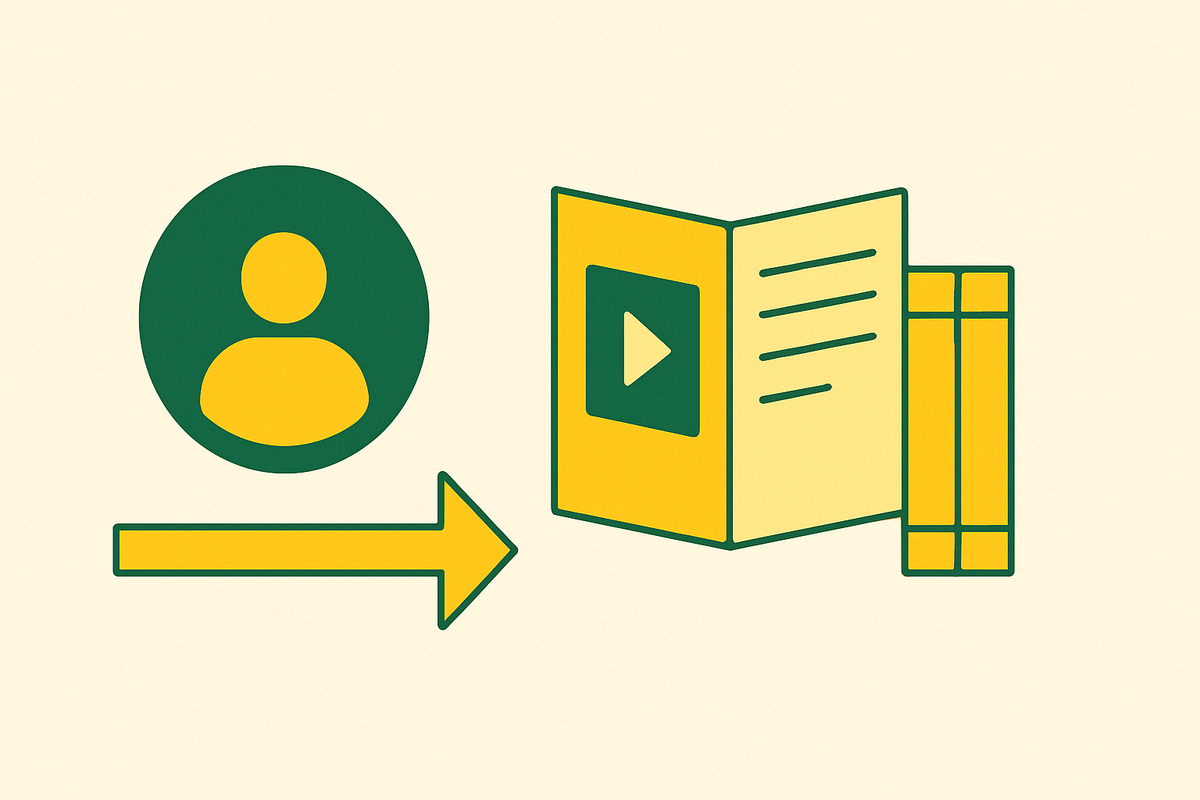
A written case study on the website helps buyers find out about the product, while a leave-behind one-pager puts the key outcome in front of a committee late in the deal. A short video clip serves the stakeholder who will not read the longer account. The same customer interview can produce all three without a second session. These are different handoffs for the same substantiated result.
Building a repeatable evidence engine, not a one-time case study project
A strong case study closes one part of the proof gap. Different industries, company sizes, use cases, and stakeholder roles require different evidence. A finance reviewer and an IT reviewer may look at the same purchase but need different reasons to approve it. To cover those needs, the library has to be built around buyers and go beyond a few stories from whichever customers agreed to an interview.
That library also needs renewal. A case study that made a strong case eighteen months ago may be out of step with today’s rules, what the product can do, or what buyers now worry about. Yet evidence collection is often reactive, with a request sent to customer success when a deal is already stuck. Evidence collection needs a scheduled program with a trigger in the customer lifecycle. Approach customers when results are measurable and satisfaction is high, using a 30-minute conversation in which the vendor writes and the customer reviews.
Tooling can help turn existing conversations into that repeatable supply. Laudable’s autostories page describes integrations with Gong, Chorus, and Zoom that surface customer quotes and draft story content from recordings. This illustrates a useful capability category, namely systems that extract candidate evidence from conversations the team has already collected. Such systems help teams gather evidence, but the outcomes still need to be clearly set out and backed by proof.
The organizational distinction matters more than the software choice. Evidence collection is a customer marketing function with a direct sales outcome. A process the team can repeat adds to the library and keeps it in step with buyers’ needs as new results come in. It also creates the supply needed for the final task, which is getting each asset into the deal where it belongs.
Getting proof assets in front of the right stakeholder at the right committee stage
Even evidence people trust cannot help if nobody can find or use it when the committee asks. The CFO needs ROI expressed in finance terms, while legal needs compliance certifications and data handling documentation. The end user needs operational proof, and the CISO needs evidence of security posture. One asset format cannot serve all four equally well. Distribution has to reflect those different responsibilities.
The trust center model is useful here again because it makes organized answers available at the point of diligence. Evidence of outcomes needs to be just as easy to reach in the tools sales teams already use, including CRM, email, and messaging. SlapFive’s documentation says that recommended reference companies and contacts appear on the Salesforce Opportunity page. A library nobody visits is an archive.
The champion remains the person who carries much of this material into the committee. Give them an asset they can forward to a specific reviewer with a one-line explanation of its relevance. If they must interpret, edit, or repackage it first, the seller has handed over another task. Each asset must make its case without a seller there to explain it.
That completes the system the quiet deal was missing. A relevant proof asset used in one committee review becomes reusable evidence for the next deal.