LinkedIn Post Formats That Work for B2B Customer Stories
Naming your actual customer beats anonymity by roughly nine times on LinkedIn engagement.
LinkedIn is where B2B buyers go to read customer proof before they will admit to anyone, including themselves, that they are shopping. Data cited by gracker.ai puts LinkedIn at 277% more B2B leads than Facebook and Twitter combined. A B2B Lead Generation Report surveying 244 marketers at B2B Marketing Live in London found 97% of them use LinkedIn among social platforms. That is about as close to unanimous as marketing data ever gets.
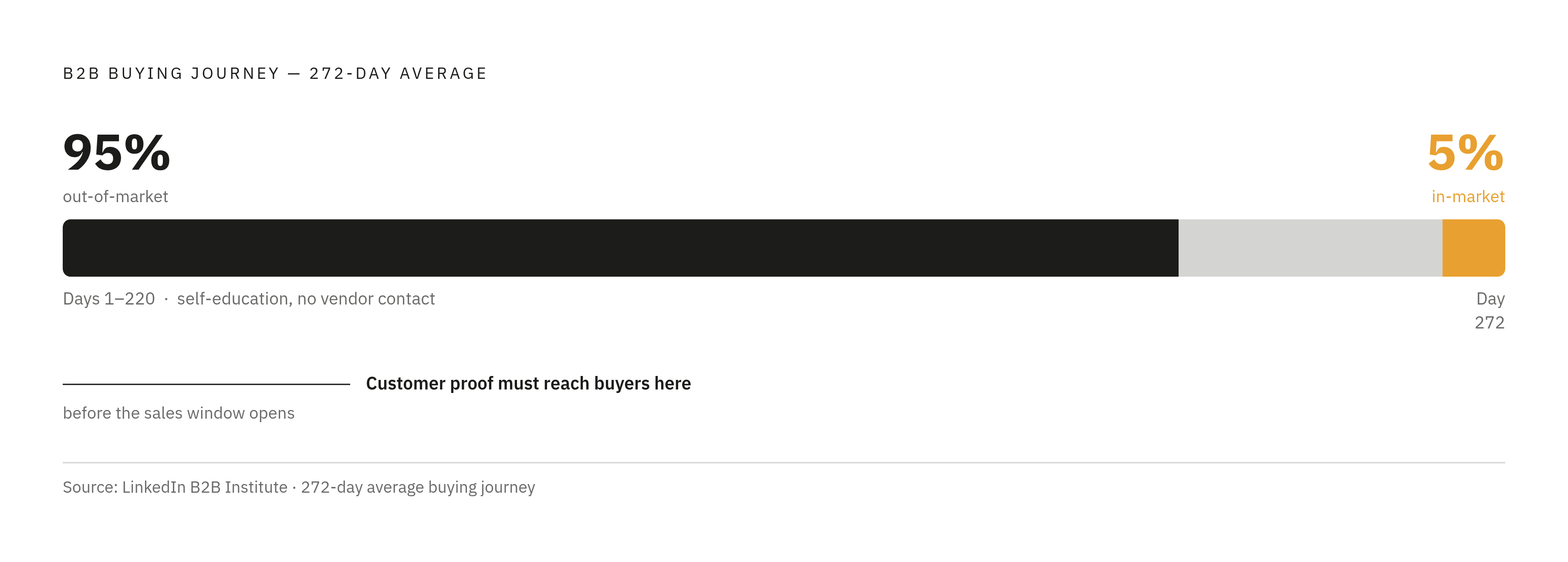
Format matters because almost nobody is ready to buy at any given moment. LinkedIn's B2B Institute found a 95/5 split: only 5% of potential buyers are in-market right now, and the other 95% spend months quietly forming opinions before a sales rep gets anywhere near a calendar invite. Dreamdata's 2026 benchmarks fill in the timeline. The average B2B buying journey runs 272 days, and roughly 220 of those go to self-education before a vendor even enters the picture.
Picture the actual buyer: scrolling at 11pm on a Tuesday, half-watching something on the other screen, reading a comment thread instead of whatever's playing. If the customer proof does not exist where that person already is, it does not exist to them. Companies that wait for a buyer to visit their website and read a case study are betting on a moment that mostly does not happen anymore.
What decides which customer stories get seen or buried
The gap between a mediocre post and a great one is closer to a canyon than a gap. Median engagement on B2B company pages is 5.72%, according to the Oktopost LinkedIn Benchmark. The top 10% of posts clear 22.45%, per the same Oktopost benchmark. That is roughly a 4x spread, and it comes down to more than luck.
Three things decide it: dwell time, meaningful comments (weighted well above simple likes), and format variety. LinkedIn wants proof that people stopped scrolling, that someone bothered to type something, and that the account is not running the same shape of post on a loop every single day.
Timing does more work than most people give it credit for. The algorithm makes its first real judgment on a post within 60 to 90 minutes of it going live. Engagement from the poster's immediate network in that window decides that the post reaches second and third-degree connections or gets buried under the next fifty posts in everyone's feed. If someone comments, replying within two hours tells the algorithm a real conversation is happening.
None of this is mysterious once someone lays it out. Think of the algorithm as a bouncer deciding whether the party gets past the velvet rope: prove there is already a crowd inside, or nobody else gets let in either.
Named specificity is the ingredient that makes a customer story post work regardless of format
An analysis by StoryVoice looked at 12 LinkedIn customer story posts. Nine named the actual customer. Three stayed anonymous, and those three pulled in 5, 4, and 16 reactions. The named posts that performed best pulled 109 reactions each. Different sport, not a close one.
Gallium's framing nails the distinction: "Wispr Flow's founders now drive 5M+ impressions a month" is a customer story. "We help founders grow" is a slogan wearing a customer story's coat, and buyers can tell the difference in about two seconds. The named specifics are the story. Without a name attached, a number, and a real outcome, there is no story, just a claim.
The Content Marketing Institute backs this up. 73% of B2B buyers say case studies are a key factor in purchasing decisions, and decision-makers consistently identify more strongly with success stories told from the customer's perspective than the vendor's. Buyers do not want to hear a company describe itself. They want to hear about someone who looks like them, who solved a problem shaped like theirs, and walked away with a number they can bring to their own boss.
The hook should always lead with the customer's number or the customer's own sentence, never the vendor's pitch. Everything after that is packaging: carousels lay the proof out across slides, text posts build it as a narrative, video delivers it in the customer's actual voice, hesitations included. Same cargo, different container.
The carousel: packaging customer proof for discoverability and dwell time
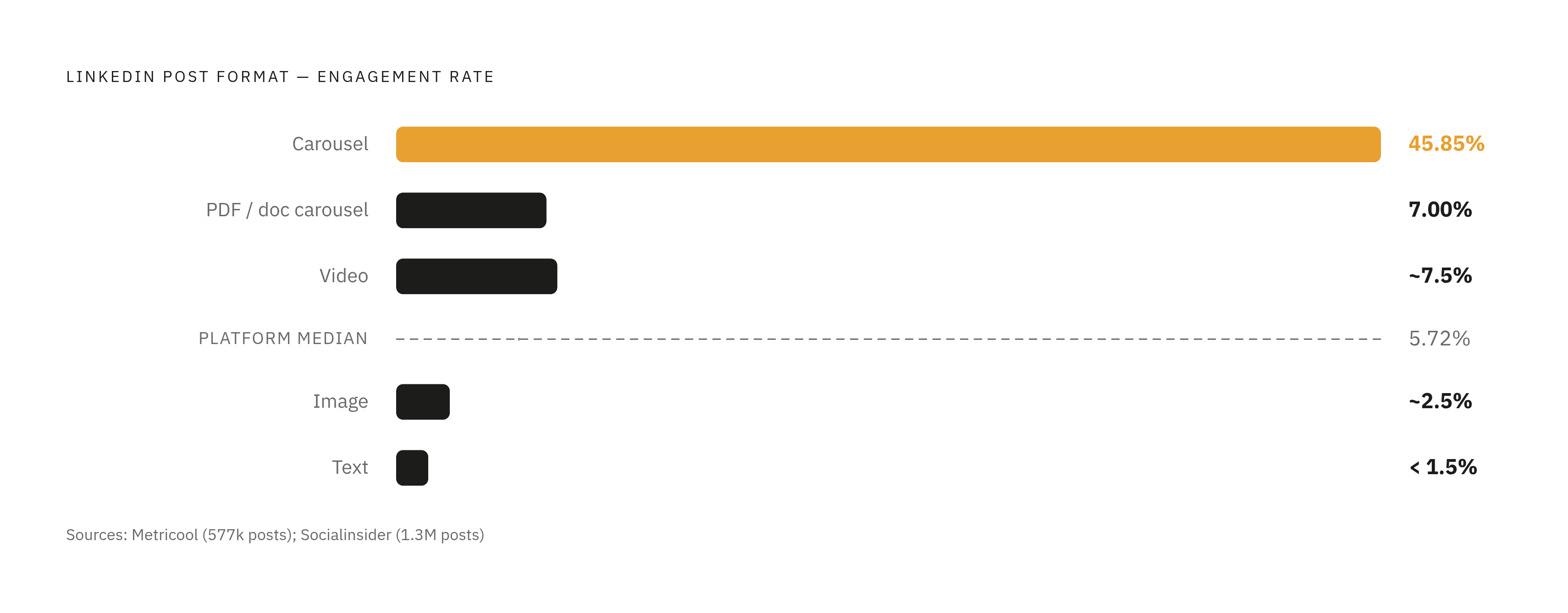
Carousels are having a moment, and the data backs it up instead of just riding a trend. Metricool analyzed 577,180 posts and found carousels hitting 45.85% engagement, the strongest format heading into 2026. Socialinsider, working from 1.3 million business page posts, found native document and PDF carousels leading every other format at 7.00% average engagement. Buffer's analysis, cited by Trade Press Services, found carousels generating nearly 3x more engagement than video or images, and nearly 7x more than plain text.
None of this is magic. It is mechanical: carousels bank the two signals the algorithm actually cares about, dwell time and saves. Every swipe adds seconds to time-on-post, and each second tells the algorithm this content deserves a wider audience. Documents also pull a disproportionately large share of saves relative to how rarely they get posted. Someone bookmarking a case study carousel is a stronger buying signal than a thumbs-up will ever be, and it is not close.
For a customer story, that means splitting the challenge, the fix, and the result across their own slides, each one built to make a thumb stop mid-scroll. A carousel works like a slow reveal, well suited to the extended self-education phase that makes up most of the B2B buying journey.
The text post: converting customer detail into a conversation that signals buying intent
Text posts undersell themselves on paper. They average below the platform median on business pages according to Gallium and Socialinsider, below the platform average. But engagement rate is the wrong number to obsess over here, because text posts generate a disproportionate share of comments, and comments are the strongest lead-generation signal LinkedIn offers.
Gallium's finding cuts right to the point: leads that come through LinkedIn close at a meaningfully higher rate than cold outreach. A text post feeds what people call the dark funnel: the buyer who argues with the point in the comments, agrees a little too enthusiastically, or slides into DMs with a follow-up question. That buyer is already halfway into a sales conversation. They just have not clocked it as one yet.
The Edelman-LinkedIn B2B Thought Leadership Impact Report, cited by Gallium, found 71% of hidden buyers (the ones inside that quiet 95%) say thought leadership proves a vendor's value better than conventional marketing does. And 95% of those same buyers say they are more receptive to outreach from vendors who consistently show up with strong thought leadership. Text carries that voice best, because it reads like a person thinking out loud instead of a brand reciting a deck.
The advantage compounds when the post comes from a person instead of a company page. Personal posts get 561% more reach than company page posts, and posts from founders and executives specifically outperform company pages by 8x on engagement. A founder posting from their own profile simply reads as more believable, full stop.
Native video: carrying credibility that static formats cannot replicate
Video does something carousels and text posts structurally cannot manage: it lets the customer's own face and voice do the convincing. QuickFrame's manager of partnerships and growth, in a LinkedIn partnership video cited by Trade Press Services, said video drives 3x more engagement and shapes B2B buying decisions in ways other formats do not touch. The credibility lift from real customer voices over polished brand content is a consistent finding across B2B research. Not actors, not stock footage. The actual person who bought the thing.
The mechanism is simple once someone names it. A testimonial video tells the same story as a written case study, but it keeps the pause before someone answers a hard question, the specific phrase a customer uses that no copywriter would ever have picked. Buyers trust it more precisely because it looks harder to fake. An unscripted stumble reads as proof, not a flaw, which is the opposite of how it works everywhere else in marketing.
The platform picture on video is genuinely mixed right now. Studies cited by postiv.ai, working from a large sample of posts, report video reach dropping, with LinkedIn currently favoring carousels and PDFs over video in distribution. That sits at odds with the stronger engagement numbers cited for video, and the two data sets simply do not agree. What holds steady either way: video uploaded natively to LinkedIn beats video posted as an outside link, no matter which broader trend turns out right.
Posting from the right place: personal profile versus company page
Where a post comes from changes what it is worth before a single word gets read. Connectsafely.ai reports that personal profiles pull 561% more reach than company pages, and founders or executives posting from their own accounts outperform company pages by 8x on engagement. Research tracked by AuthoredUp puts personal profiles at a median of 751 impressions. That gap is baked into how the algorithm treats an individual account versus a branded one, and no amount of clever copy on the company page closes it.
Format performance shifts depending on which of the two is doing the posting. On company pages, carousels win. On personal profiles, text posts pull ahead on comments and DMs, and polls reach 1.78x the platform median. There is no single correct format here, only the correct format for the account posting it, and mixing that up is the most common unforced error in B2B social.
The sequence that actually works: the founder or account executive posts the customer story from their own profile first. The company page follows with a repost, or a cleaned-up branded version of the same story. Oktopost lists this exact pattern, employee advocacy, as one of its 10 high-performing content types, and it works because it lets the algorithm do what it was already built to reward.
Rotating formats across a content calendar so proof compounds over time
No single format carries a whole customer story campaign on its own. Trying to make one do it is how good proof dies quietly in a feed, one flat repost at a time. Accounts that rotate through text, carousel, video, and polls consistently outperform accounts stuck on one format. A rotation calendar built across a month keeps an audience from going numb to the same shape of post showing up every week like clockwork.
Go back to that 95/5 split. Only 5% of the audience is in-market at any given moment, so one customer story post, no matter how good, only reaches a sliver of the people who might eventually buy. A rotating calendar fixes that by putting the same proof in front of different people at different points in their thinking. The carousel catches the researcher who wants something to save and reread. The text post catches the person ready to argue or ask a question in the comments. The video catches the evaluator who needs to hear it in the customer's own voice before believing any of it.
One customer interview can fill a full month of that rotation: a written case study kept to roughly 600 to 1,000 words (long enough to carry credibility, short enough that a busy executive actually finishes it), a carousel that splits the story into challenge, solution, and result, a short clipped testimonial video, and a text post that opens with the customer's single best number. The interview is the raw material. The formats are just how it ships.
Volume backs this up structurally. The Content Marketing Institute found 75% of B2B marketers already treat case studies or customer stories as a top content type, and companies holding 15 or more industry-specific case studies consistently report shorter sales cycles and better close rates than competitors leaning on product spec sheets alone. Tell a lot of good stories, in every shape the platform rewards, and let the algorithm do what it already wants to do: put proof in front of the people quietly deciding whether to trust you.
Sources
- LinkedIn post examples for B2B marketers in 2026 — Oktopost
- Anatomy of a Viral LinkedIn B2B Post in 2026
- Five Effective LinkedIn Post Formats for B2B Company Pages - Trade Press Services
- LinkedIn Content Formats in 2026: Which Ones Build Pipeline | Gallium
- LinkedIn Content Strategy: 7-Step Framework + Free Template [2026]
- LinkedIn Post Ideas for Business: 20 B2B Lead Formats
- LinkedIn Post Ideas: 25+ Content Types That Drive Engagement
- growleads.io