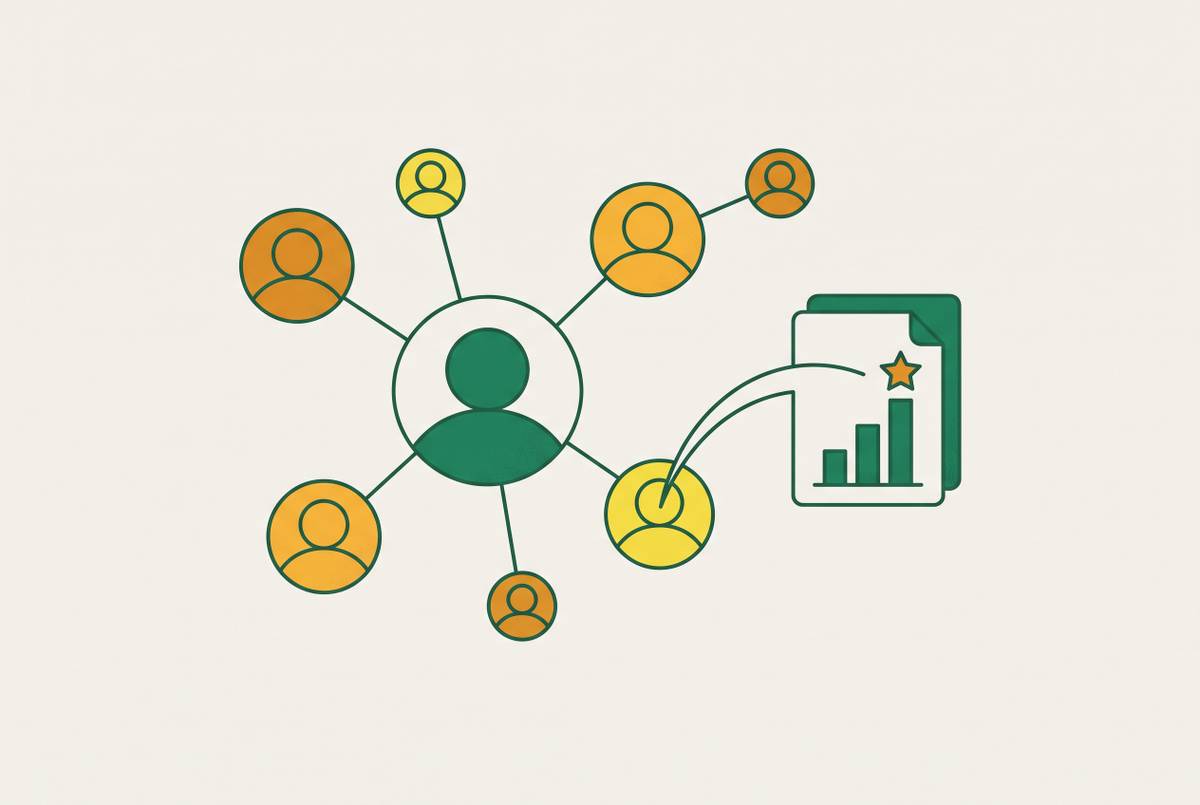
Employee Amplification of Customer Stories on LinkedIn
Employees sharing customer wins on LinkedIn reaches buyers during their research phase.
Picture the best case study a sales team has ever produced, sitting three clicks deep in a "Customers" tab, underneath the nav menu, next to a stale blog post from two years ago. That's where most customer proof lives, and it's why it never gets used. Most B2B teams publish a case study, put it on the website, and consider the job done. The asset exists, but nobody is actually pushing it anywhere.
That would be fine if buyers were still calling sales reps to ask what to buy. They aren't: most of the B2B buying journey now happens before a prospect ever talks to a salesperson, deep in what's often called the dark funnel, the research phase nobody at the vendor can see or measure.
The frustrating part is that the upside of getting this right is large. Buyers who receive genuinely helpful B2B content report higher purchase ease and close bigger deals with less buyer's remorse afterward, but only if the content reaches them while they're deciding, not after.
Posting the case study to the company LinkedIn page doesn't solve this either. Company pages have limited organic reach to begin with, and LinkedIn's algorithm deprioritizes brand-page posts compared to posts from personal profiles. So the case study goes from buried on a website to buried in a feed nobody scrolls through. Same outcome, different address.
LinkedIn's algorithm favors employee posts over company broadcasts
This isn't a matter of company pages being unlucky or under-resourced. The Vainu example shows automated feedback collection and testimonial display working together as one system, with the collection and distribution engine as two halves supporting sales teams. Personal profiles routinely out-perform company pages on engagement, because the platform reads person-to-person content as more authentic and worth showing to more people.
The 2025 data on this is blunt. Organic views across LinkedIn have dropped significantly year over year, while engagement per post has gone up. LinkedIn auctions off reach to whoever earns real conversation instead of handing it out.
And "real conversation" has a specific mechanical definition here. The algorithm tracks how deep the conversation goes and how long people linger, more than how many likes stack up. A case study shared by a sales director with one honest sentence about why it mattered will out-earn the same link posted cold from the brand account, every time.
Timing compounds this. Posts that pick up several commenters in the first hour get an amplified second wave of reach, and employees have a structural advantage in hitting that window: their networks are made up of people who actually know them and reply fast, because there's a real relationship behind the follow button.
LinkedIn penalizes posts with external links in the body copy. The fix is simple. Employees should share the case study's headline, a quote, or a stat natively in the post, and drop the link into the first comment instead. Small move, meaningfully better reach.
The reach and trust multiplier that employees unlock
Stacking the algorithmic advantage on top of raw network size widens the gap between a company post and an employee post well past a rounding error. Employee networks give B2B teams access to an audience that is structurally larger and more trusting than anything a company page can reach. Employees' combined personal networks typically run about ten times larger than a company's own follower count, and content shared by employees earns dramatically more reach than the identical post from the brand channel.
Hashmeta's comparison found that a company page post pulls in a modest number of impressions, while the same post shared by a sales manager with one personal line reaches far more people. It's the predictable, repeatable result of the mechanics covered above, network size multiplied by algorithmic favoritism.
Reach alone wouldn't matter much if nobody believed what they were reading. This is where the trust side of the equation locks in. A large majority of B2B buyers say they trust employee recommendations over traditional advertising, and separate research from the Edelman Trust Barometer backs this up at a broader scale: people are more likely to trust content shared by an individual than the same content coming from an official brand account. That matters enormously for case studies specifically, because a case study is fundamentally a claim, an assertion that this company achieved this result. Buyers have to decide whether to believe it.
Reach without trust is just noise blasted at more people. Trust without reach is a great, believable message that nobody sees. Employee sharing is the rare setup that delivers both at once, and that combination is why it beats paid promotion and brand-page posting for this kind of content. Money can buy impressions. It can't buy a coworker's credibility.
Why customer stories are high-value content for employees
Not every piece of content deserves this distribution machine. Thought leadership, product updates, hiring posts, they all have a place, but customer stories are built differently, and they do a different job. A customer story shared by an employee functions like a sales conversation that happens without a salesperson in the room. It carries a specific, real outcome, the actual words of a named customer, and the credibility of a human being vouching for it by choosing to share it. Generic thought leadership can't fake that combination.
Think about what a buyer is actually trying to figure out while scrolling LinkedIn before ever booking a call. They're asking one question, over and over: has this worked for someone like me? A case study answers that question head-on. An article about industry trends doesn't, no matter how well-written.
Specificity is what separates a case study that gets shared from one that gets scrolled past. Naming the customer, quoting their team directly, and attaching a hard number does more persuasive work than a vague summary ever could. QuicksortRx's case study is the clean example: a multi-hospital health system, a tracked $5 million in savings, named and quantified. Compare that to "we helped a healthcare company save money," which stops nobody mid-scroll, because it could describe literally any vendor on the platform.
Case studies no longer belong only to the bottom of the funnel, saved for the moment a prospect asks for proof. Pieces of a good customer story, a stat here, a quote there, work at every stage: building early awareness, supporting mid-funnel comparison, and handling objections late in a deal. That means the story doesn't just belong to sales reps closing deals. A customer success manager, an engineer, a marketer, anyone whose network overlaps with the target buyer, can share a relevant slice of it.
Thought leadership builds familiarity with a brand over time. Customer stories build confidence to actually buy. Both are worth doing, but only one of them moves a deal from "interested" to "ready."
What makes a customer story shareable by an employee
A great case study that nobody can share in under thirty seconds is a great case study that will never leave the website. The story itself might be excellent, but if it isn't built for fast consumption, it dies in the drafts folder of every employee who considered posting it.
The fix is designing the asset to work at three different speeds. There's a five-second version, the headline stat, the kind of number someone catches out of the corner of their eye while scrolling. There's a thirty-second version, a visual summary that tells the whole story in one glance. And there's the three-minute version, the full narrative for someone who wants the detail. Employees will almost always share the five-second version, so it has to be able to stand entirely on its own, with no context required.
Structure helps here more than clever writing. A challenge-solution-result format with a punchy, data-rich headline gives an employee something to lead with in their own words. Without that hook built in already, most employees won't bother writing one from scratch, and the case study quietly stays unshared.
The single most shareable unit inside any case study is a direct quote from the customer. An employee can copy the customer's exact words, paste them into a post, and add one sentence of personal framing. That takes under a minute, and it consistently beats a polished, corporate-sounding caption that sounds like it came from a press release.
Format is not a cosmetic choice on LinkedIn, either. Multi-image carousels and native documents earn the platform's highest engagement rates, well ahead of a plain link to a PDF. A case study rebuilt as a five-slide carousel, one slide for the challenge, one for the approach, one for the result, one for the quote, one for the next step, will travel farther than the same content sitting behind a download link.
None of this should be left for an employee to invent on the spot. Marketing teams should be producing the short caption, the pull-quote graphic, and the carousel version at the same time as the full case study, not after someone asks for it, so distribution starts in the content brief.
Building an internal system that routes customer stories through employee networks
None of the above works if it depends on employees remembering to do it. Programs like this fail because nobody removed the friction, not because people refuse to share things. They fail because nobody removed the friction, and there was never a system telling anyone what to share, when, or with whom.
Start by defining what the program is actually for, before a single piece of content gets built. Is the goal filling pipeline in a specific vertical? Speeding up deals already in motion? General brand awareness? The goal determines which stories get prioritized and which employees should be sharing them, so skipping this step means building a library nobody knows how to use.
Leadership involvement isn't a nice-to-have, it's structural. When senior leaders post customer stories visibly and regularly, it signals that this is genuinely part of how the company operates rather than a side project marketing is pushing on everyone. If the CEO never shares a customer win, the sales team reads that signal clearly and stops bothering too.
Pick the first group carefully instead of rolling this out company-wide on day one. Sales teams, subject-matter experts, and founders make the strongest starting cohort, because they have the clearest personal stake in these stories performing well. Recruit the people who are already enthusiastic, prove the model works with them, then expand.
Behind that first cohort needs to be an actual library, organized so a rep isn't hunting through old folders. Pre-approved posts, pull-quote graphics, caption starters, and carousel files, sorted by industry, persona, and use case.
Guidelines matter here, but the wrong kind of guideline kills the whole thing. Cover the basics, confidentiality, disclosure, what can't be shared publicly, and then step back. Overly scripted, mandatory captions strip out the genuine voice that made employee sharing valuable. Nobody trusts a testimonial that sounds like it was written by legal.
Tools that rewrite shared content into each employee's own voice automatically are seeing meaningfully higher adoption than tools that just offer a generic copy-paste caption. Authenticity at scale has become a tooling problem as much as a culture problem.
And the collection side of this can't be separated from the distribution side. Vainu, a sales intelligence platform, automated the collection of customer feedback and displayed testimonials across its marketing channels, building a steady stream of fresh social proof that fed directly into what sales teams could use. Collecting new proof and distributing existing proof are two halves of one engine. Building only one half starves the other.
Employee-distributed customer stories and deal acceleration
Everything above is framed around reaching cold buyers earlier, but the same mechanism does real work on deals that are already open. A prospect who saw an employee share a relevant case study weeks before a sales call walks into that call already halfway convinced. One founder described prospects opening calls with "I've been following you for a while," a direct result of consistent content exposure before the call ever happened, with that exposure estimated to shave roughly two weeks off the average sales cycle.
The same content library built for broad advocacy doubles as a sales enablement tool. A rep working a deal in manufacturing shouldn't have to file a request and wait two days for the right proof point. Indexed by vertical, company size, and use case, the right story should surface in under a minute.
There's a difference between sharing broadly and sharing directly, and both matter. Posting a case study for a whole network to see builds general trust over time. Sending that same case study directly to a stalled prospect is a much more targeted move, a rep using the asset like a scalpel instead of a megaphone, aimed at the exact objection holding the deal up.
Leads that come in already having engaged deeply with content, so-called content-qualified leads, tend to convert faster and with less back-and-forth, because the trust-building work already happened before a rep ever said hello.
The numbers from outside the advocacy space back up how much proof-driven content moves pipeline. Fello Agency replaced technical specification sheets with customer-focused content for Mosaic Manufacturing and saw inbound leads and booked meetings both rise within two months. Restructuring Sphere's site around ROI-led, industry-specific case studies tripled overall lead generation. Different companies, same underlying lesson: proof assets built around the buyer's actual profile, not generic specs, move pipeline in measurable ways.
The cleanest test of whether any of this is working is simple. Are reps pulling these stories into conversations on their own, without being told to? If they're not reaching for the library unprompted, the problem is either the friction in finding the right asset or the quality of what's in it, not the underlying strategy.
Measuring whether the program is generating pipeline, not just impressions
A program that only reports reach and engagement numbers is a program waiting to get its budget cut. Impressions and engagement are useful as a pulse check, telling a team whether content is actually circulating, but they say nothing about whether any of it turned into a closed deal.
Track what the content is actually doing downstream instead. UTM-tagged links on every shared case study show where referral traffic is coming from and which posts are driving clicks back to a demo page or a pricing page. Pair that with direct, qualitative feedback from sales reps on whether prospects are mentioning specific stories in calls. Compare pipeline velocity and close rates for deals touched by employee-shared content against deals that weren't.
Impressions tell a team the content traveled. Pipeline data tells a team it mattered. Building the second kind of measurement in from the start is what keeps a customer story program funded past its first quarter, and what turns it from a marketing side project into something sales leadership actively asks for more of.