LinkedIn Company Page vs Personal Profile for B2B Social Proof Distribution
Personal profiles reach B2B buyers earlier in their decision, when proof still matters.
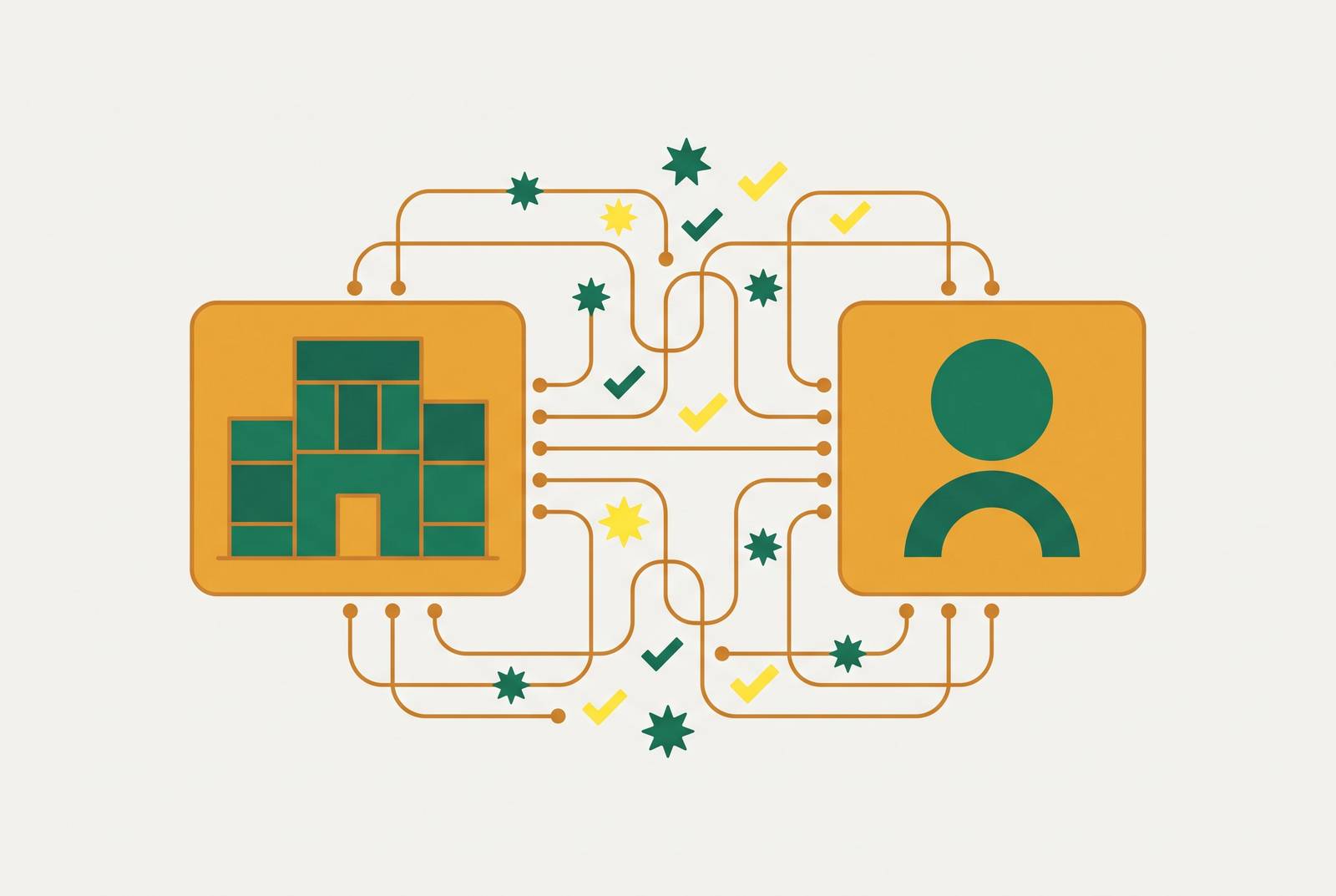
Personal profiles and company pages aren't competing for the same job, they're built to move information in completely different ways. Treating them as substitutes collapses two distinct distribution mechanisms into one preference, and that is why so many B2B teams get proof distribution wrong.
Social proof carries a specific burden in B2B that a lot of content doesn't. It has to reach someone who is already deep in a decision. The 6sense 2025 B2B Buyer Report finds that the majority of B2B buyers have already picked a preferred vendor before they ever talk to a rep, so proof that appears only on a sales call has already missed its window. That changes the whole question. It's not "which channel wins," it's "which channel gets this specific piece of evidence in front of this specific buyer, at the moment it can still change their mind." Most LinkedIn advice treats whether to use personal profiles or company pages as a performance contest to be settled with a single winner.
What the engagement data shows
Start with the numbers, because they're not in dispute. Sprout Social's Q1 2026 Index, built off a large sample of posts, found median engagement running well ahead on personal profiles compared to company pages. And a Refine Labs study comparing employees' personal profiles against the company's own page found the employees pulling in significantly more impressions and engagement, even though their combined follower count was smaller than the page's. The gap costs companies deals: it's not a rounding error.
Whether a specific customer quote, a specific case study number, or a specific named outcome performs best as a personal post, a company post, or neither is what none of that tells you. The aggregate gap describes averages across millions of posts on every topic imaginable, from career updates to hot takes on remote work. It says nothing about what happens when the content is a customer's actual result, tied to a specific format, aimed at a specific kind of buyer. Engagement data is a weather report. It tells you the climate favors one channel. It doesn't tell you what to pack for your specific trip. The engagement gap is real and large: personal profiles receive 8x more engagement than company pages (Digital Applied, April 2026).
Why the algorithm structurally favors personal profiles
The gap isn't a fluke of user behavior, it's built into the machinery. By design, a person interacting with another person outweighs a brand interacting with a person. Translation: the platform was built to prefer humans talking to humans, and no amount of clever copywriting from a company handle changes that math.
Timing compounds it. Posts that pick up real comments in the first hour get a disproportionate boost in reach, and personal profiles have a natural advantage here because peers comment on peers far more readily than they comment on a logo. Nobody rushes to reply to a corporate announcement the way they jump into a former colleague's post. LinkedIn has also gotten more aggressive about policing the games people play to fake that early signal: by August 2025 the platform had rolled out large language models to judge content on context and reasoning, not just engagement counts, actively flagging engagement bait and catching coordinated "pods" with something like 97% accuracy.
What does that mean for proof content specifically? A customer story told by the founder or the rep who closed the deal lands in a context the algorithm already trusts, professional expertise, one person telling another person what actually happened. The same story, posted from the company page, starts in a lower gear and hits a reach ceiling before it ever gets the chance to earn more. Narrative proof, told in first person, with real specifics, fits the algorithm's read on "genuine knowledge" in a way a branded announcement just can't fake.
What company pages are structurally built to do
None of that makes the company page a consolation prize. It does jobs personal profiles structurally cannot do, starting with the fact that it's the only place LinkedIn Ads can run from at all. Any team doing paid amplification needs a maintained company page, full stop, that's infrastructure, not decoration. Career pages, product pages, and premium analytics tools live there too, and they do real work: hiring, credibility signaling, building an audience at the institutional level rather than the individual one.
There's also a conversion story that favors the page. Visitors who land from a company page post convert at a higher rate, because they showed up already looking for the brand, they weren't stumbled onto, they came on purpose. And pages solve a continuity problem no individual can. If the founder or the star rep walks out the door tomorrow, their personal brand walks with them. The company page stays exactly where it is. Even the newsletter opportunity, which sounds like it should be neutral ground, tilts hard toward individuals: roughly 98% of the top 100 LinkedIn newsletters are written by people, not companies. So the honest read is that company pages aren't losing a popularity contest they were supposed to win.
The division of labor: which proof format belongs on which channel
Personal profiles carry proof that needs trust and narrative, company pages carry proof that needs permanence and paid reach.
On personal profiles, that means first-person customer stories told by the rep, founder, or customer success lead who actually owns the relationship, since that's the exact format the algorithm reads as genuine expertise rather than marketing copy. It means short outcome posts, a named result, a specific number, a clean before-and-after, framed as one person sharing something interesting rather than a brand shouting an announcement. It means quotes dropped into posts that pick a real fight with a real objection buyers actually raise. Native video belongs here too. LinkedIn video saw a real year-over-year jump in performance, and vertical clips with captions do well on personal feeds, though document carousels still edge out video on raw engagement. Document carousels themselves, built like a customer's journey (problem, solution, result) work well here as a structured mini-framework rather than a glorified brochure.
On the company page, put the full written case studies, the long-form stuff that needs to be permanent, findable, and easy to drop into a sales deck or a proposal. Put the logo walls and outcome grids there too, so a buyer looking the company up sees density of evidence at a glance. Reshare the strongest personal-profile proof posts from the page, that's amplification without redoing the work. Thought Leader Ads live here as well, paid promotion that runs through the company page's ad infrastructure while keeping the rep's or founder's actual face and voice front and center. And product pages should carry embedded customer quotes and stats right where high-intent visitors are already standing.
Format matters just as much as channel. Document carousels average 1,387 impressions against 589 for plain text posts. Case studies broken into stages do well as carousels. Short quotes belong in email signatures and personal posts. Long structured stories belong in the company library and the proposal deck. Video does different work on each channel, raw and conversational when it's native to a personal profile, polished and permanent when it lives on the page.
The division of labor's breakdown without a proof production system behind it
None of that split is executable without a way to actually produce the material, and that's where most teams quietly fall apart. The split above assumes proof appears in multiple formats from a single customer story. Teams that produce one PDF per customer and call the job done have exactly one asset. Exactly one channel gets fed, and the other one starves.
This isn't a hypothetical cost either. Per UserEvidence's Evidence Gap report, 67% of buyers have ruled a vendor out because the evidence in front of them felt untrustworthy. Most companies have plenty of happy customers. It's a shortage of a system that turns those happy customers into usable proof fast enough for sales to actually use it. Legal approval alone can take anywhere from a single day to over a month, so without a documented consent process built in from the start, timely deployment is basically a coin flip. Add to that the fact that customer success usually knows exactly which accounts are thriving and would happily talk about it, while sales is the team hearing the objections that proof needs to answer, and neither one of them typically owns turning that raw material into content. It's a classic case of everyone holding half the map.
The frustrating part is the raw material is already sitting there. Most B2B buyers use case studies during research and find them valuable in the middle and late stages of buying, yet only a small share of companies actually use case studies well. That gap between having great customers and having deployable proof is a production problem. It's a production problem, plain and simple, and a lot of "we only post on the company page" or "we only do personal posts" strategies are really just that production bottleneck wearing a strategy costume.
Building a proof engine that feeds both channels consistently
The fix starts with a mental shift: treat every customer story as a source asset, not a finished product. One good conversation with one happy customer should generate proof in every format both channels need.
Timing comes first. Capture the story soon after the result lands, while the details are still sharp and the customer still remembers the exact numbers, and build a real process for asking at specific customer milestones instead of hoping someone remembers to follow up. Then structure it the same way every time. What was the problem, quantified wherever possible, "the sales team was spending X hours per week" lands harder than "the process was inefficient". What changed. And what the measurable result was, framed with real context, the same context-action-result logic career coaches use for interview stories works just as well here.
None of it moves anywhere without rights sorted out up front. Document exactly which channels each quote or logo is cleared for at the moment it's collected, keep that record somewhere both legal and marketing can actually reach, because permissions for the website often don't match permissions for a sales deck or a paid ad. And proof has to live where reps actually work, inside Salesforce, Seismic, Highspot, or Slack, filterable by industry, role, use case, and competitor, because if it's parked in some separate portal nobody logs into, every rep just defaults to the one case study they already have memorized. On gating, keep the long research reports and guides behind a form if that's the strategy, but leave customer stories and quotes wide open, trust is the entire point of the asset, so don't put a wall in front of it. That matters even more now that a large share of B2B buyers are running parts of their research through LLMs, and those tools tend to surface proof that's freely available and clearly structured, gating it just removes it from a discovery layer that's only getting bigger. A short video clip if the customer is willing (native video on LinkedIn saw a 69% performance boost year-over-year, Whitehat SEO, April 2026).
Run this consistently and the library compounds. Every milestone produces new proof, in every format, without anyone having to sit down and decide from scratch what to make this week. A document carousel (problem-solution-result, 8–10 slides). A pull quote for email signatures, proposals, and DM follow-ups.
Personal profiles and company pages working together in an active deal
Buyers don't move in a straight line, they poke around individuals and companies at the same time, often before a rep even knows the account exists. Both channels are already doing work in the background.
In the pre-contact phase, the majority of buyers have already settled on a preferred vendor before anyone from sales says a word, per the 6sense B2B Buyer Report. Personal proof posts are quietly building that preference the whole time, while the company page is doing the institutional gut-check, is this a real company, does it look legitimate. Early in an active deal, a rep's personal post, a short, specific customer story in the prospect's own vertical, can land in their feed and open a DM conversation that same day, something a company page post almost never manages to do. Move into evaluation and the buyer goes looking for the page itself, where structured, permanent case studies sorted by industry and use case and company size do the job no personal feed could organize. And when hesitation shows up late, right before the deal should close, a 60-second native video testimonial shared from a personal profile, sometimes with paid amplification behind it, can do more to settle nerves than another round of slides ever will.
Two channels, two jobs, one deal moving through both of them at once. That's the whole argument in miniature.
Sources
- How to Increase Engagement on LinkedIn: 2026 B2B Algorithm Guide | Whitehat
- Personal LinkedIn Profiles Outperform Company Pages with 5x More Engagement
- LinkedIn Statistics 2026: 140+ B2B Marketing Data Points
- LinkedIn personal profile vs company page: what the data says for B2B leaders (2026) | Blueberry Media