LinkedIn Founder-Led Content as a Pipeline Channel for B2B Startups
Founder posts generate eight times more engagement than company pages with identical content.

The founder's profile versus the company page
Post from the company page and LinkedIn treats it like an ad nobody paid for. Post the same words from a founder's personal account, and it reads as a peer sharing something real. Most early-stage B2B founders never figure out that whose name posts the content is the whole trick. They're spread across five platforms, posting inconsistently on all of them, wondering why none of it turns into pipeline, when the actual fix was sitting in their own name the whole time.
LinkedIn's own numbers explain why this platform specifically. A large majority of members drive business decisions at their companies. The platform counts tens of millions of senior-level influencers and decision-makers among its users. That's the entire buying committee, logged in and scrolling during lunch.
The lead-gen math backs it up too. LinkedIn produces a dominant share of all B2B leads that come from social media, and converts visitors to leads at a rate that substantially outpaces other major platforms. A meaningful structural edge over the alternatives. That's a structural edge worth serious attention. That's structural.
None of that advantage touches the company page, though. LinkedIn's algorithm throttles company posts on sight, the same way it throttles any ad it wasn't paid to run. A founder's personal post skips the penalty entirely, because the algorithm reads it as one human telling another human something useful. Same platform, same content, completely different treatment, because the algorithm's judgment changes with whose name sits under the post.
Personal profiles generate roughly 8 times more engagement than company pages posting identical content. Employee-shared content drives about 5 times more engagement than the same post from the brand account. Shopify makes the point cleanly: when the company announces a major feature, CEO Tobi Lütke's personal post on that same news pulls in something like 10 to 15 times the engagement of the company page version. HubSpot shows the same gap. So does Stripe. So does Andreessen Horowitz. Different industries, different products, identical pattern.
What that means for a startup with no funding milestones behind it yet is stark: a brand-new company page starts with zero history and zero reason for anyone to follow it. A founder posting the same update, even to a small personal network, sees dramatically more traction, because a person's credibility already exists where a page's has to be built from nothing. The company page is a cold email campaign sent to an empty list. The founder's profile already has a contact list warmed up and waiting.
How buyers move through the dark funnel before they ever contact you
Buyers often pick a favorite vendor before a salesperson ever gets on the phone, and that early preference shapes the outcome of most deals. All the actual research happens somewhere sales can't see it: call it the dark funnel, the stretch of the buyer journey that occurs when a buyer researches without touching a CRM, without filling out a form, without becoming a tracked event anywhere. By the time someone books a call, the decision is usually already halfway made, and the call is just paperwork on a choice that already happened.
Cold outbound tries to interrupt that process after the fact. A rep reaches out hoping to wedge their product into a preference that's already formed and already leaning somewhere else. Content works on a different clock: it shapes the preference before it exists, which is the real difference between the two approaches, not just a matter of timing but a matter of which one gets to build the shortlist first. Outbound is a knock on a door that's already been answered by someone else. Content leaves the key under the mat months before anyone knocks.
The 2025 Edelman-LinkedIn B2B Thought Leadership Impact Report backs this with real numbers. Among buyers who research vendors before making contact, 71% say thought leadership content proves a vendor's value more effectively than standard marketing material. Ninety-five percent say they're more receptive to sales outreach after reading a piece of thought leadership from that company. And 79% say strong thought leadership makes them more likely to advocate for that vendor internally, during an RFP process, in a room the vendor's own team never enters.
The 2024 edition of the same research found something sharper still: 75% of decision-makers said a specific piece of thought leadership led them to research a product they hadn't considered before. Content doesn't just reinforce a decision already underway. It creates consideration that didn't exist a week earlier, something outbound can't manufacture on its own, since outbound only works once the prospect already knows the company's name.
What a pipeline-mapped content system looks like
Most founders fail at LinkedIn content the same predictable way. They post when inspiration strikes, go quiet the moment their calendar fills up, and never once ask which buyer stage a given post is supposed to move. Likes appear in the engagement metrics. Comments trickle in. Pipeline doesn't, because the content mix is random instead of deliberate, and random never compounds into anything.
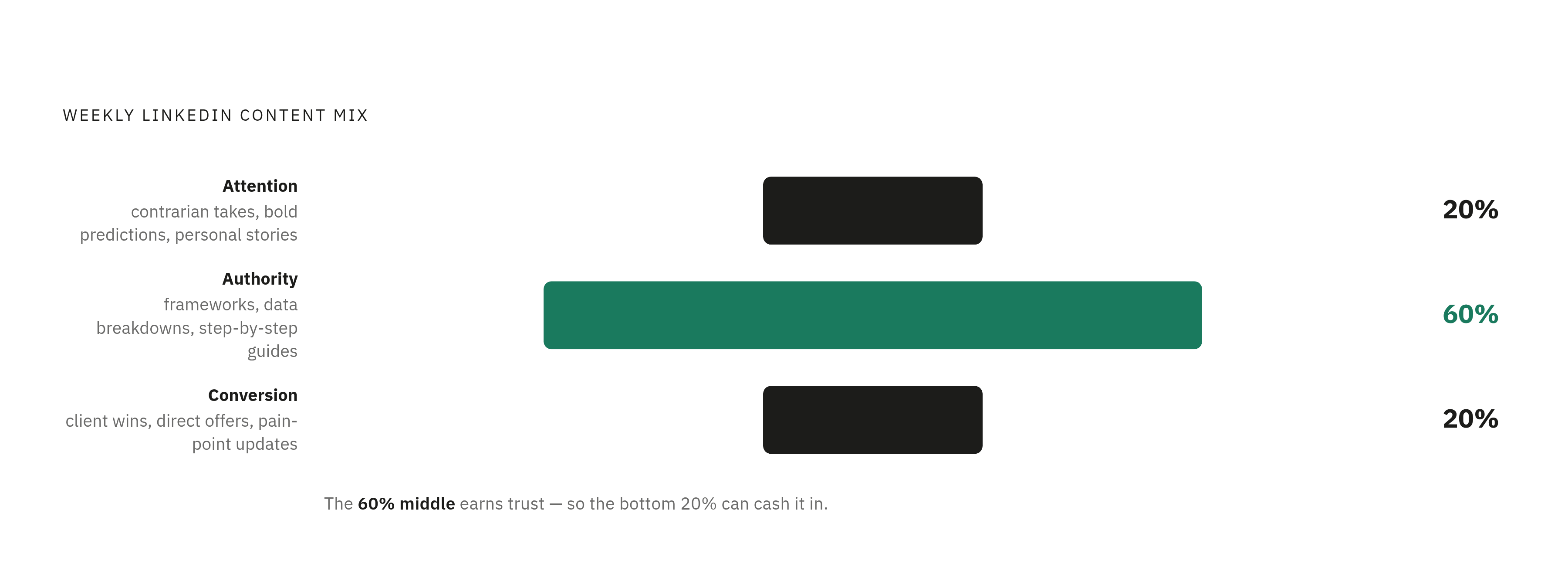
A pipeline-mapped system runs a structured split across the funnel, with most content anchored in the middle and smaller shares at the top and bottom, and the ratio isn't arbitrary.
The top 20% is attention content. Contrarian takes, bold predictions, and personal stories reveal something true about how the industry works, and that truth is produced by the fact that these formats expose what's happening beneath the polished surface most companies present. This is what reaches people who've never heard of the company and gives them a reason to keep scrolling instead of past.
The middle 60% is authority content, and it eats the bulk of the calendar on purpose. Tactical frameworks, data-backed breakdowns, step-by-step guides that show a founder understands the problem at a level the reader hasn't seen written down before. This is aimed at buyers who already know they have the problem. They just haven't picked who solves it best yet.
The bottom 20% is conversion content, made up of client transformation stories with specific numbers attached, direct offers for something concrete such as a guide, a template, or a tool, and product updates tied to a named pain point. Smallest slice of the calendar, and that's the design, not an oversight. The middle 60% earns the trust. The bottom 20% cashes it in, and by the time someone reads a case study from a voice they already believe, it doesn't read like a pitch. It reads like evidence somebody already trusts.
Mapped across a week, the five posts do five distinct jobs. A Monday contrarian take builds authority. A mid-week framework post proves competence. A Friday case study converts. Five posts, five jobs, one system that adds up to something instead of five random guesses at what might land.
Building a content production system that fits a founder's actual week
Founders don't lack ideas. They lack a system for catching the ones they already have before those ideas evaporate. Every week, a founder makes a hard call, has a conversation that shifts how they see the market, or hits a wall that would make a genuinely useful post, and then it's gone by Thursday because nobody wrote it down.
Eric Lay, co-founder and CEO of Virio, a B2B LinkedIn content company based in San Francisco, runs this at a pace that sounds unsustainable until you see the math. Two posts a week. Ninety minutes of total production time. More than 90% of Virio's leads come from LinkedIn, and the company adds a substantial amount of ARR every month off that same two-posts-a-week cadence. Ninety minutes is less time than most founders lose to a single unproductive internal meeting, and it's outperforming departments that spend forty hours a week trying to do the same job.
A running note is the habit that produces this: it captures what would otherwise be lost, and you know it because the record exists in whatever tool was at hand when the moment happened. Phone, Slack, a sticky note on a monitor, the tool doesn't matter. The pricing call that went sideways in a useful way gets logged. So does the prospect question that reframed how the team talks about the product, and the internal argument over a feature decision that accidentally revealed something about the market. None of it needs polish yet. It is raw material, not a finished thought, and treating it like a finished thought too early is how founders talk themselves out of writing it down.
The production system runs on structured interviews instead of a founder staring down a blank draft. Every two weeks, or once a month, a content strategist sits with the founder for 30 to 60 minutes and asks questions built around what actually happened recently. The questions map to funnel stages on purpose, so the output balances out without anyone doing math in the moment. The founder's raw answers get transcribed and shaped into finished posts, keeping the actual voice and the actual specific details intact while the format shifts to fit the platform. One session turns into text posts, carousels, video clips, and long-form articles across several weeks. One conversation in, a month of content out, and the founder never opens a blank document.
How customer stories convert LinkedIn followers into pipeline
By the time a prospect has read weeks of a founder's top and middle-funnel posts, that voice has already earned some trust. So when a case study appears from the same voice, it doesn't register as sales material because that voice has already earned trust from weeks of prior posts. It reads as evidence from someone the reader already decided to believe, and that's a completely different experience than a case study cold-linked in an email from a rep the reader has never spoken to.
This is the handoff point between consideration and decision. During consideration, prospects want proof that someone with a similar problem actually solved it. During decision, a well-built case study is often the final nudge, the format that closes the gap sales calls can't close alone. Founders who treat case studies as an afterthought, something legal signs off on and marketing quietly posts, are sitting on the highest-converting content format in the whole system and leaving it unused.
Narrative structure decides how the story lands. The client is the hero. The product is the thing that got them there, nothing more, nothing less. That single shift changes everything about how a reader receives the story: someone facing a similar problem sees themselves in the client, not in the vendor, so the story reads as relevant instead of promotional. It also keeps the tone consistent with weeks of prior LinkedIn posts, so the case study extends a voice the reader already knows instead of lurching into corporate case-study language out of nowhere.
Specificity is what makes any of it shareable. Numbers do the work: revenue gained, time saved, cost cut, all tied to a clear baseline and a clear timeframe. "344 employees trained, 63-point NPS increase" gets shared by people who will never buy anything from the company, purely because it's a specific, interesting fact sitting in a feed full of vague ones. That's free reach a soft testimonial never earns, because nobody reposts "great experience working with the team."
Building the repeatable system behind social proof collection and distribution
Most companies collect customer proof the way someone looks for a spare key: only after the door's already locked. A rep needs a reference, someone digs through an old spreadsheet nobody's updated in months, and the deal sits waiting while the search happens. That's reactive by design, and it breaks exactly when it matters most, mid-deal, with a clock running and a prospect losing patience.
A systematic approach turns that fire drill into something always running in the background. Three jobs matter here: collecting proof continuously across every customer segment, making that proof searchable by industry and company size, and surfacing the right story to the right rep at the right moment in a deal, without needing a bigger marketing team standing by to field every request.
UserEvidence is one platform built specifically for this problem in B2B software. It runs evidence collection through in-app surveys, email, or a shared link, and formats the responses into usable proof points automatically. It also handles advocate management, reference coordination, and original research inside one system instead of three disconnected tools duct-taped together. Customers on the platform include Pendo, Workato, Gong, Jasper.ai, and Ramp. In 2025, UserEvidence acquired Zealot, adding proactive advocate activation, one-to-one reference management, and AI-powered deal matching. The Evi AI assistant lets a rep type something like "show me testimonials from fintech companies with 500 to 1,000 employees" and get an answer in seconds, no ticket filed to marketing, no two-day wait for someone to get around to it.
Speed is the entire point. A rep mid-deal who pulls the exact right proof point in under a minute closes differently than one waiting two days for someone else to dig it up, and in a competitive deal, two days is often the gap between winning and getting ghosted. Every case study, every metric, every quote logged this way becomes raw material for the founder's next LinkedIn post, feeding back into the same content system that built the pipeline.