Using LinkedIn to Recruit Customers Into Case Study Programs
A systematic LinkedIn approach replaces ad-hoc asks with reliable case study recruitment.
Most B2B teams already have the customers they need. What they don't have is a process for turning "happy customer" into "published case study," and that gap is operational. Nobody's short on goodwill. They're short on a repeatable way to find the right person, ask at the right moment, and follow through without the whole thing depending on one overworked CSM remembering to send a Slack message.
That gap costs more than a thin content library. Per UserEvidence's Evidence Gap report, 67% of B2B buyers have ruled out a vendor because the evidence didn't hold up LinkedIn Talent Solutions. Read that again: the proof wasn't convincing enough to trust. An empty case study library is lost pipeline, plain and simple. It's lost pipeline, plain and simple LinkedIn Talent Solutions.
The usual approach is a one-off ask. A CSM fires off a Slack message after a good call, or a rep asks a customer for "a quick favor" post-renewal. These produce results about as reliably as a vending machine that's been kicked one too many times. Sometimes it works. Mostly it doesn't, and even when it does, it's one story, not a pipeline. Sales teams don't need one good story. They need a steady supply of willing participants who match whatever deal is currently stuck.
The downstream damage is predictable. Deals stall at the proof stage because nobody has a case study for this specific industry or this specific use case. Marketing scrambles to produce something reactively instead of publishing on a schedule. None of this is a talent problem. It's a systems problem, and it has a systems solution: LinkedIn, treated not as a place to occasionally post but as structured outreach infrastructure.
Why LinkedIn's professional context makes it the right recruitment channel
LinkedIn's advantage starts with something deceptively obvious: people show up there as their professional selves, on purpose. Job title, company, outcomes, all public by default, which makes it far easier to spot the customer with the right role and the results worth talking about. Per B2B Marketing Live's research, surveying 244 B2B marketers, LinkedIn has become the backbone of modern B2B marketing, the place where business credibility gets built and read by the people who matter.
That context changes how the ask lands. Inviting a customer to share their story on LinkedIn isn't asking for a favor, it's handing them a stage. Their name, their result, their face, in front of their own professional network. That's a value exchange.
A LinkedIn DM arrives in a professional context where the customer is already thinking about their work, their results, and their reputation. Email and phone outreach carry none of that built-in professional framing, and neither can be warmed up through content engagement the way a LinkedIn connection can. You can't "like" someone's voicemail.
And the pool is enormous. LinkedIn counts more than 1.2 billion members across more than 200 countries, which means virtually every B2B customer worth recruiting is already present and reachable. The infrastructure exists. Most teams just haven't built a system on top of it.
How to identify the right customers to recruit before any outreach begins
Recruitment doesn't start on LinkedIn. It starts in the CRM. The target list should already exist before anyone opens a browser tab, built from customers with documented, measurable outcomes, the kind of numbers that make a story land instead of a story that just sort of exists.
Certain moments in the customer lifecycle are gold for this. A post-onboarding success review, a renewal, an expansion, or a specific number surfaced in a QBR or CSM call, all of these are natural flags. Specificity is the whole game here. "Customer is happy" doesn't make a case study.
Once the pool of candidates exists, prioritize. Relationship warmth matters: a CSM who reports genuine satisfaction and a recent positive interaction, not someone who just filed a support ticket about a broken integration. Strategic fit matters too (does this account fill a gap in the existing library, a new industry, a new company size, a new use case). And check their LinkedIn activity level: an active poster will amplify the finished story once it's live, and tends to respond faster to outreach in the first place.
Regulated industries complicate the "named case study" model, understandably. Legal and compliance teams get nervous about public logos. The workaround worth building into the system is the blind-but-verified approach, where results are shared without naming the company. Per UserEvidence's report, the trust gap between named and anonymous-but-verified proof is smaller than most marketers assume, which means it's still very much worth recruiting these customers, just with a different final asset.
The output of this stage should be a short-listed recruitment queue.
The warm-up sequence: how to approach customers before sending any ask
Sending the ask cold is the single most common way to torch a good candidate. Cold DM response rates on LinkedIn have dropped sharply, per Expandi's data, and a recruitment message sent to someone who's never heard of the sender will underperform a warmed one every time. The fix is a warmed-up connection before the message ever gets sent. It's not skipping the warm-up in the first place.
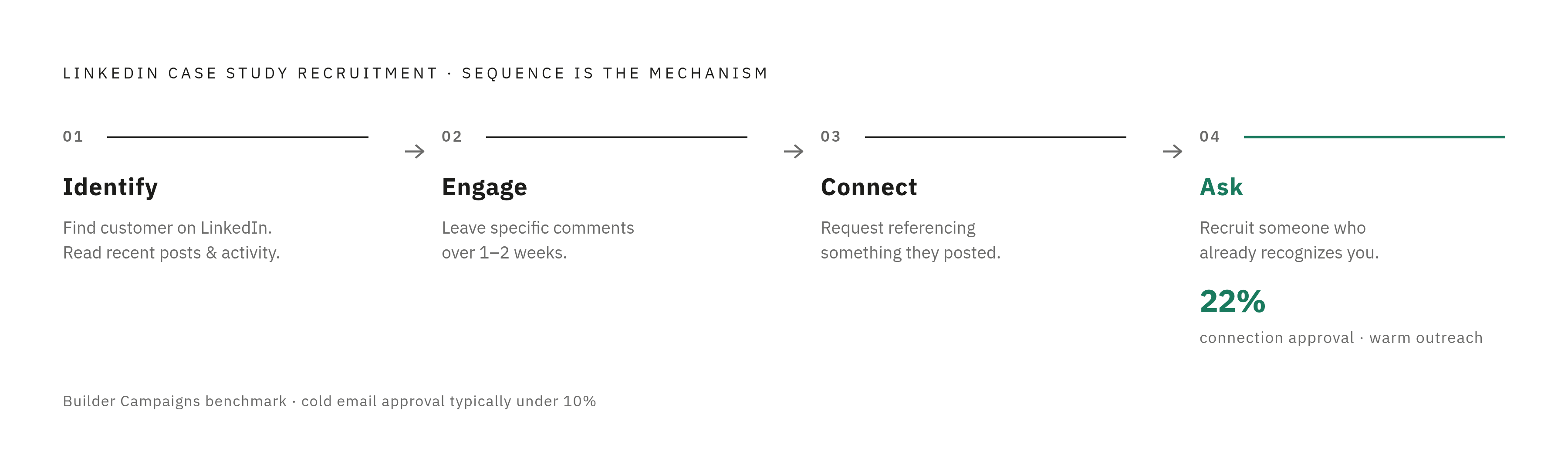
The data backs this up with real numbers. Expandi's 2026 figures show warm "Builder Campaigns," sequences built around prior engagement, generate a 22% connection approval rate and reply rates well above cold email benchmarks. The mechanism is nothing mysterious: people say yes to names they recognize.
The warm-up itself runs in four stages. First, identify: find the customer on LinkedIn and actually read their recent activity, posts, comments, articles they've shared. Second, engage authentically over one to two weeks, leaving comments that reference the specific content of their posts, not generic praise. Third, connect with context, sending a request that references something specific they posted rather than the generic "I'd like to add you to my network" line that everyone's learned to ignore. Fourth, send the ask itself, by which point the customer already recognizes the sender's name and tone, so the message reads like it's coming from someone familiar.
Who sends these messages matters as much as the sequence itself. Per LaGrowthMachine data, personal profiles dramatically outperform company pages on engagement, so the outreach should come from the CSM, the account executive, or the founder who actually owns the relationship, never a branded company handle that screams "marketing department." Messenger campaigns to first-degree connections also see meaningfully higher reply rates than cold InMail, which makes the connection step non-negotiable. It's not a nice-to-have before the ask. It's the mechanism the whole thing runs on.
None of this needs to stretch into a months-long courtship. One to two weeks of genuine engagement is enough. The goal is recognition.
How to write the recruitment message that gets a yes
Open with their result. "The move from 50 to 500 qualified leads" beats "your team's great work" because one is specific and the other could be copy-pasted onto literally anyone. Generic praise reads like generic praise, no matter how sincerely it's meant.
Keep the ask small. A 30-minute conversation, with the customer getting final review rights over anything published, removes almost all the friction, both for the customer personally and for whatever legal department they answer to. Nobody wants to commit to an open-ended "let's tell your story" project with no idea what they're signing up for.
A message that works tends to follow a simple shape. Reference the specific result: "saw the outcome your team shared in the last QBR". Name the value to them, framing the finished piece as something other people in their role or industry would actually learn from. State the format and time commitment: "a 30-minute conversation, you'd review everything before it publishes". And close soft, not with a hard call to action, something closer to "happy to share more about what the process looks like if you're open to it".
The message should sound like it's coming from the same person who's been leaving thoughtful comments on their posts, because it is.
Turning LinkedIn's content mechanics into a passive recruitment engine
Outreach isn't the only lever here. Published content does recruitment work on its own, quietly, in the background, while everyone's busy doing other things. Teaser posts that hint at a result before the full story publishes build curiosity, and LinkedIn's algorithm rewards exactly that kind of engagement.
Lean into video specifically. LinkedIn data shows video posts pull in substantially more engagement than text-only posts, and short clips pulled from customer interviews rank among the highest-ROI formats on the platform. They do double duty: distributing proof to prospects while quietly signaling to other customers that participating is worth the half hour.
Newsletters are the underused piece of this puzzle. LinkedIn newsletters work like a hybrid between a blog and an email list, and by late 2025 the platform reported over 500 million subscriptions spread across more than 146,000 active newsletters. A case study series published as a newsletter compounds with every new issue, and it tells future subscriber-customers, without anyone having to say it directly, that their story would land in front of a real audience.
A flywheel effect drives this. Customers who see a peer get featured often reach out on their own, or respond far more warmly when the outreach eventually comes. A polished, professional-looking published story lowers the anxiety of the next candidate. Tagging the featured customer in distribution posts extends the story's reach into their network and shows, in real time, what the thought-leadership benefit actually looks like.
None of this requires flooding the feed. Two to three organic posts a week from at least two internal voices, mixing education, opinion, and customer stories, keeps the algorithm satisfied without tripping the platform's suppression of volume-chasing accounts. And patience matters: a LinkedIn program typically hits steady engagement somewhere between 60 and 90 days, and the first real interactions appear around weeks four through eight. Early quiet is the ramp. It's the ramp.
Building the back-end system so recruitment doesn't depend on memory
None of the above survives contact with reality unless it's tracked somewhere other than someone's head. A live recruitment queue, whether it's a CRM view or a shared doc, should track every candidate through each stage: identified, warming, connected, asked, committed, in production, published. Without it, the whole program collapses the moment the one person running it goes on vacation.
Ownership needs to be explicit, too. The CSM or account executive who owns the relationship should own the warm-up and the ask; a content or marketing function should own the interview, the production, and the distribution.
Sourcing should also stop being reactive. CRM automations that flag customers the moment they hit a renewal, an expansion, a high satisfaction score, or a glowing QBR note turn identification into something systematic instead of something that only happens when a marketer happens to remember to ask around.
There's a reason this is worth the setup cost. Analysis of more than 6,500 real queries submitted to a customer proof AI tool found that requests for case studies, customer stories, and similar-company lists made up the single largest category. A well-stocked, properly maintained library isn't a nice-to-have for the occasional big deal. It pays off across every sales motion running at once.
How recruited stories should be structured and deployed to justify the effort
Once a customer says yes, the story itself needs a structure that does real work, and challenge-solution-impact remains the production standard for a reason: it organizes the narrative around the buyer's own decision-making process instead of a list of product features nobody outside the company cares about. Every interview should be built to surface the situation before, the moment that forced a change, how the evaluation actually went, and the outcome, in the customer's own words and their own numbers.
Format should follow where the story gets used. A written case study serves SEO, sales collateral, and the skim-readers deep in evaluation mode.
Production quality only matters if the asset actually gets used, and most of it doesn't. Forrester research found that the majority of marketing-created sales content goes untouched, simply because reps can't find it. Proof needs to live inside the tools reps already have open all day, not buried three folders deep in a portal nobody bookmarks.
Matching the story to the deal stage isn't optional polish, it makes the story close something instead of just sitting there looking nice. An industry-matched case study early in a deal builds credibility before skepticism sets in. A written case study during evaluation answers the specific criteria a committee is scoring against. A short video overcomes hesitation late, when momentum is the only thing left to protect. The right story at the wrong stage does roughly nothing.
That stage-matching matters even more once the math on buying committees sinks in. Groups of six to eleven people are now typical, and the rep gets only a sliver of that group's total attention. Whatever gets left behind after the meeting does more selling than the rep ever will, which means the recruited story has to be built for the committee members who will never once get on a call. Case study software designed specifically for this, turning recruited conversations into structured, deal-ready assets and surfacing the right one at the right stage, actually connects a working recruitment system to deal velocity. Recruitment and production and sales enablement aren't three separate projects. Treating them that way means the compounding return gets missed. A short video clip of 90 seconds or less serves late-stage hesitation, as a champion shares it internally with a buying committee.