Bottom-of-Funnel SEO for B2B SaaS Conversions
Comparison pages and targeted use-case content convert four times better than typical landing pages.
How B2B buyers behave at the decision stage
Buyers finish most of the work before anyone from sales ever picks up the phone. Averi's 2026 analysis of bottom-of-funnel content puts the number at 70% of the buyer journey completed before first contact, and 75% of B2B buyers say they'd rather skip the sales conversation altogether if the content can answer their questions instead. That's not a preference. That's the whole game plan now.
The average buyer reads about 11 pieces of content before ever reaching out, and 72% start that whole process with a plain search engine query. By the time the rep gets involved, the buyer has usually already made up their mind about two or three finalists, so the pages showing up in that search determine outcomes more than the pitch deck sitting in a rep's inbox.
A typical B2B deal has 6 to 10 people who need to sign off, which makes the picture messier. The CFO wants pricing math. The IT lead wants a security answer. The end user just wants to know if the product is going to make their Tuesday easier or worse. All three are reading different pages, often at the same time, and none of them are waiting around for a demo to find out.
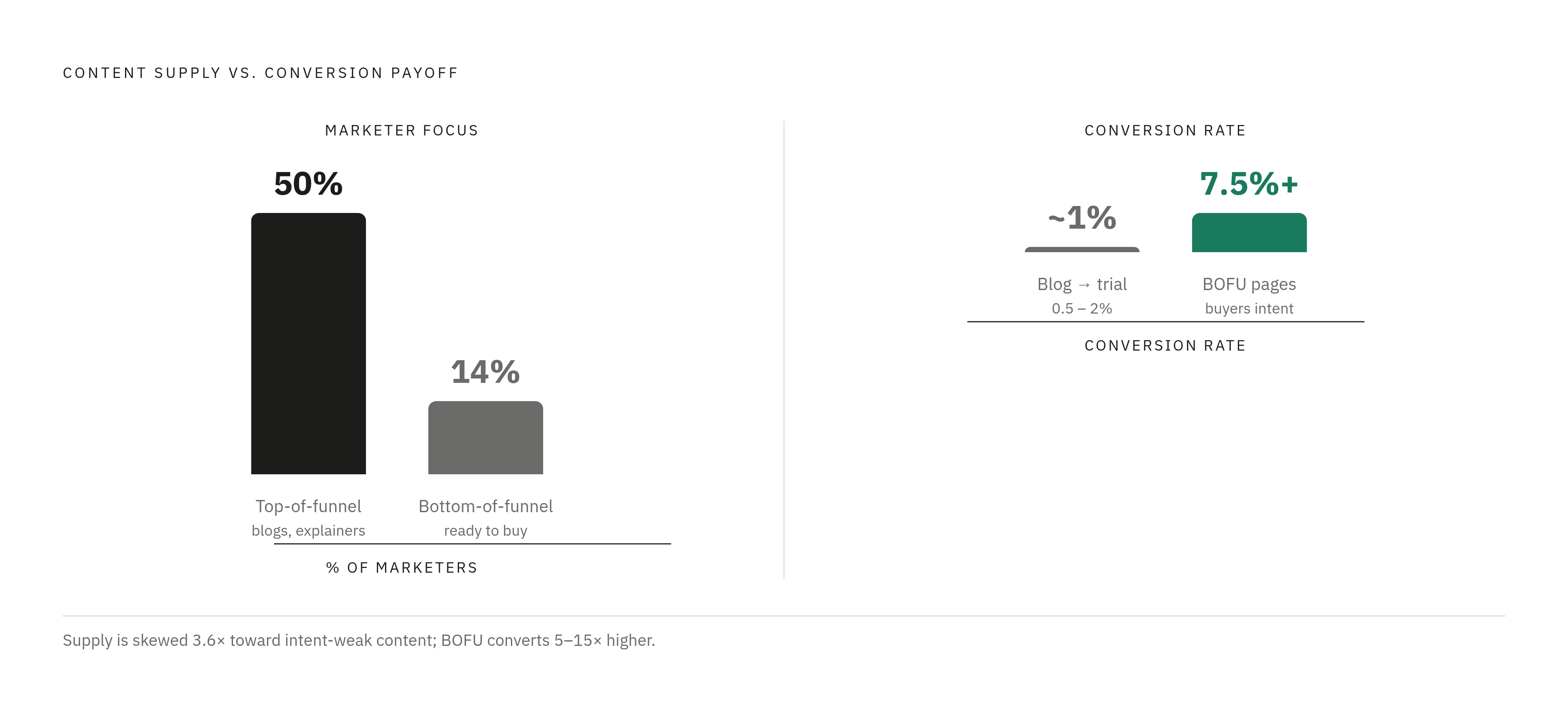
Here's the mismatch: about 50% of marketers are pumping out top-of-funnel content (blog posts, "what is X" explainers, industry trend roundups), and only 14% are building bottom-funnel content built for the people ready to buy. That's an inversion. Most content teams are stocking the shelves with appetizers while the buyer is standing at the register with their wallet out, looking for the checkout line.
Search behavior gives away the buyer's stage without them saying a word. Someone typing "what is [category]" is browsing. Someone typing "[Product] vs [Competitor]" or "[Competitor] alternatives" or "[Product] pricing" already has a credit card within arm's reach. That second group is small in volume and enormous in value, and it's exactly the group most companies are least prepared to catch.
The comparison and alternatives page: the highest-ROI BOFU asset
Comparison and alternatives pages convert north of 7.5%, compared to the 0.5% to 2% typical for a blog-to-free-trial path. That's not a marginal improvement. That's an entirely different category of page doing an entirely different job. Visitors landing on bottom-funnel content convert 4 times more often than the average landing page visitor, according to Averi, because the intent is already locked in before they click.
Two page types matter here, and they're not interchangeable. A "[Your Product] vs [Competitor]" page serves someone who already has you on the shortlist and is trying to make the final call. A "[Competitor] Alternatives" page serves someone who's already decided against the competitor (maybe on price, maybe on a bad support ticket) and is actively hunting for what comes next.
The "1v1v1" page is a third move worth knowing. Compare two competitors head-to-head, sliding your own product in as the smarter third option. Write "Freshbooks vs QuickBooks," and instead of picking a side, make the case that your tool solves what both of them get wrong. That page ranks for searches where your brand isn't even mentioned, and it still lands your name in front of the buyer.
Ahrefs runs this playbook well. Its "X vs Y" comparison articles hold first-page rankings for high-intent searches in a genuinely crowded software category, and those pages feed prospects straight into trial signups. It's proof the tactic scales even when the competition is fierce and well-funded.
A comparison page that actually converts has to do triple duty: answer the CFO's pricing question, the IT lead's security question, and the end user's "will I actually like using this" question, all on one page, without making any of them scroll through content meant for someone else. Companies running full-funnel strategies that include this kind of bottom-funnel content see 45% higher ROI than teams running single-stage campaigns. The lift is from traffic that was already halfway convinced.
Use-case pages and buyer-context landing pages that close the remaining intent gaps
Comparison pages work for buyers who know which products they're choosing between. Use-case pages work for buyers who know their problem but haven't picked a product yet. Different buyer, different page, different job.
Think about the query patterns: "[category] for [industry]," "[category] for [team type]," "[product] plus [specific workflow]." Each one narrows the audience further, and each narrowing concentrates intent. A buyer searching "project management for construction teams" isn't browsing; they're trying to find the tool built for their exact headache.
These pages win because they speak the buyer's language, not the vendor's. Nobody searches "enterprise workflow optimization software." They search "scheduling software for HVAC dispatch," because that's the actual sentence in their head. Bottom-funnel assets like these, along with pricing pages, ROI calculators, and use-case landers, convert 3 to 5 times better than educational content, even when the search volume behind them looks small on paper.
Every use-case page needs to stand on its own two feet. It needs its own call to action. It shouldn't be a blog post crossing its fingers that the reader clicks through to some other page to actually convert. If the page can't close on its own, it's doing half a job.
A workable operating model is to pick 10 to 15 commercial topics worth chasing. Each one should have a primary keyword, a buyer stage, a CTA, and a named person on the sales side who owns follow-up. Publish the core page first. Then go back and layer in proof points, screenshots, FAQs, and objection-handling pulled straight from real sales calls, the actual words prospects use when they hesitate.
Use-case pages are for acquisition (new buyers finding you for the first time), while feature pages are for existing users trying to get more out of what they already bought. Blurring the two is a common mistake, and it waters down the conversion intent on both.
Customer proof: what separates a BOFU page that ranks from one that converts
A page can rank on page one and still convert nobody, and the difference usually comes down to proof. Research into B2B buyer behavior consistently finds that buyers place significant weight on proof that a solution has worked for companies like theirs. Proof is the actual mechanism that gets someone to click "start trial." It's the actual mechanism that gets someone to click "start trial."
The format matters as much as the content. A named person with a specific, checkable outcome beats a vague paraphrased quote every time, partly because buyers can verify it, and partly because AI answer engines favor attributed, verifiable claims over generic ones when they're deciding what to surface.
The strongest proof follows a structure: challenge, approach taken, and result achieved. The challenge, approach, result structure is the format that top-performing SaaS companies return to most consistently when building case studies.
Placement matters just as much as format. Proof should sit exactly where hesitation peaks, not get dumped at the bottom of the page like an afterthought:
- On comparison pages, next to the feature rows where the buyer is actively weighing trade-offs
- On pricing pages, right beside the plan tier, answering the unspoken "is this actually worth it"
- On use-case pages, a same-industry, same-role customer story doing the anchoring work
- On alternatives pages, a customer who switched from that exact competitor, with a specific number attached to the outcome
Proof also has to match the audience. A glowing fintech testimonial does nothing for a healthcare buyer reading it, because the buyer's brain filters it out as "not like me." Segment-matched proof is what actually closes the trust gap.
For regulated industries where a named case study isn't legally possible, there's a workaround: blind-but-verified proof, where a third party confirms the customer is real without publishing who they are. Research suggests buyers trust blind-but-verified testimonials at rates only marginally below named ones, a gap small enough that it's a reasonable substitute when naming names isn't an option.
Tools like UserEvidence can auto-generate quotes, ROI numbers, and mini case studies sorted by industry, product line, persona, use case, and even by competitor through dedicated Competitive Proof Pages. That means sales and content teams can pull the right proof for the right page or the right deal without filing a ticket and waiting a week for marketing to get back to them.
A repeatable process makes this hold up long-term. Structured customer interviews, the Challenge-Solution-Impact format, a publishing workflow that doesn't depend on one overworked person remembering to do it. Teams that treat case studies as a one-off project (something that happens when someone finally gets around to it) can't produce the volume or the segment coverage that bottom-funnel SEO actually demands.
BOFU content in AI-influenced search and what it changes about optimization
AI is already part of the B2B buying process, not a future trend to plan around later. The 6sense Buyer Experience Report found 94% of B2B buyers now use large language models somewhere in their purchase journey. That number alone should reorganize how bottom-funnel pages get built.
Traffic arriving from AI tools tends to convert at higher rates than regular organic search. The reason isn't mysterious: the AI already pre-qualified the visitor before they clicked anything. By the time someone lands on the page, the model has already done part of the sales conversation for you.
When a buyer asks an AI "which is better, X or Y, for this specific use case," the model's answer carries real weight in that decision. Companies with clear entity signals (a defined product name, category, and differentiation that's easy to extract) show up more often in those answers than companies whose site reads like a wall of marketing fog.
What that means practically for how BOFU pages get built:
- Structure content around clear entities: product name, category, use case, differentiation, spelled out rather than buried in adjectives
Tracking AI citations is starting to become its own leading indicator, separate from traditional keyword rank tracking. A comparison page that gets cited by an AI tool is winning the buyer's attention before a single click on a search results page ever happens.
AI Overviews have cut into organic click-through rates pretty significantly for informational queries, the kind of searches people run when they're just learning. Comparison and bottom-funnel queries hold up better against that shift, because buyers making a real decision tend to want to click through and verify things themselves rather than trust a two-sentence AI summary.
The SEO channel benchmarks that tell you which traffic is worth converting
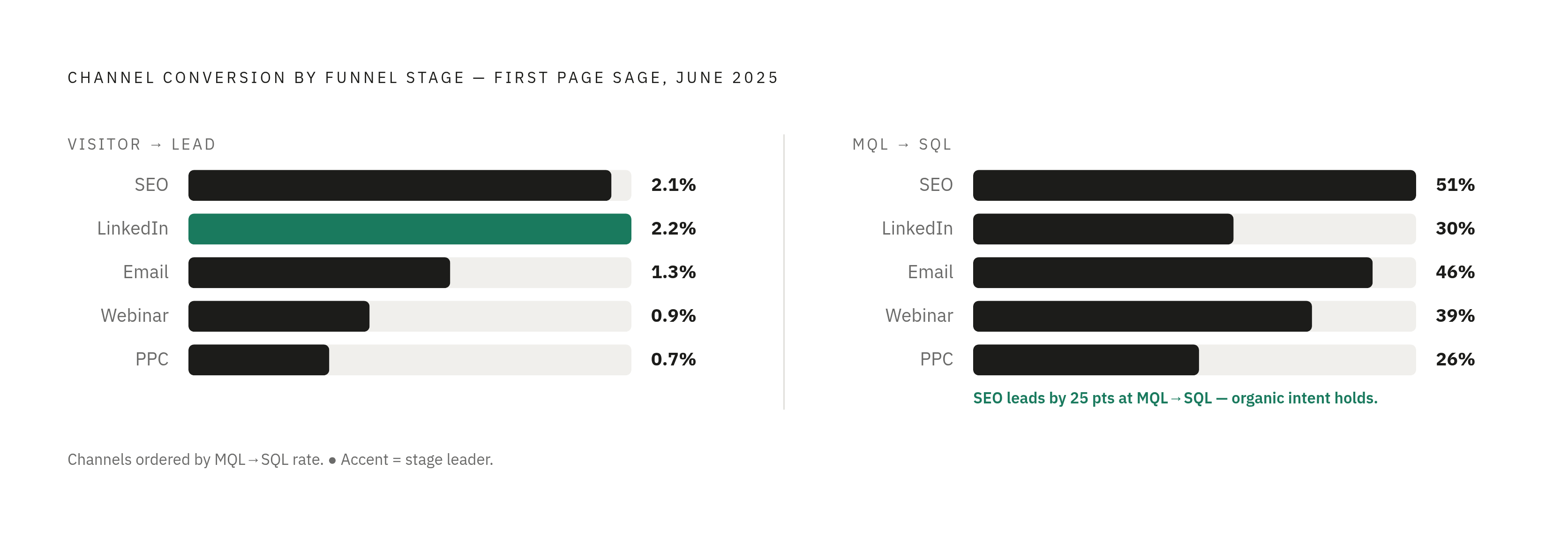
Numbers help settle arguments about which channel deserves budget. First Page Sage's June 2025 benchmarks put SEO's visitor-to-lead rate at 2.1%, ahead of PPC at 0.7%, LinkedIn at 1.3%, email at 0.9%, and webinars at 0.9%.
The gap doesn't stop at the top of the funnel either. SEO traffic converts from an early qualified lead to a sales-qualified one at 51%, versus 26% for PPC. Organic visitors who make it into the pipeline tend to stay qualified longer, stage after stage, which suggests the intent behind an organic click just runs deeper than a paid one.
Full breakdown, by channel (First Page Sage, 2025):
- SEO: 2.1% visitor-to-lead, 41% lead-to-MQL, 51% MQL-to-SQL
- PPC: 0.7% visitor-to-lead, 36% lead-to-MQL, 26% MQL-to-SQL
- LinkedIn: 2.2% visitor-to-lead, 38% lead-to-MQL, 30% MQL-to-SQL
- Email: 1.3% visitor-to-lead, 43% lead-to-MQL, 46% MQL-to-SQL
- Webinar: 0.9% visitor-to-lead, 44% lead-to-MQL, 39% MQL-to-SQL
PPC still has its place: it's fast, and it fills a pipeline quickly when there's nothing else going. But it tends to hand over lower-intent visitors, while SEO builds slower and pays off harder at every stage after the click. Bottom-funnel content is what speeds up both halves of that equation: more volume, and sharper intent, from the same organic channel.
None of these numbers mean anything without tracking attached. A page with no CTA, no UTM tagging, and no attribution model is just decoration, and per the Content Marketing Institute's B2B Report, 56% of marketers currently can't tie their content efforts back to ROI. A team stuck at 0.7% visitor-to-lead has a completely different problem to fix than a team with 2.1% but watching MQL-to-SQL fall below 26%. Same funnel, different leak, different fix.
Building the BOFU content system: prioritization, production, and ongoing optimization
Start with an audit. Most SaaS sites are missing comparison and alternatives coverage for more than half of their most-searched competitor pairs. There's already a list of obvious gaps sitting there before any new strategy gets written down.
From there, the sequence is straightforward:
- Audit existing pages against actual buyer-ready search terms (competitor names, "alternatives," "pricing," "for [industry]")
- Pick the 10 to 15 commercial topics with the clearest signs of buyer-ready intent
- Assign each topic a keyword, a buyer stage, a CTA, and a named sales owner before a single word gets written
Production has its own checklist, and skipping any part of it lowers the conversion numbers later:
- Proof placed exactly at the point of hesitation, not tacked on at the bottom like a footnote
- A specific, named, checkable outcome, not a vague category-level claim
- FAQs built from real sales call objections, written in a way AI tools can actually extract and quote
- One clear CTA matched to the buyer's actual stage (a demo request for someone late-stage, a free trial for a product-led motion)
The hardest part to sustain is proof supply. Teams that build case studies one at a time, whenever there's a spare afternoon, can't keep pace with the segment-matched, use-case-matched coverage that bottom-funnel SEO needs once it's running at scale. A repeatable system for finding, structuring, and publishing customer stories is what keeps the whole engine fed.
Optimization isn't a one-time publish and walk away. Ship the core page, then come back and add proof points, screenshots, FAQs, and real objections pulled from calls that happened after launch. The page gets better in layers, not in one big final draft.
Measurement should track bottom-funnel pages on their own, separate from the rest of the content program. Compare visitor-to-lead rates against the 1.5% to 2.5% baseline average, and against the 7.5%-plus benchmark that strong comparison pages hit, to spot which pages are underperforming for their intent tier.
The payoff compounds. Every new case study, every new comparison page, every new use-case lander cross-links into the next one, strengthens the entity signals search engines and AI models both rely on, and builds the kind of topical authority that eventually decides which product gets recommended when a buyer, human or AI, is asked to pick one.