Programmatic SEO for B2B SaaS With a Small Content Team
Google's 2026 update killed thin programmatic pages, leaving room for quality ones.

Programmatic SEO for B2B SaaS with a five-person content team either works or it wrecks the domain. There's no in-between anymore. Google's March 2026 core update went after scaled content abuse hard enough that sites running low-value programmatic pages lost 50 to 80 percent of their organic traffic, MADX Digital's 2026 playbook reports. That's not a slap on the wrist, that's a domain-wide penalty box.
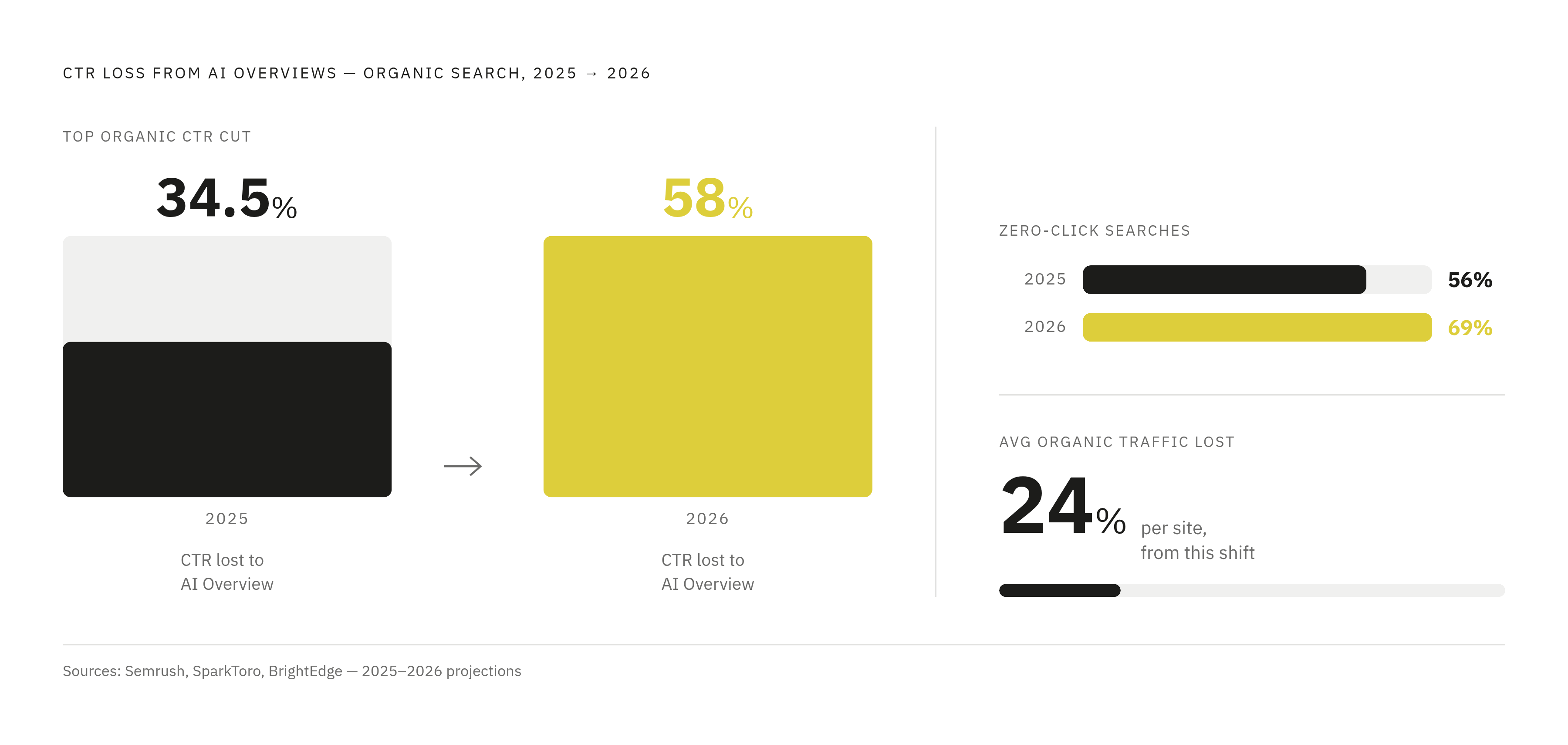
The lesson is "raise the bar until every page could survive a human reading it and asking, so what?"" It's "raise the bar until every page could survive a human reading it and asking, so what?" AI Overviews made the problem worse before the update even hit: Ahrefs data cited in that same playbook found an AI Overview cut the top organic result's click-through rate by 34.5 percent in 2025, and a 2026 re-run of that study pushed the number to 58 percent. Zero-click searches climbed from 56 to 69 percent. Sites are losing an average of 24 percent of their organic traffic just from that shift. The old math (more pages equals more clicks) doesn't hold anymore, structurally, no matter how clean your templates are.
Most competitors torched their own domains trying to game this system with thin, keyword-swapped pages, which should actually cheer up a small content team. The opportunity for well-built, high-utility programmatic pages didn't shrink. It got bigger, because the field just thinned itself out. This piece walks through how to build that system on purpose, not stumble into it.
What programmatic SEO is for a B2B SaaS context, and what it is not
Programmatic SEO is a production method: one page template, paired with a structured data set, published at scale to create hundreds or thousands of pages, each answering one specific search. That's the whole definition. It's not a content type, and it's not a shortcut for writing.
It's also not the same thing as a content cluster. A cluster is a handful of researched, hand-written articles linked around a theme. Programmatic pages are assembled from structured fields, and they win the repetitive, patterned queries no writer could realistically cover one at a time. Nobody's sitting down to hand-write "Salesforce integration for a 40-person logistics company" and "Salesforce integration for a 400-person logistics company" as separate blog posts. That's a job for a data table and a template, not a writer.
B2B SaaS happens to be unusually well set up for this. Most products already sit on structured data: the integrations they support, the use cases they serve, the competitors buyers stack them up against. That data is the raw material a programmatic system needs, and most SaaS companies already have it sitting in a database somewhere, unused.
A page whose only unique content is a swapped keyword in the H1 is filler. A page carrying live pricing, a working calculator, verified numbers, or real comparison detail passes the test. The asymmetry here matters for a small team especially. The upside of a good programmatic set builds slowly, over months. A weak page drags down the whole domain's performance quickly. A page you never publish costs you nothing. A thousand weak pages can drag the whole domain down with them (per MADX Digital). This isn't "AI-generated content spam" versus "real content" either, that framing misses the point. The real dividing line is whether the data behind each page is genuine and specific, not whether a machine stitched the words together.
The six page types that generate genuine utility for B2B SaaS buyers
TripleDart, working across more than 50 B2B SaaS accounts, found six page types do the heavy lifting: integration pages, competitor alternative pages, comparison pages, template libraries, industry-specific landing pages, and role-based use-case pages.
Integration pages are the clearest case study. Zapier built one page per app combination, plus single-app and workflow-specific pages, each aimed at someone searching for that exact pairing. Zapier now ranks for a large number of keywords and pulls in a substantial volume of organic monthly visitors, with the bulk of that traffic attributed to this exact pattern, Averi's 2026 playbook reports. A small SaaS company doesn't need Zapier's catalog of thousands of integrations to use this play. Even a modest integration list is enough, because the data already lives inside the product.
Competitor alternatives and comparison pages ("{product} alternatives," "{product A} vs {product B}") catch buyers who are already deep in the evaluation process (per TripleDart, via BeginDot's approach). These pages do the filtering work a salesperson would otherwise do on a discovery call. The buyer shows up already knowing the landscape, which means the page just has to confirm or reframe what they already suspect.
Template libraries work a little differently. Wrike's "time management templates" and "project planning templates" pages each target a specific workflow need, and they carry a nice side effect: practitioners bookmark and share them, which extends the page's reach beyond organic search alone.
Industry-specific and role-based landing pages are where ICP targeting actually happens at the page level, which gets its own section next because most teams get this wrong.
For a team deciding where to start, rank these six by data availability first and search demand second. Build the page type where the structured data already sits in your product.
Designing pages around ICP, not just around keywords
The design principle, per Dango's pSEO analysis for SaaS: use entity modifiers to narrow each page down to a buyer profile that matches the actual ICP, not to catch everyone who shares a vague pain point.
"Small business CRM" pulls in every small business owner with a CRM question, most of whom will never buy anything from anyone. "Small business CRM" pulls in every small business owner with a CRM question, most of whom will never buy anything from anyone. "[Your product] vs. Salesforce for Series A SaaS companies managing inbound sales" pulls in a much smaller crowd, but every one of them is close to qualified. That second page did in its title what a sales rep normally does fifteen minutes into a discovery call.
The qualifier entities doing the filtering are the same ones a rep already uses: company stage, use case, existing tool stack, team size, industry vertical. Building the modifier set means building an ICP matrix and then letting the keyword surface fall out of it.
This matters more in B2B than in B2C for a fairly boring, practical reason. A B2B SaaS company might have a total addressable market of a few thousand to a few million buyers, not hundreds of millions. Unqualified traffic is expensive to convert and it inflates customer acquisition cost, so precision isn't a nice-to-have here, it's closer to a financial requirement.
There's a GEO angle too. Pages built around specific entity combinations are more likely to get cited by AI answer engines, because they answer one precise, bounded question instead of a broad, mushy one. AI models don't cite vague. They cite specific.
Building a data layer that makes pages worth indexing
Gracker's 2026 piece on B2B SaaS marketing calls this the content moat, and it's the right name for it. If a programmatic page just repeats information already public somewhere else, it's disposable, and both Google and any LLM crawling the web can tell. If the page carries first-party data (industry ROI benchmarks, integration compatibility matrices, a real-time cost calculator), it becomes something an LLM can't hallucinate its way around and has to cite as a source.
Data quality for a small team breaks into three rough tiers. First-party product data (integration usage patterns, feature compatibility, anonymized account benchmarks) is the most defensible tier, and most companies are sitting on it untapped. Public API data, restructured and made interactive in a way competitors haven't bothered to do, sits in the middle. Manually curated industry data, dropped into a calculator or tool format, ranks lowest on defensibility but still clears the utility bar if nothing equivalent exists anywhere else.
Gracker's 2026 strategy piece says: stop building pages that look like blog posts, start building tools. A dynamic compatibility matrix where someone picks their tech stack and gets a real answer back is an interaction signal, and it reads as quality in a way that a wall of prose never will.
MADX has a clean test for this: strip out the auto-filled variables from the template and ask what's left. If nothing useful remains, the page fails before it ever ships. For a lean team, the sourcing work is where the time budget should go up front. Page generation is fast once the data layer is solid, and it can't be patched in after the pages are already indexed, that ship sails early. On the GEO side, proprietary data is the single highest-leverage input for AI citation. Gracker finds that the more first-party the data, the higher the odds of showing up inside an AI-generated answer.
Sequencing the build for a small team: topical authority before scale
Dango's pSEO analysis lays out the order that actually works: build topical authority first through core editorial pages, then deploy the programmatic set to catch the long-tail query surface. Programmatic pages amplify authority that already exists. They don't create it from nothing.
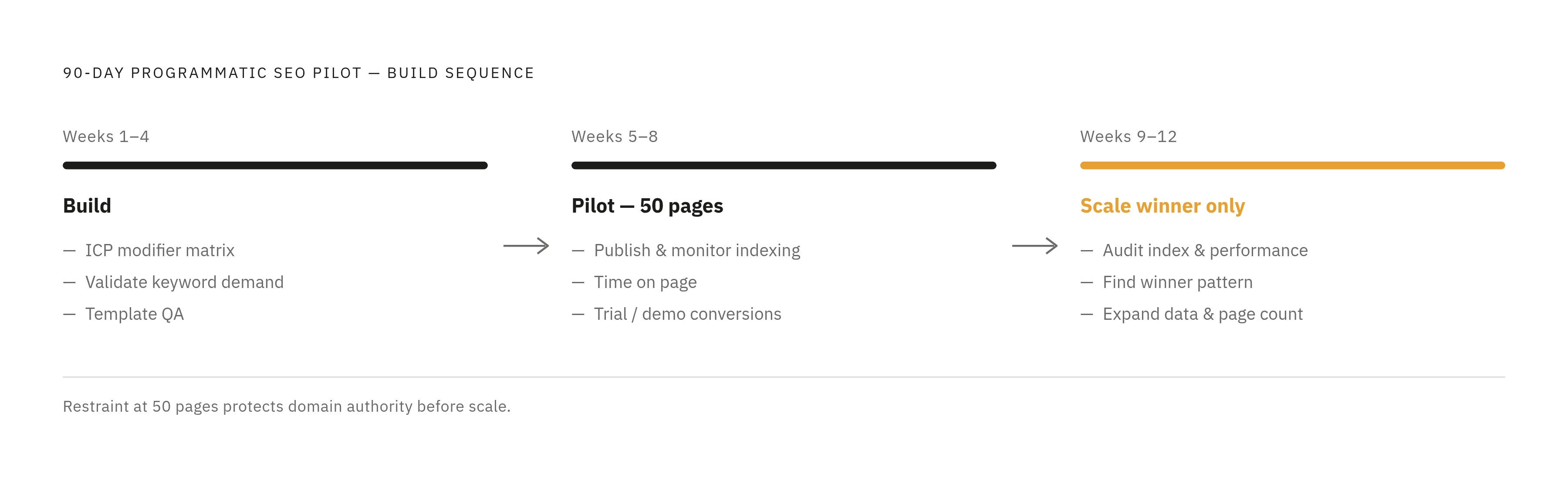
Gracker warns that a seed-stage startup with zero dev hours to spare should not be building a massive programmatic launch out of the gate. Start with 50 pages. Averi's 2026 playbook backs this up with a 90-day framework, concept to scaled deployment, starting with a 50-page pilot and iterating from there.
For a small team, that breaks into three phases. Weeks one through four: define the ICP modifier matrix, pick the one page type where the richest data already exists, validate keyword demand, build and QA the template. Weeks five through eight: publish the 50-page pilot, watch indexing, and measure engagement quality (time on page, trial or demo conversions) instead of raw traffic. Weeks nine through twelve: audit what actually indexed and what performed, find the pattern among the winners, and expand the data set and page count only in that direction.
Skipping straight to volume is the wrong bet, because the downside is asymmetric. A thousand weak pages can pull a domain down, and a five-person team doesn't have spare months to spend in recovery mode, waiting for Google to trust the domain again.
None of this requires a dev team either. A workable no-code stack pairs a visual CMS with a database tool, a data enrichment layer, a sync or automation tool, and a keyword validation platform. Averi puts total cost at a modest monthly range, against $3,000 or more for a dedicated dev build. That's the difference between a weekend project and a headcount request.
How to measure programmatic SEO without being misled by raw traffic
Raw traffic is a bad scoreboard in 2026, and here's why: AI Overviews soak up a growing share of clicks even when your page is the actual cited source. Optimizing for session counts in that environment is like counting applause you can't hear.
Gracker's 2026 strategy piece points to metrics that actually reflect page quality. AI citation rate: how often the domain shows up as a source in AI-generated answers for the target queries. Utility engagement time: how long someone actually interacts with a calculator or a compatibility matrix, where a multi-minute tool session is worth more than a brief blog scroll. Pipeline contribution, whether these pages are producing qualified leads or just noise, is the number that ultimately ties back to revenue.
Run an indexing health check too. Not every page type indexes at the same speed, and tracking which ones index fastest and which earn backlinks on their own gives an early read on perceived utility, before the traffic numbers even settle.
Some benchmarks for calibration: across more than 250 B2B SaaS accounts, TripleDart reports a median 3x increase in organic traffic within six months, capturing 45 percent more high-intent queries than traditional content approaches managed. One documented case from Averi showed 220.65 percent organic traffic growth in Q1 2025 versus Q4 2024, with signups climbing from 67 to 2,100 a month, a useful ceiling to keep in mind for a first pilot.
For a small team, instrument one conversion event per page type (demo request, trial signup, a content download tied to that specific use case) before anything goes live. Bolting conversion tracking on after launch just means weeks of flying blind.
Where customer evidence fits inside a programmatic SEO system
Customer evidence isn't a separate workstream from programmatic SEO, it's one of the highest-value inputs into it. Gracker's 2026 piece finds that the more first-party and proprietary the data, the higher the odds of AI citation, and named customer outcomes with specific, checkable numbers are about as first-party as data gets.
A comparison page citing a real customer's switch story from a named competitor carries more weight than one that just recaps a feature list. A use-case page that opens with a specific, verified customer result has information in it a generic template simply can't manufacture. And role-based landing pages built around segmented customer outcomes, by industry, stage, use case, are exactly the ICP-specific proof that the modifier-entity targeting strategy needs to actually work.
The system that makes this repeatable, rather than a one-off case study every quarter, is a structured customer interview process built to produce more than ten assets per conversation: video clips, quote pulls, outcome metrics, use-case summaries. That interview pipeline is what keeps a small team fed with differentiated material instead of running dry after the first three case studies.
Building a centralized evidence repository, a structured database of customer outcomes and testimonials tagged by ICP attribute, does double duty. It becomes the data layer for programmatic pages and the proof library sales pulls from during a deal cycle. One useful reference point here: Spendgo went from zero to eight pillar case studies in six months, generating more than ten marketing assets per customer interview, with each story feeding product marketing, content marketing, and sales enablement at the same time. Spendgo was acquired by Olo in December 2025.
For a small B2B SaaS company, customer evidence is one of the few data assets nobody else can copy. A competitor can clone your pricing page overnight. They cannot clone the specific story of your customer who cut onboarding time by a real, verifiable number, because that story belongs to you and the customer who lived it.
Common failure modes and how to avoid them before they cost the domain
Programmatic pages need an established, trusted domain underneath them, because without one they read as thin no matter how good the data is. A domain with no editorial foundation trying to launch 500 programmatic pages at once is asking Google to trust a stranger with a firehose. Build the core content first. Let the programmatic layer sit on top of something that's already earned some credibility.